

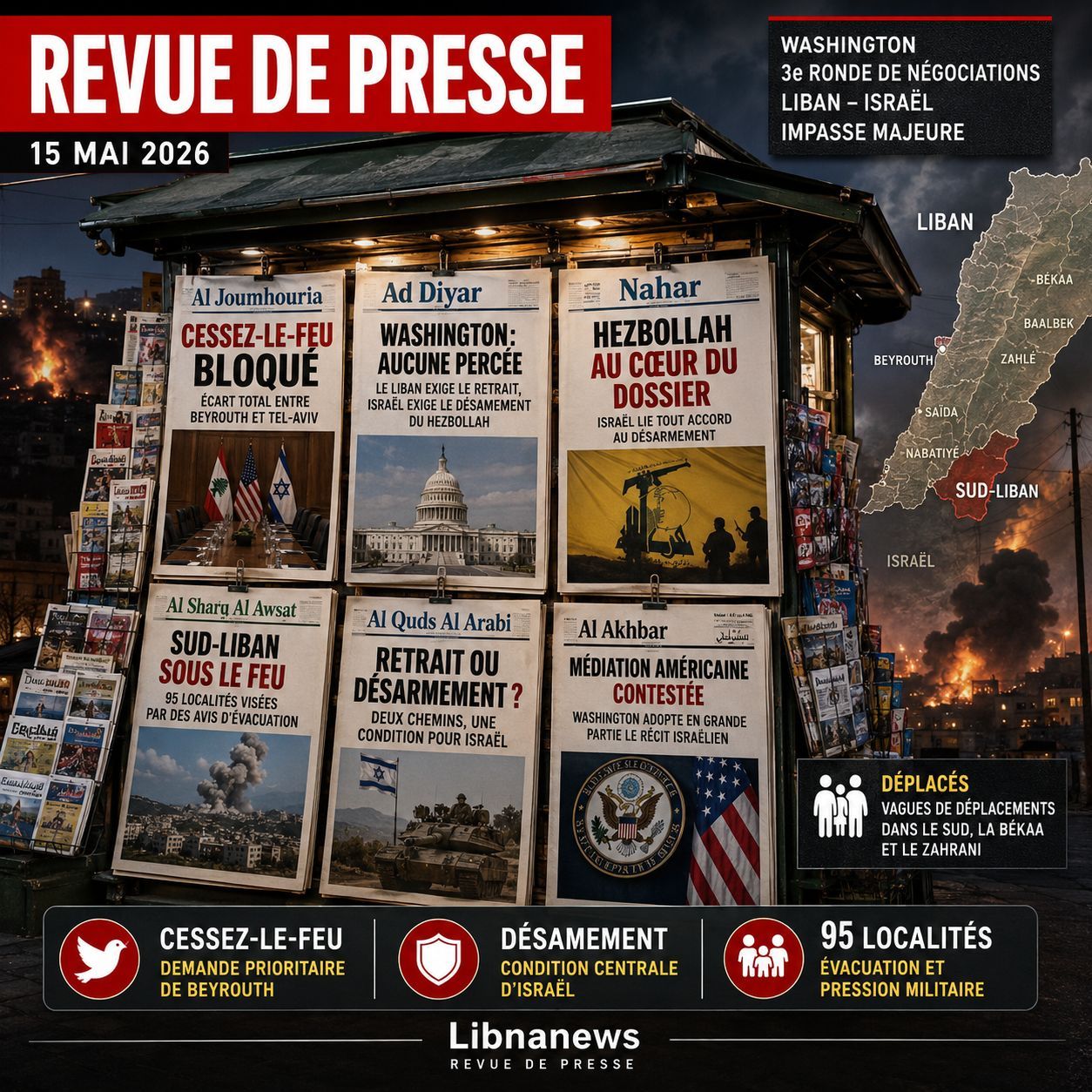
A negotiating table dominated by the field
The Lebanese political day was dominated by the third round of negotiations between Lebanon and Israel in Washington. The case was treated by the press as a test of force rather than as a mere diplomatic sequence. According toAl Joumhouria of 15 May 2026The discussions opened under the sponsorship of the US State Department after two preparatory meetings at ambassadorial level. The newspaper highlights a climate of concern, which is due to a clear gap between Lebanese demands and Israeli conditions. Lebanon first called for a ceasefire. Israel has put on the table a comprehensive peace agreement in exchange for the dismantling of Hezbollah. This opposition of objectives gave the meeting its main framework: Beirut wants to stop the fire before any broader political debate, while Tel Aviv wants to obtain security guarantees before any lasting cessation of operations.
InAd Diyar of 15 May 2026, the reading is even darker. The newspaper believes that the first day in Washington did not lead to hope for a real breakthrough. He writes that the ceasefire demanded by Lebanon remains rejected by Israel, while Washington does not seem to exert sufficient pressure to impose it. This lack of breakthrough places the Lebanese State at the centre of a question: should we continue a process that could only renew a fragile truce, while strikes, destruction and displacement continue in the South and the Bekaa.Ad Diyar of 15 May 2026also evokes a possible revival of a Saudi role, through an expected visit by the envoy Yazid bin Farhan to Beirut, with the aim of opening a third path between Washington and Islamabad.
Lebanese demands in the face of Israeli conditions
The Lebanese position appears to be concentrated on four priorities.Ad Diyar of 15 May 2026reports that the Lebanese file includes a permanent and comprehensive ceasefire throughout the territory, the cessation of Israeli strikes, including in the south, in Bekaa and Beirut, the return to the Monitoring Mechanism Committee, and the complete withdrawal of Israeli forces from the occupied areas in southern Lebanon. The newspaper adds that Beirut also wants to secure the recognition of State sovereignty throughout the territory and allow the deployment of the Lebanese army at the border with enhanced support. Broader topics, such as border demarcation, reconstruction, the return of residents and the release of prisoners, would then come.
On the other hand, Israeli conditions are equally structured.Ad Diyar of 15 May 2026israel calls for the complete disarmament of Hezbollah, the dismantling of its military structure, the absence of a ceasefire without Lebanese progress on this issue, a buffer zone of up to 10 kilometres, and a peace agreement including clear borders and diplomatic and economic relations. This inverse sequence the order desired by Beirut. For Lebanon, security begins by stopping attacks and withdrawing. For Israel, it begins with the disarmament of Hezbollah and a reorganization of the border ground.
Nahar of 15 May 2026confirms this divergence. The newspaper reports that Lebanon has submitted three main requests: to fix the ceasefire, to stop Israeli attacks and to secure Israel’s withdrawal from the occupied areas in southern Lebanon. On the other hand, Israel has linked every political path to the disarmament of Hezbollah and the securing of its northern border. The same article states that Washington, despite Donald Trump’s earlier calls to stop fighting, does not ask the Israeli government for a comprehensive ceasefire. This data changes the scope of American mediation. It suggests conflict management more than direct pressure to stop it.
War goes on around the table
The paradox of the day lies in the simultaneousity between negotiation and escalation.Al Sharq Al Awsat of 15 May 2026lebanon negotiates with Israel under fire. The newspaper reports an increase in Israeli strikes in southern Lebanon and notes that the number of locations targeted by evacuation notices reached ninety-five, some 40 kilometres from the border. He adds that Tel Aviv refused the Lebanese request for a ceasefire at the meeting, linking its withdrawal to the elimination of Hezbollah’s military capabilities and the securing of its northern border.
This military pressure puts pressure on the political reading of the dossier.Al Sharq Al Awsat of 15 May 2026also describes an extension of evacuation alerts since the entry into force of the 17 April ceasefire agreement, with waves of internally displaced persons in the areas of Nabatiyah, Saida, Western Bekaa and Zahrani. The Israeli army justifies these opinions with accusations against Hezbollah, which it accuses of violating the agreement. This Israeli speech directly links the continuation of the strikes to the presence of Hezbollah. It therefore makes the ceasefire dependent on a permanent Israeli security interpretation.
Al Quds Al Arabi of 15 May 2026evokes a Lebanon caught in a race between fire and diplomacy. The newspaper reports that the Israeli ambassador to Washington, Yehiel Leiter, said that Israel was ready for a wider political path with Lebanon, but only on the condition of the dismantling of Hezbollah. He also spoke of two paths, one towards a peace treaty and the other safe. He claimed that Israel would not accept a ceasefire allowing Hezbollah to rearm itself. This declaration gives the negotiation a very difficult dimension. It concerns not only the South, but also the Lebanese internal balance.
A contested US mediation
The US position in the negotiations is the other central point.Al Akhbar of 15 May 2026writes that the U.S. State Department repeats the Israeli reading that a cease-fire already exists in Lebanon and that Hezbollah would be the main rapist. The newspaper adds that Israeli strikes would then be presented as the application of an Israeli right to defence against threats deemed imminent. This reading is heavy for Beirut. It means that the American referee does not place himself at equal distance from the two accounts, but largely validates the Israeli security logic.
InAl Sharq of 15 May 2026The analysis stresses the risk of transforming negotiations. The newspaper believes that the discussion could move from a path to a stoppage of fire to a path to reorganize the Lebanese security reality. The strengthening of the Lebanese army is presented as a legitimate requirement in any national strategy. But the newspaper raises a sensitive question: will this strengthening be a tool of sovereignty or an instrument of external conditions imposed under military pressure. The question summarizes the Lebanese dilemma. The country needs a strong state and an army capable of exercising its authority. But he fears that this need will be used to make him accept an Israeli and American agenda.
Al Sharq of 15 May 2026stresses also that Washington seeks to link any border solution to a more effective role of the Lebanese army. The newspaper reports that the disarmament of Hezbollah has become a daily issue in American and diplomatic exchanges. In this perspective, the ceasefire is not an end in itself. It becomes a stage conditioned by a broader change in armed balance in Lebanon.
Lebanese authorities between official support and internal reserves
In Beirut, the case involved the highest officials.Al Quds Al Arabi of 15 May 2026reports that Joseph Aoun and Nawaf Salam followed the third round of Washington since Baabda. The same newspaper quotes Nabih Berri, for whom the success of direct negotiations depends on a real ceasefire. He also quoted the Foreign Minister Youssef Rajji, who said that Beirut was not talking at this stage about a peace agreement. In his view, the priority was to stop attacks, protect civilians, end destruction and create conditions conducive to serious negotiations. He also stressed the Israeli withdrawal from southern Lebanon, the return of displaced persons and the processing of prisoners ‘ files.
Al Akhbar of 15 May 2026reports that Nabih Berri remains in favour of indirect negotiations that begin with a real stop to fire. He claims that any agreement must be guaranteed by Saudi, Iranian and American guarantees. The newspaper adds that Joseph Aoun contacted Berri to find out the position of the Shiite tandem, especially Hezbollah, against Washington’s possible results. Berri reportedly recalled that a unilateral ceasefire was not acceptable and that the cessation of assassinations, the cessation of village shaving, the Israeli withdrawal, the deployment of the Lebanese army and the return of the inhabitants were necessary.
This internal tension weighs on the Lebanese delegation. It must negotiate with Israel, meet American expectations, maintain a link with the institutions in Beirut and take into account Hezbollah’s position.Al Quds Al Arabi of 15 May 2026reports that voices close to Hezbollah oppose direct negotiations, which they consider a political concession. This refusal does not block the Lebanese presence in Washington, but it limits its margin. Beirut wants to appear as a responsible State, knowing that the issue of Hezbollah’s weapons cannot be resolved by a simple clause negotiated abroad.
A Lebanese file taken from a regional equation
The negotiations finally go beyond the southern front alone.Al Bina of 15 May 2026writes that Lebanon is not outside of regional bargaining. According to the newspaper, the Southern and Hezbollah files are part of a broader equation that includes Iran, Gaza, Gulf security and American influence in the Middle East. This reading joins the idea of negotiating at several levels. So what is at stake in Washington is not just about the Lebanese-Israeli border. It also affects the relationship between Washington and Tehran, Arab balances and the ability of the Lebanese State not to be absorbed by a compromise that goes beyond it.
In this context,Ad Diyar of 15 May 2026refers to the possible return of a Saudi initiative through Yazid ben Farhan.Al Sharq of 15 May 2026also reports that Nabih Berri considers it necessary to have a Saudi-Iranian agreement or agreement on Lebanon, under American umbrella. These two elements show that the Lebanese debate is already seeking a broader guarantee than the American mediation alone. Lebanon wants to stop the fire. Israel wants to change the military balance. Washington wants to oversee security. Regional actors could act as guarantors or counterweights.
Local politics: the Lebanese state faced with the decision of war and peace
Baabda at the centre of political monitoring
The local political scene remained dominated by the follow-up to the Washington negotiations. According toAd Diyar of 15 May 2026The Baabda Palace accompanied the discussions in direct connection with President Joseph Aoun and the team to support the Lebanese delegation led by former Ambassador Simon Karam. The newspaper stated that the Presidency had chosen to keep contact with the delegation open. This data shows that Baabda wants to keep his hands on a matter that affects sovereignty, security of the South and the role of the State. The same article states that the Lebanese delegation has tried to avoid the negotiations becoming a direct political normalization path or a platform for imposing security arrangements beyond Lebanese sovereignty. In parallel, Israel spoke of two ways. The first would lead to a comprehensive peace agreement. The second concerns security, Hezbollah, disarmament and the buffer zone. The Presidency therefore faces a difficult equation. It must defend the cessation of strikes. It must also prevent negotiations from turning into direct pressure on the internal political order.
This presidential centrality is reinforced by the link with Prime Minister Nawaf Salam.Al Quds Al Arabi of 15 May 2026reports that Nawaf Salam informed Joseph Aoun of the results of his last visit to Syria and his discussions with Syrian President Ahmad Al Sharaa. The same exchange also covered the course of talks with Israel. Salam considered his Syrian talks good and referred to an agreement to strengthen cooperation in several areas. This sequence gives a broader picture of government action. Lebanon does not only deal with the southern front. It also seeks to reopen blocked regional files, including the relationship with Damascus. However, negotiations with Israel remain the most sensitive axis. They oblige the executive couple to coordinate their positions, while taking into account the reactions of Parliament, the parties and Hezbollah.
Nabih Berri, between conditional support and refusal of a unilateral ceasefire
The role of Nabih Berri remains central to internal political reading.Al Akhbar of 15 May 2026reports that the Speaker of the House has reaffirmed his support for indirect negotiations aimed first at a real ceasefire. He asked if there really was a ceasefire, stressing that the enemy had not respected any agreement since October 2024. He said he was pessimistic and optimistic at the same time, without approving direct negotiation. He also stressed the need for a Saudi, Iranian and American guarantee for any agreement. This position gives Berri a function of balance. He did not reject the principle of a settlement, but he refused to allow Lebanon to accept a formula in which it would be alone in committing itself while Israel maintained its military freedom.
The same newspaper adds that Joseph Aoun contacted Nabih Berri to assess the possible reaction of Shiite tandem, especially Hezbollah, to Washington’s results. Berri reportedly replied that it was impossible to accept a one-way ceasefire or a return to the situation prior to 2 March. He called for a real stop to the fire, an end to the assassinations, a halt to the destruction of the southern villages, a rapid Israeli withdrawal schedule, the deployment of the Lebanese army and the return of the inhabitants. These conditions reflect a clear political line. Berri wants to place priority on the concrete effects of the war. He talks about villages, displaced people, the army and withdrawal. He refused to reduce the debate to an external request for disarmament. This approach also allows the Speaker of the House to preserve his role as a bridge between the State and the Shiite base.
Samir Geagea attacks Naim Kassem and defends the state’s decision
In contrast, Samir Geagea chose to focus the debate on state authority. According toAl Sharq of 15 May 2026The Lebanese Forces leader responded to Naim Kassem ‘ s criticism of direct negotiation. He claimed that the Hizbullah Secretary-General could express the opinion he wanted, but that he had no right to obstruct the state’s path. Geagea recalled that Hezbollah, according to him, has for nearly forty years been unaware of the existence of an authority derived from the popular will through the parliamentary elections. He added that these elections produce Governments whose decisions must be implemented. Its angle is therefore institutional. He’s not just talking about Washington’s tactics. It raises a question of principle. Who decides in Lebanon. The government, the presidency and the institutions, or an autonomous armed force.
The same articleAl Sharq of 15 May 2026reports that Geagea also criticized Naim Kassem’s last message. He felt that the message contained errors and that the Hizbullah leader should review them in the name of credibility. In particular, he challenged the idea that Israel would see Lebanon as part of its territorial project. For Geagea, Israel had left Lebanon in 2000 and Hezbollah would have returned with his choices. He also stated that Nabih Berri is the Speaker of the Chamber and not the Chief Executive. According to him, the decision to negotiate is the responsibility of the President of the Republic and the Government, and then Parliament intervenes if a result is communicated to him. This institutional distinction aims to limit Berri’s political role in the process. It also confirms the local divide between those who first want to secure a stop to the fire and those who first want to reaffirm the state monopoly on the decision.
Government seeks to master its public speech
The management of official speech has also played an important role.Al Sharq of 15 May 2026reports that Nawaf Salam’s office denied the existence of a bilateral meeting or special positions with Kaja Kallas in Luxembourg. The office asked the media to check the information and return to official sources before publishing material related to the Prime Minister’s positions or diplomatic activities. This reminder may seem secondary. Yet he is political. In a phase of sensitive negotiations, each word attributed to the head of government can be used in local debate or in external pressure. The government therefore seeks to avoid leaks, interpretations and partisan readings.
The same logic appears in the treatment of the Iranian case.Al Sharq of 15 May 2026reports a clarification from the Department of Foreign Affairs. The Ministry reported that Lebanon had not filed a complaint against Iran, but had submitted replies to letters sent by Tehran to the Security Council. This precision is important. It shows that Beirut wants to preserve a delicate diplomatic balance. On the one hand, the State affirms its right to respond through its official channels. On the other hand, it avoids turning the exchange with Iran into a public confrontation. In the current context, this caution is intended to prevent the Lebanese issue from being absorbed by regional war. It also aims to maintain room for manoeuvre between Washington, Tehran and Hezbollah-related local actors.
Sovereignty at the heart of the Hezbollah debate
The question of Hezbollah structure almost all local political readings.Al Joumhouria of 15 May 2026reports that official sources claimed that the Lebanese delegation had first requested a ceasefire, prior to any discussion of an agreement ending the state of war. Israel, for its part, allegedly proposed a comprehensive peace agreement with Lebanon in exchange for the dismantling of Hezbollah. The newspaper adds that Joseph Aoun called Nabih Berri to inform him of the atmosphere of the negotiations and to ask him to what extent Hezbollah would be prepared to respect a stop to the fire. Berri reportedly replied that the problem was in Israel and not in the party. This sequence summarizes the Lebanese division. For some, the central obstacle is the continuation of Israeli aggression. For others, there is a non-state armed force.
Al Bina of 15 May 2026gives a more critical reading of the Israeli and American offer. The newspaper states that the plan presented by Israel would amount to cooperation between the Lebanese army and the Israeli army against Hezbollah, with a security commission to share information. According to the newspaper, this model would create a new definition of sovereignty, centred on the security of Israel and carrying a risk of civil war. This analysis reflects a fear present in part of the Lebanese political field. The State is invited to exercise its authority. But the way this authority would be implemented could become explosive if it appeared to be imposed by the outside world. Thus, the local debate is not just about disarmament. It also addresses the methodology, timing, safeguards and risk of internal confrontation.
Joseph Aoun connects justice, state and institutional rehabilitation
On the sidelines of the security issue, Joseph Aoun also tried to place the state’s action on the institutional front.Ad Diyar of 15 May 2026reports that, when the Attorney General was sworn in to the Court of Cassation Ahmad Rami Al Hajj, he claimed that justice was a pillar of the construction of the State and the safeguarding of its authority. He added that the current phase required a concerted effort to uphold the rule of law, combat corruption and consolidate the rule of law. According to him, there is no state without fair justice. After the ceremony, he brought together Minister of Justice Adel Nassar, President of the Supreme Council of the Judiciary Souheil Abboud and Ahmad Rami Al Hajj to discuss the situation of justice and the role of prosecutors.
This institutional message is not separated from the political crisis. It complements the discourse of sovereignty. A State negotiating its security future must also show that it can restore its internal authority. Justice, the fight against corruption, the control of administrations and the role of state services therefore become signs of credibility.Al Sharq of 15 May 2026also reports that Joseph Aoun has received the Director General of State Security, General Edgar Lawandos, to examine the security situation and the work of his service in public administrations and institutions, particularly in the fight against corruption. Thus, the local politics of the day are not limited to Washington. It draws the same thread: to restore official authority in negotiation, security, justice and administration.
Quote and speech by political figures: the words of sovereignty, war and compromise
Joseph Aoun puts the state in the language of institutions
InAd Diyar of 15 May 2026Joseph Aoun gave his speech an institutional scope, far from the military. During the swearing-in of the Attorney General at the Court of Cassation, Ahmad Rami Al Hajj, he claimed that justice is the basis for the construction of the State and the safeguarding of its authority. He also presented the judiciary as the last refuge for the citizen in his quest for justice. This formula comes at a time when Lebanese sovereignty is being discussed in Washington under Israeli fire, but it is targeting another front. The President seeks to link the strength of the State to justice, the fight against corruption and law enforcement. He added that the current phase required a concerted effort to uphold the rule of law, combat corruption and consolidate the rule of law. Then he concluded this sequence with a direct idea: there is no state without fair justice.
This speech is also an indirect response to the crisis of confidence. InAl Sharq of 15 May 2026The same point is repeated with an important nuance. Joseph Aoun asserts that the stronger and more integrity justice, the more the state will regain the confidence of its people and its place. He also promises to be alongside the judges in everything that protects justice. The message is clear. The president does not only talk to magistrates. He speaks to a public opinion that judges the State’s ability to protect, punish, redress and deliver on its commitments. In the context of negotiations with Israel, this word gives the Presidency a double line. On the one hand, the state must defend its borders. On the other hand, he must prove that he deserves the authority he claims.
Youssef Rajji refuses the word peace and sets the humanitarian priority
Foreign Minister Youssef Rajji has chosen a vocabulary of caution. According toAl Quds Al Arabi of 15 May 2026He said Beirut is not talking at this stage about a peace agreement. It placed priority on stopping attacks, ending destruction, protecting civilians and creating conditions suitable for serious and lasting negotiations. This sentence distinguishes two things. Lebanon accepts a negotiation. But he does not want it to be presented as a global political normalisation. The word peace is therefore kept at a distance. The word ceasefire becomes central.
Youssef Rajji also used a formula that summarizes the Lebanese argument. He felt that it was not possible to negotiate seriously while civilians were killed and villages were being destroyed. This sentence serves as a moral and diplomatic line. It targets Israel, but also American mediators. It means that negotiation only makes sense if it reduces violence on the ground. The Minister also insisted on the withdrawal of Israeli forces from southern Lebanon, the return of internally displaced persons to their homes and the processing of prisoners ‘ files. He finally claimed that the Lebanese government had decided to separate the Hezbollah file completely from the American-Iranian discussions. This precision is important. It seeks to prevent Lebanon from becoming a mere map in a regional agreement.
Nabih Berri speaks as guardian of the real ceasefire
In the internal debate, Nabih Berri holds a speech based on mistrust. According to the evidence reported in the sources of 15 May 2026, it supports the idea of a negotiation that begins with a real ceasefire, but refuses a formula where Lebanon would engage alone. Its position is based on a simple question: is there really a ceasefire if the villages are hit, if the assassinations continue and if the inhabitants cannot return home. This question guides his entire political speech. It brings the debate from the diplomatic register back to the reality of the southern localities.
Berri thus defends a precise sequence. We must stop the attacks, get an Israeli withdrawal schedule, deploy the Lebanese army and allow the people to return. This speech seeks to prevent the issue of Hezbollah from absorbing all others. He does not deny the weight of the weapons file, but he refuses to place it before the end of the war. In this sense, the ceasefire cannot be an abstract formula. It must result in fewer deaths, fewer destruction and fewer displacements. His speech also maintains a link with the Shiite base, which considers the South as the first test place for any negotiation.
Samir Geagea turns controversy into a debate on authority
Samir Geagea responded to Naim Kassem with an opposite logic. InAl Sharq of 15 May 2026The Head of the Lebanese Forces believes that the Secretary General of Hizbullah has made mistakes and must review them in the name of his credibility. He disputes in particular the idea that Israel would still regard Lebanon as part of a broader territorial project. According to him, Israel had left Lebanon in 2000 and Hezbollah would have returned with his choices. This sentence is controversial. It reverses the narrative of Hezbollah. Where the latter presented his force as a defence against Israel, Geage described it as a cause for the return of the threat.
The most institutional part of his speech aimed at Nabih Berri. Still according toAl Sharq of 15 May 2026Geagea recalls that Berri is President of the House, not Chief Executive. He claims that the decision to negotiate lies with the President of the Republic and the Government. Parliament then intervenes, if the results are communicated to it. This distinction is more than a constitutional detail. It aims to remove the right to define the national position alone from the Shiite tandem. She placed Joseph Aoun and Nawaf Salam at the centre of the decision. Geagea’s speech is therefore based on a simple idea: there may be a debate on negotiation, but there cannot be several decision-making centres on war, peace and borders.
Naim Kassem imposes the limit of indirect trading
The words of Naim Kassem are presented in the sources as a refusal to trivialize direct negotiation.Al Quds Al Arabi of 15 May 2026reports that he has shown a conditional opening to negotiations, linking them to the American-Iranian dialogue and the possibility of a ceasefire. But he insisted on one condition: any negotiation must remain indirect. This formula summarizes Hezbollah’s line. The party does not reject any political outcome. On the other hand, he refused to allow Lebanon to be led towards a direct relationship with Israel that would resemble political recognition or normalization.
This position creates friction with the presidency and the government. Hezbollah accepts the idea of an exit from crisis, but wants to control the form of the process. The choice of indirect word is therefore not technical. It reflects an ideological and political limit. It allows the party to tell its base that it does not give in to the principle of hostility to Israel. It also allows it to maintain a link with Iran, as the discussions between Washington and Tehran influence the Lebanese issue. On the other hand, Hizbullah’s opponents say that the state must decide the form of negotiations alone. So words become a battlefield. Direct, indirect, peace, ceasefire, disarmament: each term bears a vision of the country.
Nawaf Salam chooses official speech control
Prime Minister Nawaf Salam’s speech appeared less exposed, but his office had to intervene to protect his meaning.Al Sharq of 15 May 2026reports that his press service denied a story circulating on social networks, which attributed him to a supposed meeting with Kaja Kallas in Luxembourg. Nawaf Salam’s office claimed that there had been no bilateral meetings and that the words disseminated were invented. He also recalled that Salam had only given a speech to the ambassadors of the States of the European Union, a text published and accessible to the public.
This denial shows the sensitivity of the moment. In a negotiation phase with Israel, each sentence attributed to the head of government can be exploited. A word can be read as a concession. A grade can be converted into an official position. The Salam office therefore wanted to re-establish a communications discipline. He regretted the use of manufactured information and anonymous sources. The message targets the media, but also political actors. He recalls that the government wants to speak through verified channels. This mastery of speech becomes a component of public action.
Donald Trump and Xi Jinping speak over the Lebanese case
The international discourse also weighed on the Lebanese scene. InAl Quds Al Arabi of 15 May 2026Donald Trump, after his meeting with Xi Jinping in Beijing, claims that the Chinese president told him that he would not provide Iran with military equipment. He adds that Xi wants to see the Strait of Ormuz open and that he says he is ready to help. This sentence goes beyond the Sino-American case. It affects Lebanon’s regional balance. If China supports the opening of the Strait and avoids military support for Iran, Washington can present this position as a lever against Tehran and, by extension, against its allies.
Xi Jinping, for his part, moved the center of the debate to Taiwan.Al Quds Al Arabi of 15 May 2026reports that he described the question of Taiwan as more important in Chinese-American relations. He warned that mismanagement of this case could lead both countries to a collision or even a conflict, placing the whole relationship in a very dangerous situation. This word expresses a Chinese hierarchy. Beijing wants to talk about trade, Iran and maritime security, but refuses Taiwan to be treated as a secondary issue. At the same time, Trump said the relationship between the United States and China would be better than ever. This juxtaposition gives a contrasting image. The tone is courteous, but the red lines remain strong.
Marco Rubio and Mahmoud Abbas give two other political frameworks
Marco Rubio formulated Beijing’s expected role in the Iranian case. According toAl Quds Al Arabi of 15 May 2026The US Secretary of State said he hoped to convince China to play a more effective role in pushing Iran to give up what it does in the Gulf. This sentence places China in a function of pressure, not just mediation. It confirms that Washington is seeking to mobilize the great powers against Tehran’s regional action. For Lebanon, this approach has a direct effect. The more the Iranian case is treated as a matter of international constraint, the more Hezbollah is placed within the scope of this pressure.
In another register,Al Sharq Al Awsat of 15 May 2026reports that Mahmoud Abbas criticized the attack of 7 October 2023 and held him responsible for a disaster suffered by the Palestinians. It also reaffirmed its commitment to the Oslo Agreement, the subsequent agreements, the Palestine Liberation Organization, the unity of the Palestinian political system, the unity of arms, reforms and elections. This Palestinian speech joins, by another way, the Lebanese debate on single authority and weapons. Abbas talks about one political system and one weapon. In Lebanon, the same formula is disputed through the Hezbollah file. The contexts are not identical. But the words show that the crisis of political authority is going through several scenes in the region.
International Policy: Beijing, Ormuz and Gaza Redesign the Relationship of Force
Trump and Xi are looking for relaxation without clearing the red lines
The international policy of 15 May 2026 is dominated by the meeting between Donald Trump and Xi Jinping in Beijing. According toAl Joumhouria of 15 May 2026This is the first visit by an American president to China in nearly nine years. The newspaper describes a day marked by highly regulated ceremonies and high-level meetings, with issues ranging from trade to Taiwan, Iran and energy stability. The issue therefore goes beyond the bilateral relationship. The two Powers sought to reduce tensions on markets, maritime routes and military balances. Yet this relaxation remains cautious. The tone is cordial, but the interests remain distant. Washington wants more commercial openness and Chinese pressure on Tehran. Beijing wants to preserve its strategic freedom, protect its position on Taiwan and appear as a power capable of stabilizing the world order.
Ad Diyar of 15 May 2026reports that Xi Jinping described Donald Trump’s visit as historical. He also said that the rebirth of China and Trump’s American slogan can move forward side by side. This sentence gives an image of possible coexistence between two powerful national projects. It seeks to show that China-American rivalry is not necessarily doomed to become an open cold war. However, this language of cooperation does not suppress competition. Both countries want to talk to each other, but each one tries to make the most of the other. China wants to avoid direct confrontation. The United States wants to achieve economic and strategic gains without giving the image of a decline.
US Trade Seeks Chinese Door
The economic component occupies a major place in this sequence.Al Sharq of 15 May 2026reports that Donald Trump was accompanied in Beijing by a high-level economic delegation, made up of eighteen top executives from US companies. The newspaper notes that these companies together represent a value of approximately $27 trillion, which is close to the size of the U.S. economy and higher than China’s gross domestic product. This data gives the measure of the visit. It is not just diplomatic. It is also a weighty operation led by large US companies to better access the Chinese market.
This presence of the private sector reflects a very trompian approach to international relations. Business and power work together. Companies want fewer barriers, fewer restrictive rules, more visibility and more access to Chinese consumers. Oppositely, Beijing can use its market as a lever. China knows that American companies want to stay there, even in a climate of rivalry. It can therefore offer limited openings, without yielding to the most sensitive political issues. Thus, trade serves as an area of dialogue. But it also serves as a pressure field. China-US economic relations remain deep, despite tensions over security, technology and global influence.
Taiwan remains the possible breaking point
The Taiwan question remains the clearest limit.Al Quds Al Arabi of 15 May 2026reports that Xi Jinping warned Donald Trump of the danger of a conflict if Washington treats the Taiwanese case badly. The Chinese President considers this to be the most important issue in the Sino-American relationship. Its warning gives a clear limit to relaxation. China can speak trade. She can discuss Iran. It can participate in efforts to keep the Strait of Ormuz open. But she refuses to see Taiwan out of its strategic framework.
This Chinese line places Washington in front of a difficult calculation. The United States wants to maintain its support for Taiwan and contain Chinese power in Asia. But they also want to avoid a major military crisis at a time when Iran, the Middle East and maritime routes already occupy a large part of the international agenda. The Beijing summit thus shows a double reality. Both powers want to avoid shock. However, they do not give up their positions. Taiwan remains a matter of sovereignty for Beijing. For Washington, it remains a strategic point of presence in the Pacific. Relaxation can therefore progress on some issues, but it remains fragile at the heart of the balance of power.
Ormuz becomes a global test
The Strait of Ormuz appears as the other major record of the day.Al Bina of 15 May 2026insists on the contradiction between US public discourse and the more conservative assessments attributed to US intelligence. The newspaper reports that some internal estimates consider that Iran could hold between ninety and one hundred and twenty days in the face of pressure, longer than Washington could cope with energy and economic shocks. According to this reading, the United States quickly moved from war language to a language of de-escalation, opening the Strait and returning to negotiation.
This issue directly affects the world economy. Ormuz is not just a sea pass. It is a point of tension for energy, insurance, transport and prices. A prolonged crisis would have an impact on Asia, Europe, Gulf States and American markets. That’s why China can’t stay away. She needs energy security. She also has an interest in presenting herself as a responsible actor.Al Quds Al Arabi of 15 May 2026reports that Israeli analyses wonder whether Trump will seek to exploit the Chinese need for an open strait to push Beijing to choose between the Gulf and Iran. This hypothesis shows that energy has become a diplomatic weapon.
Iran under pressure but still in the centre
The Iranian crisis is creating several dossiers. It affects Ormuz, Lebanon, Iraq, China and the balances of the Gulf.Al Joumhouria of 15 May 2026reports that Antonio Tajani, Italian Foreign Minister, mentioned Italy’s readiness to participate, after the conflict, in an international defensive coalition aimed at guaranteeing freedom of navigation in this vital passage. This European position shows that the Ormuz crisis is not limited to a face-to-face between Washington and Tehran. It also attracts European powers, concerned about world trade and food security.
Diplomacy around Iran is therefore played on two levels. The first is military and maritime. It concerns ships, navigation corridors and risks of attack. The second is political. It concerns the possibility of a return to negotiation in stages.Al Bina of 15 May 2026presents the sequence as a moment when Washington might want to emerge from a logic of total war. This reading does not mean a near peace. Rather, it indicates that the pressure has reached a level where each actor begins to measure the cost of an extension. Iran does not seem to be isolated to the point of yielding quickly. The United States does not seem free to ignore the economic effects of an escalation. China, for its part, can serve as a useful channel, but it will not want to be a mere Washington relay.
Palestine between memory of Nakba and current war
The Palestinian question occupies a major place in the newspapers of 15 May.Al Quds Al Arabi of 15 May 2026reports that the Palestinians commemorate the seventy-eighth year of Nakba in a context marked by the war in Gaza. The newspaper quotes figures from the Ministry of Health, with at least 72,744 Palestinians killed and 172,588 injured. It also stresses that this commemoration is taking place for the third consecutive year under the weight of the war waged by Israel against the Palestinian people. The Nakba is therefore not presented as a distant memory. It is linked to displacement, destruction and threat to Palestinian political existence.
Al 3arabi Al Jadid of 15 May 2026adopts the same reading by saying that Nakba is no longer merely an event of the past, but a reality that is repeated in different forms, through displacement, colonization, annexation of the West Bank, the Judaization of Jerusalem and the weakening of the Palestinian Authority. The newspaper presents the Israeli right as the bearer of a clear programme: reducing any prospect of a two-state solution and imposing a reality of fact. This reading gives the commemoration an immediate political dimension. She recalled that the conflict was not only about Gaza, but also about the West Bank, Jerusalem, refugees and Palestinian national representation.
Mahmoud Abbas and the attempt to restore Palestinian order
In this context, the official Palestinian discourse seeks to take hold.Al Quds Al Arabi of 15 May 2026reports that Mahmoud Abbas opened the eighth Fatah Congress by calling for the implementation of signed agreements and the accountability of Israel. The newspaper also reports that the Congress unanimously re-elected President. This sequence aims to demonstrate institutional continuity. Yet it is taking place in a moment of deep crisis of legitimacy. The war in Gaza, Palestinian divisions, the weakness of the Palestinian Authority and the rise of speeches about a national recomposition weaken the old framework.
Abbas’s message therefore tries to hold two positions. It defends the agreements, the Palestine Liberation Organization and the political path. But it must also respond to a Palestinian view marked by war and the feeling that the old tools have failed. The gap between the Nakba commemoration and the Fatah Congress is revealing. On one side, a people is experiencing an existential crisis. On the other hand, one management tries to preserve an institutional architecture inherited from previous decades. This tension weighs on the future of Palestinian representation.
Iraq forms an incomplete government under US compulsion
Iraq is another important political front.Al Quds Al Arabi of 15 May 2026reports that Parliament has given its confidence to the Government of Ali Al Zaydi, but that disagreements persist over the Ministries of Interior, Education and Planning. The newspaper also reports that the case of the armed factions weighs on the composition of the Government. Cabinet formation is not only a parliamentary compromise. It reflects external pressure and internal struggle over the position of armed groups in the State.
Al 3arabi Al Jadid of 15 May 2026reports that the Iraqi Parliament has given its confidence to an incomplete government, composed of fourteen out of twenty-three ministers, after the postponement of several portfolios due to disagreements between political forces. The newspaper states that the armed factions did not obtain direct representation, despite the weight of their political wings in Parliament. This absence is linked to American pressure on Baghdad. The Al Zaydi government therefore appears to be an unstable compromise. It must satisfy the Iraqi parliamentary forces, reassure Washington and avoid a break with groups close to the factions.
Iraqi factions face power test
The issue of factions is detailed byAl Quds Al Arabi of 15 May 2026which states that the Asaib Ahl Al Haq movement, led by Qais Al Khazali, was removed from the first government composition due to an American veto. The newspaper states that this movement has a significant parliamentary weight, with at least 25 seats. This situation shows that electoral logic is not enough to explain the formation of Iraqi power. The distribution of portfolios is heavily affected by regional imbalances and US pressure.
The Iraqi issue thus joins the broader debate on state authority. As in Lebanon and Palestine, the issue of non-official weapons goes through politics. Baghdad must form a government, but must also prove that it can limit the role of factions. Washington links its support to actions on this ground. The forces close to resistance seek to preserve their influence without causing an immediate crisis. This tension makes the Al Zaydi firm fragile from birth. It announces lengthy internal negotiations around the remaining ministries, secondary posts and the issue of arms control.
The Turkish economy suffers the effects of regional war
The regional crisis also affects neighbouring economies.Al 3arabi Al Jadid of 15 May 2026reports that the Governor of the Turkish Central Bank, Fatih Karahan, raised the inflation target by the end of 2026 from 16% to 24%. He explained this change by rising energy prices and the American-Israeli war against Iran. The newspaper also reports that inflation could stabilize at the end of the year by almost 26%, after reaching 32.4% in April. This data shows that war is not limited to military fields. It changes central bank calculations, fuel prices, transportation costs and daily living.
Turkey is thus at the junction of several pressures. It depends on energy flows. It is affected by monetary tensions. It must manage a population that has already been affected by rising costs of living. The revision of inflation forecasts is therefore not technical. It reveals the economic spread of the Middle East crisis. The longer the war lasts, the more non-belligerent states have to adjust their policies. International policy thus becomes a direct factor in bread, transport and purchasing power.
Economy: the banking sector at the centre of confidence-building
The bank as a national recovery test
The economic section of the day is less rich in conventional indicators than in political and financial signals. It focuses mainly on one idea: Lebanon cannot get out of the crisis without resolving the banking issue. According toAl Sharq of 15 May 2026Joseph Aoun received at the Baabda Palace the president of the Association of Banks, Salim Sfeir, accompanied by a delegation from the organization. The President stated that the State must stand alongside the banking sector, reform and restructure it in order to preserve the economy and guarantee depositor rights. He also stressed the need for a just and comprehensive solution to the banking crisis, capable of satisfying the parties concerned and protecting rights. Without a sound banking sector, there will be no investment or country. She summarizes the presidential diagnosis. Recovery is not just a budget. It involves restoring a credible financial intermediary, able to receive savings, finance businesses and reconnect with investors.
InAl Liwa, 15 May 2026The same message appears on the front page, under the assumption that the banking sector is a pillar of the economy. This presentation shows that the Lebanese press read the Baabda meeting as a political moment, not as a mere professional meeting. The bank remains at the heart of the open crisis of confidence since the financial collapse. Applicants are still seeking their rights. Banks want to avoid being alone in bearing losses. The State is trying to resume its role as arbitrator. This re-establishment of authority is taking place in a climate of war, negotiations with Israel and international pressure. The economic message is therefore linked to the political message: a State wishing to negotiate its sovereignty must also repair its financial system.
Banks want to spread losses
The Bank Association’s speech gives the sector’s defence line. According toAl Sharq of 15 May 2026Salim Sfeir told Joseph Aoun that the country is not facing an ordinary banking crisis, but a systemic crisis. He cited the decision of the Council of State of 6 February 2024, which brought the Lebanese State first responsibility in the financial crisis, due to the use of borrowing from the Bank of Lebanon to finance budget deficits. The Association’s reasoning is clear. The banks claim to have placed their clients’ funds with the Bank of Lebanon and to be entitled to restitution. They say they agree to participate in the effort to deal with losses, but call for a fair division of responsibilities and burdens.
This position is important because it announces the next economic conflict. Banking restructuring will not only involve balance sheets. She’ll decide who pays for the crisis. The State, the Bank of Lebanon, banks, shareholders and depositors do not have the same interest. The Association of Banks warns that an excessive burden on institutions would lead to the liquidation of most or all of them. It states that such a scenario would affect depositors, shareholders, employees, the State and the economy. After the meeting, Salim Sfeir said banks support Joseph Aoun’s national choices in terms of sovereignty, stability and restoration of state authority. He also stressed the need for cooperation between the relevant ministries, the Bank of Lebanon and the Bank Association. According toAl Sharq of 15 May 2026Joseph Aoun replied that dealing with the banking crisis is a shared responsibility and that no party should bear the sole responsibility for settlement.
Bank of Lebanon between fragile balance sheet and gold debate
The situation of the Bank of Lebanon also appears from a more controversial angle.Al Akhbar of 15 May 2026questions the management of reserves and assets, asking who would have asked Karim Suaid to place billions of the Bank of Lebanon in the United States. The newspaper refers to the sending of $2.2 billion in foreign cash to benefit from interest. He also cited figures associated with the Bank of Lebanon’s apparent strength, with gold assets valued at $42.7 billion, a state debt of $16.6 billion and a line related to revaluation operations of $13.1 billion.Al Akhbar of 15 May 2026argues that such robustness could be vulnerable if depositors launched shares abroad and sought to seize gold deposited in the United States.
This reading reflects a broader concern about the protection of public assets. The Bank of Lebanon is not merely an accounting figure. It has become, in the Lebanese debate, a symbol of national security and the last financial bulwark. Discussions on its location, legal status and exposure to foreign procedures therefore take on a political dimension. The question raised byAl Akhbar of 15 May 2026this is a mistrust of any transaction that could transform a reserve asset into an implied guarantee. In the current climate, this debate is sensitive. The country negotiates its security stability. It also negotiates less visibly the limits of its financial sovereignty.
Repayment circulars under review
The banking debate also focuses on mechanisms for partial return of deposits.Al Joumhouria of 15 May 2026publishes a critical reading of the results of Bank of Lebanon Circulars 158 and 166. The newspaper said that it had read with astonishment the communiqué of the Bank of Lebanon, which presented the fact that some depositors had recovered all or part of their funds. According to the article, the figures show a worrying reality. The share of private banks in the March 2026 payment would have been only 11.8%, while the Bank of Lebanon would have paid 88.2% of the amounts paid to depositors. Total payments since the start of these mechanisms would have reached $6.109 billion until the end of March 2026, of which only $1.926 billion was paid by banks, or 31.54 per cent of the total.
ArticleAl Joumhouria of 15 May 2026this situation is problematic, as the sums paid by the Bank of Lebanon are presented as belonging to the Lebanese people and their reserves. The newspaper believes that, when the Bank of Lebanon pays instead of banks, it reduces their burden and allows them to preserve earnings. This criticism opposes the position of the Association of Banks, which claims that it cannot bear the losses alone. It shows that the debate on restructuring remains open and conflicting. The depositors want their funds back. Banks want to avoid collapse. The Bank of Lebanon is trying to manage exits. The State is seeking an acceptable political formula. But no mechanism seems yet able to solve the central question: how to recognize losses without making them disappear in opaque montages.
Al Qard Al Hassan, the shadow economy and the risk of sanctions
The second major economic issue of the day concernsAl Qard Al Hassan.Nahar of 15 May 2026it recalls that the association imposed itself after 1987 in granting loans against guarantees, especially gold, with a revaluation of this metal at a level below its market value in order to protect the rights of the association. In exchange for gold, the beneficiary obtains a loan not exceeding $5,000. The newspaper also recalls that the US Treasury Department has registeredAl Qard Al Hassanon the list of terrorist financiers in 2006, then imposed new sanctions in 2016. In 2021 Washington again sanctioned persons associated with Hezbollah and the association. According to the US authorities cited byNahar of 15 May 2026The institution claims to serve the Lebanese, but would illegally circulate funds through fictitious accounts and expose Lebanese financial institutions to possible sanctions.
Al Sharq Al Awsat of 15 May 2026adds that the Bank of Lebanon is committed to implementing the US sanctions requirements forAl Qard Al Hassan. The newspaper reports that it has prohibited commercial banks, financial institutions and exchangers from dealing with this institution in order to avoid sanctions. A responsible source at the Bank of Lebanon states that the central bank has no direct authority over the association, as it does not operate under its supervision, unlike commercial banks and institutions subject to the Currency and Credit Code. The same source reports that Karim Souaid has already sent circulars to banks and authorized financial institutions to warn them of any relationship with this institution, presented as active in an unauthorized financial framework.
Between law, security and social balance
The folderAl Qard Al Hassangoes beyond financial regulation.Al Sharq Al Awsat of 15 May 2026reports that a source from the Bank of Lebanon has already sent a letter to the Ministry of Interior requesting appropriate measures against the association, accused of carrying out financial activities contrary to the authorization received. The newspaper points out that the possible withdrawal of authorisation could have political, financial, social and even security consequences, because of the direct link between this file and the financial and social structure of Hezbollah. For the party, the pressure exerted against this institution is a continuation of the sanctions and financial blockade imposed on its environment for years. Conversely, political forces hostile to Hezbollah are calling for law enforcement in all institutions without exception.
The same newspaper reports that the authorization obtained in 1987 allowed the association to grant interest-free loans, but that it had become a Hezbollah-specific financial structure for two decades, offering deposits, loans and transfers within its environment, apart from the Bank of Lebanon’s supervision and traditional banking rules. This transformation is at the heart of the debate. One side,Al Qard Al Hassanresponds to real social demand in a country where traditional banks have lost the confidence of a part of the population. On the other hand, its operation outside the regulated system raises a question of financial sovereignty, the fight against sanctions and equality before the law. The Lebanese economy is therefore divided into two parts: a formal banking sector to be restructured, and a parallel financial network that the State does not fully control.
Airport, infrastructure and external assistance
The economy of the day is not limited to banks.Al Sharq of 15 May 2026reports that the Minister of Public Works and Transport, Fayez Rasamny, has received from the Qatari Ministry of Communications air navigation equipment and communications equipment to strengthen the operational capabilities of Rafic Hariri International Airport. The ceremony was held in the departure hall in the presence of official, diplomatic and security officials. The Qatari Ambassador to Lebanon, Sheikh Saud bin Abdulrahman Al Thani, said this aid reflects the depth of relations between the two countries and the Doha commitment to support Lebanon, including its vital institutions.
The same article states that Fayez Rasamny paid tribute to the airport employees and air traffic controllers, who continued to work despite the war and military overflights. This aid therefore has a practical economic impact. The airport is a gateway for travellers, business, freight, help and image of the country. Strengthening its operational capabilities is about protecting a strategic asset. In a Lebanon weakened by the banking crisis and the war in the South, infrastructure is becoming another ground of confidence. They show that the country can still function, receive support and maintain certain essential services. But they also stress its dependence on external aid to modernise essential equipment.
Society: civilians face the ruins, evacuations and wear and tear of war
The South under pressure and the people waiting
Lebanese society appears, in the newspapers of 15 May 2026, as caught in a war that is no longer limited to the front lines. According toAl Liwa, 15 May 2026The last few hours have been marked by a series of Israeli strikes against southern and western Bekaa communities, with evacuation notices addressed to the inhabitants of several villages. The newspaper cites, inter alia, Labbaya, Sohmor, Tefahta, Kfar Melki, Yohmor, Ain Al Tineh, Houmine Al Faouqa and Mazraat Sinai among the localities affected by the threat of evacuation. The inhabitants were ordered to leave the houses and to move at least 1,000 metres away to open spaces. This instruction transforms civilian life into a forced movement. It takes families out of their ordinary settings. She’s emptying the houses. It creates a geography of fear, where each village can become a place of waiting, flight or uncertain return.
Al Sharq Al Awsat of 15 May 2026described an extension of the perimeter of the threatened localities, with evacuation notices reaching villages sometimes 40 kilometres away from the border. This distance gives a new social significance to the crisis. The danger does not only affect border areas. It affects wider regions, with effects on schools, businesses, family networks and local services. Evacuation is not an abstract military fact. It means the closure of a workshop, the suspension of an agricultural activity, the abandonment of a dwelling or the temporary break-up of a family. It also increases pressure on host cities and localities, already weakened by the economic crisis.
Relief between strikes, closed roads and blocked civilians
Daily life is also told through the work of rescue workers.Al Liwa, 15 May 2026reports that a drone strike targeted a car near the rescue centre of theKashafat Al Risala Al Islamiyain the town of Al Qsaybeh. The newspaper also reports that the Lebanese Red Cross teams, from central Nabatiyah and with the support of the army, evacuated a Syrian family from their homes, as well as several Bangladeshi workers trapped in a house and confectionery factory in Mifdoun. These people were trapped by strikes, artillery fire and exhaustion of supplies. This scene gives the crisis a broader social dimension. The internally displaced are not only Lebanese. Foreign workers, often invisible in war stories, are also exposed to the same risks, sometimes with fewer resources and fewer family relays.
The same articleAl Liwa, 15 May 2026reports that the teams removed the body of a Bangladeshi victim who died a few days earlier in a strike in Mifdoun. This detail recalls that wars create unequal vulnerabilities. A migrant worker can die away from his family, without a strong protection network, in an area where access to relief depends on the rate of bombing. In parallel, the newspaper reports strikes on Sarifa, Zibqin, Aita Al Chaab and other localities, with wounded, affected women, and bodies removed from the rubble. Local civil society thus finds itself between the medical emergency, evacuation, the search for victims and waiting for a lull. In this configuration, first aid workers become a final link between the state, the inhabitants and the areas under fire.
The ruins as a social and environmental problem
The war also produces another, slower crisis: that of the ruins.Nahar of 15 May 2026devotes a file to the issue of war rubble. The newspaper reports that the amounts of rubble resulting from the 2024 war in Lebanon are officially estimated at approximately 22 million tons in the affected areas, including between two and three million nine hundred thousand tons in the southern suburbs of Beirut. The figure gives a physical measure of the shock. They are not just destroyed houses, but a massive volume of concrete, iron, dust, wood, glass and unknown materials to be managed. The ruins then become an urban, health, financial and land problem. They occupy space. They’re blocking the streets. They remind us every day of past and present violence.
According toNahar of 15 May 2026, the management of these rubble is distributed among several organizations. The Southern Council is responsible for the removal of rubble in the South. The High Rescue Committee manages the case in Beirut, Bekaa and the southern suburbs. The Ministry of Public Works is limited to opening roads and removing obstacles, without a legal mandate to remove all rubble. This administrative fragmentation weighs on the inhabitants. An owner does not recover his place of life at the end of a strike. He must wait for a procedure, signatures, authorisation, a company and a choice of destination for debris. Social reconstruction therefore begins with a slow administrative battle around the material remains of war.
The rubble between promised recycling and health risks
Nahar of 15 May 2026reports that in February 2025 the government established a list of forty-two temporary sites to receive rubble. The newspaper also mentions an emergency aid programme in Lebanon, financed by the World Bank, with an initial envelope of $2.50 million, in a framework of up to $1 billion. One of the objectives is to reintroduce about 70 per cent of rubble into the circular economy through reuse or recycling, while insulating 30 per cent of inert materials. On paper, this approach turns waste into a resource. In fact, the same article states that recycling has not yet been applied effectively. Contractors sometimes extract iron and move the rest to landfills or embankment sites.
The environmental issue is central.Nahar of 15 May 2026quotes environmental expert Naji Kodeih, who requires laboratory analysis before materials can be reused. It considers it necessary to classify the rubble according to the substances it contains, in order to determine whether it can be reused, treated or disposed of safely. This caution is essential because people sometimes live near ruins that may contain batteries, vehicle remains, wood burned, heavy metals or other pollutants. The same file also cites the President of the Union of Municipalities of the Southern Suburb, Mohammad Dargham, who claims that sorting operations remove batteries, exhausts, wood and iron, and deny the presence of hazardous chemicals in the rubble resulting from the bombings. Between these two positions, the company expects evidence, analysis and transparent management.
Reconstruction begins with found objects
The human dimension of the ruins is strongly told byNahar of 15 May 2026. The newspaper reports the testimony of Abir Haidar, finding an old man in the rubble of his home in Beirutmehbagdamaged but preserved. She sees more than just an object. She finds part of her home, her habits and her life before. This scene shows that civilian casualties are not only measured by the number of buildings destroyed or the material value of the damage. War also destroys everyday gestures, odours, utensils, photos, corners of the house and small evidence of continuity. When a person searches the ruins, they don’t always look for expensive property. She’s looking for a sign that her life hasn’t been completely erased.
The sameNahar of 15 May 2026tells the story of Saad Al Zein in Kfar Rumman. His heritage house, built in 1940 and transmitted by his father, was destroyed near the local Husseinite club. It housed ancient pieces, pottery and objects retracing family history. Rather than considering the stones as a permanent loss, Saad Al Zein wants them back to create a museum. This approach gives rubble a sense of memory. The rubate is no longer just a matter to move. It becomes a trace, a proof, sometimes a material to transmit to succeeding generations what happened. In a society marked by repeated wars, this transformation from ruin to memory becomes a form of civil resistance.
Movement, solidarity and collective fatigue
War also creates internal displacement and deep social fatigue.Ad Diyar of 15 May 2026reports that the Progressive Socialist Party has given priority to the displaced, with a crisis cell to monitor their needs. The newspaper presents this mobilization as a model of national reception, far removed from religious and regional discourse. This dimension is important because displacement can easily awaken local tensions. Families leaving the South or the southern suburbs are looking for a roof, help, security, schools and care. The host regions must absorb this pressure, although they often already lack services, income and infrastructure.
Al Liwa, 15 May 2026also refers to tensions created by the displacement of populations from villages in the South to areas deemed safer. The newspaper notes that the forced departure of many inhabitants has created pressure in the areas of refuge. This observation shows one of the heaviest effects of prolonged war. Even when the bombings remain geographically concentrated, their consequences spread elsewhere. Rents are rising. The schools are in charge. Host families are exhausted. Associations sometimes replace the state. The displaced remain suspended between waiting for the return and fear of finding a destroyed house.
Society between crisis management and security demand
In the articles of 15 May 2026, Lebanese society thus appears as a space for concrete survival. People are not just debating the ceasefire or the Washington negotiations. They want to know if they can go home, get an object, reopen a road, evacuate a loved one, remove a body, clean a house, register a child in school or breathe without toxic dust.Nahar of 15 May 2026recalls that the issue of rubble poses long-term risks to the health, environment and urban development.Al Liwa, 15 May 2026shows, for its part, that evacuations and strikes put families, workers and relief workers at the heart of a permanent emergency.
This society is not limited to victimization. It sorts, preserves, hosts, evacuates, testifies and tries to rebuild meaning. But it pays the price for the lack of sustainable security. The ruins accumulate faster than the treatment mechanisms. Displaced people arrive faster than housing solutions. Environmental risks appear faster than public analyses. Thus, the Lebanese social crisis of the day is found in displaced bodies, roads cut off, objects saved from the ruins and millions of tons of rubble still without permanent destination.
Culture: Lebanese memory between ruins, art and transmission
Libraries destroyed as a symbol of a war against memory
Lebanese culture of 15 May 2026 is first read through loss.Nahar of 15 May 2026devotes a file to the libraries destroyed by the war and reports the words of the Minister of Culture Ghassan Salamé, who affirms his commitment to the reconstruction of the places of reading affected. According to the newspaper, thirteen public libraries were destroyed or damaged in Lebanon, including five fully razed and eight partially affected, closed or abandoned as a result of the displacement of the inhabitants. The Minister states that the private areas of their libraries will not accept to remain without places of culture after the residents return. This sentence gives the file a scope that goes beyond the building. A library is not just a room with books. It is a neighbourhood landmark, a place of study, a space for children, a trace of public life and a tool of transmission. War therefore also destroys access to knowledge. It deprives the inhabitants of places where generations meet. It erases collections sometimes long to build. It imposes on reconstruction a task deeper than the restoration of the walls. We must find books, archives, readers, librarians and trust. In this context, culture becomes a form of collective reparation. It responds to destruction through continuity.
The sameNahar of 15 May 2026gives this loss an intimate dimension. The newspaper refers to Lebanese who inherit rare books and fragments of culture after the fire or destruction of places of memory. He cites in particular the idea that the poet buried his books, poems and archives, with a part of his life that will not return. This image summarizes a silent crisis. When a house, a library or a cultural centre disappears, it is not only objects that are missing. These are years of reading, ranking, notes, manuscripts, meetings and memory. Thus, war produces cultural damage that is difficult to quantify. Property losses can be assessed. Burned collections, annotated books, private archives and early editions are not always replaced. This reality makes cultural reconstruction as urgent as urban reconstruction, although it is less visible in the urgency of negotiations and security assessments.
Wael Saleh transforms Lebanon into living memory
In a different register,Nahar of 15 May 2026highlights the exhibition of the Lebanese-American painter Wael Saleh in Washington. The newspaper states that the exhibition, entitled in FrenchRenaissance 10452: Culture through Life, is held from 14 May to 30 June in a gallery in the American capital. It explores identity, memory, resilience and cultural continuity through painting, installations, luminous projection and interactive digital experiences. The number 10452 refers to the surface of Lebanon in square kilometres. Here it becomes a symbol of collective belonging. The artist treats Lebanon not only as a place, but as a living memory carried by generations and by exile. This choice is significant. Lebanese culture is also spreading outside the territory, in the cities of the diaspora. It preserves images, gestures and stories that war and migration have not erased.
Nahar of 15 May 2026also describes a central phoenix-shaped installation composed of hundreds of webs connected to each other. It takes life by light projections and symbolizes the shift from dispersion to unity and uplift. Clothes left empty are the future to be written by future generations. The visitor also participates in an interactive work in which his movement makes appear a digital phoenix. This staging gives the recovery a collective form. The visitor does not only look at a work. It becomes part of the artistic gesture. Wael Saleh says the exhibition talks about what remains alive in us and the ability of culture to last despite crises, changes and exile. This approach joins the file of destroyed libraries. In both cases, culture is presented as what survives when the physical place is threatened. It becomes a memory carried by bodies, gestures, images and narratives.
The thread, needle and war in Gaza
Regional culture is also marked by Palestinian memory.Ad Diyar of 15 May 2026devotes an article toThe Gaza Genocide Tapestry, exhibited at the Venice Biennale. The newspaper presents this work as a vast documentary work composed of a hundred panels embroidered by Palestinian women in Palestine, refugee camps in Lebanon and Jordan. The project, visible until November, bears a title that the newspaper summarizes with an invitation to watch the exhibition when words are no longer enough. Embroidery thus becomes a form of witness. It transforms images of destruction and suffering into lasting memory. The newspaper states that the work shows a journalist mourning his dead child, children seeking food, scenes of displacement and destruction. Each panel consists of thousands of points. This slow motion contrasts with the speed of the images circulating on the screens. It sets out what news may erase.
According toAd Diyar of 15 May 2026, this tapestry extends the project of theTapestry of Palestinian history, launched in 2011 in Oxford to tell the story of Palestine through the art of embroidery. Women from Ain Al Hilweh camp in Lebanon, Ramallah and other Palestinian areas participated. The direct participation of women in Gaza has become difficult owing to the bombing, displacement and blockade. This is important for a Lebanese cultural section. It shows the role of the Palestinian camps in Lebanon in Palestinian cultural transmission. It also stresses that art can link places separated by war. Ain Al Hilweh, Ramallah, Gaza and Venice are found in the same textile story. Culture then becomes a shared archive. It does not replace political or judicial testimony. But it keeps a sensitive record of what words and numbers are not enough to carry.
Arabic Poetry in China as Cultural Diplomacy
The cultural section also covers international trade.Ad Diyar of 15 May 2026reports the launch, in Guangdong Province and Beijing, of the International Youth Poetry Festival 2026, in an edition dedicated to China and Arab countries. The event takes place from 8 to 17 May 2026. It is organized by the Union of Chinese Writers and cultural services linked to the Guangdong and Beijing authorities. The newspaper presents the initiative as a space for dialogue between young authors and as a means of strengthening literary and cultural exchange between peoples. This type of event is part of a wider trend. China is not only developing economic and political relations with the Arab world. She also invests in culture, books, poetry and symbolic encounters.
The same articleAd Diyar of 15 May 2026indicates that the festival includes an academic dialogue on poetic traditions and perspectives for the future, with a debate on the transformations of the modern poem and on the role of poetry in the era of technology and artificial intelligence. Another highlight combines Cantonese opera and poetry. This meeting between old and new forms gives the festival a broader dimension than reading texts. It is about how poetry can survive in a world dominated by fast images, platforms and digital tools. For the Arab public, this issue has a particular echo. Poetry has a strong place in Arab cultural history. But it must find new forms of dissemination and dialogue. The Sino-Arab festival thus places the poem in a soft diplomacy, where language becomes a tool of relationship between powers and societies.
The Doha Book Fair and the Centrality of the Arab Book
Al 3arabi Al Jadid of 15 May 2026announces the opening of the thirty-fifth edition of the Doha Book Fair. The newspaper presents the event as the great cultural meeting organized in the Gulf since the outbreak of the war. It also indicates that local titles dominate the exhibition. This information gives the show a special meaning. The book does not only appear as an editorial product. It serves as a cultural marker in a period of regional crisis. Publishers, authors and readers find themselves in a time when war occupies the public and media space. The fair then becomes a place of cultural continuity, but also a space where the intellectual priorities of the Gulf are changing.
The dominance of local titles indicated byAl 3arabi Al Jadid of 15 May 2026can be read as a sign of consolidation of own editorial production. It shows that the Arab book fairs are no longer limited to importing books from the major ancient publishing centres. They also become showcases of national cultural policies. This development has a dual effect. It reinforces local scenes. But it also raises the question of regional circulation of ideas, translations and debates. In the context of war, lounges can play a breathing role. They offer a space to think about crises, publish essays, host debates and support reading. For Lebanon, which has long been central in the Arab edition, this rise in the Gulf trade fairs also recalls the new competition between Arab cultural capitals.
Cinema, Palestine and place of criticism
Finally, cinema occupies a notable place.Al Quds Al Arabi of 15 May 2026reports that Mexican actress Melissa Barrera has launched a production company to support artists and creators marginalized or excluded because of their positions in favour of Palestine and their refusal to attack Gaza. The newspaper recalls that she was excluded in 2023 from the series of horror filmsScreamafter statements denouncing siege, death and hunger in Gaza, describing what is happening there as ethnic cleansing and genocide. The dossier shows that global culture has become a space for political conflict. Positions on Gaza affect careers, financing and production networks. Melissa Barrera’s response turns a stand-off into a collective project. It seeks to create a space for voices that large circuits consider too risky.
In the same newspaper,Al Quds Al Arabi of 15 May 2026also publishes a reflection on European festivals, American film and the role of critics. The article observes that the Cannes Film Festival is held this year without major Hollywood studio productions, as was the case in Berlin a few months earlier. He describes a cold relationship between Hollywood and major European festivals, while independent American films and non-American productions are more prominent. The author believes that criticism can improve the level of festivals by defending a conception of film as an artistic, literary, aesthetic and political work, before being a profitable commodity. This analysis joins the other topics in the section. Whether it is destroyed libraries, Palestinian embroidery, Chinese-Arab poetry or committed cinema, culture appears as a field where memory, the market, freedom of speech and the survival of narratives are negotiated.
Technology: artificial intelligence pushes education, music and industrial power
University facing the end of automatic trust
Today’s technology is dominated by artificial intelligence, not as an abstract promise, but as a force that forces institutions to review their rules.Nahar of 15 May 2026reports that the University of Princeton has decided to reinstate the supervision of the examinations after more than one hundred and thirty-three years of support for a « honour pact ». This decision is not presented as a mere administrative measure. It marks a break in university culture. For more than a century, trust between students and the institution was sufficient to frame examinations. Now, the tools of artificial generative intelligence make it more difficult to distinguish between a work produced by a student and a text written by a machine. According toNahar of 15 May 2026, the university was confronted with an increase in cases related to academic integrity, which led to a return to surveillance. However, the newspaper points out that the problem goes beyond cheating. Artificial intelligence does not create the education crisis alone. Rather, it reveals the fragility of information-based assessment systems, rather than measuring critical thinking, analysis and the ability to use knowledge in reality.
This reading broadens the debate. The question no longer is whether a student used a digital tool to write a paper. It concerns the very value of the classical examination. If a machine can summarize a text, produce a structured response, imitate a style and solve a expected exercise, the school must ask for something else. It must test understanding, argumentation, judgment, oral, ability to connect knowledge and ability to verify information.Nahar of 15 May 2026insists on this mutation by explaining that artificial intelligence tools are capable of writing texts, summarizing research and producing answers that mimic human style with unprecedented precision. This situation forces universities to change not only their rules of control, but also their way of thinking about learning. Monitoring can respond to the emergency. It is not enough to meet the deep challenge.
Music between human creation and automated production
The sameNahar of 15 May 2026move the debate to music. The newspaper asks a direct question: has the era of music without artists begun. He explains that artificial intelligence tools can now compose, sing and produce within minutes. This finding changes the creative chain. In the traditional model, a song requires an author, composer, performer, arranger, studio, time and artistic direction. With the new tools, some of these steps can be simulated. Sounds, voices and styles can be generated at high speed. This opens up opportunities for small creators, independent producers or platforms. But this also worries artists, as the value of human work could be diluted in a massive production of automated content.
Nahar of 15 May 2026reports, however, that many artists believe that artificial intelligence, regardless of its level of development, will not be able to replace the full human experience carried by the true artist. This experience includes emotion, public reaction, personal memory, fragility, presence and artistic identity. The newspaper cites the idea that the public is not only looking for sound quality or technical precision. He also seeks the feeling and identity that give the song its value. This distinction is essential. Technology can produce a clean, fast and efficient result. But art is not limited to efficiency. It depends on a link between a story, a voice, a body and a reception. The music thus enters a phase of tension. The machine can speed up production. Humans must prove what cannot be reduced to surgery.
Content creators become an organized industry
Technological transformation also affects platforms.Al 3arabi Al Jadid of 15 May 2026devotes an article to the economy of creators onYouTubeand shows that the platform is no longer just an amateur space. For many creators, it becomes a full-time source of income. The newspaper explains that commercial success now requires an ongoing strategy to attract the public and maintain the flow of views. Creators must adapt to algorithms, formats, uses and supports. In recent years, the audience on TV screens has increased, rather than being limited to the telephone. This trend is similarYouTubedistribution platforms such asNetflix. In response, long videos, often over thirty minutes, have become more attractive. They demand better production, more investment and a more professional organisation.
This development creates new jobs.Al 3arabi Al Jadid of 15 May 2026reports that growth experts for chainsYouTubecan promise significant audience increases. The newspaper quotes a specialist saying that the average increase in views after a year of work with his team is 350 per cent. It also indicates that some consultants charge from $15,000 per month, with rates that may increase depending on the project. A creator followed by more than two million subscribers claims that this aid has partly changed its course. The newspaper also cites the idea that a creator can go from zero to a million subscribers alone, but that between a million and ten million, or more, he often needs a strategist. This logic shows that digital creation becomes an industry. Individual talent still counts. But it is now accompanied by data, audience tables, title tests, publication rhythms and format choices.
The algorithm becomes a partner and a constraint
The weight of algorithms transforms the freedom of creators. In the old model, a medium chose an editorial line and defended it before an audience. In the platform model, the creator depends on an opaque recommendation system. It must please the spectators, but also the invisible rules of diffusion.Al 3arabi Al Jadid of 15 May 2026shows that strategies change with algorithms and with uses. This requires creators to adapt their style, video duration, editing, publication frequency and even tone. The platform offers an income opportunity, but it also imposes a permanent discipline. Success is never achieved. A recommendation change may cause the views to fall. A new trend can force a format change. An audience accustomed to TV quality can increase costs.
This change also has a cultural effect. Long and more produced videos bring together creators of traditional media. They promote surveys, narratives, interviews and documentary formats. But they can also exclude small producers unable to fund teams. Specialist consultants, editors, writers and data analysts then become important players in the ecosystem. Technology here is not just a substitute for tools. She’s recompressing the job. It creates a new hierarchy between those who understand the platform codes and those who publish without strategy. In this system, creativity must coexist with optimization. Content becomes an editorial, cultural and economic product at the same time.
Chips at the heart of China-American rivalry
Technology is also a power issue.Al Sharq Al Awsat of 15 May 2026reports that, despite the green light given by Washington to the sale of chipsH200to large Chinese companies, transactions remain in a waiting area. Blockage is caused by several factors. Washington imposes security conditions and complex financial arrangements, while China is reluctant to buy foreign chips that could weaken its own industrial efforts. The paper states that the U.S. Treasury would earn 25% of revenues from certain sales. This data shows that chips are not only technical components. They have become instruments of negotiation, control and strategic rent.
Al Sharq Al Awsat of 15 May 2026explains that Beijing fears that the import of advanced chips will hinder the development of its own artificial intelligence components. Chinese fleas remain behind those ofNvidia, but companies likeDeepSeekthe use of local chips, including those developed byHuawei. This dynamic shows the tension between immediate performance and industrial sovereignty. Buying the best American chips would speed up some projects. But that would maintain a dependency on Washington. Developing a local sector costs more and takes longer, but strengthens Chinese decision-making capacity. The flea battle is therefore a battle for the future of artificial intelligence, defence, data centres and economic autonomy.
Taiwan, Semiconductors and US Advance
Al Quds Al Arabi of 15 May 2026links the technological issue to Taiwan. The newspaper reports that the US press is concerned that Donald Trump may seek rapid economic gains in his relationship with China, at the risk of giving Beijing long-term benefits. Taiwan’s case is directly related to semiconductors, as the island produces an essential part of the components used by US companies. This fact gives Taiwan a strategic value that exceeds its size. The island is both a political, military and industrial subject. A crisis around Taiwan would not only affect the balance in Asia. It would also disrupt global electronic production chains.
The same articleAl Quds Al Arabi of 15 May 2026indicates that China is clearly lagging behind the United States in the most advanced artificial intelligence race, notably due to previous restrictions on the sale of the most modern semiconductor production lines. The newspaper adds that Xi Jinping is keen to lift these restrictions and Donald Trump has begun to ease them. This development shows the unstable nature of US technology policy. The restrictions protect the national advance. But American companies want to sell. The White House therefore sought a difficult balance between national security, commercial benefits and diplomatic pressure. For China, every relief is an opportunity. For the United States, each concession can become a long-term risk.
Digital archives as a memory and evidence issue
Finally, technology appears in a less industrial but equally sensitive area: archives.Al Quds Al Arabi of 15 May 2026reports that historical records of the United Nations Relief and Works Agency for Palestine Refugees have long existed only in hard copy. The archives include original registration cards for Palestinian refugees who arrived in Gaza in 1948, as well as birth, marriage and death certificates. The newspaper reports that digitization efforts had been undertaken, but hundreds of thousands of historical documents remained in paper form until 2023, making them vulnerable to fire, flooding or deliberate destruction.
This question shows that digitisation is not an administrative luxury. It can become a protection of memory, identity and law. Documents cited byAl Quds Al Arabi of 15 May 2026allow Palestinians to trace the origins of their families, the places where their ancestors were forced to leave and the property they lost. Technology is then used to preserve evidence. It protects against erasure. It also allows data to be passed on to generations who live far from the places of origin. But it also raises questions of security, access and control. Who owns the scanned files. Who can consult them. How to protect them from computer attacks or loss. In a time of war, the digital archive becomes a discreet but vital field of sovereignty and memory.




