

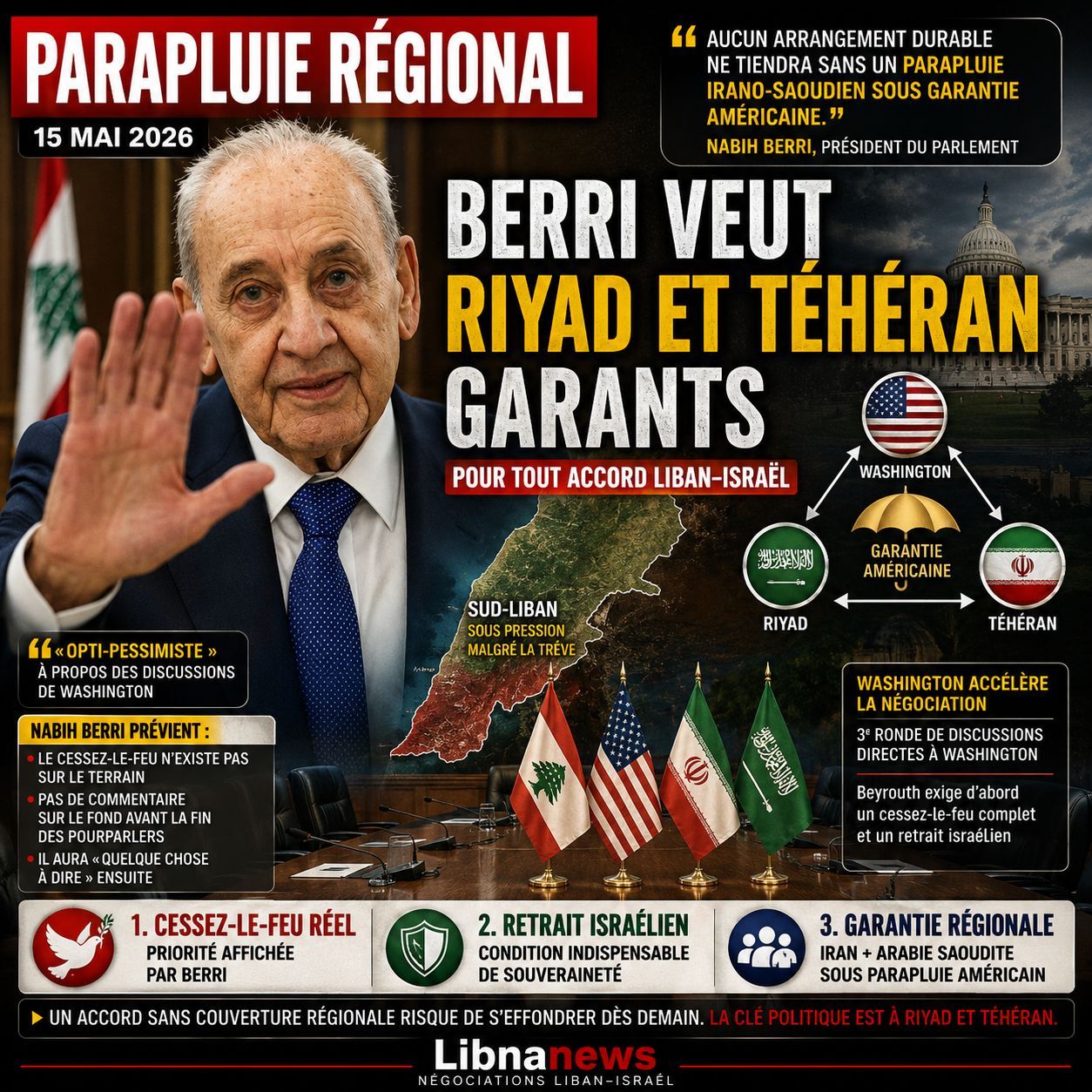
Nabih Berri now sets the political key to negotiations between Lebanon and Israel: no lasting arrangement, he said, will be able to hold without an Iranian-Saudi umbrella placed under American guarantee. The Speaker said he was « opti-pessimistic » about the third round of direct discussions in Washington. He refused to comment on the substance before the end of the talks, but warned that he would have « something to say » after the sequence had been completed. His message is both method and result. For him, the ceasefire remains non-existent on the ground, and a real truce requires regional guarantees capable of engaging the sponsors of the Lebanese balance of power.
An Iraqi-Saudi umbrella as a political condition
Nabih Berri’s formula deserves attention because it moves the center of the discussion. Washington welcomes the Lebanese and Israeli delegations. However, the head of Parliament claims that an agreement cannot be based solely on American arbitration. He wants Saudi-Iranian cover, with the United States as guarantor. This combination is not a diplomatic detail. It reflects the idea that the Lebanese crisis exceeds face-to-face between Beirut and Tel Aviv. It also concerns the balance between Riyadh, Tehran and Washington.
Berri knows that Hezbollah cannot be treated as a technical dossier. The movement is Lebanese, but its regional integration remains decisive. It is linked to Iran, while occupying a central place in the community and security balance of the South. On the other hand, Saudi Arabia weighs heavily on the Sunni scene, on Arab political aid and on possible reconstruction. A US guarantee alone could therefore appear insufficient. It could also be seen as too favourable to Israel. The Iranian-Saudi umbrella is used in this reading to balance pressure.
This request reveals a specific concern. Berri does not want a text signed in Washington that would collapse in Beirut. Nor does he want an agreement that would impose an impossible timetable on Lebanon on Hezbollah’s weapons, without effective Israeli withdrawal or cessation of strikes. Regional sponsorship would reduce the risk of internal refusal. It would also offer a political exit to actors who do not speak directly between themselves. In other words, Berri is looking for a diplomatic ceremony less than a guarantee mechanism.
The scepticism of a key negotiating man
The President of Parliament did not close the door to the Washington discussions. He didn’t call for their breakup. But his « opti-pessimism » sums up the ambiguity of the Lebanese position. Beirut participated, as the absence at the table would leave the ground for Israeli and American decisions. At the same time, part of the power fears that direct negotiation will create a political precedent. Berri therefore resumes his usual role: to maintain a channel, to set limits, and to retain the possibility of saying no.
Its silence until the end of the talks is also a tactic. It avoids offering an easy target to both supporters and opponents of negotiation. He let the delegation work, but said that he would publicly evaluate the outcome. This expectation allows him to stay at the centre of the game. If a credible cease-fire is achieved, it will be able to put it in line. If the text remains vague, it may denounce an insufficient operation. If he links Israel too quickly to the disarmament of Hezbollah, he will be able to challenge it in the name of internal balance.
Berri speaks from a particular position. He leads Parliament, chairs the Amal movement, talks with Hezbollah and maintains relations with Arab capitals. It embodies part of the Shiite political channel in the state. His speech is not acceptable to Hezbollah, but it often indicates the scope of what can be discussed. When Berri demands an Irano-Saudi umbrella, he therefore does not formulate a protocol preference. He describes the regional structure he believes he needs to make a compromise workable.
A cease-fire deemed fictitious on the ground
The first condition remains the ceasefire. Berri claims that there is no real one. This sentence refers to the continuing strikes in the south and east of Lebanon, despite a nominal truce announced last month. Beirut was relatively spared by the latest bombings, but its southern suburbs were also targeted during the truce period. The inhabitants of the South continue to live under drones, alerts and evacuation orders.
For the President of Parliament, negotiations during strikes create an immediate imbalance. Israel retains the military initiative while Lebanon discusses under pressure. This situation makes any compromise suspicious. It may give the impression that Washington is asking Lebanon to accept politically what Israel is trying to impose militarily. That is why Berri prefers, according to the report, indirect negotiations capable of first producing a real truce. The indirect form further protects the Lebanese internal scene.
This preference does not mean an absolute refusal to process substantive files. It means that the order of priorities counts. For Berri, the cessation of fire must precede the discussions on the next steps. Israeli withdrawal, reconstruction, the return of the inhabitants and the deployment of the Lebanese army cannot take place in an atmosphere of permanent threat. The issue of Hezbollah’s weapons must remain a Lebanese issue, not a commitment given to Israel under external pressure.
Washington wants to speed up, Beirut wants to frame
The third round of discussions takes place in a tight schedule. The Lebanese and Israeli delegations met in Washington before the end of the truce. An American official described the first day of discussions as productive and positive. This assessment is not enough to resolve the differences. The United States is looking for a quick result. They want to stabilize the front, limit the risk of regional expansion and perhaps open a wider sequence. Lebanon wants to avoid an unbalanced agreement.
The level of delegations has increased. Lebanon is represented by Simon Karam, former ambassador and lawyer. Israel sent a national security official. This development shows that the meeting is no longer limited to contact. She tests concrete formulae. They include, according to an Israeli media, a diagram linking Israeli withdrawal and Hezbollah disarmament. Such a formula remains to be found. It was not announced as an official agreement by Beirut.
It is precisely this hypothesis that feeds Berri’s caution. An Israeli withdrawal in exchange for Hezbollah’s disarmament may seem legible to Washington. It can also satisfy a major Israeli requirement. But in Lebanon, it raises a question of sovereignty. The State may decide on a monopoly of arms in its territory. It can organize a national dialogue. He can strengthen the army. On the other hand, if he appears to be executing a clause negotiated with Israel, he exposes the agreement to an immediate challenge.
The order of the stages at the heart of the dispute
The Lebanese line, as reflected in the reported exchanges, places the complete ceasefire before the Israeli withdrawal and then the internal treatment of the weapons. Israel wants the opposite or, at least, a direct link between the three elements. The US is looking for a sequence that allows each game to display a victory. The problem is that words are not enough. A blurred calendar can mask deep disagreements. A truce without a robust mechanism can be violated the next day.
Berri therefore wants an Iranian-Saudi umbrella to transform the sequence into a regional commitment. Iran could weigh on Hezbollah and frame a de-escalation. Saudi Arabia could give Arab legitimacy to a Lebanese arrangement and open the prospect of economic support. The United States could provide pressure on Israel and the diplomatic framework. This triangulation does not guarantee success. However, it responds to one reality: none of the local parties has the necessary levers alone.
The application also includes a message in Washington. The United States cannot ask Lebanon alone to bear the political cost of an agreement. They must obtain from Israel an effective halt to the strikes and a clear withdrawal. They must also accept that the Lebanese scene should not bend to an external calendar. In claiming Riyadh and Tehran around the case, Berri recalls that Lebanon does not want to be the ground for a regional compromise whose consequences it would suffer without controlling its guarantees.
Riyadh and Tehran, two opposing keys to the Lebanese case
The Saudi-Iranian rapprochement initiated in 2023 changed regional language without erasing rivalries. The two capitals resumed diplomatic relations after years of breakdown. This has reduced the risk of open confrontation. It has not eliminated influential competitions, notably in Lebanon, Syria, Iraq and Yemen. In the Lebanese case, their interests cross without confusion. This is precisely what makes their presence useful to Berri.
For Tehran, Lebanon remains linked to the regional security issue and to Hezbollah’s place. Any discussion of the movement’s weapons touches on a broader strategic architecture. For Riyadh, Lebanese stability requires the strengthening of the State, the control of arms and the reduction of Iranian influence. Both approaches may seem incompatible. But a guarantee framework would at least prevent a unilateral reading of the agreement. It would limit the risk of a truce signed by some and rejected by others.
Berri’s calculation is based on another data. The reconstruction of the South will not depend solely on Lebanese funds. The State lacks resources. Municipalities are weakened. Displaced families will need funding, safe roads, services and regular military presence. Saudi Arabia and the Gulf countries can play a role in a reconstruction conditional on stability. Iran can influence the political balances that make this stability possible or impossible.
A guarantee against the return of old failures
Lebanon remembers agreements that have not survived their regional environment. Every attempt to settle with Israel has been directed against external power relations, internal refusals or military changes. Berri tries to avoid this repetition. He knows that a text without regional acceptance can be announced as a victory, then quickly become impracticable. He also knows that an agreement imposed on a single Lebanese community may rekindle internal fractures.
The Iranian-Saudi umbrella must therefore serve as a political as well as a security guarantee. It must prevent the truce from being read as a defeat of one Lebanese camp and as a victory of another. It must include the Israeli withdrawal within a framework recognized by the main regional sponsors. It must also prevent the issue of arms from becoming an open confrontation between the State and a part of its population. Berri does not say how to achieve this balance. But it sets the minimum conditions.
This position differs from that of Israeli officials, who portray the disarmament of Hezbollah as the heart of the process. It also differs from the American demand for rapid progress towards a broader security agreement. For Berri, security cannot begin with pressure from Lebanon. It must start with stopping the strikes. It must then file a withdrawal. Finally, it must open an internal debate on the future of the non-State armed force. The sequence of steps becomes a red line.
Hezbollah weapons, internal file or external clause
The issue of weapons remains the most flammable point. Hezbollah refuses to see her treated in direct discussions with Israel. Instead, Lebanese officials refer to an internal settlement, after a ceasefire and a withdrawal. This would preserve State sovereignty while responding to an old international demand. However, it leaves an open question: what mechanism could make this debate credible to Washington and Tel Aviv?
The Lebanese army would occupy a central place in such a scenario. It should deploy further to the South, control sensitive areas and possibly receive or neutralize certain weapons. But it cannot act without means, political coverage and minimal consensus. Direct confrontation with Hezbollah would weaken the institution. A full status quo would not satisfy mediators. Berri’s regional umbrella also aims to resolve this contradiction.
In this perspective, Saudi Arabia and Iran would not be mere spectators. They would become implicit guarantors of the behaviour of their allies or partners. Riyadh could support the state and reconstruction. Tehran could accompany a de-escalation by avoiding turning the Lebanese front into a confrontation variable with Washington. The United States, for its part, should obtain verifiable commitments from Israel. Without this triple function, negotiation may remain an incompatible exchange of requests.
South Lebanon expects facts, not formulas
The people of the South already judge the discussions from the ground. Residents want to know whether the bombings will stop, whether the roads will be workable, whether the schools will be able to reopen and whether the houses destroyed will be rebuilt. Diplomatic formulas are no longer sufficient. Villages live under recurring alerts. Displaced families are reluctant to return. Farmers lose working time and sometimes entire seasons. The ceasefire must therefore be measured by visible facts.
Berri builds his position on this reality. It cannot support an agreement that would leave the people of the South without concrete guarantees. Nor can he ignore international pressure on Hezbollah’s case. His request for an Iranian-Saudi umbrella seeks to keep these two constraints together. It says that security peace cannot be only Israeli-American. It must also integrate the actors influencing Lebanese and regional decisions.
In Washington, Friday’s discussions must show whether this condition can enter the text, or whether it will remain a parallel requirement from Beirut. Berri chose not to speak until the end. Its silence leaves the negotiators a narrow margin. But its warning already enshrines the reading of the result: an agreement without a real cease-fire, without clear withdrawal and without Iran-Saudian coverage under American guarantee would be presented in Lebanon as a fragile truce, exposed from the moment of its birth to the fire of the ground and political refusals.




