

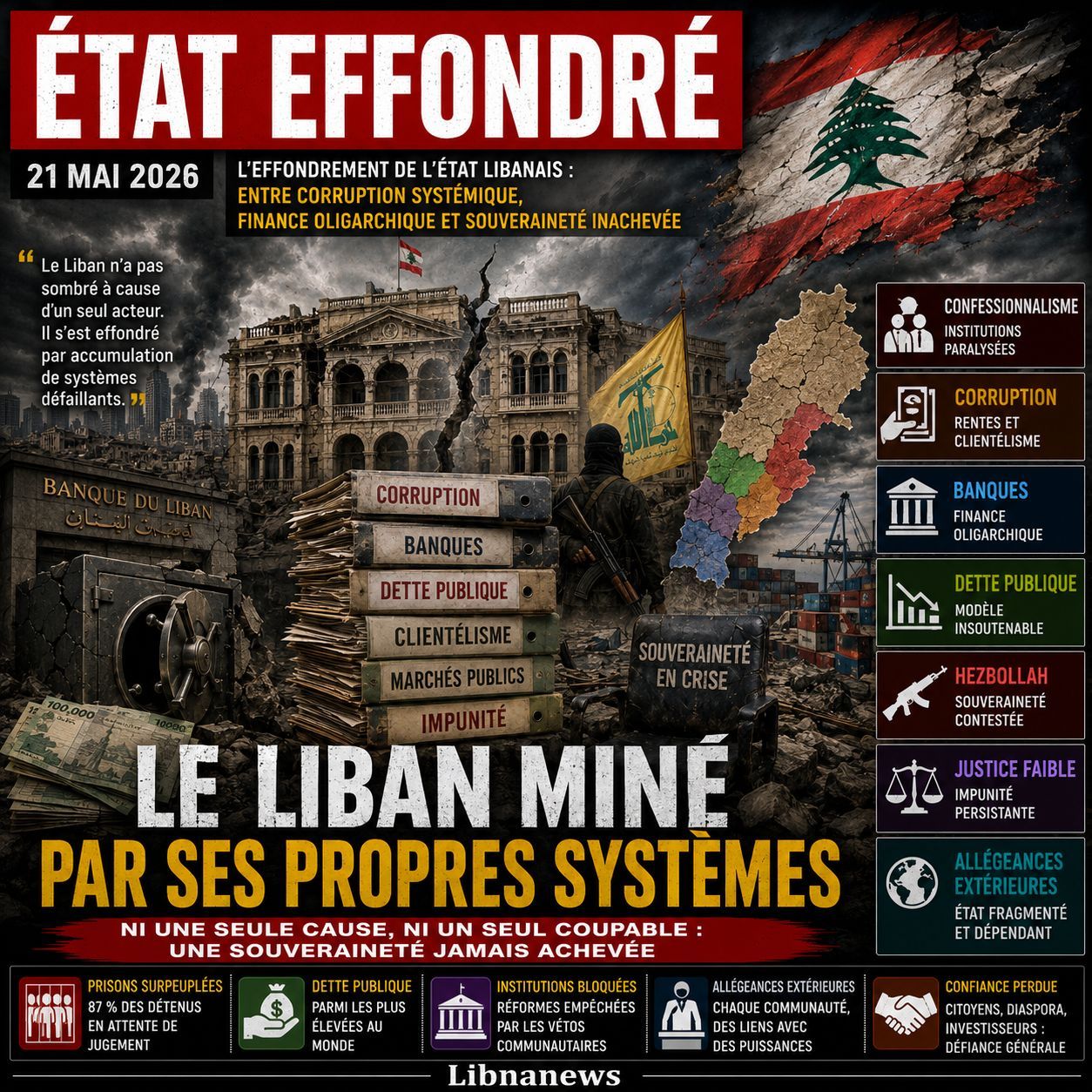
For several years, a question has been insistent in political and intellectual debates in Lebanon: is the collapse of the Lebanese state only the consequence of the rise of Hezbollah, or is it the result of a much deeper and older crisis?
For some, the answer seems obvious: the presence of an autonomous armed organisation, linked to Iran and with a major military and political weight, has gradually paralyzed the state and caused its regional and international isolation. Yet this reading, although it contains some truth, remains insufficient if it alone claims to explain Lebanon’s bankruptcy.
For the Lebanese collapse cannot be understood without analysing the very structure of the political, financial and institutional system that was established long before the rise of Hezbollah. The current crisis is the result of a historical accumulation of religious clientelism, systemic corruption, massive indebtedness, external dependence, lack of reforms and the gradual merger of political elites and financial interests.
Hezbollah is undoubtedly a major factor in institutional and geopolitical imbalance. But it is part of a system that has been weakened for decades. In reality, the Lebanese tragedy is that of a state that has never completely completed its sovereign construction.
Summary table: the main factors of the Lebanese collapse
| Factor | Nature of the problem | Consequences on the Lebanese State |
| Religious system | Community power-sharing favours political balances rather than state efficiency. | Blocking reforms, institutional paralysis and clientelism. |
| Structural corruption | Progressive transformation of the State into a system of distribution of privileges and annuities. | Public services weakened and popular confidence lost. |
| Incest between politics and finance | Deep interlocking between politicians, banks and great fortunes. | Explosion of public debt and protection of bank interest. |
| Financial engineering | Artificial maintenance of monetary stability through continued dollar entry. | The financial system collapsed when flows stopped. |
| Lack of productive economy | Excessive dependence on external services, imports and transfers. | Structural economic fragility. |
| Presence of Hezbollah | Existence of an autonomous armed force outside the state monopoly. | The weakening of sovereignty and geopolitical tensions. |
| Regional conflicts | Lebanon’s indirect involvement in regional rivalries. | Increased political risk and capital flight. |
| Low Justice | Audit institutions and justice often politicized. | Impunity and inability to combat corruption effectively. |
| External claims | Historical dependence of the different elites on foreign powers. | Fragmentation of national sovereignty. |
| Client culture | Community loyalties stronger than the idea of a state. | Transforming Lebanon into a mosaic of political fiefs. |
One of the most frequent errors in the analysis of the Lebanese crisis is to seek a single cause for a collapse that is in reality systemic. Lebanon did not sink only because an armed organization has considerable influence. It sank because a set of political, financial and Community mechanisms gradually drained the state from its substance.
The Lebanese denominational system, originally conceived as a mechanism of community balance, has been transformed over the decades into an institutional paralysis machine. Each reform becomes a potential threat to community balance. Each institution is fragmented between competing interests. In such a system, the national interest struggles to emerge above clan logics.
In addition to this political fragmentation, corruption has become structural. A large part of the ruling class has gradually used the state as an instrument of enrichment and clientelist control. Public procurement, administrative appointments and major infrastructure projects have often become rent-sharing spaces rather than national development tools.
The financial sector also played a central role in the collapse. For years, Lebanon has maintained an illusion of prosperity through a model based on debt, high interest rates and constant foreign currency inflows. This system increasingly looked like a mechanism of financial dependence unable to survive without new capital flows. When confidence collapsed, the entire banking and monetary system collapsed with it.
Hezbollah intervenes in this equation as an additional factor of imbalance. Its military weight, its ability to block politics and its integration into the Iranian-Syrian axis have profoundly altered Lebanon’s internal and external balances. Coexistence between an official State and an autonomous military power has contributed to undermining Lebanese sovereignty and increasing the international perception of risk.
But reducing the Lebanese crisis to Hezbollah alone would also mean exempting traditional elites from their historical responsibilities. For corruption, debt, over-billing, lack of reform and incestuous links between politics and finance existed long before the rise of the Shiite movement.
Lebanon’s fundamental problem may lie elsewhere: its historical inability to become a fully sovereign and modern State. A State capable of imposing the same law on all, having the monopoly of legitimate force, guaranteeing independent justice and building a stronger national identity than denominational affiliations.
To this is added a phenomenon deeply rooted in Lebanese history: external allegiances. All the major Lebanese communities have, at different times in history, maintained privileged relations with foreign powers. This external dependence has often prevented the emergence of a truly unified national project.
The Lebanese tragedy is therefore that of unfinished sovereignty. A country where institutions have been gradually absorbed by the Community, financial and geopolitical logics. A country where the State has lost its capacity to arbitrate, control and protect.
The current collapse is not the product of a single actor. It is the result of decades of fragile compromise, cumulative corruption, cross-interest and collective inability to build a true modern state.
Bernard Raymond Jabre




