

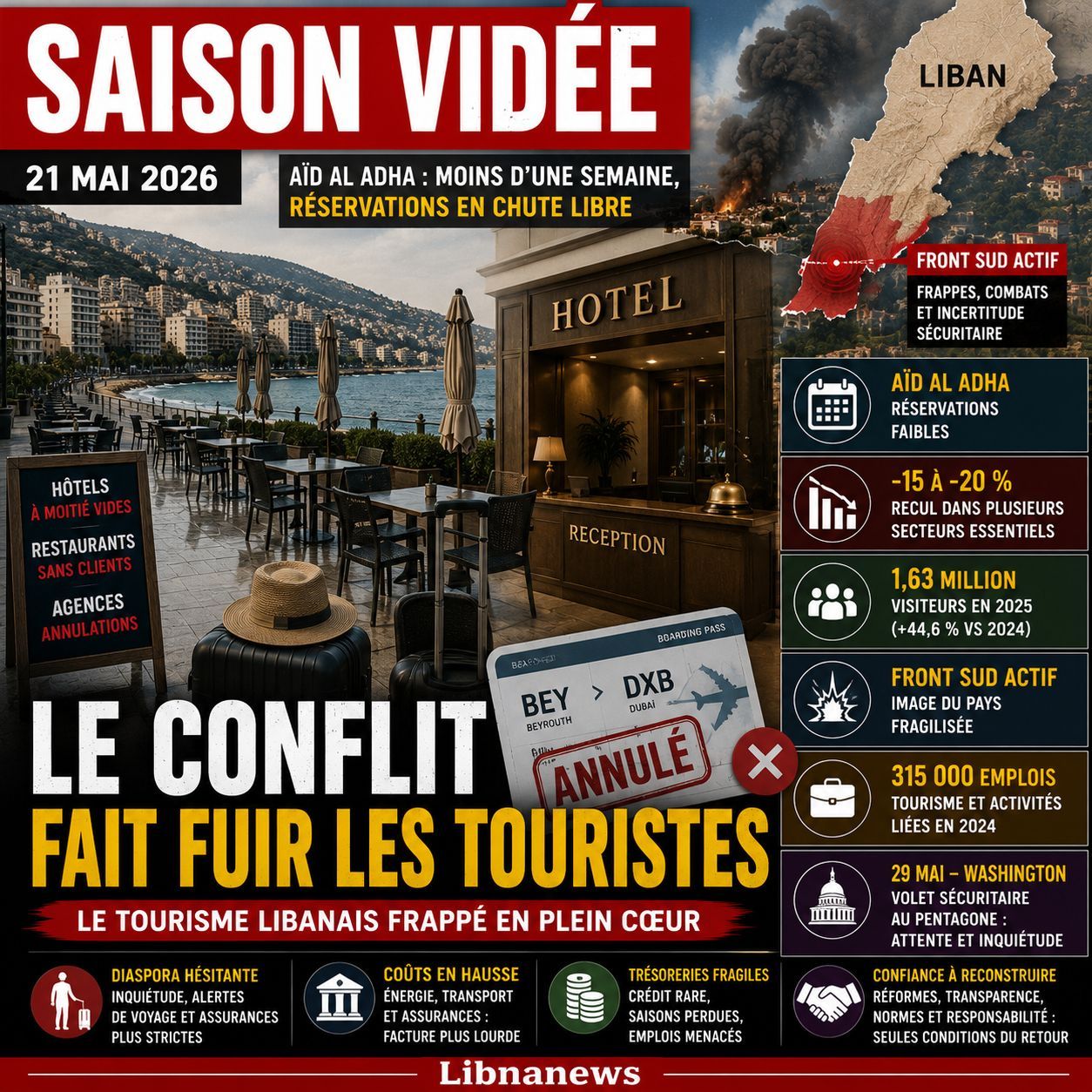
Lebanese tourism is approaching Eid Al Adha without the expected start, in a country still under direct pressure from the conflict. The southern front remains active, the Israeli strikes weigh on the country’s image, the displaced people recall that the crisis is not only diplomatic, and the expected opening of a security wing in Washington on 29 May keeps the professionals waiting. Low bookings are therefore not a mere seasonal slowdown. They reflect immediate distrust of war risk, possible cancellations, travel alerts and lack of visibility.
Lebanese tourism in the face of the conflict
Lebanese tourism is not going through a bad week. He’s in a context crisis. Hotels, restaurants, travel agencies, car rental companies and visitor-related businesses find themselves caught between a prudent clientele, high internal costs and a country that fails to separate its tourism offer from its political risk. The party was supposed to support consumption. On the contrary, it may confirm that the partial recovery observed in 2025 did not resist the return of war as a central variable of the economy.
The military situation is decisive. A few days away from Eid Al Adha, the Lebanese press describes a country suspended from regional negotiations, the expected security talks in the Pentagon and the continuation of operations in the south. The fighting around certain localities, the strikes, the destruction and the debate on the role of the army fuel a climate that the tourism sector cannot compensate for by means of reductions or communication campaigns. A traveller does not always distinguish between an active area in the south and a more remote area. He sees a country at risk.
This perception is enough to weaken a season. A diaspora family hesitates to reserve if they fear an extension of the strikes. A foreign visitor postpones his stay if his insurance becomes tougher or if his Ministry of Foreign Affairs recommends caution. A hotelier does not know if he should recruit for the high season. An agency hesitates to block aircraft seats. A restorer reduces his orders. The conflict turns political uncertainty into direct economic loss.
A party without a workout effect
The clearest signal comes from economic circles. According to the Lebanese press, Mohammad Choucair warned about the lack of positive dynamics within a week of Eid Al Adha. He mentioned a marked decline in sales and activity in several tourism-related segments, including hotel reservations, restaurants, airline tickets and car rental. It also reports a decline in industry, agriculture and services, with a decline of 15 to 20% in some key sectors.
This figure of 15 to 20 per cent is a measure of low demand. It shows that the problem is not limited to foreign tourists. Local consumption is also slowing down. However, religious holidays normally play a role of accelerator. They trigger travel, meals, purchases, rentals, family stays and expat temporary returns. When these peaks no longer work, the loss spreads into thousands of small transactions that bring the economic fabric to life.
The same message insists on the repetition of lost seasons. Eid Al Fitr and Easter had already been affected. Eid Al Adha could join the list. A low season can be absorbed by some establishments. Three successive highlights weaken cash flow, temporary employment and investment. The charges remain, even when customers do not come. Rents, energy, wages, insurance, purchases and maintenance continue to fall.
Figures showing a fragile recovery
Comparison with 2025 makes the situation more bitter. The figures compiled from data from the Ministry of Tourism indicate that Lebanon received 1,635,490 visitors in 2025, an increase of 44.6 per cent over the 1,131,100 visitors in 2024. But the level was still 2 per cent lower than the 1,666,492 visitors of 2023. The recovery therefore existed, but it had not erased the previous shock. The current conflict threatens to break this trajectory before it consolidates.
The 2025 chronology also shows the importance of the seasons. Arrivals reached 238,009 visitors in the first quarter, 397,513 in the second, 612,101 in the third and 387,867 in the fourth. The third quarter remains the heart of the tourist year, as it concentrates summer, expatriate returns and part of family stays. If spring and pre-summer holidays deteriorate, professionals fear a training effect on July and August bookings.
The decline of 2024 had already been brutal. Arrivals had dropped to 1,131,100 visitors, compared with 1,666,492 in 2023, a decrease of approximately 32%. The available data attributed this decline to security escalation and the deterioration of the country’s image. The 2026 season is therefore part of a series hit: a sharp decline in 2024, a partial rebound in 2025, and a new uncertainty related to the conflict. This instability prevents professionals from planning.
The origin of visitors requires a finer reading. In 2024, Europeans accounted for 41.11% of arrivals, or 464 942 visitors. Arab visitors accounted for 23.72 per cent, with 268,281 arrivals. Visitors from the Americas accounted for 20.45 per cent, or 231,355 people, while Asians accounted for 5.61%, with 63,400 arrivals. This distribution shows that Lebanon does not depend on a single basin. It must reassure several audiences, with different sensitivity to risk.
Agencies first sell flexibility
The Arab clientele remains strategic, but it is not automatic. Gulf tourists look at security, political relations, air links and the general image of the country. European and North American visitors also look at travel notices, insurance and the possibility of cancelling without loss. The diaspora maintains a more emotional bond, but now it calculates more. Some expatriates may prefer to send money to their families rather than come in an uncertain climate.
Travel agencies have understood this caution. According to the Lebanese press, they offer more studied offers, with nearby regional destinations, such as Turkey, Cyprus or Egypt, and payment facilities. They also add low-cost, sometimes free, modification or cancellation clauses to encourage bookings. This flexibility is not a commercial luxury. It has become a direct response to the risk of conflict.
Agencies now sell a form of psychological insurance. In a normal period, a guest compares the price, destination, hotel and dates. In Lebanon of 21 May 2026, he also compares the probability of escalation, the risk of a cancelled flight, the condition of the roads, the safety of his family and the possibility of not losing the money committed. Flexibility therefore becomes a product in itself. It reduces fear, but it also reduces margins.
This movement reveals a paradox. Lebanon is seeking to attract visitors, but part of its sector is more easily selling foreign stays to Lebanese residents. It’s not a fault of the agencies. They adapt to demand. But the signal is heavy. When Cyprus, Turkey or Egypt seem simpler to sell than a local stay, the problem goes beyond tourism promotion. It affects confidence in the country itself.
Hotels, restaurants and cars: the chain slows down
The hotels undergo a more brutal version of this uncertainty. Last minute bookings are increasing. Cancellations can occur as soon as a bombardment or regional alert dominates the news. Institutions do not know how many rooms open, how many staff mobilize, and how much to buy. This cost-effective management. It also makes service more difficult to stabilize.
Restaurants live the same tension. A party without solid reservations forces them to buy less, reduce teams and wait for the last moment. Their model is based on volume and rotation. Family meals, party parties, weddings, baptisms and expat meetings are an important part of seasonal activity. When families reduce their outings or move their expenses to help relatives, the whole chain slows down.
Car rental serves as a thermometer. An expatriate who reserves a car often announces a family or summer stay. A visitor who gives up renting also reduces travel, shopping and outings. The weakness of this segment therefore indicates a wider decline in tourism mobility. It affects gas stations, car parks, road restaurants, shops and villages that live by visitors.
Energy and airport, two points of vulnerability
Air transport plays a central role. Lebanon relies heavily on Beirut airport for its tourism. Any concern about airspace, insurance, cancellations or ticket prices immediately affects demand. Regional war adds another factor: energy prices. In the context of tensions around Iran, the international press has reported significant movements in oil prices. For tourism, this results in higher costs for flights, transport and services.
Global and regional figures confirm the importance of the sector. According to World Travel and Tourism Council estimates, the travel and tourism sector in Lebanon supported 315,000 jobs in 2024, or 19.6 per cent of total employment. International visitor spending was estimated at 519.7 thousand billion Lebanese pounds in 2024, compared to 201.9 thousand billion in 2023, but still far from 820.7 thousand billion in 2019. These differences show both rebound and fragility.
These figures should be read with caution, as methods vary depending on whether direct tourism is measured or its broad effect on the economy. But they converge on a simple idea: tourism is not limited to hotels. It supports jobs in catering, transport, commerce, events, leisure, services, agriculture, crafts and culture. When a festive season fails, the loss does not remain in the balance sheets of the establishments. It reaches employees, suppliers and regions.
A destination competing with its war image
The conflict has also left a material bill on the attractiveness of the country. The World Bank estimated the recovery and reconstruction needs associated with the conflict at $11 billion, with an estimated overall economic cost of $14 billion, including 6.8 billion in physical damage and 7.2 billion in economic losses. An economy that needs to rebuild housing, infrastructure and businesses is struggling to project the image of a stable destination.
Tourism is particularly sensitive to the image. Lebanon continues to sell a strong promise: sea, mountains, cooking, cultural life, hospitality, heritage, festivals and family ties. But this promise is challenged by another image: strikes in the south, displacement, military negotiations, regional tensions and political uncertainty. Travellers often choose the lowest risk. Even when a large part of the country remains practicable, news can be sufficient to divert demand.
This dimension is sometimes underestimated. A country can be partially safe and commercially penalized as if it were not. Professionals know that. They spend their time explaining that all Lebanon is not a war zone. But they face the logic of insurance, foreign agencies, concerned families and the international media. The image is quickly built in the crisis and is slowly repaired.
A liquidity crisis for professionals
The banking crisis adds additional vulnerability. Many tourism enterprises no longer have normal access to credit. They work with their own cash, pay cash suppliers, limit renovations and delay hiring. A bad season cannot be easily financed. A hotel, restaurant or agency that once used a banking facility must now absorb the shock almost alone.
This financial weakness also reduces the ability to invest. Modern tourism requires reliable online bookings, high service standards, renovated rooms, good connectivity, fluid means of payment, staff training and ongoing communication. However, operators who barely survive cannot always modernise their offer. The country may then enter a dangerous circle: fewer tourists, less investment, less quality, and then less attractiveness.
Domestic tourism could dampen some of the shock. But it runs counter to the purchasing power of households. Past inflation, falling real incomes, spending on health, education and housing reduce the margin available for leisure. Families who have booked a weekend may prefer to limit outings. Restaurants and hotels must then offer cheaper offers, at the risk of still ripping their margins.
What the State can still do
The State can act, even if it does not control the entire conflict. It can first produce fast and reliable data. Arrivals, cancellations, occupancy rates, countries of origin, ticket prices and reservations should be monitored accurately. Professionals need weekly figures in times of crisis, not only annual reports published too late. Without data, everyone works on impressions.
The government can also coordinate its communication. It is not about minimizing risks. It is a question of saying clearly what is open, accessible, not advised or affected. A blurred communication lets rumors decide. A specific message allows visitors to better assess their stay. It also allows professionals to respond with facts, not promises.
Airlines must be involved in this strategy. Maintaining connections, visibility of schedules, managing cancellations and price stability are essential. If tickets become too expensive or too uncertain, the season is lost even before visitors arrive. This is not only a matter for the Ministry of Tourism. It concerns transport, foreign affairs, security, insurance and airport authorities.
Municipalities also have a role. Regions that can accommodate visitors must ensure cleanliness, traffic, security, reasonable events and local information. Domestic destinations cannot expect everything from Beirut. A guest house, a mountain village or a family beach also depend on local management. In a difficult year, the slightest lack of service is expensive.
The diaspora remains the strongest asset, but it should not be considered captive. Expatriates come by family attachment, but they are also subject to security, cost and scheduling constraints. Some can shorten their stay. Others can wait until August. Still others may carry over to the following year. The emotional bond is powerful, but it does not cancel the risk calculation.
Lebanese tourism is therefore caught up in a severe equation. It can bounce quickly if the calm comes back, because latent demand exists. But it can also contract abruptly if tensions increase. This volatility discourages investment and weakens jobs. It prevents professionals from moving from a survival logic to a development strategy.
Future booking, flight and visitor data will therefore not only measure the state of tourism. They will say whether the conflict remains within a limited geography, or whether it continues to impose on the entire country the economic cost of a war without a clear horizon.




