

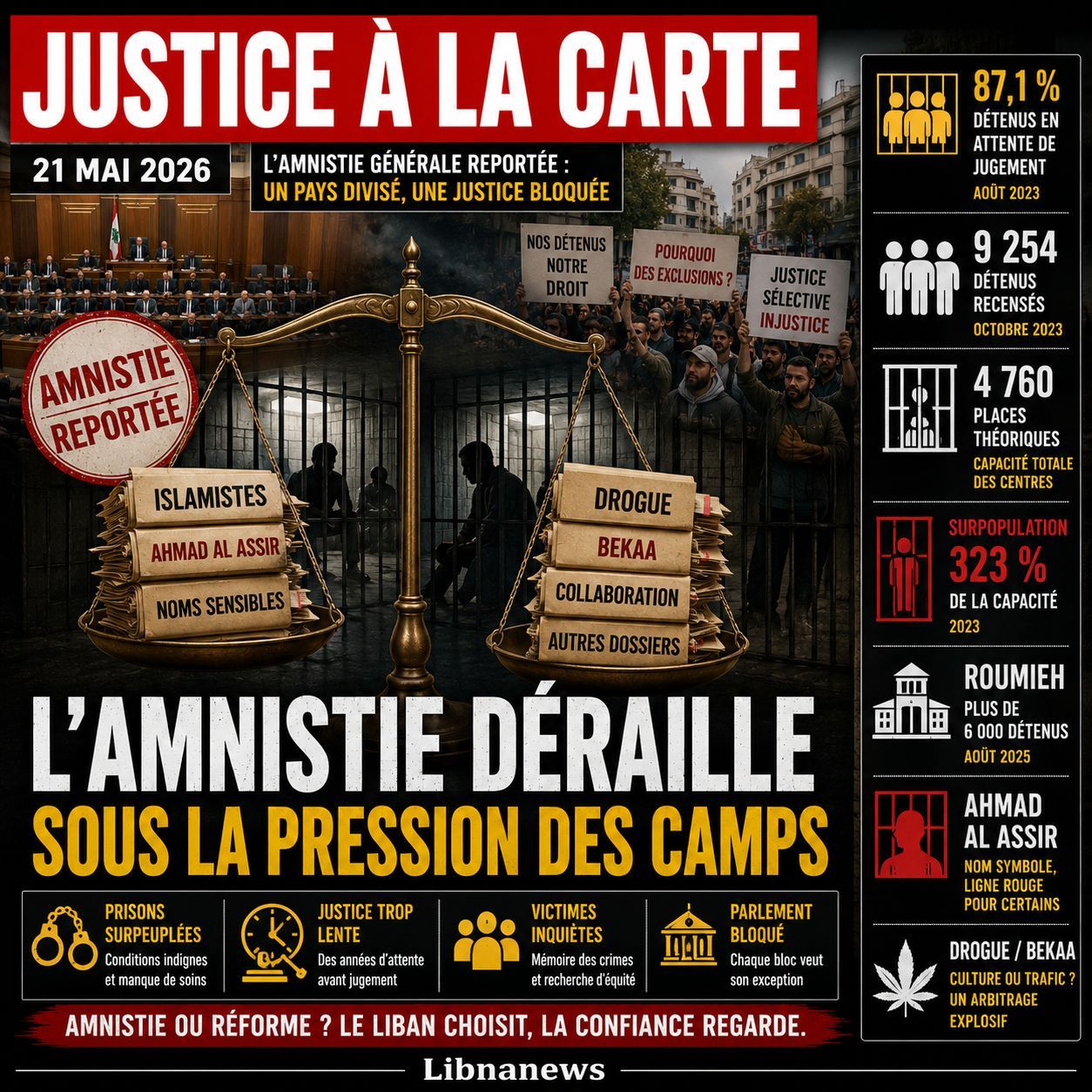
The general amnesty was postponed before even reaching the vote. The draft, adopted in commissions and subsequently referred by the Speaker of the House, was to respond to a real crisis: overcrowded prisons, too slow judgements, prisoners who had been waiting for years and justice unable to deal with all cases within acceptable time frames. But above all, the text revealed another Lebanese reality. Every camp wanted its exception. Every region wanted its inmates. Each block wanted to satisfy its audience. Justice, instead of being a principle, has again become a sharing of quotas, narratives and power.
The general amnesty caught by the street
The word amnesty carries a special burden in Lebanon. It refers to the exit from war, religious balances, political arrangements and the idea that certain crimes can be erased in the name of civil peace. But the sequence of 21 May shows that the country is not only debating a penal text. He discussed the capacity of the State to apply the same rule to all. This issue becomes explosive when Islamist detainees, drug cases, persons accused of collaboration, armed violence cases and some very sensitive names are in the same negotiation.
The postponement of the meeting does not regulate anything. He only suspends a crisis. It leaves the families of detainees waiting, the victims worried, the judges under pressure and the politicians facing their contradictions. General amnesty can be an exceptional tool. It can correct the effects of slow justice and unworthy prisons. But it becomes dangerous when it is used to sort prisoners according to their political utility, community affiliation or weight on the street.
The heart of the debate is simple. Does Lebanon need an amnesty or criminal justice reform? Both responses are not equivalent. An amnesty erases or reduces judicial consequences. A reform dealt with the cause: slow trials, abusive pre-trial detention, lack of judges, difficult transport of prisoners, dilapidated prisons, lack of care and lengthy procedures. Without reform, amnesty becomes a periodic valve. It clears some of the pressure, and then the system begins to produce the same injustices.
Nabih Berri invokes consensus
The justification put forward by Nabih Berri is based on a difficult observation. The President of Parliament presented the text as an exceptional way of reducing certain penalties and making its place in the principle of justice, in a context of chronic delays in criminal judgements. He also explained the postponement by the scenes observed in several regions and by a climate of confessional and community mobilization. The word chosen for the future is consensus. He’s careful. It’s also revealing. In Lebanon, even criminal justice seems to have to wait for a Community agreement before it exists.
Parliament is therefore faced with a paradox. He wants to correct the injustice created by judicial delays, but he makes a text that gives the feeling of negotiated justice. The commissions had worked on a formula. Blocks had accepted compromises. But as soon as the text came out of the room, the street took over the file. Families of Islamist detainees protested. Families of convicted or wanted persons in the Bekaa also challenged the exclusions. Roads have been cut. Movements were reported in Tripoli, Akkar, Saida, Bekaa and around the Rumieh prison. The law was no longer a text. It became a battle of gratitude.
Islamic detainees at the centre of the protest
The case of Islamist detainees is the most politically sensitive. Family committees believe that the proposed formula does not meet their primary claim. They denounce a text that could benefit other categories while leaving dozens of Islamist detainees in prison. Some talk about a trap that would desecrate injustice. This perception cannot be ruled out with a backhand. The Lebanese judicial system has experienced significant delays, and pre-trial detention has often lasted far beyond what a rule of law should accept.
But the other side of the debate also exists. Not all files look the same. Some concern armed clashes, deaths, attacks against the army or cases that have been lasting in the security institutions. Too wide an amnesty can be experienced by the families of victims as a second sentence. It may give the impression that time, street pressure or community membership are enough to eliminate responsibility. It is this risk that makes the case almost insoluble.
The direct entry of Dar Al Fatwa into the crisis gave wider scope to mobilization. According to the Arab press, an official linked to the follow-up of prisoners and their families denounced a justice perceived as selective. The argument is political as well as legal. Why consider reducing or removing certain cases of drugs, collaboration or other crimes, while keeping Islamists detained for years? The question concerns the Sunni perception of differential treatment. It puts Parliament before a heavy accusation: that of a justice that does not measure cases with the same rule.
Ahmad Al Assir, symbol name and red line
The name of Ahmad Al Assir concentrates this tension. In particular, the protests challenged its exclusion from the text. For his supporters and for some families, his case symbolizes the injustice done to Islamist detainees. For other Lebanese, it symbolizes the limit not to be crossed, due to the armed clashes in Abra in 2013 and the victims among the military. The difficulty comes from that. The same name activates two opposing memories. One speaks of persecution and imbalance. The other refers to bloodshed and state damage.
The names Nouh Zeaiter and Abu Takiyeh were also mentioned in the press debates. Again, the problem goes beyond people. It affects the temptation to build a general law around particular cases. When an amnesty text seems designed to allow or prevent the inclusion of a few names, it loses some of its legitimacy. A law must be able to be explained by criteria, not by implicit lists. The boundary between exceptional justice and political arrangement then becomes too narrow.
Drugs, Bekaa and impossible arbitrations
The issue of drug-related crimes has also brought out contradictions. The formula discussed distinguished the cultivation of narcotics plants, which could remain included, from drug trafficking, especially in cases of recidivism, which should be excluded. It also excluded drug-related offences committed by military or security forces. On paper, the distinction can be defended. It separates an activity often rooted in a poor local economy from a more structured criminal trafficking. In practice, it provoked the anger of families who felt that the text abandoned some of their relatives.
The Bekaa is at the centre of this ambiguity. The cultivation of narcotics was often presented as the result of a lack of development, weak statehood and a lack of economic alternatives. Trafficking refers to networks, violence, illegal money and corruption. A serious law should distinguish situations, but it should also avoid turning social poverty into an automatic excuse or organized crime into a simple regional problem. The text seems to have tried this sorting. The street showed that it remained politically explosive.
A Bekaa MP said he was not enthusiastic about releasing people convicted of drug trafficking. This reserve illustrates the discomfort of local officials. They know the traffic damage. They also know that their electoral bases include families affected by warrants, convictions or procedures. Public prudence then becomes a strategy. In closed rooms, positions can be more nuanced. On the street, they get tougher.
Victims, army and memory of sensitive files
Opponents of the text also denounce the risks of injustice to the victims. Former politicians recalled sensitive cases, including that of Captain Pilot Samer Hanna, killed in 2008 when his helicopter was targeted in the south. This example aims to ask a broader question: which cases can be erased and which must remain out of compromise? If the amnesty excludes certain files to protect the military institution, it may be accused of inequality. If she includes them, she can be accused of betraying the dead and their families.
The debate on those who fled to Israel after the 2000 withdrawal adds another layer. The formula referred to the legislative framework adopted in 2011. This category remains highly sensitive as it relates to collaboration, exile, the return of families and the memory of the occupation. Here again, the law mixes with politics and memory. Words used are never neutral. For some, it is about allowing returns and closing an old file. For others, it is a matter of not trivializing collaboration with the enemy.
Saturated prisons and too slow justice
Prison statistics show why pressure comes back periodically. The data available do not always overlap, as they do not date at the same time and are not all based on the same perimeters. However, they converge on one observation: the Lebanese prison system is saturated, and pre-trial detention occupies an excessive place. International data indicated 9,254 prisoners in October 2023. The proportion of persons in pretrial detention was estimated at 87.1 per cent in August 2023. A human rights organization reported in 2023 that detention centres had a total capacity of 4,760 places for approximately 8,502 detainees, of whom only 1,094 were convicted. Another organization referred to 323 per cent of prison capacity and about 80 per cent of pre-trial detainees.
| Indicator | Available data |
|---|---|
| Total prison population in October 2023 | 9 254 persons |
| Share of detainees awaiting trial in August 2023 | 87,1 % |
| Total capacity of detention centres, data 2023 | 4,760 places |
| Number of detainees, same data | 8,502 persons |
| Convicted persons, same data | 1,094 persons |
| Prison overcrowding indicated in 2023 | 323% of capacity |
| Detained in Roumieh reported in August 2025 | more than 6,000 people |
| Syrian prisoners affected by transfer in 2026 | about 300 people |
These figures explain why amnesty comes back as a political solution. When a very large proportion of prisoners have not yet been convicted, the problem is no longer just criminal. It becomes institutional. The prison is used to contain people that the judicial system cannot judge quickly enough. Delays are not an administrative detail. They change the nature of the sentence. A person awaiting trial may spend years in prison without a final verdict. If it is finally acquitted or sentenced to less than the time already spent behind bars, injustice is irreparable.
Conditions of detention aggravate this situation. Human rights organizations have described overcrowded prisons, inadequate access to care, lack of medicines and deaths in detention due in part to the deterioration of the prison health system. The question of amnesty is therefore also a humanitarian issue. A State that cannot judge quickly and cannot adequately treat detainees cannot simply invoke the law. He needs to fix his system.
A valve, not a reform
But the general amnesty is not the only possible response to overcrowding. Other tools exist: accelerated hearings, specialized chambers, wider use of alternative sentences, supervised parole, electronic bracelets if the legal and technical framework permits, limitation of pre-trial detention, increased transport of detainees to the courts, judicial recruitment, digitization of cases and better coordination between the Ministry of Justice, security forces and bar associations. These measures are less spectacular than an amnesty law. They are also less useful to political blocs seeking immediate gain from their audiences.
The danger is therefore to make amnesty a shortcut. It can empty cells, calm a street and produce immediate relief. But it does not treat the machine that manufactures overpopulation. If the courts remain slow, if the prisons remain dilapidated and if pretrial detention remains massive, the same debate will resume in a few years. The same families will mobilize. The same deputies will negotiate. The same victims will worry. Lebanese justice will turn around.
The presence of Syrian detainees adds another dimension to the prison crisis. In 2026, the Lebanese government approved and signed an agreement to transfer approximately 300 Syrian prisoners to Syria to serve their sentences. The case does not concern Lebanese detainees or cases awaiting trial. However, it shows that the Lebanese prison is also affected by regional crises. Thousands of Syrians have been imprisoned in Lebanon in recent years, and some issues remain related to the Syrian war, bilateral relations and security concerns. This situation further complicates any draft general amnesty.
A law or a bargain?
The political lesson of 21 May is severe. Parliament has shown that it can produce a compromise formula in committee. He also showed that this formula did not resist the mobilization of streets and communities. The postponement decided by Nabih Berri avoids immediate confrontation, but it does not answer the substantive question. Is the country capable of producing a criminal law based on public criteria, or only a formula acceptable to the main pressure groups?
To be credible, a new version of the text should be readable. It should state clearly which categories are included, which are excluded, why they are excluded, and according to which criteria. It should distinguish between persons in pre-trial detention, final convicts, repeat offenders, perpetrators of violent crimes, drug cases, attacks on the army, collaboration cases and humanitarian cases. It should provide for a judicial supervisory mechanism to prevent implementation from becoming a new political intervention fair.
It should also respect the rights of victims. Amnesty cannot only be written from the point of view of detainees and their families. Victims, families of soldiers killed, injured persons, residents of drug-affected areas or violence, and citizens seeking equal justice must also be heard. A text that appeases one community hurts another is not a national solution. He only moves anger.
The most critical question remains that of the state. Lebanon wants to restore confidence in its institutions, negotiate on the southern front, revive its economy and convince its partners that it can decide. But he struggles to pass a criminal law without religious affiliations taking over. This contradiction is at the heart of the blockage. A State which cannot say who must be tried, who can be released and according to which rules gives the image of a system where the law comes after the balance of power.
The next step will determine whether the deferral is used to improve the text or to expand bargaining. If Parliament comes back with precise criteria, public data and a strict judicial mechanism, amnesty can still be presented as an exceptional measure in a real prison crisis. If the new text merely adds or removes names to calm the streets, it will confirm that Lebanese justice remains subject to a logic of shares, clientele and competing memories.




