

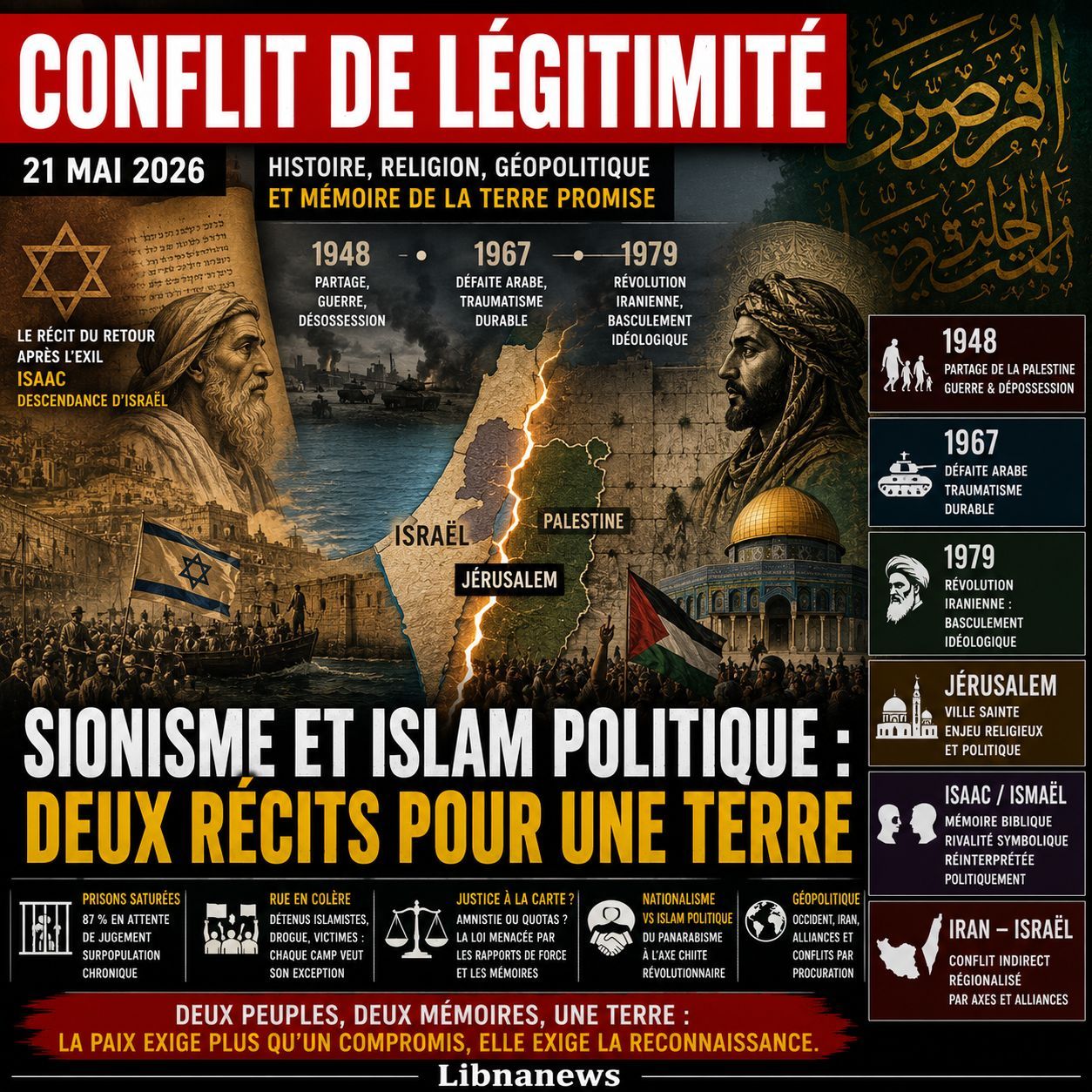
The conflict between Zionism and part of the Muslim world cannot be reduced to mere religious opposition between Jews and Muslims. It is a complex entanglement of biblical memory, historical narratives, competing nationalisms, geopolitical traumas and spiritual representations of the Promised Earth. For a long time, the fight against Israel was mainly carried by Sunni Arab nationalism. But after the Arab military defeats of the twentieth century and especially after the Iranian revolution of 1979, the ideological center of gravity of the conflict gradually shifted to revolutionary political Shiism.
At the heart of the problem are two historical accounts that cross without ever really joining one another: on one side the Jewish account of the return to the land of ancestors after centuries of exile and persecution, and on the other side the Arab and Palestinian account of a dispossession experienced as a historical injustice imposed from the outside.
To this is added a biblical and abrahamic depth. In Jewish, Christian and Muslim traditions, Abraham occupies a central place. Isaac, the son of Abraham and Sarah, becomes in the biblical tradition the ancestor of the people of Israel, while Ishmael, the son of Abraham and d’Agar, is considered in the Islamic tradition as the spiritual ancestor of the Arabs. Over the centuries, this symbolic duality between the descendants of Isaac and those of Ishmael has often been politically reinterpreted as a rivalry over the legitimacy of the Promised Earth. Historically, modern conflict does not arise directly from this biblical history, but religious and identity imaginations give it considerable emotional depth.
Summary table: the ideological, religious and geopolitical roots of confrontation
| Dimension | Arab Sunni Islam (1948–1970) | Shiite political Islam (since 1979) | Impact on confrontation with Zionism |
| Territorial issue | Refusal to share Palestine and perception of dispossession of the Palestinian Arab people. | Same refusal, but with a stronger revolutionary and anti-imperialist dimension. | There are two national stories fighting the same land. |
| Share of 1948 | The Arab States refuse to allow a predominantly Arab land to be divided in favour of a Jewish state. | Political Shiism also sees sharing as a historical injustice imposed by the West. | The rejection of the sharing plan becomes the starting point of the war. |
| Religious dimension | Jerusalem and Al-Aqsa are considered holy places of Islam. | The defense of Jerusalem becomes a religious and revolutionary duty. | The conflict takes on a sacred and emotional dimension. |
| Nationalism | The main driving force is long the Arab nationalism of Nasser more than Islamism. | After the failure of Arab nationalism, revolutionary Shiism recovers the theme of resistance. | The conflict gradually becomes more ideological and religious. |
| Western Report | Israel is seen as a Western ally in the Arab world. | After 1979, Israel was seen as an American strategic extension. | Confrontation is also becoming geopolitical. |
| Arab military defacies | The wars of 1948 and 1967 caused immense trauma in the Arab world. | Political Shiism turns this humiliation into an ideology of permanent resistance. | The memory of defeats feeds radicalization. |
| Culture of martyrdom | Present but less politically central. | The memory of Kerbala and Hussein’s sacrifice becomes a political model. | Conflict is interpreted as an existential struggle. |
| Bible Dimension | Palestine is seen as a historical Arab and Muslim land. | The symbolic rivalry of Isaac-Ismael is sometimes politically reinterpreted. | The conflict acquires a civilizational and identity depth. |
| Contemporary development | Several Sunni states are now focusing on their strategic and economic interests. | The Iranian axis remains at the centre of the confrontation with Israel. | The Arab-Israeli conflict is largely becoming an indirect Israeli-Iranian conflict. |
Opposition to Zionism in the Muslim world is therefore not based on a single cause. It combines several dimensions that have overlapped over time.
The first is territorial. For Palestinian Arabs and neighbouring Arab States, the creation of Israel in 1948 was seen as dispossession. Many felt that it was unfair for a majority Arab population to lose a large part of its territory in the aftermath of a European tragedy, the Holocaust. The refusal to share Palestine is therefore the result of a sense of historical loss and political injustice.
The second dimension is religious. Jerusalem has immense value for Judaism as for Islam. The presence of the Al-Aqsa mosque gives the city considerable spiritual centrality in the Muslim imagination. When the conflict becomes linked to holy places, it ceases to be only territorial: it touches the very identity of the peoples.
The third dimension is geopolitical. For decades after 1948, Sunni Arab nationalism fought against Israel. The Egypt of Gamal Abdel Nasser then embodies this Arab resistance. But successive military defeats, especially in 1967, profoundly weakened the pan-Arab dream. From then on, political Islam began to gradually replace nationalism as an ideological engine.
The Iranian revolution of 1979 marks a major turning point. Revolutionary political Shiism transforms the struggle against Israel into a global symbol of resistance against the West and against American influence in the Middle East. In this new vision, the Palestinian cause becomes as much an instrument of revolutionary legitimacy as a religious or moral struggle.
We must also distinguish anti-Zionism from anti-Semitism. Historically, the rejection of Zionism in the Arab world was first political and territorial. However, some radical discourses have sometimes slipped towards hostile representations of the Jews themselves, blurring the boundary between opposition to a political project and identity hostility. This confusion has contributed to further radicalizing the conflict.
Finally, the biblical depth of the conflict continues to feed collective imaginations. The figure of Abraham, the common father of Jewish, Christian and Muslim traditions, symbolizes both spiritual unity and the historical divide between the descendants of Isaac and those of Ishmael. This dimension is not enough to explain contemporary geopolitical reality, but it gives the conflict a unique emotional and civilizational charge in modern history.
The tragedy of the Israeli-Palestinian conflict lies precisely in this overlay of historical memories, beliefs and trauma. Each camp bears its own account of legitimacy, suffering and survival. And as long as these stories remain totally incompatible, confrontation will continue to fuel the tensions in the Middle East.
Bernard Raymond Jabre




