

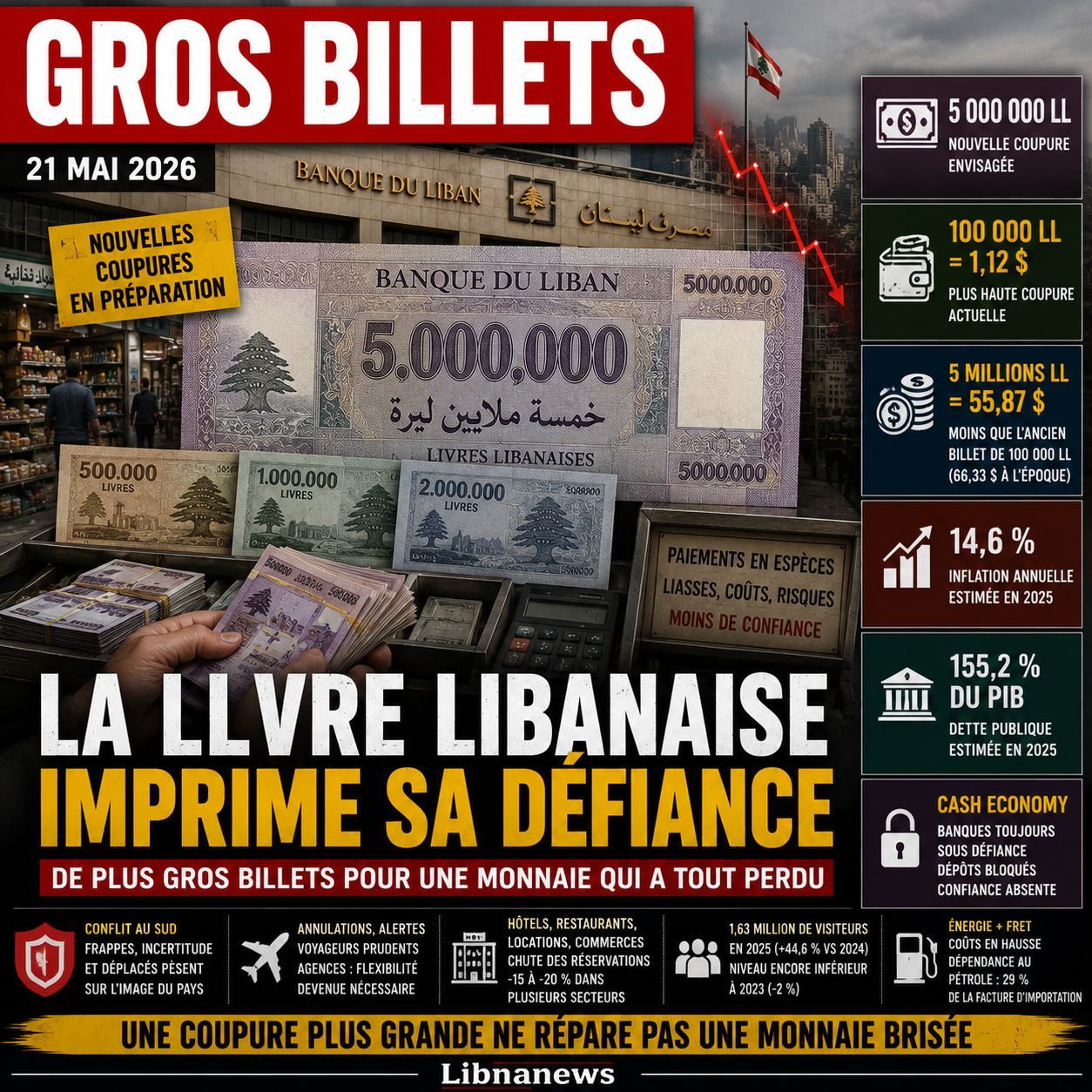
The Lebanese pound is about to change scale. According to the Lebanese press, the Bank of Lebanon is continuing to prepare new banknotes of 500,000, one million, two million and five million pounds, while the 100,000 pound note remains the highest denomination in circulation today. The operation is presented as a technique: reducing legumes, simplifying payments, reducing cash transport and replacing some of the small used cuts. But in a country where the currency was pulverized by the financial collapse, the question is not only practical. She’s political. Can we ask the Lebanese to see in these notes a simple payment tool, while the political, banking and administrative leaders who accompanied the crisis remain largely in place?
Lebanese pound: a practical operation, a heavy symbol
The Bank of Lebanon insists on the absence of a direct inflationary effect. The argument holds if the new denominations replace existing banknotes without increasing the money supply. In this case, it is not a question of creating more money, but of changing the physical form of the currency already used. The reasoning is technically valid. It is not enough at the social level. For many households, the arrival of a £5 million bill will not be read as a modernization. It will be received as the symbol of a loss. It will say, in a single cut, the extent of the journey since the time when 100,000 pounds represented a significant sum.
The Lebanese pound has not only lost value in the accounts. She lost her psychological role. Currency is supposed to measure, pay, save and reassure. In Lebanon, it measures a crisis. The banknotes that citizens carry in liases recall devaluation, inflation, banking crisis, blocked deposits and lack of accountability. The new denomination can therefore solve a cash problem, but it will not only restore confidence in the currency.
The practical justification is clear. Daily amounts have increased to the point where the 100,000 pound bill is insufficient for many regular payments. A race, full of fuel, invoice, delivery, repair, family restaurant or food purchases may require packages of tickets. Traders must count more. Banks and businesses need to store, transport and sort more paper. Citizens carry more cash, with more risk of loss or theft. In this reality, a higher cut can facilitate transactions.
| Cut | Approximate value at £89,500 per dollar |
|---|---|
| £100,000 | $1.12 |
| pound500,000 | $5.59 |
| £ 1,000,000 | $11.17 |
| £2,000,000 | $22.35 |
| £5,000,000 | $55.87 |
| 100 000 at the old official rate of 1 507.5 | $66.33 |
The numbers give the measurement of the changeover. At the official rate of £89,500 per dollar, the current 100,000 pound bill is worth about $1.12. A 500,000-pound note would be worth about $5.59. A $1 million ticket would be worth $11.17. A $2 million ticket would be worth $22.35. A $5 million note would be worth $55.87. Even the largest proposed denomination would therefore remain lower than the 100,000 pound note at the historical official rate of £1,507.5 per dollar, or approximately $66.33.
This comparison is brutal. It shows that the new five million note is not an expansion of purchasing power. Rather, it represents the administrative catch-up of a devalued currency. The country is not about to print a new wealth. He is about to print a cut adapted to the relative poverty of his currency. Nuance is essential, as it explains the discomfort that the operation can cause.
Larger denominations for a smaller currency
According to the Lebanese press, in April 2025 Parliament authorised the issuance of new £500,000 and £1 million cuts before a change added the possibility of a five million note. The central board of the Bank of Lebanon then selected four values: 500,000, one million, two million and five million pounds. The same information indicates that the 100,000 pound note represents about 95 per cent of the printed and circulation currency, compared with 4.5 per cent for the 50,000 pound note, while the remaining banknotes share the rest.
This details the operational objective. The cash payment system is based almost entirely on a cut that has become too low. Replace part of these volumes with higher banknotes may reduce the number of tickets required to pay the same amount. This can also reduce handling costs for banks, businesses, money carriers and public institutions. But this rationalization of the cash must not mask the reason for departure. If the 100,000 pound note has become too small, it is because the purchasing power of the currency has collapsed.
The timing remains uncertain. The project would not have been frozen, according to the information published, but it is still in a technical phase. Design choices, safety features, specifications and validations precede the dispatch of final designs to specialized printers. The recent war and the country’s slowdown would have delayed certain steps, including trade with foreign banknote companies. World production times are also long. Specialized companies are facing high demand, and schedules can be up to two years. However, Lebanon would have reserved a place within one year to complete the operation.
This wait gives time to clarify the message. Monetary authorities can explain what they print, why they print, how much they replace and how they will avoid misunderstandings about money supply. They can also publish a strategy for phasing out the most used small cuts. The more accurate the communication, the less the operation will be perceived as a sign of panic. Conversely, a poorly explained launch would reinforce the idea that the state simply follows the devaluation rather than repairing it.
The note is not inflationary, but memory is
The central argument of the Bank of Lebanon is that the operation is not inflationary. In theory, a new cut does not increase prices on its own. Inflation depends on many factors: money supply, exchange rates, imports, energy, wages, expectations of economic agents, taxation, competition, trade margins and confidence. Printing a higher value note is not equivalent to injecting a new value, if the issue replaces already existing notes. But in a country traumatized by collapse, theory must face collective memory.
Lebanese have seen inflation reach extreme levels. International data estimate inflation at 221.3 per cent in 2023 and 45.2 per cent in 2024 and 14.6 per cent in 2025. The fall in inflation does not mean that prices have fallen. It only means that their pace of progress has slowed. In 2025, some key positions continued to increase sharply: education by about 38.8 per cent, imputed rents by about 27 per cent and food by about 20.4 per cent. For households, the shock is therefore far from being absorbed.
The country is thus experiencing a paradoxical situation. The official exchange rate has remained stable at £89,500 per dollar since 2024 in the Bank of Lebanon series. But prices continue to weigh heavily on families. Foreign exchange stability is not enough to erase the cumulative effects of past inflation. Nor is it enough to restore confidence in the banking system. The new cut therefore occurs in an economy where the appearance of monetary stability coexists with a still damaged standard of living.
The context of the conflict adds additional pressure. Tensions in the south, strikes, displacements, uncertainty about security negotiations and possible increases in transport or energy costs can boost inflationary pressures. International forecasts point out that Lebanon’s dependence on oil for electricity and transport makes the country vulnerable to energy prices. Energy imports accounted for about 29% of the import invoice in 2025. An increase in oil or freight can therefore quickly affect domestic prices.
In this context, the issuance of large cuts can be misinterpreted. If prices go up when new banknotes arrive, the opinion can establish a direct link, even if it is not technically accurate. The Bank of Lebanon will therefore have to monitor the timing, volumes and pedagogy. It will have to explain that inflation is fought by monetary, budgetary and banking discipline, not by the graphic choice of banknotes. But it will also have to admit that symbolism counts.
The real question: trust in who?
The subject refers to the responsibility of the actors in the crisis. The Lebanese currency did not collapse alone. It has been undermined by unsustainable public policies, a failing banking architecture, a state unable to reform, a sovereign default, an accumulation of losses and a long absence of a clear decision on the distribution of the cost of collapse. In these circumstances, trust cannot be sought as an act of faith. It must be obtained by accounts.
The question is simple: why should citizens believe that new monetary management is different if accountability mechanisms remain weak? Where are the full losses balance sheets? What is the status of banking restructuring? What protections are provided for applicants? Which officials were punished? What guarantees prevent the return of the same practices? As long as these questions remain open, any monetary decision will be read through the prism of mistrust.
Karim Suaid, Governor of the Bank of Lebanon, inherits an explosive file. It must manage a devalued currency, a still fragile banking system, a partially dollarized economy, a large flow of cash and an opinion that associates the central bank with the years of crisis. His challenge is not only technical. It is institutional. It must prove that the central bank is no longer merely accompanying imbalances, but is helping to correct them.
New cuts can also accentuate cash economy. Since the banking crisis, most payments have been made in cash, often in dollars, sometimes in books. The use of cash responds to distrust of banks and account restrictions. But it makes the economy less traceable. It complicates taxation, promotes informal margins and increases the risk of money laundering. Larger book cuts can make some payments easier. They can also facilitate liquidity storage if the controls do not follow.
This argument does not justify automatic refusal of the new cuts. It imposes a framework. The Bank of Lebanon and the financial authorities must accompany the operation with compliance rules, supervision of cash channels and a gradual revival of electronic payments. A country cannot remain permanently dependent on banknotes to settle its current operations. Large cuts are an emergency fix, not a model of modernization.
Practical gains, but no monetary reform
However, daily use must be taken seriously. For an employee paid in books, a neighbourhood merchant or a small business, reducing the physical volume of tickets represents a real gain. Long counting costs time. Errors are common. The damaged notes are circulating. The boxes are packed. Money transport is becoming expensive. New cuts can thus improve practical life, even if they do not resolve the crisis.
Banknote design must also address security issues. The available information refers to elements of protection against falsification and characteristics adapted to the visually impaired. This is important. The higher a cut, the more attractive it becomes for counterfeiters. The quality of the paper, safety wires, inks, tactile marks, microtexts and visual elements must be irreproachable. A cut of £5 million that is poorly protected could cause immediate distrust among traders.
The Bank of Lebanon will also have to manage the transition. New banknotes cannot appear without clear information to banks, businesses, cashiers, distributors, carriers and the public. It will be necessary to explain their appearance, their security features, the exchange arrangements, the processing of used notes and whether or not to maintain old notes. A poorly prepared transition can create refusals to pay, suspicions of counterfeit notes and new frictions in transactions.
The social dimension cannot be ignored. By 2025, poverty among Lebanese people remained estimated at around 36 per cent, after a peak due to disruptions of conflict and contraction of activity. Food insecurity had declined since the end of 2024, but it remained close to 13% at the beginning of 2026. In this context, a five million pound note may seem high in its figure, but low in its real purchasing power. He can pay some expenses. It does not restore a middle class.
The comparison of the cuts illustrates this loss. Before the crisis, £100,000 was about $66 at the official rate. Today, 100,000 pounds are just over one dollar at the current official rate. The future $5 million bill would be less than $56. The country therefore needs a 50 times higher denomination to stay below the international value of its former largest banknote. This reality is the heart of the subject.
A currency is not only repaired by printing
Public debt remains another reminder of fragility. International estimates place debt at about 155.2 per cent of gross domestic product in 2025, despite a decline from previous years due to increases in nominal gross domestic product. The country has been excluded from international markets since the default of 2020. This situation limits the State’s ability to rebuild rapid credibility. Money cannot be separated from debt, budget, banks and external trust.
The monetary table should therefore be read with caution. The new denomination is useful if it reduces the costs of cash without fuelling uncontrolled monetary creation. It is dangerous if it serves as a substitute for deeper reform. The risk is not the ticket itself. The risk is to present a material adjustment as monetary progress. Lebanese know how to distinguish between a more convenient and a stronger currency.
This should lead the authorities to publish a simple commitment: new denominations should not increase the money supply beyond replacement requirements, volumes should be monitored, issues should be transparent, and data should be accessible. The Bank of Lebanon publishes monetary series and foreign exchange data. It should also be accompanied by vulgarised explanations. Trust is also built by legibility.
Parliament, on the other hand, cannot be content with authorizing the issue. It must follow the effects of the decision. MPs validated a change that affects every citizen. They must ask for reports, question printing costs, distribution arrangements, security guarantees and the impact on cash flow. In a country marked by the crisis, even technical choices must be controlled.
Commercial banks will also have a role. They will have to manage the reception of new banknotes, the exchange of banknotes, the updating of internal procedures and the training of cashiers. But they themselves remain at the centre of a crisis of confidence. For many Lebanese, banks are no longer places of financial security. They are associated with restrictions, losses and the inability to access deposits freely. The circulation of new denominations will not change this perception until a global banking solution is adopted.
The banknote file thus reveals a broader truth. Lebanon knows how to treat technical symptoms. It struggles to address political causes. It can replace liasses with larger notes. It can improve cash logistics. It can modernize safety signs. But it cannot restore the value of a currency without restoring confidence in the state, justice, the central bank, banks and public finances.
In the coming months, the follow-up to the project will tell a lot about the new monetary governance. If the operation is transparent, limited, explained and accompanied by broader financial reform, it can be seen as a practical measure. If it arrives alone, without progress on bank losses, without responsibility and without precise communication, it will be seen as an additional admission of collapse. The real test won’t be the color of the five million pound bill. It will be the capacity of the institutions to convince that this cut does not herald a new stage in the crisis, but the lucid management of its consequences.




