

On Monday, November 9, 2026, the American Supreme Court allowed the resumption of work in Big Bend, Texas. It suspends the federal injunction blocking the border barriers and roads required by the Trump administration. The decision takes place during the litigation on derogations from environmental laws. It does not terminate this procedure.
The order concerns the border area of Big Bend, in western Texas, on the border with Mexico. This area includes the National Park of the same name. Justice Ketanji Brown Jackson states that she refused the suspension requested by the government.
Work at Big Bend blocked since 2 October
A Federal Court in the West District of Texas suspended the administrative derogations and arrested the associated work on 2 October. The administration then appealed to the Supreme Court for the removal of this obstacle.
In particular, the Department of Homeland Security is opposed to the Friends of the Ruidosa Church, the Center for Biological Diversity and a river guide. These claimants contest the exemptions from the rules granted to speed up the border yard.
The Secretary of Homeland Security invoked a 1996 Immigration Act. Article 102 permits the construction of barriers and roads to deter irregular passage in the areas concerned. It also removes legal requirements in order to speed up this work.
Jurisdiction of the judge at the centre of the decision
In its five-page decision, the Court stressed the limits imposed on appeals against such derogations. The law reserves control of the courts to constitutional grievances. It excludes their jurisdiction over other challenges.
The complainants had invoked the so-called « major issues » doctrine. It requires a clear authorization from Congress when the executive claims certain broad powers. The Federal Court had held that this argument could fall within the constitutional separation of powers.
The Supreme Court rejects this reading at this stage. According to her, accusing the secretary of exceeding his powers under a law remains a legislative challenge. The invocation of the doctrine of major issues does not turn it into a constitutional grievance.
The judges therefore consider it very likely that the government will win over the lack of jurisdiction of the court. This assessment justifies the suspension of the injunction, without constituting the final closure of the case.
Construction costs and landscape risks
The Court also considers the financial consequences of the judgment. It cites the declaration of a customs and border protection officer. The Government estimates the unrecoverable costs incurred by the Government at almost $500,000 per day.
Opponents warn about lasting damage to landscapes, local activities and heritage. In their memoir of 29 October, they include canyons, the Rio Grande corridor and the historic church of Ruidosa. They argue that a recovery could cause destruction before the dispute is resolved.
However, the Court finds that Congress, by allowing these derogations, has favoured the rapid construction of border infrastructure. It considers that this arbitration weighs more in this urgent procedure than the alleged environmental and recreational damage.
The suspension remains linked to the next judicial steps. The Government must request a review of the case by the Supreme Court on time. If it refuses, the suspension will automatically end. If it agrees, the measure will remain in effect until its judgment is transmitted.
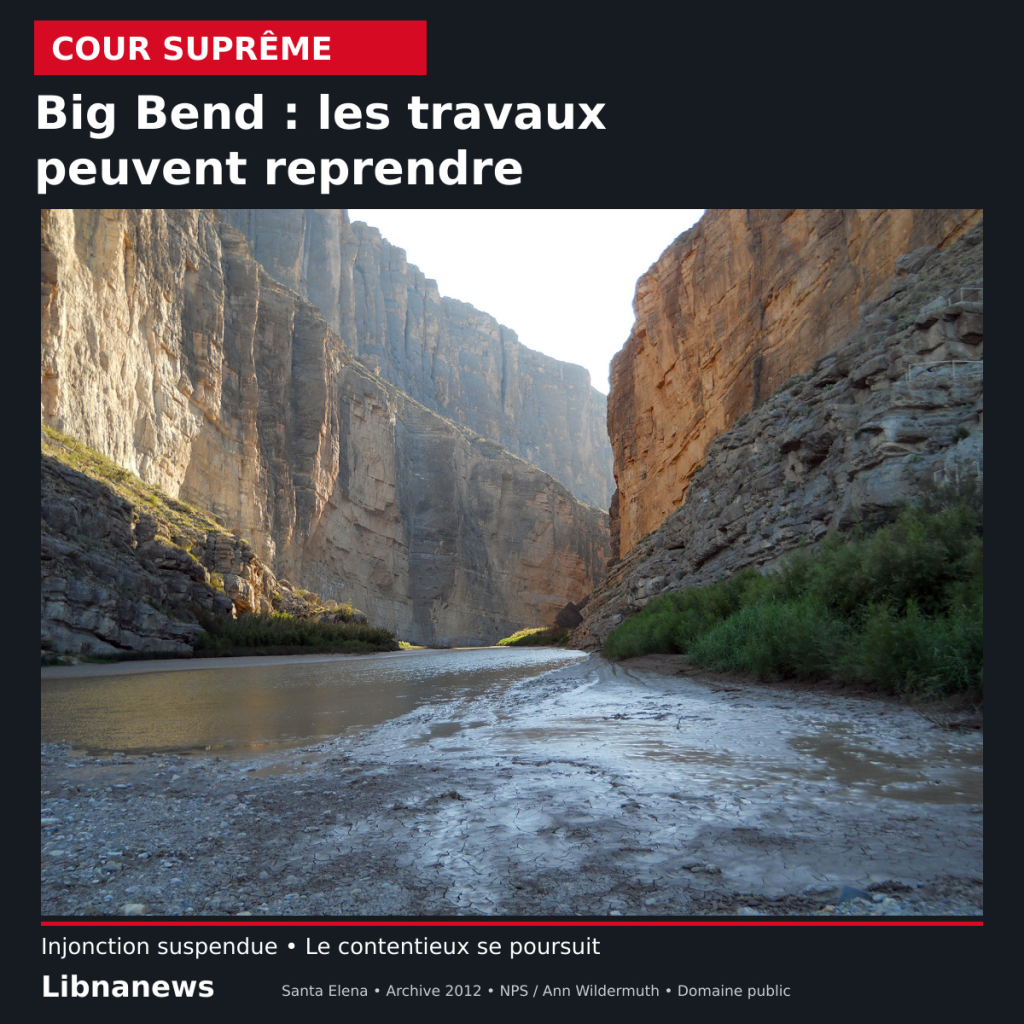
Photo of illustration: Santa Elena Canyon, Big Bend National Park. National Park Service Image Bank Archive, 18 September 2012 time stamp. Photo: NPS / Ann Wildermuth, public domain. Whole photo preserved without retouching; Libnanews dressing. This image does not show the border yard.Original photo, credits and fees.





Comments