

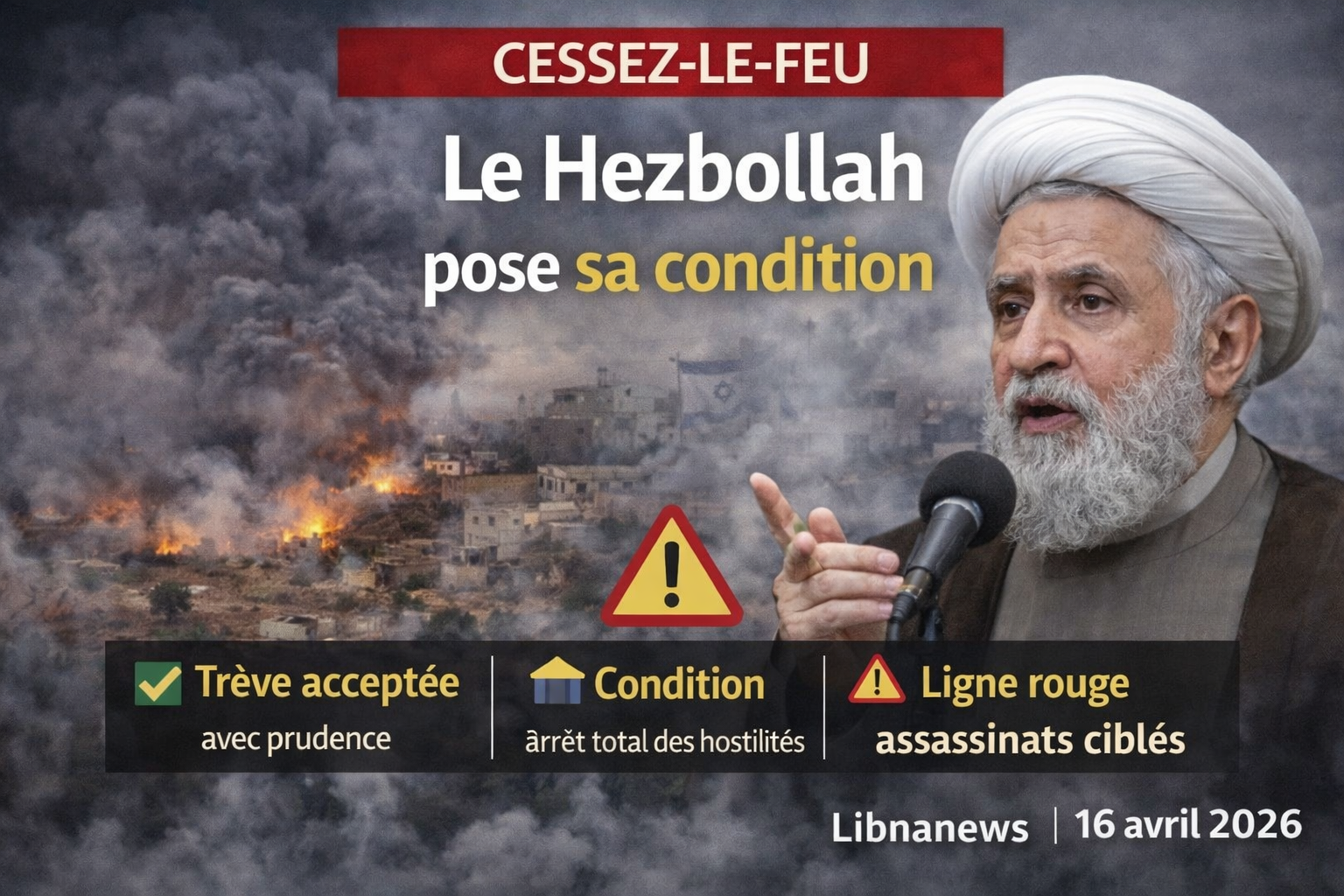
Hezbollah gave its clearest political response to the announcement of the ceasefire in Lebanon on Thursday night. The movement says it will respect the truce announced for the evening, but on a central condition: that Israel completely cease its hostilities, including targeted assassinations against its members. The formula is important because it is neither enthusiastic about the Washington process nor is it immediately rejected. It outlines a prudent course of action, suspended from Israeli behaviour within hours of the announced entry into force of the ceasefire.
MP Ibrahim Moussawi, one of the party’s political figures, summarized in a statement relayed by a news agency. According to him, Hezbollah will respect the ceasefire « in a cautious manner » provided that it is a global cessation of hostilities and that Israel does not use the truce to pursue targeted strikes. Clearly, the movement does not openly challenge the principle of suspension of fighting. He says that he will feel bound only if Israel renounces the practice that poisoned the previous truce: continue to strike, in the name of security, even though a ceasefire is officially in place.
This reservation is not rhetorical. It is rooted in the experience of the previous agreement concluded at the end of November 2024. On paper, this truce was supposed to put an end to the war started the previous year. In fact, it has been experienced in Lebanon as a one-way ceasefire. Israel continued to strike, target Hezbollah members and hit infrastructure or vehicles in South Lebanon and beyond. The Lebanese government claimed in March 2026 that about 850 people had been killed since the truce of November 2024, even before the outbreak of the war on 2 March 2026. It is this precedent that sheds light on the caution displayed today by Hezbollah.
So the sequence is double. On one side, Washington, Beirut and several capitals present the ceasefire in Lebanon as an immediate window of respite. On the other hand, Hezbollah essentially says that it will not judge the truce in its communiqués, but in its concrete execution. For the movement, the question is not just whether the massive bombings stop. She also asked whether Israel was giving up targeted strikes, point eliminations and operations which it often presented as preventive, but which Hezbollah considered to be direct violations of a truce.
A careful acceptance, not a political rally
The first point to note is that Hezbollah did not choose the frontal break. For several days, the party had denounced the discussions in Washington between Lebanese and Israeli representatives and reiterated that it would not automatically feel bound by negotiations in which it did not participate. In this context, the statement of Ibrahim Moussawi marks an important inflection. The movement does not say that it rejects the ceasefire in Lebanon. He says that he will observe whether Israel too respects the terms. That shade counts.
It allows Hezbollah to maintain two positions at the same time. On the one hand, it avoids appearing as the actor who would publicly sabotage a truce expected by a large part of the Lebanese population, exhausted by bombing, displacement and destruction. On the other hand, he reserves the right to resume his fire or operations if he considers that Israel continues to strike in another form. This position is consistent with the doctrine adopted by the movement in recent months: not to endorse diplomatic cadres driven from outside too quickly, but not to cut themselves off from a Lebanese opinion that wants a cessation of hostilities.
Perhaps the most important word in the statement is « conservative ». It shows that Hezbollah does not treat this truce as a trust agreement, but as a test. He’s kind of announcing a ceasefire under surveillance. This means that the first night and the first hours will count more than all the press releases published in Washington, Beirut or elsewhere. If no strike occurs, the movement can let the truce live. If targeted attacks continue, it will have already set the political framework for its response.
This caution also echoes the words of another leader of the movement, Hassan Fadllallah, quoted by Reuters. He also stated that the truce remained conditional upon the cessation of all Israeli hostilities. The convergence between these two positions indicates that Hezbollah seeks to give its side a common line: not to reject the truce in Lebanon in principle, but to reduce it to a simple, verifiable, almost mechanical equation. Israel really stops, or the ceasefire does not exist.
The burning memory of the November 2024 truce
To understand this mistrust, we must return to the previous ceasefire. The agreement reached at the end of November 2024 had been presented as a framework for de-escalation between Israel and Hezbollah, with the idea of its withdrawal north of the Litani and the redeployment of the Lebanese army to the South. On paper, the text had to reduce confrontation. In reality, calm has never been complete. In Lebanon, the ceasefire was quickly described as a largely unilateral truce.
Israel continued to carry out targeted strikes against Hezbollah members, targeting vehicles, positions and sometimes locations in the South. On the Israeli side, these attacks were presented as preventive operations or as a response to alleged violations. On the Lebanese side, they were seen as proof that the agreement did not really protect the territory or the inhabitants. It is in this context that the idea of a « one-way » ceasefire has gained ground in the Lebanese public debate.
The figures presented by the Lebanese authorities in March 2026 reinforced this reading. According to the government quoted by the Associated Press at the time, about 850 people had been killed since the November 2024 truce. This is politically very heavy. It means that between the official end of the previous war and the outbreak of fighting on 2 March 2026, Lebanon continued to pay a very high human price. Although full detail between combatants and civilians was not provided for the entire period, several documented strikes affected civilians, rescue workers and non-combatants. In these circumstances, a bilateral ceasefire was increasingly a fictional issue.
It is this memory that Hizbollah is today reactive. When Ibrahim Mussawi says that the new truce in Lebanon will only be respected if Israel does not take advantage of it to carry out assassinations, he does not speak of a theoretical scenario. It aims at a practice already proven in the period 2024-2026. He wants to point out that the party will not be confined to a situation where Hezbollah’s fire stops while Israeli strikes continue in a more targeted form.
This reference to the past also weighs on the Lebanese power. The Presidency, the Government and part of Lebanese diplomacy defend the ceasefire as a top priority. But they too know that a truce not respected by Israel would be politically untenable in Beirut. If the November 2024 sequence were repeated, the 2026 ceasefire would immediately be discredited.
Until the last hours, the land remained on fire.
The military context makes this prudence even more understandable. The ceasefire in Lebanon was not announced after a day of calm. On the contrary, it was announced after further Israeli strikes and intense fighting in several sectors. On Thursday, the Lebanese National Information Agency reported shelling of Bint Jbeil and Yarun, severe damage to the government hospital in Tebnine, and destruction of the Qasmiyeh bridge. Other strikes have hit roads, civilian buildings and already very fragile areas.
Around Bint Jbeil, one of the most active foyers on the front, ANI again reported intense artillery fire and violent fighting. This region remains the most visible point of military concentration in the current sequence. The Israeli army carried out a heavy offensive there, with the assumed objective of permanently weakening Hezbollah in this southern bastion. For the movement, this sector will be one of the first tests of the reality of the ceasefire. If the fire stops there, the truce can begin to acquire a concrete existence. If they continue, the political announcement will quickly lose its value.
The destruction of the Qasmiyeh bridge also marked the last few hours before the truce. Beyond the military impact, this attack has a strong logistical and symbolic dimension. It further cuts the South, complicates traffic and reinforces the impression that the war continues to redraw Lebanese territory as diplomacy speaks of respite. A cease-fire announced in such a sequence can only be credible if this type of strike is stopped immediately.
Tebnine provides another example. The damage to the government hospital, reported by the ANI, has reactivated one of the most constant Lebanese criticisms of the Israeli campaign: that of a war that does not spare civilian and health structures. Again, for Hezbollah as for the Lebanese State, the issue is not only military. It concerns the very definition of a cessation of hostilities. If hospital centres, relief workers and civilian infrastructure continue to be affected, the truce will not be perceived in Lebanon as serious or comprehensive.
The day before, the Associated Press reported the deaths of four Lebanese relief workers who had been struck in Mayfadoun during successive raids, while the rescue teams were already involved in a first attack. This type of incident directly feeds Hezbollah’s and, more broadly, Lebanese society’s mistrust of any truce that does not include an immediate mechanism of respect on the ground.
What Hezbollah’s condition says
The condition formulated by Hezbollah is precise and deserves to be read word by word. The movement not only demands the end of large-scale operations or mass bombings. He called for a « global cessation » of hostilities. This includes targeted assassinations in his reading. This precision is not secondary. It means that in the eyes of the party, a targeted strike against a framework, activist or infrastructure linked to the movement would already be a violation of the ceasefire.
This position makes the truce more demanding than simply stopping artillery exchanges or major raids. She’s laying a high bar. For Israel, which has often defended the principle of point strikes even during periods of relative calm, this creates a potential zone of friction. If the Israeli army considers that it retains the right to strike what it describes as imminent threats, then the cease-fire may be challenged from the very beginning.
At the same time, this formulation allows Hezbollah to present its position as defensive rather than offensive. The movement does not say that it is seeking a margin to resume the war. He said that he wanted to prevent a ceasefire in Lebanon from being emptied of its substance by an Israeli practice already observed. It is a way of covering up politically, but also of speaking to its base and Lebanese opinion: we do not reject the truce, but we do not want a repetition of November 2024.
This line also has an effect on Beirut. It reminds the Lebanese authorities that a ceasefire in Lebanon cannot be sold as a success if it does not produce a real suspension of the attacks. The government and the presidency need this truce. But they can’t afford it to look like the previous one, otherwise their own diplomatic strategy will be discredited.
Hezbollah adjusts its image in the current sequence
The statement of Ibrahim Moussaoui also has an internal political significance. Since the opening of direct discussions between Lebanese and Israeli representatives in Washington, Hizbullah has endeavoured not to appear as the isolated actor who would block any route of de-escalation alone. The party remains hostile to normalization or direct political dialogue with Israel. But it also does not want to bear the cost of an absolute refusal of a truce expected by the displaced, the families of the South and a large part of Lebanese society.
By saying that it will respect the ceasefire in Lebanon if Israel too respects it, the movement occupies a more politically defensible position. He can tell his camp that he doesn’t give in. He can tell the rest of the country that he doesn’t close the door in respite. And he can above all prepare the argument that he will use if the truce collapses rapidly: it is not we who will have sabotaged it, but Israel that will have raped it.
This posture is all the more important as Hezbollah has been under very strong military and political pressure since 2 March 2026. Israeli strikes have resulted in more than 2,000 deaths in Lebanon since then, according to Lebanese authorities relayed by Reuters and AP, and more than one million people have been displaced. The party knows that part of the country blames him for reopening the front in solidarity with Iran. It is therefore in his interest not to appear as the main obstacle to stopping the fighting.
But this repositioning remains very framed. Hezbollah does not support the logic of direct discussions in Washington. Nor does it recognize the existence of a broader political process with Israel. It only accepts the idea that a ceasefire in Lebanon can be observed if Israel completely ceases to attack. This remains a military logic, not diplomatic.
The first test will be immediate
For all these reasons, the first night will count more than the statements. The ceasefire in Lebanon will be judged on very concrete facts: do drones continue to fly? Do targeted strikes stop? Do the bombardments around Bint Jbeil actually stop? Are roads, bridges, vehicles and persons suspected of belonging to Hezbollah still targets?
Hezbollah has already fixed its reading grid. It will not distinguish between a large strike and a targeted elimination. If Israel continues to target its members, the movement will say that the ceasefire has been violated. This position therefore announces a permanent truce. She’s not a white-sing. It’s a test.
The precedent of November 2024 weighs heavily in this mechanics. In Lebanon, too many leaders, families and communities feel that this truce has mostly protected Israel from the Hezbollah response without preventing strikes on Lebanese territory. This memory makes any suspension of fighting more difficult to believe, but also more urgent to verify.
The stakes this time are simple to formulate. If Israel truly ceases all its hostilities, Hezbollah leaves the ceasefire in Lebanon to settle. If the targeted strikes continue, the movement already considers that it has no reason to hold back.




