

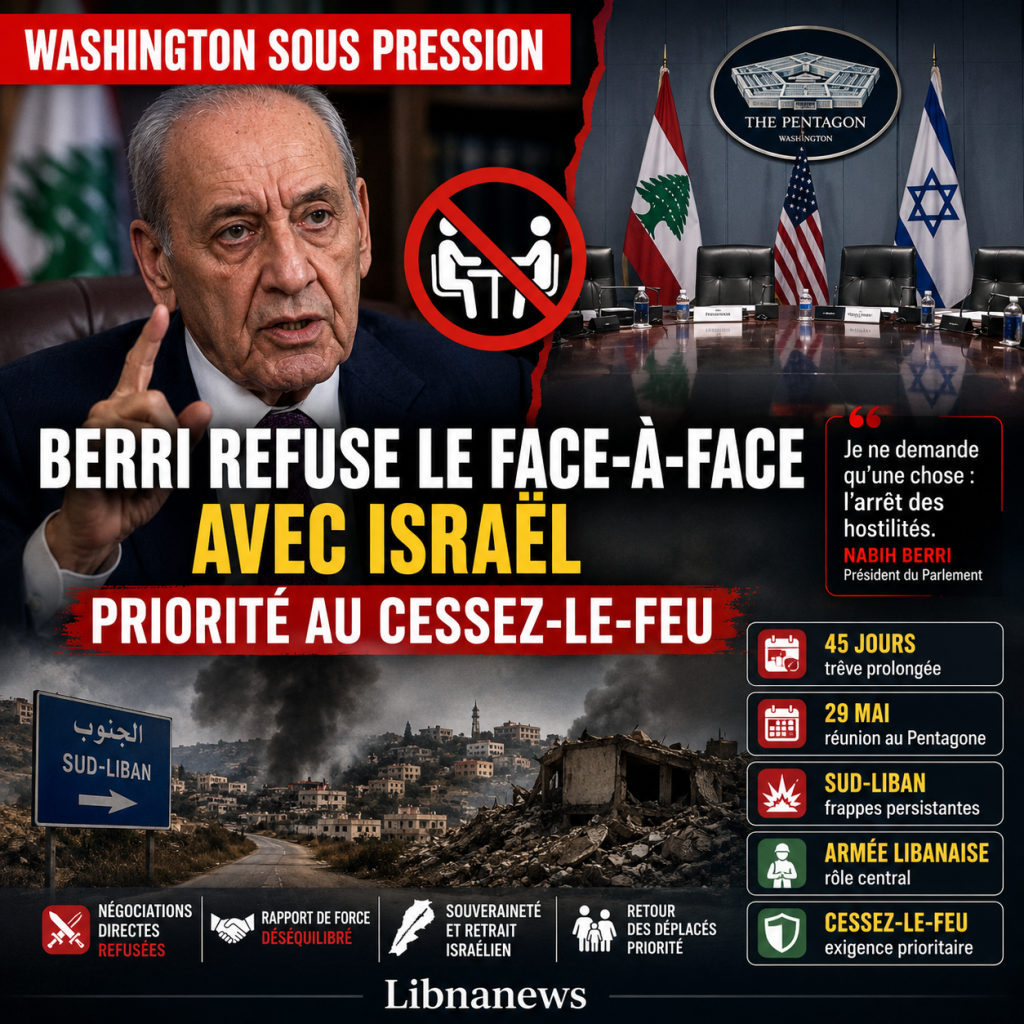
The President of the Lebanese Parliament, Nabih Berri, rejected any direct negotiations with Israel on the eve of a security meeting scheduled for Friday, 29 May, in Washington, D.C., saying that priority should remain to secure a genuine ceasefire in Lebanon. In statements reported by the Lebanese press, the Chief Legislative Officer indicated that he did not seek to know the contents of the file submitted by the Lebanese military delegation. He said to ask only one thing: the cessation of hostilities. His stance comes as the United States tries to maintain a channel between Beirut and Tel Aviv, in a climate of persistent strikes in southern Lebanon and internal political tensions.
Berri refuses direct negotiations
Nabih Berri distanced himself from the announced appointment in the Pentagon. He said he knew that the table should bring together three Lebanese soldiers, three Israelis and three Americans. He added that he did not want to know what the Lebanese delegation was taking with her. The Speaker of the Chamber brought the case back to one goal: a clear, enforced and guaranteed ceasefire in Lebanon. This formula contrasts with the diplomatic vocabulary used in recent days around Washington.
The Lebanese official recalled that several ceasefire agreements had already been concluded, but were not respected. It also considered that the current period did not correspond to a real cessation of hostilities. According to him, the country is in a 45-day truce, but without an effective ceasefire. Berri claimed that the war had even intensified, with communities destroyed before the eyes of the one who was supposed to guarantee the agreement. He concluded, on this point, that there was no longer any guarantor.
This statement directly refers to the sequence opened by Washington. The United States announced a 45-day extension of the current arrangement, with a security component in the Pentagon on 29 May and a resumption of political discussions on 2 and 3 June. Friday’s meeting should address military and border issues. It comes after several exchanges presented as productive by the American side. In Beirut, this formal reading is not enough to dispel reservations.
The President of Parliament also repeated his refusal to negotiate directly. He said he was opposed to it and wanted to remain so. His argument concerns the balance of power. For him, a delegation cannot sit at a table without playing cards. He considered that Lebanon was going to this type of meeting without any leverage, therefore without the ability to pull a result. This position sets the tone for a debate that goes beyond the Pentagon meeting alone.
Stop the fire in Lebanon: the priority displayed
Nabih Berri’s line holds in a few words: before the mechanisms, it is necessary to stop the fire. This position responds to a shared concern in several Lebanese political circles. American diplomacy is pushing for a structured framework. But the people of the South judge the ads from the ground. Strikes, evacuations, houses destroyed and roads cut off remain the most visible signs of the crisis. For displaced families, the question is not the format of the meeting, but the possibility of returning to their villages.
The difference between truce and ceasefire has become central. A truce may temporarily suspend operations. A ceasefire requires stronger commitment, more precise rules and effective monitoring. Berri accuses the current scheme of failing to meet this threshold. He did not only dispute the modalities of the meeting. He questioned the fact that Lebanon was entering into a security discussion while security was not yet assured.
In official circles, Lebanese priority remains the cessation of hostilities, the Israeli withdrawal, the return of displaced persons and the extension of State authority. The Lebanese army is expected to play a central role in this sequence. It must be able to deploy, control the area south of Litani and reassure the inhabitants. But this role requires a stable environment. No deployment can have a lasting effect if the strikes continue or if Israeli forces maintain freedom of action on Lebanese territory.
The Berri declaration therefore places the Washington meeting under political conditions. It does not formally block Lebanese participation. However, it sets a red line. The discussions shall not replace the stoppage of the fire. They must not give the impression that Beirut is negotiating under military pressure. The Speaker of the Chamber thus seeks to refocus the debate on the immediate outcome expected by Lebanon: the end of the attacks.
A military meeting on display in Washington
The planned appointment at the Pentagon is presented as a security component. This clarification is intended to limit its political scope. Delegations should be military, with an American presence at the table. The format addresses issues of terrain, control, withdrawal, coordination and border security. It also allows the Lebanese authorities to argue that it is not a matter of normalization with Israel, but of a mechanism to stop hostilities.
This distinction remains fragile. Lebanon and Israel have no diplomatic relations. Any encounter, even military, arouses a strong sensitivity. Historical precedents weigh heavily on the debate. Several political forces fear that a technical channel will slide towards a wider arrangement. Others believe, on the contrary, that the Lebanese State must occupy all available space to defend its demands and prevent decisions being taken without it.
The meeting also took place in a phase in which Washington wanted to revive a political path. After the military phase, American diplomacy is expected to continue the exchanges in early June. The stated objective is to transform the extension of the truce into a more sustainable process. The United States speaks of sovereignty, territorial integrity and security along the border. Lebanon, for its part, insists on the Israeli withdrawal and the cessation of the strikes. Israel calls for safeguards on Hezbollah and the absence of threats from southern Lebanon.
In that context, his delegation was in a difficult position. It must represent the State, but it cannot engage a major political choice alone. It must call for the consolidation of the ceasefire, while defending the role of the army. It must prevent the security case from becoming a charge against the military institution. It must also take into account internal divisions on negotiation, Hezbollah and the future of the southern front.
An inner pressure Berri wants to contain
Nabih Berri indicated that his priority in the current period was to prevent any recklessness or problems inside. This sentence illuminates the Lebanese dimension of its position. The Speaker of the House is not just speaking on Washington. It also addresses internal actors who fear a political crisis related to negotiation. The case can quickly become explosive if part of the country sees the meeting as a concession made under pressure.
The Chief Legislative Officer occupies a particular place in this sequence. He runs Parliament. He also chairs the Amal movement. He remains one of the main institutional interlocutors capable of speaking to Hezbollah, the Presidency of the Republic and diplomatic channels. This position makes it a mediator, but also a political target. A poorly prepared or poorly explained meeting may place it between the requirements of the state and the Shiite camp reserves.
Hezbollah rejects direct negotiations with Israel. The movement sees maintaining Israeli military pressure as a reason to refuse any concessions. Its opponents, on the other hand, believe that the state must resume the decision of war and peace. Between these two lines, Berri tries to prevent an internal confrontation. He does not want the debate on Washington to turn into a street arm or an open crisis within the government.
This caution is explained by the context. The government of Nawaf Salam must defend an official position, while preserving already fragile cohesion. President Joseph Aoun wants to place the state at the centre of negotiations. The army seeks to retain its national role over political divisions. At the same time, sanctions, American pressure and Israeli strikes fuel the mistrust of part of the Lebanese landscape. Berri seeks to prevent these factors from converging towards an internal crisis.
South Lebanon remains the judge of the process
South Lebanon is the place where diplomacy will be evaluated. Residents expect less formulas than visible results. A ceasefire in Lebanon must mean a halt to the strikes, an end to the incursions, the return of the displaced and the beginning of a repair of the affected localities. Without these elements, the extension of the truce may remain a political delay without any real effect on daily life.
Border villages have already paid a high cost. Families still live far from their homes. Agricultural activities have been discontinued in several sectors. Local infrastructure has been damaged. Municipalities have to cope with limited resources, as needs increase. In this context, the people judge the authorities to be able to achieve an effective reduction in violence. Words spoken in Washington will only have weight if they translate into changes on the ground.
The Lebanese army is at the centre of this equation. Its deployment is often described as the institutional exit route. But the army needs security, resources and clear political coverage. It cannot become the receptacle of all expectations alone. The authorities must give him a coherent mandate. Foreign partners must provide useful equipment. Israel must stop operations that prevent normal control of the territory. Hezbollah must also accept that the state should return to a more visible place in the South.
The Pentagon meeting must therefore answer a concrete question: how can we move from a diplomatic arrangement to a verifiable calm? This question cannot be rejected. It concerns the military, but also the inhabitants, local elected representatives and displaced families. Berri ll formulated in his own way, reducing the agenda to the essential. Without stopping the fire, no discussion can be presented as a real step forward.
Washington wants to maintain the calendar
The United States seeks to preserve the momentum of mediation. The 45-day extension must offer an additional window to move forward. Washington wants to organize the files in two stages: first the security side, then the political side. This method aims to deal with military emergencies without abandoning the objective of a broader arrangement. However, it places a difficult choice on the Lebanese authorities. Participate exposes to criticism. Refusal may give the image of an absent State.
The US communiqué insists on the search for real security along the border and respect for the sovereignty of both sides. This formulation is designed to reassure. It does not fully address Lebanese concerns. In Beirut, sovereignty is measured by the Israeli withdrawal, the end of the strikes and the effective control of the territory by the State. On the Israeli side, security is measured by the remoteness of Hezbollah and the limitation of its military capabilities. Priorities overlap only partially.
The May 29 sequence also takes place in a busy regional environment. The discussions between Washington and Tehran weigh on the calculations. The Lebanese issue is directly or indirectly linked to the balances between the United States, Iran and Israel. Lebanese officials want to avoid the country being treated as a simple regional map. This fear goes through several speeches in Beirut. It explains the official desire to recall that only the Lebanese State must speak on behalf of Lebanon.
The difficulty is that the terrain does not always follow the diplomatic pace. Each strike weakens confidence in mediation. Each hostile statement reduces the space for compromise. Each debate on the composition of the Lebanese delegation feeds suspicions. Washington may impose a timetable, but it alone cannot erase the Lebanese internal power relations. Berri uses this time lag to remind that the emergency is not the photo of a meeting, but the military result.
A high-risk political sequence
Nabih Berri’s position changes the atmosphere around the meeting without preventing its progress. It gives the Lebanese delegation additional pressure. It reminds him that the priority request must remain the ceasefire. It also informs Washington that the US guarantee will be judged on its effects. If the strikes continue during or after the discussions, opponents of the process will be able to assert that Lebanon has spoken without protection.
For President Joseph Aoun and the Salam government, the challenge is to maintain an institutional line. Lebanon must defend its rights, demand Israeli withdrawal and demand the cessation of violations. It must also avoid diplomatic isolation. This position requires close coordination between Baabda, the Great Serail, Parliament and the army. Any public dissonance can weaken the delegation and strengthen those who challenge the process.
Berri’s statement reveals this fragility. It is not limited to a refusal of principle. It expresses concern about Lebanon’s ability to negotiate under balanced conditions. She asked the promoters of the meeting a simple question: what can Beirut get if the Israeli side retains the military initiative? This question will weigh on the Pentagon’s discussions, and then on the political side planned for early June.
On Friday, the Lebanese military delegation must therefore enter a meeting room dealing with issues beyond maps, contact lines and technical arrangements. It will bring the demand of a weakened State, but determined to reaffirm its sovereignty. It will also be waiting for the people of the South, for whom the ceasefire in Lebanon will be credible only on the day when the roads reopen without fear, the families will return long-term and the villages will cease to be the daily theatre of a war that diplomacy says they want to stop.




