

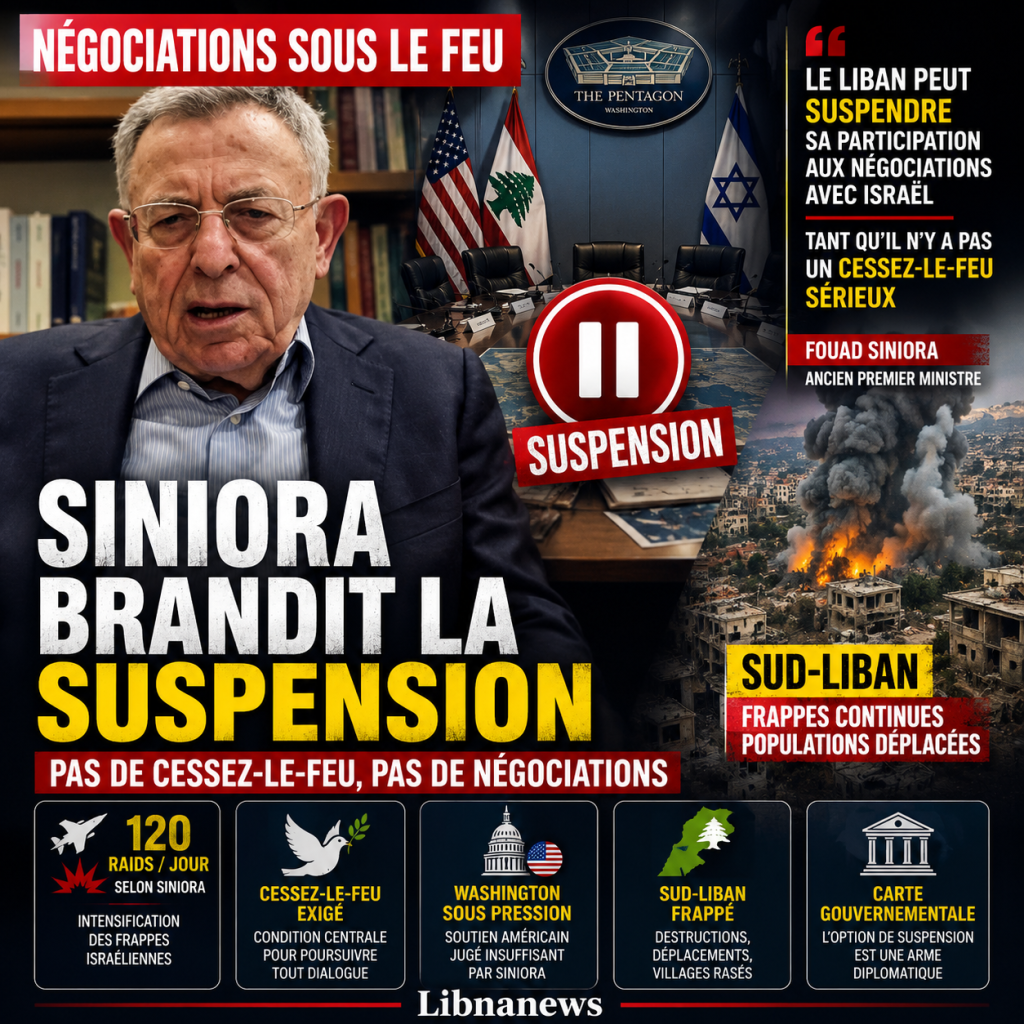
Former Prime Minister Fouad Siniora said on Friday, 29 May, that Lebanon could suspend its participation in negotiations with Israel until the latter made a serious commitment to a ceasefire. In an answer to an Al-Arabiya question, he presented the suspension as a political map at the disposal of the Lebanese government. His statement comes at a time when Washington is trying to maintain a channel of discussion between the two countries, as Israeli strikes continue and the Lebanese authorities call for more concrete guarantees.
Siniora evokes a diplomatic card
Fouad Siniora has placed responsibility for the decision in the hands of the state. The former head of government claimed that the Lebanese government has a means of pressure: to stop its participation in the negotiations with Israel until the latter actually respects the ceasefire. He did not present this option as a definitive break. He described it as a diplomatic instrument designed to obtain a more serious commitment to halting attacks.
This position comes in a sequence marked by increasing tension around discussions under American sponsorship. Lebanon has agreed to enter into a negotiating framework, including addressing Israeli withdrawal, stabilization of the South, the role of the Lebanese army and security assurances. But Lebanese officials reiterate that this approach cannot progress if military operations continue. Siniora takes up this idea by giving it a practical translation: the suspension of participation.
The former Prime Minister also criticized the attitude of the United States. According to him, Lebanon has made a political breakthrough, but Israel has not fulfilled its commitments. He added that Washington had not provided Lebanon with the real support necessary to continue the negotiation process. This remark refers to American mediation, which is the guarantor of an arrangement, but which several Lebanese officials consider insufficiently effective in containing Israeli strikes.
Siniora’s comments are part of a broader debate on the value of negotiations under fire. Some Lebanese officials consider that it is necessary to remain at the table to defend the interests of the country. Another believes that continued strikes reduce the scope of any dialogue. Siniora does not close the door to negotiation. He only said that Lebanon should not continue to participate without obtaining a verifiable ceasefire in return.
Lebanon-Israel negotiations: conditional participation
Fouad Siniora’s statement comes as the Lebanon-Israel negotiations have become one of the most sensitive issues in Lebanese political life. They take place in an American setting, with successive security and political aspects. The format aims to avoid uncontrolled escalation, consolidate a fragile truce and pave the way for a more lasting arrangement along the border. But this architecture remains contested until the land confirms diplomatic announcements.
For the former Prime Minister, Lebanese participation only makes sense if it allows for a result. It considered it possible for the government to withdraw from discussions to demand a serious cessation of hostilities. He described this as a healthy position if adopted by the government. Its reasoning is based on a simple idea: a state cannot be forced to discuss while its cities and villages are struck.
Siniora’s argument was based on the intensity of Israeli operations. He claimed that Israel is conducting more than 120 raids a day. This data, presented in his speech, aims to highlight the gap between diplomatic language and military reality. In this context, he said, the Lebanese Government cannot continue to participate in the negotiations as the shooting, destruction and death continue.
This position echoes a concern already expressed by other officials. The President of Parliament, Nabih Berri, also stressed the absolute priority of a real ceasefire. Government officials recalled that negotiations should first be used to stop attacks. The debate therefore focuses less on the existence of a diplomatic channel than on the minimum conditions for Lebanon to participate without appearing in a situation of weakness.
The government faces a difficult choice
The government of Nawaf Salam is facing a delicate equation. If he continues negotiations, he may be accused of accepting a dialogue under military pressure. If he suspends them, he may be accused of allowing a diplomatic window and depriving Lebanon of a space to defend its demands. Siniora’s proposal places this tension at the centre of public debate. It obliges the executive to define what it actually expects from American mediation.
The Lebanese official line is based on several requests. Beirut calls for the cessation of hostilities, the Israeli withdrawal, the return of the displaced, the cessation of destruction and the full restoration of State authority in its territory. The Lebanese army is expected to play a central role in this sequence, particularly in the South. But its action depends on a minimum of stability. Deployment under strikes would be politically and militarily difficult.
The executive also seeks to preserve internal unity. The Israeli case remains one of the most flammable in Lebanon. Hezbollah rejects normalization and is wary of direct discussions. On the contrary, its opponents call for the state to take over the decision of war and peace alone. Between these two poles, the government tries to maintain an institutional position. He wants to speak on behalf of Lebanon without opening an internal crisis that would further weaken his room for manoeuvre.
In this context, the suspension mentioned by Siniora can be read as a pressure to Washington as well as Israel. It does not necessarily mean abandoning the process. It can serve as a warning. Lebanon cannot remain indefinitely engaged in a diplomatic process if the other party continues to use force. The credibility of mediation therefore depends on its ability to produce a visible effect on the ground.
Washington called to prove its role as guarantor
Fouad Siniora’s criticism of the United States is one of the most prominent points in his speech. The former Prime Minister claims that Washington did not provide real support to Lebanon to allow it to continue negotiations. It thus targets the heart of the American device. The United States encouraged discussions and organized the schedule. They must now demonstrate that they can weigh on the Israeli side.
This request joins a shared question in Beirut. What is an American guarantee worth if it doesn’t stop the strikes? The question is being asked more and more strongly by people with different sensitivities. The Lebanese authorities know that Washington remains the most influential external actor in Israel. They therefore expect the United States more than facilitation of meetings. They expect political pressure to produce a real ceasefire.
The difficulty lies in the differing priorities of the parties. Israel presents its operations as a response to the threat posed by Hezbollah. Lebanon affirms that continued strikes violate its sovereignty and prevent stabilization. The United States is trying to build a framework that combines cessation of hostilities, strengthening of the Lebanese army and guarantees against renewed attacks from the South. But as long as the strikes continue, this construction remains fragile.
Siniora therefore introduces a requirement of reciprocity. Lebanon has accepted a step forward, he says. Israel must now commit itself. The United States must help Lebanon achieve this step. Without this, the continuation of the negotiations can give the impression that Beirut makes procedural concessions without security compensation. This perception would be politically costly for the government.
Ceasefire as a criterion of credibility
The concept of a ceasefire now occupies the centre of the Lebanese debate. The leaders no longer speak only of a de-escalation or truce. They call for a clear, serious and respected halt to operations. Siniora uses this distinction precisely. For him, the problem is not the holding of a meeting. It is due to the absence of a credible Israeli commitment to stop the fire.
This criterion is essential for people in the South. Displaced families do not judge the situation through international communiqués. They consider it possible to return to their homes, reopen shops, repair schools, cultivate land and move around without fear. A diplomatic process that does not change these realities remains abstract. Political pressure therefore increases as the terrain contradicts the stabilization discourse.
The ceasefire is also a condition for the Lebanese army. The military institution is regularly presented as the actor to regain control of the land south of the Litani. But it cannot fulfil this role if the areas concerned remain under permanent threat. Deployment requires political protection, physical means and operational visibility. A credible negotiation must therefore create this environment.
Siniora’s position finally refers to the legitimacy of the state. A negotiating government must be able to show that it protects its citizens or that it obtains guarantees to do so. If destruction continues, public opinion may perceive negotiation as an exercise without effect. The suspension proposed by the former Prime Minister aims to avoid this trap. It transforms Lebanese participation into a condition, not an automatic obligation.
A Declaration Beyond His Political Camp
Fouad Siniora belongs to a political generation associated with post-war governments and the 14 March camp. His positions have long been marked by strong criticism of Hezbollah and a commitment to the role of the central state. Yet his statement of 29 May is not limited to a classic partisan reading. On the specific point of the ceasefire, it joins the concerns expressed by officials of other political families.
This crossing does not mean complete convergence. Differences over Hezbollah, weapons, defence strategy and relationship with the United States remain deep. Siniora remains committed to the primacy of the state and the sovereign decision of the government. But it believes that the State must use the cards at its disposal. The suspension of negotiations, he said, was part of it if Israel refused to engage seriously.
This position can speak to a part of opinion that refuses both military escalation and negotiation without guarantees. It reflects an expectation of institutional firmness. Lebanon cannot simply suffer. It must formulate conditions, use its levers and remember that sovereignty is not being negotiated in an atmosphere of bombing. Siniora’s comments seek to give this firmness a diplomatic form, rather than a military response.
The declaration also comes at a time when several politicians are trying to prevent the external crisis from causing an internal divide. Discussions on negotiations with Israel, Hezbollah weapons and the American role can quickly polarize the country. Speaking of a government map, Siniora brings the decision back to the state. He doesn’t propose a faction reaction. It calls on the executive to act within its prerogatives.
South Lebanon in the centre of the event
The situation in South Lebanon gives these statements political weight. Border localities have been under military pressure for months, which has transformed daily life. Villages have been emptied. Houses were destroyed. Local infrastructure was damaged. Families live in temporary accommodation or with relatives. The already fragile local economy has been affected in its agricultural, commercial and educational activities.
In this context, the continuation of negotiations raises conflicting expectations. Some people hope that the American channel will finally put an end to the attacks. Others fear that the discussions will prolong an intermediate situation, where the war continues without being officially named as such. Siniora’s sentence on the possible suspension of negotiations reflects this impatience. She says diplomacy must produce protection, otherwise she loses her raison d’être.
The issue of the return of internally displaced persons also remained central. A serious ceasefire must pave the way for this return. It is intended to enable municipalities to identify damage, public services to resume, schools to reorganize and families to check the condition of their homes. Without a real stop to the strikes, these steps remain impossible. The Lebanese authorities cannot ask the inhabitants to return to areas still at risk.
The government will therefore need to link negotiations more clearly to measurable effects. This may include an immediate reduction in strikes, a cessation of operations in certain areas, a verification mechanism or a withdrawal schedule. The suspension mentioned by Siniora is just one tool among others. But it raises the question that many officials avoid saying openly: when does a negotiation become politically untenable?
Additional pressure before next step
Fouad Siniora’s statement adds a strong voice to the debate on Lebanese strategy. She’s not from a marginal actor. The former Prime Minister knows the diplomatic mechanisms and the constraints of the state. Its intervention makes the option of a framed suspension of negotiations more visible. It also gives the government an additional argument against mediators: the continuation of the process requires a concrete Israeli signal.
The Lebanese authorities will have to decide how to use this pressure. They can continue to participate while hardening their speech. They may condition their presence to written commitments. They may ask the United States to produce public guarantees. They may also temporarily suspend their participation if the strikes continue at the same rate. Each choice has a cost, but there is also one inaction.
The debate should continue as the diplomatic calendar moves forward. The discussions announced in Washington, the positions taken by Lebanese officials and the military evolution in the South will form a single dossier. Siniora recalled that Lebanon has a map. It remains to be seen whether the government will choose to brandish it, use it or keep it in reserve while the mediators are still trying to obtain a ceasefire that can be seen in villages, on roads and at southern crossing points.




