

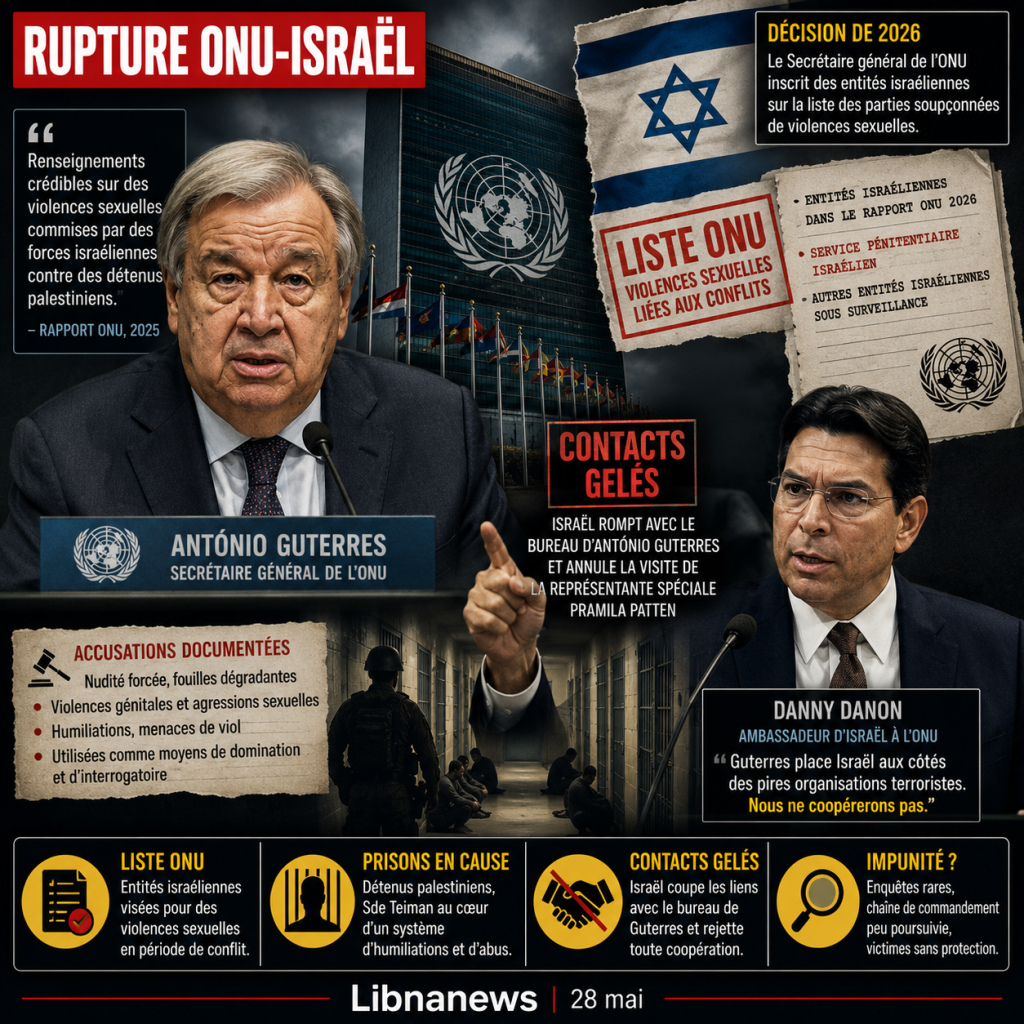
The Israeli government chose the break with António Guterres as the United Nations prepares to list Israeli entities on the list of parties suspected of conflict-related sexual violence. The decision, announced by the Israeli Ambassador to UN Danny Danon, is to freeze contacts with the Secretary-General’s office and cancel a planned visit by the Special Representative on Sexual Violence in Time of War. Israel talks about a political decision and a damage to its reputation. The gesture, however, is less like a legal defence than a diplomatic sanction against the institution, which now documents abuses long denounced by NGOs, Palestinian detainees, doctors and independent experts.
The case marks a new level in the confrontation between Israel and the United Nations. Since October 2023, Benjamin Netanyahu’s government has regularly accused United Nations agencies of partiality, hostility and complacency with its enemies. The United Nations, for its part, is accumulating reports on Gaza, massive detentions, deprivation of aid, attacks on civilian infrastructure and Palestinian detention conditions. The current controversy is about a particularly sensitive issue: sexual and gender violence. It is not just about isolated excesses. She questioned the existence of a system of detention where corporal humiliation, forced nakedness, degrading searches, genital violence and sexual assault were allegedly used as means of domination, punishment or interrogation.
Israel presents the listing as a step in the same direction with Hamas, ISIS and other armed groups. This line of defence is effective in the Israeli media space, as it moves the discussion of the content of the accusations towards moral indignation. But the Secretary-General’s list is not intended to compare ideologies or crimes in their entirety. She pointed out that the United Nations believed that there were credible elements on patterns of sexual violence in conflict. This framework does not absolve Hamas, already targeted for the crimes of 7 October and violence against hostages. Nor does it exempt Israel from responding to accusations against its own forces and prison system.
The heart of the case concerns the Israeli prison administration. According to reports from the Israeli press, the prison service must be included in the 2026 list, while other Israeli authorities are included in a monitoring framework that may lead to subsequent inclusion. This distinction is important. She suggested that the United Nations should not be content with a single incident. It observes an institutional chain, from mass arrests to prisons, detention centres, interrogations and military bases. The possible liability is therefore not limited to the soldier filmed, the guard denounced or the interrogator accused. It refers to the organisation, supervision and control mechanisms.
A diplomatic breakdown rather than a judicial response
The freezing of relations with the Guterres office is a political response to a legal and humanitarian charge. Israel claims to have cooperated with the United Nations, provided documents and provided explanations. He also claims that the Secretary-General would have ignored these elements. But by suspending contacts, Israel reduces the channels through which it could challenge, document or correct UN conclusions. This strategy has a paradoxical effect. It feeds the idea that the Israeli state prefers to delegitimize the messenger rather than allow an independent and lasting review of the allegations.
The cancellation of Pramila Patten’s visit reinforces this impression. An on-site visit could have been used to compare testimonies, review procedures, verify access to detainees and interview the responsible authorities. By blocking it, Israel deprives the UN investigation of an official exchange channel and gives arguments to those who denounce a policy of opacity. On such a serious case, access to places of detention, medical records, released detainees, lawyers and surveillance records is central. Without full access, the word of the state quickly becomes a simple denial.
This sequence extends a warning formulated in 2025. António Guterres had then placed Israel « on notice » of credible reports of sexual violence by members of the Israeli armed and security forces against detained Palestinians. The report referred to specific forms: genital violence, prolonged forced nudity, repeated and degrading searches, used in conditions of humiliation or interrogation. Israel rejected these concerns as unfounded. The 2026 decision shows that the United Nations does not consider that it has received sufficient responses, including on liability measures.
Impunity appears as the red thread of the case. Human rights organisations have been reminding for years that prosecutions against Israeli soldiers or agents accused of violence against Palestinians remain rare. Where investigations exist, they often focus on individual cases and struggle to move up the chain of command. In cases of sexual violence, this limit is even more serious. Victims fear reprisals, stigmatization and lack of protection. Medical evidence can disappear. Detainees may remain without a lawyer, family visit and access to independent observers.
Charges against Israel: prisons, bases and humiliations
The most documented accusations concern Palestinians arrested in Gaza, the West Bank or East Jerusalem since the beginning of the war. Many detainees described beatings, painful positions, sleep deprivation, threats of rape, sexual insults, bare searches, beatings on genitals and attacks in closed places. Several testimonies also refer to the use of dogs to terrorize or humiliate prisoners. The Israeli authorities contest the generalizations and claim to act in accordance with the law. But the accumulation of stories, medical reports and images has changed the threshold of international debate.
The base of Sde Teiman became one of the symbols of this drift. In July 2024, Israeli soldiers were arrested after charges of serious abuse against a Palestinian detainee. Press reports referred to very severe injuries, particularly to the rectum, as well as attacks that endanger the life of the detainee. The case provoked a revealing scene: far right activists and politicians defended suspected soldiers and forced the entry of military sites to protest against their arrest. That moment sent a disturbing message. Part of the Israeli political class seemed more concerned about the protection of suspects than about the fact-finding.
The Sde Teiman scandal was not only shocked by the alleged violence. It revealed the trivialization of a speech in which Palestinian detainees were deprived of moral and legal protection. Israeli ministers or elected officials presented the soldiers as combatants carrying out a sacred mission. Others denounced the investigation itself as an attack on the army. This political reaction weighs heavily in the analysis of the accusations. A system that intimidates investigators, glorifies suspects and humiliates victims creates the conditions for repetition. The law could not function if national loyalty was used to neutralize complaints of torture.
Israeli NGOs have also documented a profound transformation of the prison system. Since October 2023, several reports have described prisons converted into permanent punishment spaces, with food restrictions, physical violence, isolation, lack of care and systematic humiliation. There are reports of sexual violence committed away from the cameras during transfers or searches. These stories are not just from Palestinian sources. They also come from Israeli organizations that have been working for years on the rights of detainees and are familiar with the mechanisms of military and prison justice.
The Israeli Defense and its Dead Angles
Israel’s official defence is based on several arguments. The first is to recall the sexual crimes committed during the 7 October attack and against hostages held in Gaza. These crimes must be recognized, documented and prosecuted. They cannot be minimized. But their existence does not give Israel a right to impunity. International law does not function through moral compensation. Hamas’ atrocity does not allow the torture of a Palestinian detainee. Taking hostages does not justify a policy of forced nudity, humiliating searches or sexual assault in prisons.
The second argument is to talk about a political campaign against Israel. This criticism is not new. It accompanies almost every UN report on Gaza, settlements or detentions. But it becomes insufficient when the charges are based on consistent testimony, medical documents, videos and reports from a variety of sources. The question is not whether the UN is perfect. It is a question of whether Israel accepts that a State, even allied with Western powers, should be subject to the same standards as others. The answer given by the freezing of relations with Guterres is worrying.
The third argument states that Israel has a judicial system capable of investigating. This is precisely what many organizations are challenging. They denounce slow, limited, untransparent and rarely followed by proportionate convictions. Sde Teiman’s case reinforced this criticism. Where charges are dropped or reduced despite serious elements, victims and their families do not see a rule of law in action. They see a device that protects its agents. It is this perception that the United Nations inscription devotes to the international level.
It should also be recalled that sexual violence in detention is not limited to rape. International law includes acts such as forced nudity, degrading searches, sexual threats, attacks on genitals, attacks with objects, sexualized insults and public humiliation. This clarification is necessary, as accused governments often seek to narrow the debate to the most extreme. However, the United Nations is examining patterns. If humiliating practices are repeated in several places, by several units, with institutional tolerance, they can form a system of sexual and gender violence.
A credibility crisis for Israel
The inclusion of Israeli entities on the UN list is taking place in a broader context of a credibility crisis. Israel was already facing proceedings before international courts, accusations of war crimes, criticism of the famine in Gaza, destruction of civilian infrastructure and attacks on hospitals. The issue of sexual violence adds an even more devastating dimension to his image. It reaches the story of a disciplined army and a state committed to democratic norms. It exposes the contrast between the language of security and the practices denounced in places where external eyes do not penetrate.
The reaction of Ambassador Danny Danon illustrates this crisis. By accusing Guterres of placing Israel alongside the « worst terrorist organizations », he sought to turn a human rights alert into a trial against the UN. This strategy can mobilize Israeli opinion and some of the traditional allies. It does not respond to detainees who claim to have been naked, beaten or assaulted. It does not respond to physicians who describe injuries consistent with abuse. It does not respond to Israeli NGOs talking about prisons becoming torture camps. It also does not respond to experts calling for independent access to places of detention.
The decision to cut ties with the Secretary-General’s office may exacerbate Israel’s diplomatic isolation. It adds to the open war against UNRWA, attacks on special rapporteurs, accusations against the International Criminal Court and repeated refusals to cooperate fully with certain commissions of inquiry. Israel’s rejection of the monitoring mechanisms gives the image of a State that wants to choose its judges, investigators and evidence. In a war where Palestinian civilians pay a massive price, this attitude feeds global distrust.
Lebanese precedent and regional reading
In Lebanon, this decision will be read through an already very critical grid of Israel. The bombings in southern Lebanon, the strikes on the southern suburbs of Beirut, the forced displacements and the destruction of villages established the idea of a military power with broad western protection. The case of sexual violence confirms, for some Lebanese opinion, that the problem is not limited to the military front. It touches on a deeper mode of domination, where Palestinian and Arab life is made vulnerable, controllable and sometimes negable.
The regional dimension is essential. The charges against Israel do not concern only Gaza or prisons. They fuel wider anger in Arab societies, already marked by images of destruction, famine, displaced families and prisoners released in an alarming physical state. They make it more difficult for normalization discourses that separate Israel’s security from Palestinian dignity. A diplomatic agreement may be signed between Governments. He can’t erase prison stories, Sde Teiman’s images or reports on sexual humiliation.
Western states are also faced with their contradictions. Many have strongly condemned the sexual violence attributed to Hamas, rightly. They must apply the same requirement when accusations are made against Israel. But the Western reaction often remains cautious, slow or euphemized. This asymmetry weakens the universality of international law. It gives the impression that Palestinian victims must bring more evidence, wait longer and endure more denials to obtain minimum recognition. It is precisely this double standard that the United Nations is trying to overcome by the logic of the lists.
The stakes therefore go beyond Guterres’ personal fate. It concerns the ability of the United Nations to name serious violations even when the State concerned has powerful allies. It also concerns Israel’s ability to accept an independent investigation without reducing it to an anti-Semitic attack or political manoeuvre. Sexual crimes of 7 October must remain in the judicial and historical record. The alleged sexual violence against Palestinians must enter with the same rigour. Justice cannot work if each camp requires the exclusive recognition of its victims.
The next step will be the full publication of the Secretary-General’s annual report and the precise wording of the annex. It will provide information on which Israeli entities are officially registered, which others remain under surveillance and what measures the United Nations expects from Israel. The Israeli government can keep the break with Guterres and continue to denounce a cabal. It may also choose to open prisons, allow independent visits, publish internal investigations and prosecute those responsible. For now, he has chosen confrontation, at the very moment when accusations call for transparency.




