

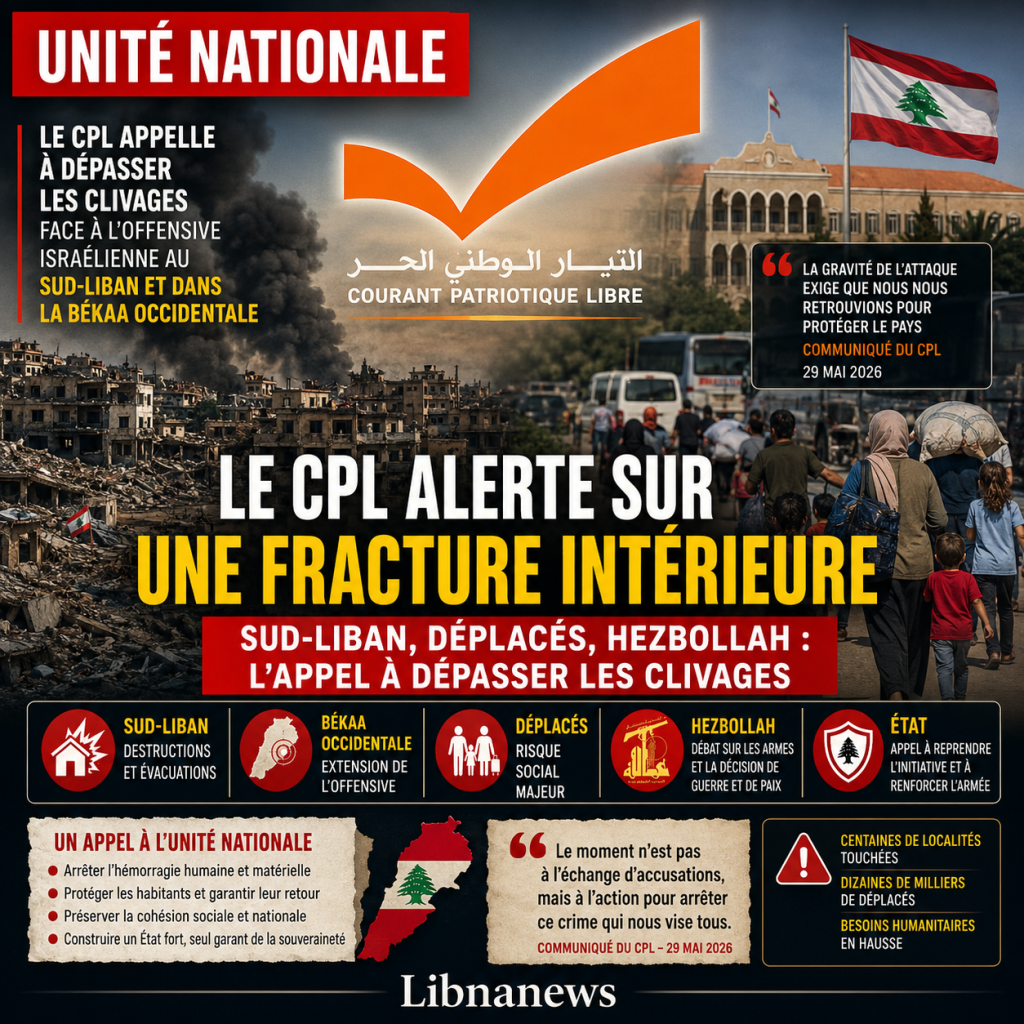
On Friday, 29 May, the Free Patriotic Movement called for a national political mobilization against the expansion of the Israeli offensive in southern Lebanon and in Western Bekaa. In a statement released in the morning, the formation founded by Michel Aoun asserts that the magnitude of the attack requires overcoming internal controversies, while maintaining the debate on Hezbollah’s weapons, the decision of war and peace and the role of the State. This is taking place in a climate marked by new strikes, massive population displacements and increased pressure on the Lebanese authorities, while security discussions are expected in Washington.
CPL alerts South Lebanon
The communiqué of the Free Patriotic Movement marks a change of registry in the Lebanese political debate. The party is not limited to condemning Israeli strikes. He describes an offensive that, in his view, no longer targets military objectives related to Hezbollah. It refers to attacks on inhabitants, land, resources, the environment and heritage. The formula gives the text a wider scope. It places the crisis in southern Lebanon in a national perspective, not just in the context of the confrontation between Israel and Hezbollah.
The CPL accuses Israel of committing « serial crimes » against people, homes and the environment in the South and Western Bekaa. He claims that the levelling of villages constitutes a form of « urban extermination » intended to tear the life of the South out and, perhaps, to prepare for a sustainable takeover of the area. The vocabulary is unusually hard for a party that, since the breakdown of its political agreement with Hezbollah, also insists on the restoration of state authority and the monopoly of sovereign decision-making.
This conviction is part of a time when the situation on the ground is affecting all Lebanese officials. Israeli operations continued despite the announcements of truce or de-escalation. Several localities in the South continue to be subject to evacuation orders, housing destruction and population movements to Tyre, Saida, Nabatiyah, Beirut and other areas. The CPL thus seeks to recall that the political debate cannot ignore the human and territorial dimension of war.
An alert about the displacement of the inhabitants
The press release insists on the displacement of the inhabitants of Jabal Amel. This expression refers to the historical and social depth of the Shiite South, beyond the administrative vocabulary of the cazas and governorates. The CPL states that the exodus of hundreds of thousands of people risks causing a social and denominational crisis in the host regions. The party stresses that Lebanon, already politically fragmented and economically weakened, does not have the necessary means to absorb such a shock in a sustainable manner.
The last few months have confirmed this fragility. Displaced families live in schools, collective centres, rented housing, family homes or improvised shelters. Pressure affects municipalities, associations, hospitals, schools and local public services. It adds to a prolonged economic crisis, the collapse of incomes, difficulties in financing the State and the depletion of humanitarian capacity. In this context, any massive displacement can quickly turn into a national crisis.
The CPL also warns against a political consequence of displacement. A uprooted population, hosted in already tried and tested areas, can become subject to local tensions, confessional discourse and partisan rivalries. The party does not say that this crisis has already broken out. He claims that the risk exists if the State fails to organise the reception, protection and return of the inhabitants. This distinction is important. It makes it possible to transform a political alert into a call for national coordination.
The displacement of people from the South is not just a matter of urgency. It also commits people to their territory. Border villages are linked to family, agricultural, religious and economic networks. Their prolonged emptying can alter local balances. The CPL reiterates this concern by talking about a project that aims to uproot the life of the South. This reading joins an ancient fear in Lebanon: that of a war that not only destroys buildings, but that permanently moves communities.
Party maintains disagreements over Hezbollah
The Free Patriotic Current text does not erase internal differences. It explicitly recalls that the Lebanese remain divided on major strategic choices, on conflict management, on Hezbollah weapons and on the decision of war and peace. The party states that these questions cannot be avoided or silenced. This sentence distinguishes the release from a simple declaration of unity. The CPL calls for a rally against the offensive, but does not give up its positions on the state.
This nuance is central to the party’s recent trajectory. The CPL has long been linked to Hezbollah by a political agreement signed in 2006. This agreement has structured part of Lebanese political life for more than fifteen years. It has weakened with institutional crises, disagreements over the presidency, Gebran Bassil’s criticism of state paralysis and differences over Hezbollah’s national responsibility. Since then, the party has tried to maintain a difficult line: to refuse Israeli aggression, without automatically placing itself behind Hezbollah’s military choices.
The press release of 29 May reflects this position. It does not repeat Hezbollah’s discourse on war as the only way of protection. Nor does it join the formations that place first the responsibility for the conflict on the arsenal of the Shiite party. He claims that the State must regain its legal institutions, sovereign responsibilities and defensive capabilities. But he adds that the gravity of the current offensive requires that the logic of the cross accusations be suspended. The message is therefore addressed to several audiences.
For Hezbollah and its allies, the CPL means that the denunciation of the Israeli attack remains necessary. For Hezbollah’s opponents, he recalls that the debate on arms and sovereignty remains legitimate. For the institutions, he asked for a collective response. This position seeks to avoid two pitfalls: unconditional alignment with Hezbollah and indifference to southern destruction. In this way, the party is trying to reoccupy a national space that is increasingly narrowed by polarization.
The State to resume the initiative
The communiqué states that the construction of a capable State remains a common national demand. This formula directly addresses the Lebanese sovereignty crisis. The country is facing a war on its territory, but it does not control the conditions of escalation or de-escalation alone. Israeli military decisions, Hezbollah calculations, American mediations, regional balances and discussions with Iran all weigh on the situation. In this environment, the Lebanese State is trying to preserve a margin of action.
President Joseph Aoun and the government of Nawaf Salam defend an institution-centred line. They want the Lebanese army, diplomacy and official channels to carry the country’s position. This line aims to achieve an effective ceasefire, an Israeli withdrawal, the return of internally displaced persons and an enhanced role for the military in the South. It is part of Security Council resolution 1701, which remains the international reference for security along the border.
The CPL reiterates part of this logic, while stressing the urgency. The party does not detail a military or diplomatic plan. It first calls for a political meeting and a common search for ways to protect the country. Its call to « get together » can be aimed at a national meeting, parliamentary coordination or dialogue between the main forces. The precise content is not fixed. The immediate objective is to create a minimum political front against what the party describes as an existential threat.
This demand, however, faces the fragmentation of the Lebanese system. The parties differ on the responsibilities of the war, on negotiations with Israel, on the role of the United States, on the place of Hezbollah and on the capacity of the army. A declaration of unity is not enough to resolve these disagreements. But the CPL is trying to move the center of gravity of the debate. He claims that the ongoing disaster requires a joint effort, even between political opponents.
A debate revived by the Washington sequence
The CPL’s position was taken as Washington tried to maintain a process of security discussions between Lebanese and Israeli representatives, with American facilitation. The expected appointment at the Pentagon must be followed, according to the announced timetable, by a political component. For the US authorities, this method must transform a fragile truce into a more lasting arrangement. For Beirut, it represents both an opportunity and a risk.
The opportunity lies in the possibility of obtaining guarantees, an Israeli withdrawal and a clearer halt to the strikes. The risk lies in the perception of negotiations under military pressure, while the southern and western Bekaa communities remain affected. Several Lebanese officials also fear that the security issue will serve to demand first concessions on Hezbollah, without immediate guarantees for civilian populations. The CPL statement is inserted into this tension.
The party does not mention the Washington table directly in the text. But his call for national unity comes at a time when the discussions in Beirut are sparking intense debate. The President of Parliament, Nabih Berri, also stressed the absolute priority of a ceasefire. Hezbollah rejects any direct negotiations with Israel. Other political forces argue that the State should occupy the available diplomatic space, otherwise Lebanon would be in danger of being subjected to arrangements decided without it.
In this configuration, the PLC tries to defend an institutional line of caution. He does not want to abandon the idea of a sovereign state. Nor does he want to seem insensitive to the extent of destruction. His statement therefore seeks to dissociate two periods: the time of immediate protection of the country and the time of the internal political settlement. The party claims that disagreements will have to be addressed, but not at the cost of paralysis in front of the offensive.
The territorial dimension of destruction
The most significant passage in the communiqué concerns the « uprooting » of the South. The CPL is not just about victims or material losses. It refers to the destruction of villages as an attack on the continuity of local life. This formulation refers to now recurring images: dynamited houses, empty entire neighbourhoods, cut roads, abandoned fields, closed shops, unusable schools and families who do not know when they will be able to return.
The question of heritage adds another dimension. South Lebanon and Western Bekaa include archaeological sites, memorial sites, religious buildings, agricultural landscapes and ancient villages. When fighting in these areas, losses are not limited to modern infrastructure. They also affect collective benchmarks. The CPL communiqué mentions « antiquities » and resources, a sign that it seeks to broaden the debate to the protection of the territory in all its dimensions.
This insistence also serves a political purpose. Speaking of the South as a national space, the party avoids reducing the region to its denominational colour or the influence of Hezbollah. It implicitly recalls that Jabal Amel is part of Lebanese identity and that its destruction concerns the entire country. This approach can target a Christian public, sometimes further away from the South War, but also political forces that accuse Hezbollah of having isolated the region through its military choices.
In this way, the CPL calls for greater solidarity. The South must not be left to its fate because it is associated with Hezbollah. Criticisms of the Shiite party’s weapons should not lead to trivialization of destruction. Conversely, solidarity with the inhabitants should not prevent discussion of the state and sovereignty. The press release places these two requirements in the same text, without seeking to solve them entirely.
A call to unity without removing responsibilities
The CPL concludes its statement by stating that the moment is not at the exchange of charges, but at the action to arrest what it calls a crime. He added that all Lebanese were targeted and all responsible. This formula seeks to produce an emergency effect. It aims to cut short the partisan reflexes that often dominate Lebanese political life. The party recalls that the current danger goes beyond the usual divisions.
This appeal does not mean a political amnesty. The text states that major national issues remain open. The CPL knows that the debate on Hezbollah’s weapons will come back immediately as soon as military pressure drops. He also knows that several parties will continue to accuse the Shiite movement of exposing the country. But he believes that the magnitude of the attack imposes a different sequence. First limit damage, organize protection and prevent social collapse. Then resume discussions on the national strategy.
This distinction corresponds to a Lebanese reality. The country cannot conduct a calm discussion on national defence while villages empty and families seek shelter. Nor can it ignore indefinitely the question of the decision of war and peace. The CPL communiqué attempts to maintain these two levels together. He wants to make unity a tool of protection, not a pretext to push back sovereignty issues.
The next few days will tell if this call is echoed. The Lebanese parties remain divided. The people of the South expect concrete guarantees. The US talks are moving forward in a tense climate. The Lebanese army remains at the centre of expectations, without having the means to resolve the crisis alone. The CPL communiqué adds political pressure on those responsible: building a common response before displacement, destruction and local tensions turn the South War into a deeper internal divide.




