

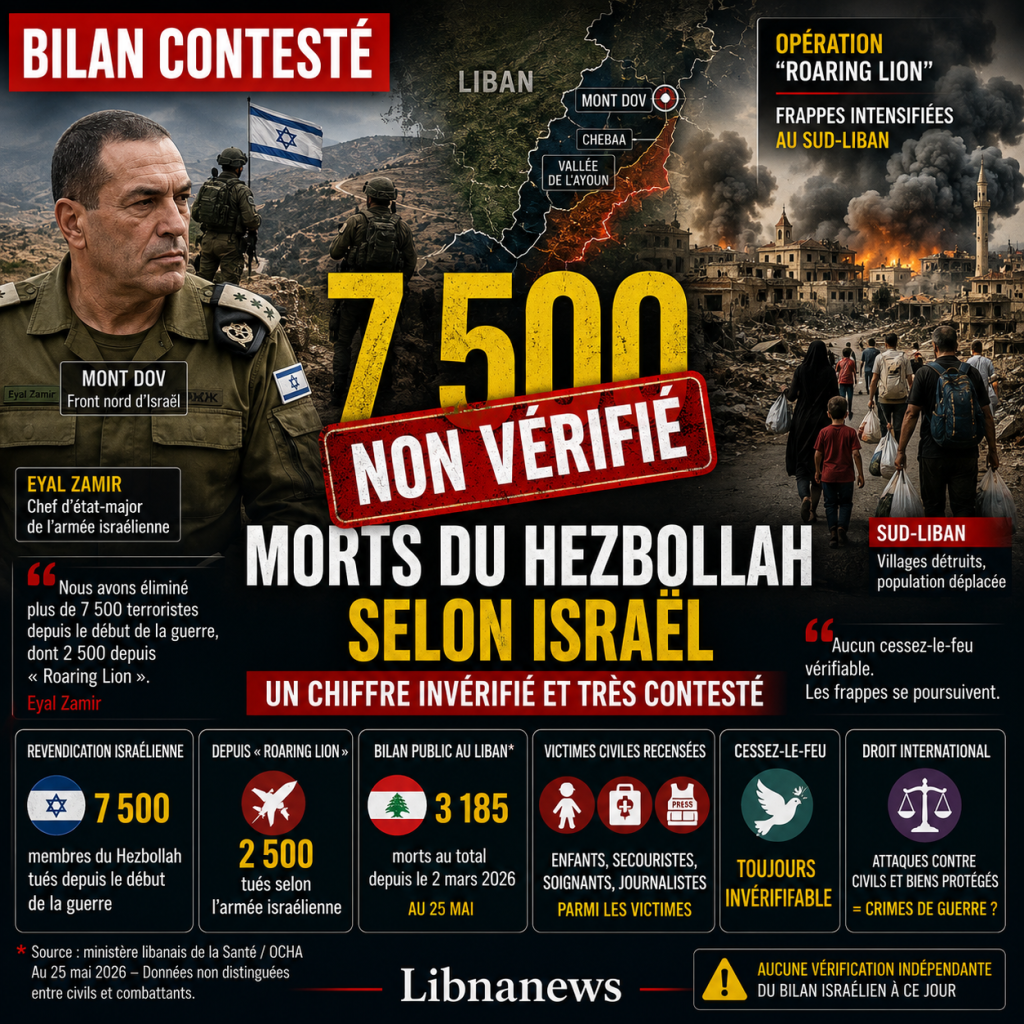
The Israeli Chief of Staff, Lieutenant-General Eyal Zamir, said on Friday 29 May that the Israeli army had killed more than 7,500 Hezbollah members since the beginning of the war, including 2,500 since the launch of Operation Roaring Lion. This announcement, made during a tour of Israeli positions in the area of Mount Dov, comes at a time when Israel is stepping up its strikes in southern Lebanon and discussions under US facilitation remain weakened by the absence of a verifiable ceasefire. The figure advanced by the Israeli army was not independently confirmed. It also seems very difficult to reconcile with the public records available in Lebanon, which show a significantly lower total number of deaths, including civilians, children, first aid workers, caregivers and journalists.
A military announcement in a moment of escalation
The Israeli communiqué describes Eyal Zamir’s visit as an operational assessment conducted on the northern front. The Chief of Staff visited Israeli soldiers with the commander of the Northern Command, General Rafi Milo, and several senior officers. The area of Mount Dov, close to the Shab`a farms and the occupied Golan, dominates sensitive areas of southern Lebanon. It offers observation points on the Ayoun Valley and the ridges to the north and west.
Eyal Zamir described a campaign to inflict lasting damage on Hezbollah. He claimed that the Shiite movement had suffered « significant » and « unprecedented » losses, with thousands of fighters killed, including senior and middle-ranking officials. The Israeli army assures itself that it wants to continue the strikes wherever it identifies a threat. The Chief of Staff also referred to ground operations, advances in new areas and the pursuit of targets deemed essential.
The message is not just about Hezbollah. It is also intended for the Israeli public, northern Israelis, Iran and international mediators. Israel wants to show that the offensive produces measurable effects. He also wants to justify the pursuit of freedom of military action in Lebanon, despite calls for a cessation of hostilities. By claiming 7,500 dead in the Hezbollah ranks, the army builds a story of operational superiority and progressive wear and tear of its opponent.
This communication is entering a phase in which Israeli strikes have expanded. In recent days, raids have targeted southern Lebanon, the Bekaa, the Tyre region, areas near Saida and areas close to Beirut. The Israeli authorities claim to be targeting Hezbollah infrastructure. The Lebanese authorities denounce attacks on civilian areas, cause massive displacement and jeopardize any serious discussion of a ceasefire.
Hezbollah: an unverifiable Israeli record
The figure of 7,500 Hezbollah members killed must be treated as an Israeli military claim. No independent body confirmed this assessment. Hezbollah does not publish a comparable global count of its losses. He announces some deaths, including at funerals or local press releases, but does not necessarily provide a complete picture of his killed, injured or missing personnel. This opacity makes any external verification very difficult.
Armed forces engaged in conflicts often produce their own records of killed enemy fighters. These figures are based on internal intelligence, aerial images, interceptions, field observations or post-strike assessments. These elements are not always made public. They may be accurate in some cases and approximate in others. They can also integrate people whose armed membership is not publicly demonstrated.
Israeli vocabulary adds a difficulty. The army speaks of « terrorists » eliminated. In journalistic treatment, it should be noted that, according to Israel, they are members or fighters of Hezbollah. Nuance is essential. It distinguishes the established fact, i.e. the statement of the Israeli army, from the statement it contains, which depends on data not available to the public. It also avoids the use of war terminology without distance.
If it were true, such a balance sheet would represent a major shock for Hezbollah. It would affect its field units, local command, drone specialists, anti-tank operators, rocket teams and surveillance networks. But even a high balance sheet is not enough to measure the real capacity of movement. Hezbollah has a decentralized structure, a political and social apparatus, human reserves and reconstruction experience from previous conflicts.
A figure that seems greatly exaggerated
The Israeli balance sheet seems all the more suspicious as it far exceeds the public balance sheets available in Lebanon. According to humanitarian data transmitted by the United Nations from the Lebanese Ministry of Health, 3 185 people had been killed since 2 March 2026, including 276 women and 217 children, by 25 May. This total includes all the deaths recorded in the period, without publicly making a comprehensive distinction between civilians, combatants and members affiliated with armed groups.
This comparison requires great caution. If Israel claims to have killed more than 7,500 Hezbollah members, this number is more than double the total number of deaths reported by the Lebanese health authorities in the same sequence. In order for the Israeli figure to be accurate, it would be necessary to assume the existence of a separate, unpublished military count, much higher than the available hospital and administrative figures. It should also be explained how these losses were recorded outside the public health, relief, funeral and census channels.
Another hypothesis would be an extremely broad counting method. People killed in strikes could be classified as Hezbollah members on the basis of unpublished Israeli intelligence, geographical proximity to targeted objectives or alleged membership of civil, social or political structures linked to the movement. Without detailed evidence, this method cannot be validated. It paves the way for military inflation.
The figure of 7,500 must therefore be read as an element of communication war. Israel seeks to demonstrate the extent of the losses inflicted on Hezbollah. Hezbollah, for its part, has an interest in minimizing its losses and demonstrating that it retains its operational capabilities. Lebanon, finally, highlights the human and civilian cost of the offensive. Between these competing accounts, no independent body established that 7,500 Hezbollah fighters had been killed.
Public balance sheets mainly show a heavy civilian cost
The results available in Lebanon give a different picture of the war. They reveal a significant number of deaths and injuries among civilians and protected personnel. News agencies and international organizations have reported deaths of children, first aid workers, caregivers and journalists since the beginning of the escalation. These categories do not sum up all victims, but they remind that strikes do not only affect combatants.
Children pay a particularly heavy price. UNICEF reported that dozens of children had been killed since the ceasefire came into effect and that child victims had increased in recent strikes. Public humanitarian data already reported 217 children killed since 2 March. These figures contradict the image of a campaign strictly directed against combatants. They show that families, houses, roads, shelters and inhabited neighbourhoods are within the direct radius of the war.
The health sector is also affected. Strikes killed paramedics and paramedics in southern Lebanon. Hospitals and health centres were damaged. The World Health Organization has documented attacks on health structures since the ceasefire. These facts are legally serious. Medical personnel, ambulances, hospitals and care centres are specially protected under international humanitarian law. Their intentional targeting may constitute a war crime.
Journalists are also among the victims. Lebanese reporters and cameramen were killed or injured in Israeli strikes, according to press organizations and news agencies. Several cases have led to accusations of targeting or attacks against teams identified as journalists. The status of the media does not disappear because of the political affiliation of a channel or employer. Under international law, civilian journalists are protected as long as they are not directly involved in hostilities.
Charges of war crimes already documented
The issue of war crimes does not depend solely on the assessment made by Israel. It is based on the facts established during each attack. International humanitarian law requires the parties to distinguish combatants from civilians and military objectives from civilian property. It prohibits indiscriminate attacks. It also prohibits disproportionate attacks, when foreseeable civilian casualties are excessive in relation to the expected concrete military advantage.
Strikes against rescuers, journalists, children, schools, places of worship or civilian infrastructure therefore raise major legal issues. If an ambulance is targeted while assisting the injured, if a team of journalists is hit when it is identifiable, or if a house is bombed without a verifiable military objective, the facts can lead to serious violations. The classification of war crime requires, however, a competent investigation, material evidence, testimony and analysis of the intent or negligence of military officials.
Several human rights organizations have already documented in previous phases of the conflict Israeli strikes in Lebanon that killed civilians or damaged vital infrastructure. Journalistic investigations have also found Israeli fire on journalists in Lebanese territory. These precedents reinforce the requirement of independent verification. They are not enough to automatically qualify each new strike, but they set a context of serious concern.
In the current sequence, accusations multiply because apparent civilian targets are repeated. The public reviews mention children, first aid workers and journalists. Images show schools, places of worship and heritage sites on display. Whole localities are emptying under evacuation orders and bombardments. This accumulation requires systematic documentation, far from military communiqués alone.
Mount Dov, a military and symbolic scene
The choice of Mount Dov as a place of declaration is not neutral. The area has for years been concentrating tensions related to the Shab’a farms, the occupied Golan and the presence of Hezbollah in southern Lebanon. For Israel, it is part of the defence of the northern front. For Hezbollah, it remains linked to the question of the occupied territories and to the justification of the armed struggle. Each military declaration in this area therefore has political value.
Eyal Zamir presented the advanced defence line as a support point for new operations. This formula means that Israel is not limited to a defensive posture. The army intends to retain the ability to enter, strike and manoeuvre in areas where it considers that a threat exists. It thus assumes a doctrine of preventive and offensive action beyond the recognized border.
For Lebanon, this logic poses a sovereignty problem. The Lebanese government is calling for the cessation of violations, the Israeli withdrawal and the return to a security framework in which the Lebanese army would have a central role in the South. But the Israeli declaration shows that Tel Aviv does not plan to reduce its short-term freedom of action. It suggests that diplomatic discussions will not suspend military operations.
This contradiction undermines negotiations. Washington is trying to maintain a security and political agenda. Beirut calls for a serious ceasefire. Israel has a strategy to expand military achievements. In this context, every Israeli offensive announcement feeds Lebanese officials who advocate a suspension of participation in the discussions as long as the strikes continue.
Drones, a sign of a persistent threat
The Israeli communiqué also contains a confession of difficulty. Eyal Zamir acknowledged that the threat of drones was an important challenge for the Israeli army. He said that operational and technological solutions were being developed and integrated. This part of the speech nuances the message of victory. If Hezbollah had been as deeply neutralized as the announced record suggests, the threat of drones would not remain as central to Israeli concerns.
The drones used in the conflict have changed the tactical balance. They can target military positions, bypass defences, fly at low altitudes, and place constant pressure on soldiers. Simple, low-cost or locally modified aircraft require modern armies to mobilize expensive means of detection and interception. For Israel, this threat affects both its troops and northern communities.
The Chief of Staff promised to pursue the launch teams, their operators and their commanders. This announcement provides for further targeted strikes against Hizbullah mobile units. It confirms that the Israeli campaign is not limited to weapons depots or fixed infrastructure. It also targets human chains for rocket fire, drone attacks and observation operations.
The persistence of these capabilities raises a question. How can a record of 7,500 deaths be reconciled with Hezbollah’s ability to maintain pressure by drones, rockets and fire against Israeli forces? The Israeli response is that the movement remains dangerous despite its losses. Another reading is to see in the above figure an overestimation intended to reinforce the narrative of military efficiency.
Beirut facing the trap of negotiations under fire
The Israeli declaration comes at a time when Lebanon is debating further discussions with Israel under American mediation. Several Lebanese officials believe that participation in the negotiations becomes politically difficult as the strikes continue. Former Prime Minister Fouad Siniora mentioned the possibility for the government to suspend its participation in order to demand a serious ceasefire. Speaker Nabih Berri also stressed the need for a real cessation of hostilities.
Eyal Zamir’s statement gives arguments to those who refuse to negotiate under military pressure. He claims the continuation of strikes, the expansion of gains and the search for new targets. It does not give the signal of immediate de-escalation. For Beirut, this posture complicates the defence of the diplomatic process. How to present a negotiation as useful if the other party publicly announces that it will continue to strike and manoeuvre?
However, the Lebanese Government must maintain a diplomatic margin. To participate in the discussions, Lebanon’s demands can be formally addressed: ceasefire, Israeli withdrawal, return of internally displaced persons, protection of civilians and the strengthened role of the Lebanese army. But staying at the table without getting any visible result exposes the executive to the impotence charge. American mediation will therefore be judged on its ability to produce concrete change on the ground.
Washington is thus placed before a contradiction. The United States wants to promote security arrangements in southern Lebanon. But Israel, the main American ally in the region, has a strategy of intensification. If this strategy continues, the negotiation process may become an empty framework, used to manage diplomatic reactions while the war continues.
A war of numbers and stories
The record of 7,500 deaths attributed to Hezbollah belongs to a war of numbers. Each camp selects the data that reinforces its narrative. Israel highlights the losses inflicted on the Shiite movement. Hezbollah highlights the persistence of its attacks and the vulnerability of northern Israel. The Lebanese authorities insist on civilian deaths, destruction, displacement and damage to protected property.
This battle of numbers is not secondary. It influences public opinion, negotiations and military decisions. A high record can be used to justify the continuation of the offensive in the name of success. A high civilian record can be used to demand a ceasefire and an international investigation. Israeli casualties related to drones may lead to further reprisals. Communication thus becomes an integral part of the battlefield.
For journalistic treatment, caution is essential. The Israeli figure must be reported as it comes from the army and the Chief of Staff. But it must not be presented as established. Lebanese assessments must also be contextualized, as they are based on public health data that do not always distinguish all categories of victims. The humanitarian figures remind us of the essence: children, first aid workers, caregivers and journalists are among the dead and wounded.
This reality limits the scope of Israeli military communication. Even if Israel had actually inflicted significant losses on Hezbollah, the legality of its operations would remain assessed by strike. A military objective does not automatically justify excessive civilian damage. A record of killed combatants does not neutralize accusations of war crimes when protected property and personnel are affected.
An offensive without a clear political outcome
The announcement by Eyal Zamir shows that Israel wants war to last. The Chief of Staff talks about extending the gains, pursuing the enemy and strengthening future security conditions. This logic can satisfy some of the Israeli opinion, worried for northern localities. However, it does not answer the central question: what arrangement will make it possible to stabilize the border in a sustainable manner?
In Lebanon, the answer cannot come only from strikes. Destructions in the South fuel displacement, anger and political fragmentation. They weaken the State, complicate the role of the Lebanese army and reinforce resistance discourse. They also make it more difficult to establish a security mechanism accepted by local people. A war that claims to remove a threat can create more if it destroys the civilian fabric that would allow a return to order.
For Hezbollah, the challenge is the opposite. The movement must prove that it is not broken, despite the losses attributed to it by Israel. It may seek to do so through drone fire, attacks on military positions or enhanced communication around its killed combatants. This dynamic maintains the cycle of climbing. The more Israel claims major blows, the more Hezbollah can want to challenge this image through action.
The figure of 7,500 deaths will therefore remain a central element of the day, but it does not end any debate. It seems exaggerated in terms of the public balance sheets available. He remains unverified. It is part of a sequence where civilian deaths, rescuers, journalists, children and attacks on protected property already raise the issue of possible war crimes. The land will tell whether this announcement announces a real military shift or only a new stage in a communication war waged while South Lebanon continues to count its dead, displaced and destroyed villages.




