

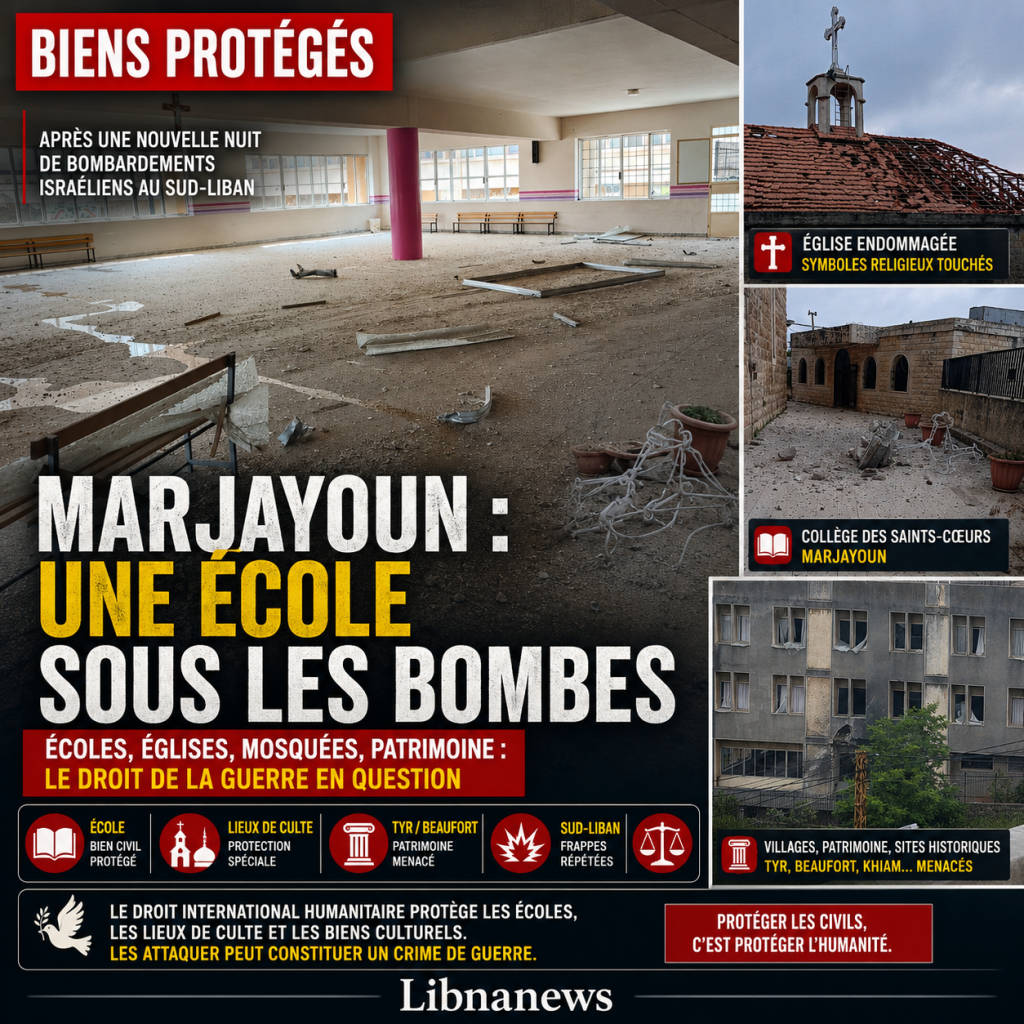
The College of the Holy Hearts of Marjayoun finds itself in the centre of the news after a new night of Israeli bombings in southern Lebanon. Images received this Friday morning show the effects of this sequence on the immediate environment of the school, a symbol of a school life now under the constant threat of strikes. No comprehensive technical assessment had yet been published on college-specific damage at the time of writing. But the alert is enough to remind that the war does not only affect military positions claimed. It also reaches schools, places of worship, religious symbols and archaeological sites that structure the civilian life of the South.
In Marjayoun, the College of Sisters of the Holy Hearts occupies a special place. The school welcomes students from Christian, Muslim and Druze families. It represents a space for transmission in a region where coexistence is also based on schools, parishes, mosques, shops, markets and family networks. In this context, seeing a school exposed to bombardment amounts to touching a collective benchmark. A school is not just a building. It depends on safe journeys, reassured parents, teachers present, students able to take a course without waiting for the next explosion.
The situation in Marjayoun is part of a wider escalation. The latest Israeli strikes targeted several areas of southern Lebanon, including Tyre, Saida, Adlun, Nabatiyah and areas of Western Bekaa. News agencies reported civilian casualties, including children, in the bombings on 28 May. Israel claims to be targeting Hezbollah-related infrastructure or frameworks. The Lebanese authorities, for their part, denounce an increase in violence against civilian areas. Between these two accounts, the inhabitants mainly measure the concrete consequences: cut roads, closed schools, damaged houses and forced displacement.
The College of the Hearts, a civilian target by nature
International humanitarian law is based on a central principle: parties to a conflict must always distinguish between military objectives and civilian objects and civilian objects. A school is, by its nature, a civilian property. It cannot be attacked unless it is effectively used for military purposes and its destruction offers a concrete and direct military advantage. Even in this case, the attacker must comply with the proportionality rules and take all possible precautions to avoid loss of life and excessive damage.
Applied to Marjayoun, this legal framework imposes a simple question. If the College of the Holy Hearts has been directly affected, or if its immediate environment has been struck without a clear military objective, the facts may fall into the category of unlawful attacks on civilian property. The definition of war crime then requires an independent investigation. It must determine the exact nature of the strike, the target, the information available, any warnings, the damage observed and the degree of knowledge of the military officials.
The Rome Statute of the International Criminal Court is explicit in this regard. It calls it a war crime to intentionally direct attacks on buildings dedicated to teaching, religion, art, science or charitable purposes, as well as against historical monuments, provided that they are not military objectives. This rule joins customary law. It does not only protect those present in the premises. It also protects the civil service of these buildings, i.e. their role in the life of a society.
In the case of a school, this is not only measured by the number of cracked walls or broken windows. It is also measured by the interruption of classes, the fear of pupils, the inability of teachers to come, the loss of confidence of families and the risk of a lasting drop-out. When war prevents a school from functioning, it causes prolonged civil damage. If the damage results from an indiscriminate, disproportionate or intentional attack on a protected property, it falls within the most serious categories of the law of war.
Christian places of worship already affected
The concern around the College of Holy Hearts comes after a series of reported attacks against Christian places and symbols in southern Lebanon. In the village of Debel, a widely distributed image showed an Israeli soldier striking a statue of Christ fallen from a cross. The Israeli army recognized the authenticity of the image and announced disciplinary measures. The incident was condemned by religious leaders and by international voices, as it does not amount to indirect damage caused by an explosion. It shows voluntary action against a religious symbol.
Another episode concerned a statue of the Virgin Mary, in which an Israeli soldier placed a cigarette, according to images published by regional media. The Israeli army reported that it had initiated an internal review. These actions do not qualify as bombing. But they participate in a climate of desecration and can feed, in a wider investigation, the analysis of intent, the behaviour of the troops and the respect due to religious property in the territories where they operate.
Other Christian sites were damaged in villages in the South. Religious media reported the destruction or damage of a convent and a former school of nuns in Yarun. Churches from such localities as Yarun, Derdghaya, Qawzah and Alma al-Sha`b have also been cited in reports of destruction or damage. In these villages, the war is not just about infrastructure. It reaches places of prayer, parish schools, ancient houses and cemeteries that bear the memory of the communities.
Under international law, churches and religious institutions enjoy special protection when they are not used for military purposes. An intentional attack on a church, convent, religious school or symbol of worship may constitute a war crime. Voluntary desecration may also constitute a serious violation of obligations to respect religious property, even if its criminal characterization depends on the established facts, the extent of the damage and the legal framework adopted by a competent court.
Muslim mosques and shrines also threatened
The attacks do not concern only Christian sites. Muslim places of worship have also been affected or destroyed in southern Lebanon. In Khiam, images broadcast in March showed the destruction of the minaret of a mosque by Israeli forces, according to regional media. The city, located near Marjayoun, was one of the most disputed areas of the recent war. It experienced massive bombings, fighting and a significant displacement of its population.
Heritage centres also documented damage to mosques, shrines and religious sites in other villages in the South. Among the cases mentioned are the Blida Mosque and the shrine attributed to the prophet Benjamin in Muhaibib. These places have religious, social and historical value. They organize rites, rallies, funerals, parties and local memories. Their destruction not only produces an architectural loss. It breaks part of the link between the inhabitants and their territory.
The protection of mosques is the same as that of churches. The buildings dedicated to religion are protected, regardless of the community concerned. International law does not prioritize places of worship according to their confession. A mosque, church, sanctuary, chapel or cemetery must be spared until they become military objectives. In case of doubt, civil protection must prevail until proven otherwise.
This rule is essential in a region such as South Lebanon, where religious places mark villages and roads. When several types of places of worship are reached in the same territory, fear exceeds each community. She becomes a national. It means that war endangers people so that they can live together, transmit a memory and return after displacement. In Marjayoun, the school of the Holy Hearts is part of this wounded landscape, where school vulnerability reaches religious vulnerability.
Tyre and Beaufort, the historical heritage under threat
Recent bombings have also revived concern about the archaeological heritage. Tyre, a UNESCO World Heritage city, was targeted on Thursday 28 May by Israeli strikes in urban areas. According to press reports, an Israeli warning mentioned a building very close to the archaeological area, before a strike hit the area. Images showed a strong explosion in the city. The Lebanese Ministry of Culture warned about the danger to the ruins of Tyre.
The city of Tyre is not an ordinary site. It bears Phoenician, Roman, Byzantine and medieval traces. Its remains belong to the history of Lebanon, but also to that of the Mediterranean. International law gives special protection to cultural property, especially when it is listed as a World Heritage Site or under enhanced protection. Even when a strike does not directly destroy a monument, shock waves, fires, vibrations and debris can cause serious damage to older structures.
Beaufort Castle, or Qalaat al-Shaqif, has also been mentioned in the alerts of recent days. The Lebanese Minister of Culture stated that the medieval fortress overlooking Nabatiyah had been directly affected, while the media reported shelling near the site and in the Arnoun area. Beaufort is one of the major historical symbols of the South. Its dominant position has made it a strategic place in several wars. But its past military value does not suppress its current cultural protection.
Unesco had granted temporary enhanced protection to several Lebanese sites, including Tyre and Beaufort, in the context of hostilities. Such protection means that the international community recognizes their exceptional importance and the need to preserve them. It does not create a physical shield against missiles. However, it reinforces the obligations of the belligerents. Intentionally attacking a protected historic monument, when it is not a military objective, may constitute a war crime.
Why these attacks can lead to war crimes
The definition of war crime is not based on the emotion caused by images, but on precise legal criteria. The first is the nature of the target. A school, church, mosque, convent, sanctuary or archaeological site are protected civil or cultural property. The second criterion is the absence of a military objective. If these sites are not used to store weapons, shelter combatants or conduct operations, they cannot be targeted. The third criterion is intent or knowledge. It must be established that the attacker knew, or could not ignore, the protected nature of the place.
Other rules may also come into play. An indiscriminate attack, which does not distinguish between military objectives and civilian property, can constitute a war crime. A disproportionate attack, which causes excessive civil damage to the expected concrete military advantage, may also fall within this category. Failure to take precautions, when the attacker does not choose the least dangerous means and methods for civilians, may result in liability. The warnings given to the population are not sufficient to legalize a strike if the target remains civilian or if the attack remains disproportionate.
This legal framework is important for the case of Marjayoun. If the bombings have affected the College of the Holy Hearts or its surroundings without established military necessity, it is not just a collateral damage to be deplored. This may be a violation of the principle of distinction. If the strikes took place in a known school, religious or heritage environment, the precautionary obligation becomes even stronger. Military officials must check targets, choose means of attack, assess risks and cancel or suspend the operation if the expected civilian damage is excessive.
Repeating attacks on protected areas can also be an important factor in the analysis. An isolated incident requires investigation. A series of incidents against schools, places of worship and heritage sites may reveal a modus operandi, systemic insufficiency of precautions or tolerance for illegal behaviour. This repetition does not replace the evidence. But it makes it more urgent to document facts, preserve images, identify damage and provide independent experts with access to the sites concerned.
Responsibility does not disappear behind the claimed objectives
Israel regularly claims to target Hezbollah, its infrastructure and its fighters. This statement must be examined in each case. The law of war recognizes that a military objective can be attacked. But it does not authorize attacks on civilian property solely because an armed movement operates in the region. It also does not allow a large impact on a village, school or historic neighbourhood if the expected military advantage does not justify foreseeable civilian damage.
The alleged presence of a fighter or military equipment near a protected site is not always sufficient to lift the protection of the site itself. On the contrary, it requires a more rigorous assessment. The attacker must distinguish the exact target from its environment. It must avoid, as far as possible, damaging the school, church, mosque or nearby monument. While there is serious doubt about the status of a good, international law requires that it be presumed civil.
This also applies to evacuation warnings. Asking people to leave does not automatically turn a neighbourhood into a freely destructible military zone. Civilian property remains protected after the inhabitants leave. Empty schools, closed churches, deserted mosques and archaeological ruins do not become legal targets because the population has been forced to move away. The displacement of civilians does not suspend the obligations of humanitarian law.
That is why the case of the College of the Holy Hearts calls for complete documentation. The images received must be kept with their date, place, origin and, if possible, elements to verify damage. Lebanese authorities, school officials, educational organizations and religious bodies must establish a factual record. A solid criminal qualification requires evidence: trajectories, craters, ammunition, coordinates, testimonies, schedules, warnings, presence or absence of military targets in the area.
An attack on the civilian life of South Lebanon
Beyond the law, the case reveals the depth of the civil crisis. The College of the Holy Hearts is not only a Christian school institution. It represents a possibility of normal life in a region that the bombings are de facto seeking to make invivable. When a school becomes vulnerable, families leave. When families leave, villages empty. When villages empty, places of worship close, shops disappear and historical sites become ruins without community around them.
This chain is visible in several southern localities. Residents of border villages have already been displaced to Tyre, Saida, Beirut or other areas. Some live with relatives. Others occupy temporary housing. Children change school, attend irregular classes or lose contact with their home school. Teachers must adapt curricula, reassure families and maintain an educational presence in impossible conditions.
The places of worship suffer the same fragility. A damaged church, a destroyed mosque or a desecrated sanctuary are not just religious losses. These are signals sent to the inhabitants: their return will be more difficult, their memory is reached, their village is no longer protected by its landmarks. Archaeological sites add another dimension. Tyre and Beaufort speak not only to the southern Lebanese. They belong to a broader history, which contemporary wars risk reducing to irreversible damage.
In this context, the demand for a ceasefire takes on a very concrete meaning. It means that Marjayoun students can return to college without fear of a strike. It means that religious statues are not humiliated, minarets are not destroyed, churches and mosques are protected, and Tyre and Beaufort are not exposed to further explosions. It also means that international law does not remain a theoretical declaration but becomes a verifiable tool for protection.
Document, protect, prosecute
The first emergency is the protection of civilians and protected areas. The second is documentation. Every attack on a school, place of worship or cultural site must be accurately recorded. The Lebanese authorities must involve the Ministry of Education, the Ministry of Culture, municipalities, school boards, churches, Muslim authorities, civil defence and specialized organizations. The file must distinguish between direct damage, blast damage, intentional destruction, desecration and structural risks.
Documentation does not only have a memory function. It is preparing for possible prosecutions. Even where the jurisdiction of the International Criminal Court depends on special conditions, war crimes are also subject to customary law and can be examined by national courts, international mechanisms or procedures based on universal jurisdiction. The evidence gathered today can therefore be used tomorrow to establish individual responsibilities.
In Marjayoun, the alert around the College of Holy Hearts opens this work. It requires to look together at schools, places of worship and archaeological sites. It recalls that protected property is not peripheral to war. They are at the heart of civilian survival. A classroom, a cross, a minaret, an ancient stone and a schoolyard all say the same thing: a population intends to stay on its land, transmit its memory and resume a life that the bombings are trying to interrupt.




