





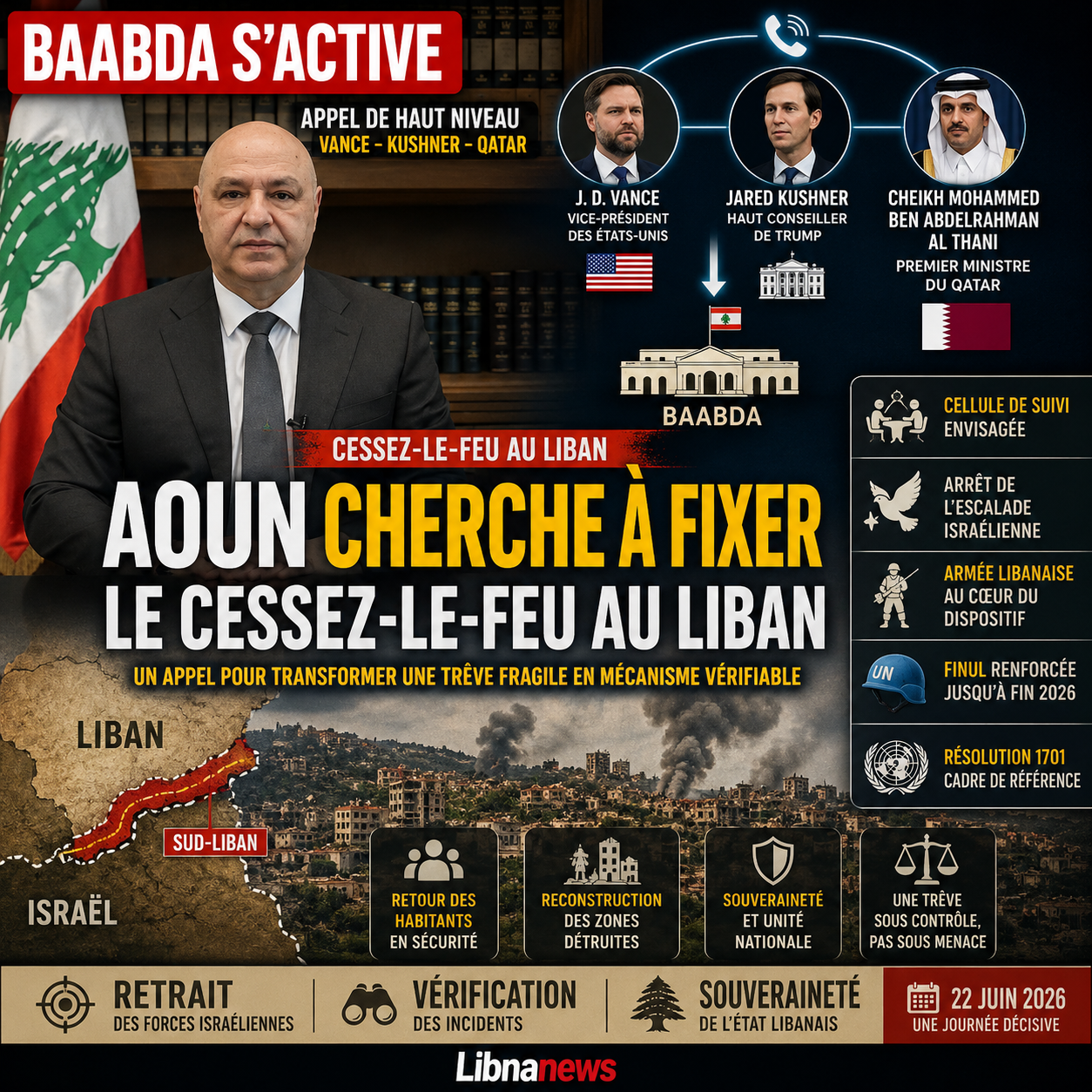
President Joseph Aoun received a call on Monday, June 22, between US Vice-President J.D. Vance, Jared Kushner, senior adviser to the US President, and Qatari Prime Minister Sheikh Mohammed bin Abdelrahmane ben Jassem Al Thani. The exchange focused on the consolidation of the ceasefire in Lebanon, the cessation of Israeli military escalation and the concrete steps to be taken, including the possibility of forming a monitoring cell. This announcement puts Baabda at the heart of a diplomatic sequence where Washington, Doha and regional mediators try to avoid the Lebanese front derailing broader discussions between the United States and Iran.
For Beirut, the call is not yet guaranteed. However, it marks a change of level. The Lebanese case is no longer only treated as a consequence of regional war. It becomes an object of direct discussion with the White House and Qatar. This development comes at a time when the truce remains fragile, Israeli positions in southern Lebanon raise a constant Lebanese challenge and the question of the role of Hezbollah remains the most sensitive point of any durable security architecture.
A call that installs Baabda in the American sequence
The call received by Joseph Aoun must be read in its format as well as in its content. This is not a simple protocol contact. Three interlocutors appear: the American Vice President, a very close adviser to the President of the United States and the Qatari Head of Government. This trio shows that the ceasefire in Lebanon is now located at the intersection of three channels. The first is American, therefore linked to pressure on Israel and negotiations with Iran. The second is Qatari, which is associated with active mediation and regional relays. The third is Lebanese, as no lasting stabilization can be proclaimed without minimum institutional membership in Beirut.
The Lebanese Presidency has not announced a formal agreement or a detailed timetable. It referred to the consolidation of the ceasefire, the cessation of Israeli military escalation and the steps needed to achieve that goal. The reference to a possible cell gives the exchange a practical scope. She suggested that the discussions no longer focus solely on principles. They are looking for a tool to track incidents, deliver quick messages and reduce the risk of a new military gear.
The choice of words matters. Beirut speaks of » The shade is important. A cease-fire announced but violated does not have sufficient political value to allow the return of the inhabitants, the resumption of services and the commencement of damage assessments. Lebanon is therefore seeking to move from a declared truce to a controlled truce.
Stop fire in Lebanon: the cell as a verification tool
The possibility of creating a cell is the most concrete element of the announcement. Its composition was not specified by the Lebanese Presidency. Its exact role also remains to be defined. But the principle responds to a known weakness of de-escalation agreements: between a diplomatic declaration and the reality of the ground, there is always a space where accusations, isolated fire, overflights and strikes can revive the war.
A useful cell should perform several functions. It should first receive reports of incidents. It should then distinguish a confirmed fact from a political allegation. Finally, it should forward requests for restraint or clarification to the capitals concerned. This work seems technical. Yet he is political. Each event in South Lebanon can be interpreted as a voluntary violation or as a limited operation. Without a common channel, each camp imposes its own story.
Lebanon must ensure that it is not marginalized in this mechanism. A cell designed solely by external actors could transform the Lebanese State into a mere recipient of decisions. Conversely, a cell that would clearly involve the presidency, the government, the army and the mediators could strengthen Beirut’s official position. It would provide the Lebanese authorities with an instrument to document violations and request corrective action.
The role of the Lebanese army would be decisive. It has the necessary institutional legitimacy. She knows the terrain, the villages, the roads and the sensitive points. It can also engage with UNIFIL, which remains the international actor already deployed in the area. A cell that ignores this existing network would leave with a serious operational handicap.
Israeli pressure, first test of the device
The Israeli military escalation stop is at the heart of the appeal. This formula refers to a reality that Beirut considers a priority: Israeli strikes, overflights, incursions and military presence beyond the border prevent normalization. Lebanon considers that its sovereignty remains incomplete as long as these elements persist. The Lebanese authorities are therefore seeking more than relative calm. They want a measurable shutdown of operations.
The Israeli position complicates this demand. The head of Israeli diplomacy claimed that his country did not have territorial ambitions in Lebanon, while indicating that Israel would not withdraw from the area it presents as security. This line creates a direct contradiction with the Lebanese reading of the ceasefire. For Beirut, a safe area on Lebanese territory remains an infringement of sovereignty. For Israel, it is presented as protection against Hezbollah.
This disagreement gives Washington a central role. If the United States wants the truce to hold, it will have to convince Israel to limit its operations and accept a verification framework. The issue is not just military. She’s diplomatic. A Lebanese mechanism without clear Israeli commitment could produce reports, but no change on the ground.
The fact that Israel is not a direct party to the American-Iranian discussions increases this difficulty. An agreement between Washington and Tehran can influence Hezbollah and regulate regional tension. It is not enough to automatically impose a permanent withdrawal or suspension of Israeli operations. That is why the call to Joseph Aoun counts: he indicates that mediators are also seeking a Lebanese and not only Iranian-American translation of de-escalation.
Doha, a discreet but indispensable mediator
The presence of the Qatari Prime Minister in the appeal confirms the role of Doha. Qatar has been acting since several sequences as a regional intermediary able to speak to actors who do not speak directly. In the Lebanese case, this function is valuable. It links Beirut, Washington, Tehran and other capitals without exposing each party to politically costly public negotiations.
Qatar can also act as a procedural guarantor. He has no troops in South Lebanon. It cannot replace the Lebanese army or UNIFIL. But it can help structure messages, collect commitments and maintain a channel when tension rises. This method often has more effect in the early hours of a crisis than the major diplomatic communiqués.
For Beirut, Qatari support has another advantage. It places the cease-fire within an Arab framework, not just an American one. This dimension is important in a country where internal balances make any external alignment sensitive. A Washington-only mediation could be politically attacked. A mediation involving Doha gives the process a more regional and more acceptable form for several Lebanese actors.
Doha can finally contribute to the post-Doha phase. If the truce stabilizes, Lebanon will need assistance for the return of internally displaced persons, the repair of infrastructure and the revival of local services. Qatar can participate in this stage. But it will probably only do so if minimum security is ensured and the financing channels remain legible.
Washington seeks to prevent a regional domino effect
The call comes in a sequence where discussions between the United States and Iran have taken on a regional dimension. The talks no longer focus solely on nuclear, sanctions and the Strait of Ormuz. The Lebanese front has become an immediate test of the credibility of the commitments. If the ceasefire in Lebanon collapses, the broader negotiation can lose its political base.
So Washington wants to avoid a domino effect. A resumption of fighting in southern Lebanon could push Hizbullah to reactivate its operations, lead to new Israeli strikes and give Iran an argument to tighten its position. It could also affect the energy markets if Tehran again linked Lebanese tension to maritime security in the Gulf. Lebanon, in this pattern, is not a secondary theatre. It’s a possible trigger.
The presence of J.D. Vance in the call gives a political signal. It shows that the file is not limited to a technical level. Jared Kushner, presented as a high-level adviser, also embodies the close negotiating dimension with the US presidency. The message to Baabda is clear: Washington wants to follow the Lebanese file at the highest level, at least during this stabilization phase.
This attention can serve Beirut. She can also put him under pressure. The United States traditionally expects the Lebanese State to assert its authority further throughout the territory. They often link South stability to the issue of non-State weapons. The Lebanese authorities will therefore have to defend two priorities at the same time: to stop Israeli operations and to prevent the debate on Hezbollah from opening an uncontrollable internal crisis.
Resolution 1701 returns to centre
Any serious mechanism should be linked to resolution 1701. The framework, adopted in 2006, provides for the cessation of hostilities, the Israeli withdrawal, the deployment of the Lebanese army and the support of UNIFIL. It also aims to prevent the presence of unauthorized weapons and armed personnel in the area between the Blue Line and the Litani River. The resolution remains the international reference, even if its full implementation has never been achieved.
UNIFIL therefore retains practical importance. His term of office was extended until 31 December 2026, with a subsequent withdrawal in 2027. This deadline gives Lebanon additional pressure. If a monitoring cell is created, it will have to be able to work with UNIFIL while it is present. It will also have to prepare for the future, as security responsibility should go further to the Lebanese State.
The issue is not only administrative. South Lebanon cannot remain suspended between an international mission to be reduced, a Lebanese army under budgetary restraint, a disputed Israeli presence and a Hezbollah that retains military capacity. The ceasefire will only hold if these elements find a form of common discipline, even minimal.
1701 offers a common language. It does not solve power relations alone. But it helps to avoid each actor inventing his own framework. For Beirut, referring to it amounts to placing Lebanese sovereignty at the centre of the discussion. For Washington, it provides legal support. For Doha, it provides a point of diplomatic support. UNIFIL defines the daily mandate.
Lebanese demands: withdrawal, security, return
Lebanese priorities can be summarized in three words: withdrawal, security, return. The withdrawal concerns Israeli positions and any military presence deemed to be contrary to Lebanese sovereignty. Safety concerns stopping strikes and shooting, but also preventing incidents. The return concerns the inhabitants of the South, who cannot resume normal life without tangible guarantees.
The return of displaced persons is the human test of the ceasefire. Families are not determined on the basis of the communiqués. They look at the condition of the roads, the presence of drones, the warnings of the municipalities, the damage in the houses and the ability of the services to function. A fragile truce may be enough to produce back images. It is not enough to rebuild stability.
The Lebanese Government must therefore link diplomacy to local measures. It will be necessary to map the hazardous areas, evaluate the infrastructure, reopen schools where possible and organize rapid assistance to the most affected municipalities. These files seem civilian. Yet they depend on the same security mechanism. A road cannot be repaired sustainably if it is in an area exposed to new strikes.
Lebanon will also have to convince donors. Reconstruction will not come without guarantees on governance, security and the use of funds. The cell mentioned in the appeal could therefore have an indirect effect on the aid. The more visibility it generates, the easier it will facilitate financial decisions. On the other hand, a vague mechanism will slow down the partners and prolong the expectations of the inhabitants.
Hezbollah, a key but unresolved issue
No stabilization in southern Lebanon can ignore Hezbollah. The movement is at the centre of Israeli and American concerns. He is also an actor rooted in Southern society. This double reality makes the file explosive. Any pressure that is too brutal can produce an internal crisis. Any lack of discussion can maintain military risk.
Current diplomacy therefore seems to favour a gradual approach. The first objective is to silence weapons. The second is to prevent incidents from degenerating. The third, more difficult, concerns the reorganization of security in the South within the framework of the Lebanese State. The debate on Hezbollah’s weapons does not disappear. It is simply being pushed back to a phase where the country would be less exposed to open war.
This method can succeed if it is based on verifiable steps. It will fail if each party uses the truce to consolidate its positions without yielding anything. Israel could maintain its security zone. Hezbollah could retain implicit military freedom. The Lebanese State could remain confined to a declarative role. In this case, the monitoring unit would become a crisis management instrument, but not a sustainable stabilization tool.
President Aoun is trying to avoid this impasse. His interest is to put the state back in the centre, without causing an internal rupture. This requires a close balance. The language of sovereignty vis-à-vis Israel, the language of state authority vis-à-vis Western partners and the language of internal stability vis-à-vis Lebanese forces must be spoken.
What the cell will need to clarify quickly
If formed, the cell will first have to answer simple questions. Who will compose it? Where will she sit? What will be the role of the Lebanese army? Will UNIFIL participate directly or through liaison? Will Qatari mediators be present permanently or only during crises? Will the United States also speak for Israeli commitments?
It will then have to define the violations. A drone overflight, a targeted strike, a troop movement, a rocket fire, an explosion in a border area or a refusal to withdraw are not on the same level. Without a precise scale, each incident will become a media battle. The cell will therefore have to set out categories and response procedures.
The third point concerns transparency. A totally secret mechanism can be effective in calming the actors. But he doesn’t reassure the people. Too public a mechanism can become a scene of confrontation. We’ll have to find a balance. Regular, brief and factual press releases could help maintain confidence without transforming each meeting into a political tribunal.
The fourth point concerns the timetable. Lebanon needs steps. Stabilizing the fire for a few days is not enough. It will then be necessary to address the occupied or disputed areas, the deployment of the army, humanitarian access, guarantees for the inhabitants and the conditions for reconstruction. The cell can’t solve everything. However, it can set the order of problems.
A narrow window for Beirut
The time is favorable but unstable. Favourable, because Washington and Doha seem to want to prevent a rapid resumption of hostilities. Favourable, too, because the Lebanese question returns to an international discussion where it can obtain guarantees. Unstable, because Israel maintains its security requirements, Hezbollah remains armed and talks between the United States and Iran can be held at any time.
Beirut must therefore act quickly. President Aoun can use the appeal to request a clear mandate: stop Israeli operations, verification mechanism, central position of the Lebanese army and respect for sovereignty. The government will then have to turn this line into operational decisions. It is not enough to welcome mediation. The administrations, security forces and southern municipalities must be prepared for a gradual return sequence.
The next concrete development will be the formation, or not, of the cell mentioned during the call. Its composition will say a lot about the balance of power. A cell that would clearly include Beirut would strengthen the state. A cell dominated by external channels would limit its range. A cell without access to the ground would be almost symbolic. On the contrary, a cell supported by the Lebanese army and UNIFIL could give the ceasefire in Lebanon a verifiable first frame.
The file is now entering a detailed phase. Maps, schedules, contact lines, incident reports, withdrawal guarantees, secure returns and access to villages will weigh more than general statements. The fact that Joseph Aoun was joined by Vance, Kushner and the Qatari Prime Minister shows that Lebanon has again become an immediate diplomatic priority. The next answer will come from the field, where the truce will have to prove that it is more than an exchange between capitals.