





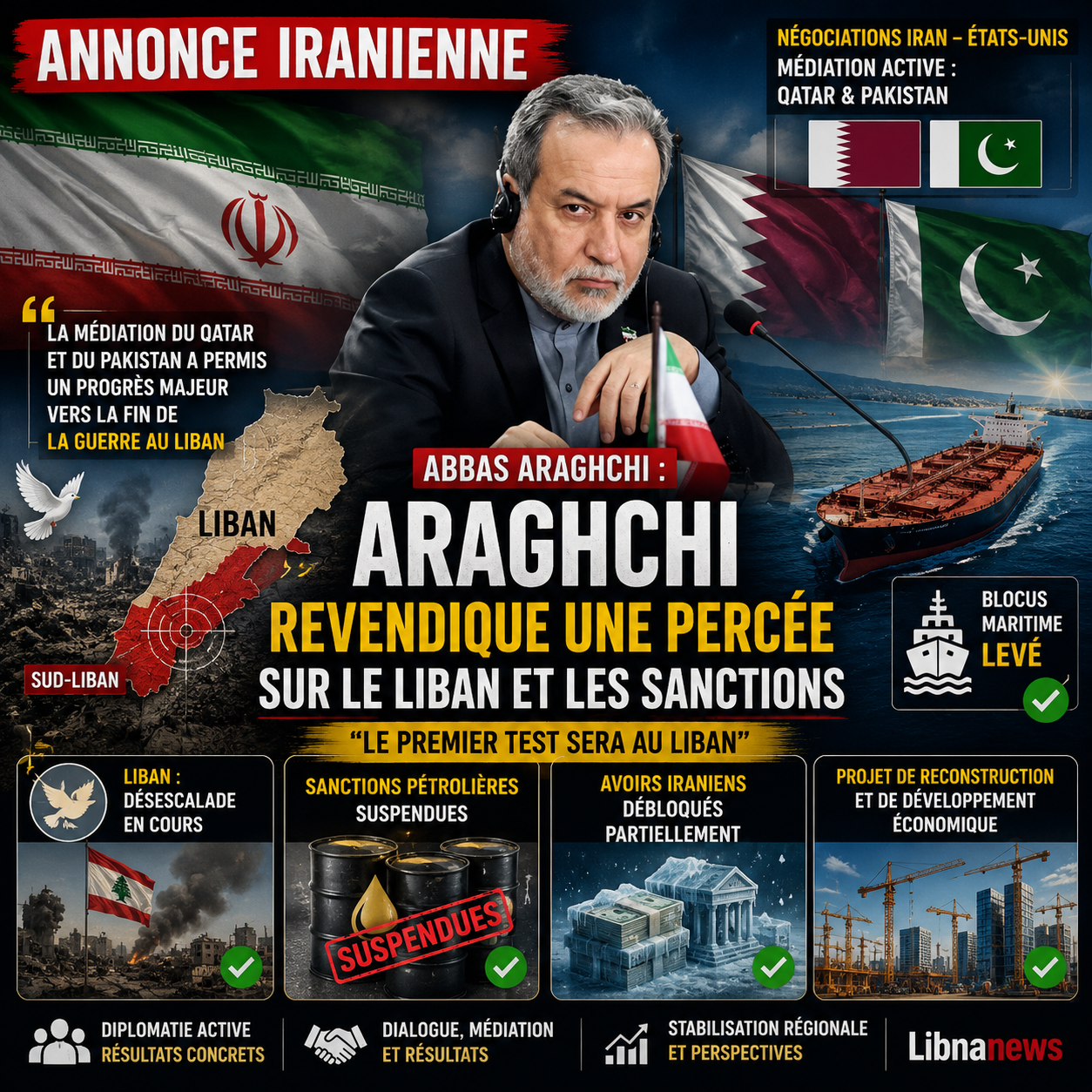
Iran’s foreign minister, Abbas Araghchi, said Monday, 22 June, that negotiations with the United States had produced significant progress towards the end of the war in Lebanon. The head of Iranian diplomacy linked this progress to the mediation conducted by Qatar and Pakistan, while referring to the suspension of sanctions on Iranian oil and petrochemical exports, the lifting of the maritime blockade and the release of some of Iran’s frozen assets. This announcement comes at a time when Washington and Tehran are trying to turn a fragile arrangement into a broader roadmap.
For Lebanon, the Iranian message is not just a diplomatic episode. It places the Lebanese ceasefire at the centre of the balance of power between the United States, Iran, Israel and Hezbollah. Araghchi presented the de-escalation unit in Lebanon as the first real test of the process. This formula summarizes the immediate issue: the success of the talks will not be measured first in the Swiss meeting rooms, but in the ability to stop the strikes, prevent incidents and put the Lebanese State in a verifiable security mechanism.
A regional Iranian announcement
The announcement of Abbas Araghchi came after a sequence of indirect and direct talks in Switzerland, with the participation of Qatari and Pakistani mediators. The discussions fall within the framework of the Islamabad memorandum, presented in recent days as the basis for a compromise between Washington and Tehran. According to the evidence made public by the mediators, the parties adopted a road map for a final agreement within 60 days. They also initiated technical discussions to clarify the implementation modalities.
The Iranian statement goes further than the prudent language of the mediators. Tehran claims that some economic measures have already been taken. The Iranian minister talks about a reduction in oil and petrochemical exports, a lifting of the maritime blockade and partial release of frozen assets. These points are the core of Iranian expectations. They also serve as political evidence to Iranian opinion that negotiations with the United States produce tangible benefits.
The communiqué of the ombudsmen insists on the progress of the process. He mentioned a constructive environment, continued technical negotiations and a structure of political supervision. This difference in tone is important. It shows that every actor speaks to his own audience. Iran highlights the concessions obtained. Mediators value the method. The United States, for its part, is seeking to preserve the idea of a conditional process, linked to the verification of Iranian commitments and the stabilization of regional fronts.
Lebanon at the heart of the Islamabad memorandum
In this context, Lebanon is no longer merely a peripheral file. It occupies a singular place in the framing text. The first clause of the memorandum refers to the permanent cessation of military operations on all fronts, including in Lebanon, as well as the guarantee of Lebanese sovereignty. This formulation gives Beirut a diplomatic lever. It points out that any regional agreement must result in a real reduction in military pressure on southern Lebanon.
The difficulty comes from the field. Israel is not a signatory to an Iran-American agreement. Hezbollah is not an institution of the Lebanese state, although it is a central military actor in the South. As for the Lebanese government, it demands respect for its sovereignty, but does not control all the security parameters alone. This dissociation between the signatories, the present forces and the legal authorities makes the Lebanese mechanism particularly complex.
A de-escalation cell still to be defined
That is why the de-escalation unit mentioned by Araghchi becomes decisive. It should be used to monitor violations, transmit warnings and prevent a local incident from causing a general resumption of hostilities. Such a cell can also reduce misunderstandings between the parties. However, it will not replace UNIFIL, the Lebanese army or the obligations of resolution 1701. It will have to connect with these frames to avoid becoming a simple parallel channel.
The composition of this unit remains an open point. Beirut would benefit from a clear and operational place, not an advisory role. The Lebanese army will have to be associated because it has institutional legitimacy and knowledge of the ground. UNIFIL should also be linked directly or through a coordination channel. Without these relays, the cell may depend only on messages exchanged between capitals, while incidents occur in villages, on roads, near military positions or along the Blue Line.
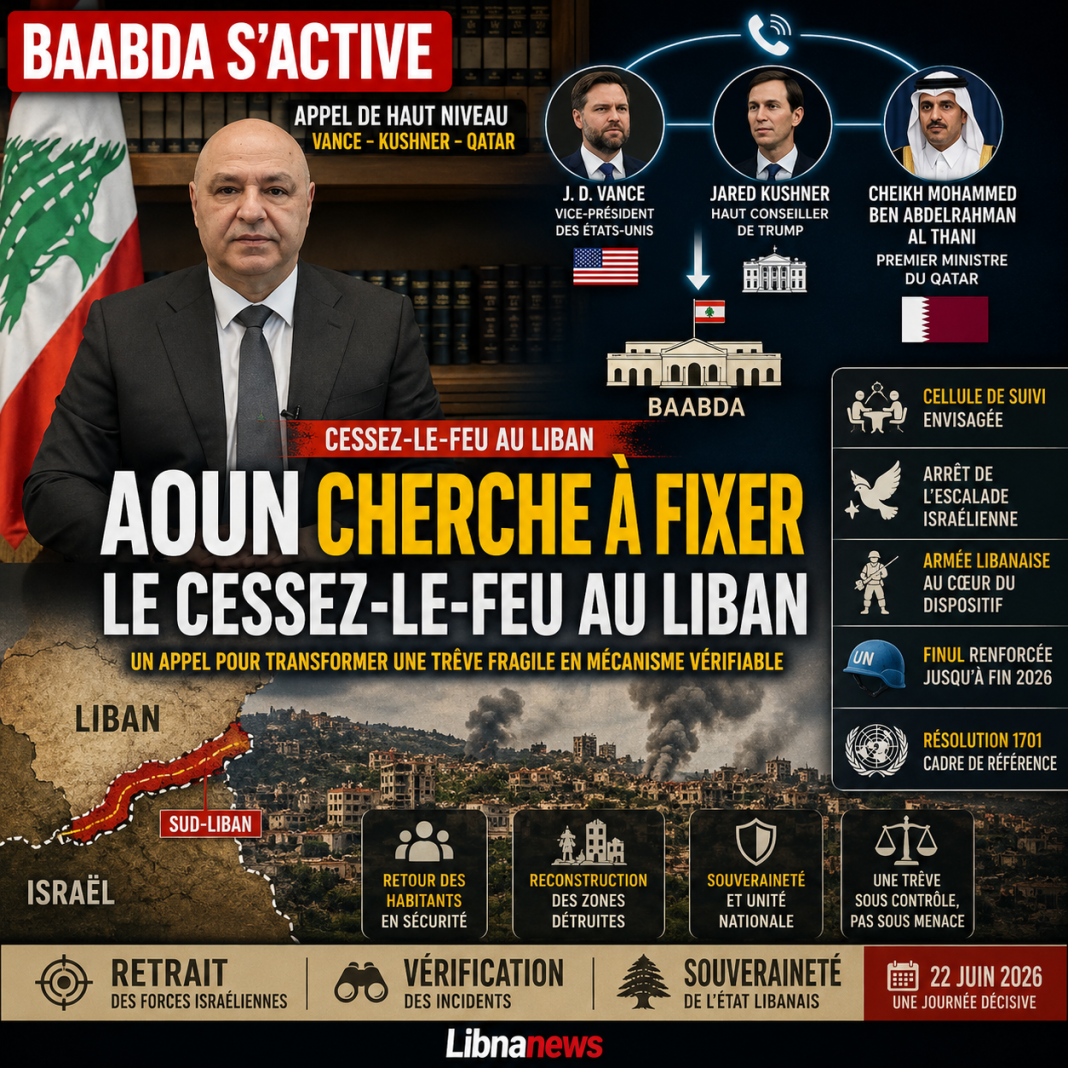
President Joseph Aoun has already received a call from senior American officials and the Qatari Prime Minister to discuss the consolidation of the ceasefire in Lebanon and the possibility of forming a cell for that purpose. This sequence shows that the file is not only handled between Washington and Tehran. The Lebanese authorities are seeking to enter the country, in order to prevent it from being treated as a theatre of application rather than as a State primarily concerned.
Israel, Hezbollah and Lebanese sovereignty
Beirut’s first demand will be to stop Israeli escalation. Lebanon considers that Israeli strikes, overflights and any military presence in its territory violate its sovereignty. A credible ceasefire must therefore produce visible effects. It should reduce armed operations, clarify disputed areas and define a withdrawal or verification procedure. General announcements will not be sufficient to reassure the people of the South, especially in the areas affected by the bombings.
Hezbollah represents the other side of the test. Iran can exert a major political influence on the movement, but it cannot erase by decree the local conditions of the conflict. Hezbollah will demand that any lasting calm be accompanied by a halt to Israeli operations and strict respect for Lebanese sovereignty. Israel will ask for guarantees on the removal of combatants and weapons. The Lebanese State will have to try to transform this confrontation into an institutional deployment, under the authority of the army and within the existing international framework.
Resolution 1701 remains the legal basis for this discussion. It provides for the deployment of the Lebanese army to the South, the support of UNIFIL, the cessation of hostilities and the absence of unauthorized weapons between the Blue Line and the Litani. This framework has never been fully implemented. Violations have accumulated for years. The current novelty is therefore less related to the text than to regional pressure. If Washington and Tehran want their agreement to survive, they will have to help make 1701 more operational.
Oil, blockade and frozen assets: the Iranian side
The economic announcements made by Araghchi add another dimension. The suspension of restrictions on oil and petrochemicals gives Iran a material interest in preserving negotiations. The lifting of the maritime blockade, if confirmed in practice, would reduce the tension around trade routes and the Strait of Ormuz. The partial release of frozen assets would provide Tehran with useful resources, in a war-stricken country, with sanctions and social pressure.
These measures are not without political risk. In Washington, part of the debate will focus on the possibility that the funds released will strengthen Iran’s regional capacity. Israel’s partners will monitor the use of resources and financial channels. The United States will therefore likely seek to maintain a control architecture, even if temporary exemptions are granted. On the contrary, Iran will present these reliefs as a necessary correction after years of sanctions and as a prerequisite for further discussions.
For markets, the issue is immediate. Any drop in tension around Iranian oil and d-Ormuz can affect energy prices. Any resumption of fighting can produce the opposite effect. Lebanon is thus linked to a global equation. An incident in the South can fuel maritime mistrust in the Gulf, provoke Iranian reactions and influence energy expectations. This interdependence explains why the Lebanese front has become a visible test of regional détente.
The risk of premature optimism in Beirut
Lebanon must, however, avoid too optimistic a reading. Even if oil sanctions are suspended, even if some Iranian assets are released, these measures do not automatically finance Lebanese reconstruction. South Lebanon needs clear roads, repaired schools, rehabilitated water systems, evaluated housing and guarantees for the return of internally displaced persons. These priorities depend first on local security and the state’s ability to coordinate aid.
The question of reconstruction will therefore be twofold. Iran talks about a major reconstruction and economic development project for its own territory. Lebanon, for its part, must defend a separate envelope or mechanisms adapted to its needs. Arab, European and international donors will demand guarantees on security, transparency and the role of institutions. They will not finance sustainable areas where the risk of renewed hostilities remains high.
The Lebanese government will also have to manage the internal dimension. Any de-escalation cell will touch on sensitive issues: the monopoly of force, the relationship with Hezbollah, cooperation with the United States, the role of Qatar and the attitude to be adopted against Israel. President Aoun can use the current dynamics to strengthen the centrality of the state. But it must prevent the security debate from turning into an internal political confrontation before the ceasefire is consolidated.
The 60 days that can change everything
The most realistic short-term formula is based on limited steps. First, establish an operational channel for incidents. Then get a measurable drop in strikes and shots. Then facilitate the supervised return of the inhabitants to areas deemed accessible. Finally, engage in a longer discussion on the deployment of the Lebanese army and the obligations of all actors south of the Litani. This sequence seems modest, but it can create a first stability.
The sixty-day delay will be heavy. It can give diplomats the time to write a final agreement. It can also become a period of vulnerability. Each camp will seek to verify whether the other is implementing its commitments. Iran will observe the American attitude on sanctions and the blockade. Washington will observe Iranian attitude on nuclear, Ormuz and allied groups. Lebanon will observe especially if the strikes stop and the villages in the South can breathe.
The Araghchi statement therefore places the bar very high. By presenting Lebanon as the first real test, the Iranian minister links Tehran’s credibility to the de-escalation on a terrain that several actors are fighting for. This emphasis can help Beirut, as it forces negotiators to look at South Lebanon as a priority point of application. It can also expose the country, as any local blockage may immediately go back to the Iran-US negotiations.
The nuclear file remains in the background of the entire sequence. The economic reductions announced do not address enrichment, sensitive stocks, international surveillance and non-proliferation safeguards. These topics will be addressed in the final agreement, if discussions progress. This separation creates a tension. Iran wants to show that sanctions are beginning to fall. The United States wants to retain leverage before validating a lasting compromise. Lebanon lies in the middle of this architecture, as the stability of the southern front can accelerate or slow down concessions on other issues.
The land as judge of the process
Finally, Lebanese policy space will depend on its ability to produce its own documents. Beirut will need to present maps, lists of affected localities, military deployment needs and humanitarian priorities. Effective diplomacy is not limited to calls received by Baabda. It requires a precise dossier, capable of being brought to Washington, Doha, Paris, Riyadh and the United Nations. The more Lebanon documents violations and needs, the more it can convert the vocabulary of sovereignty into concrete decisions.
The next step will not only be diplomatic. It will be technical and territorial. It will be necessary to know who sits in the de-escalation unit, how it receives alerts, what types of violations it documents, to whom it transmits its findings and how soon it can act. It will also be necessary to determine whether its decisions remain confidential or whether regular information will be made public to reassure the inhabitants.
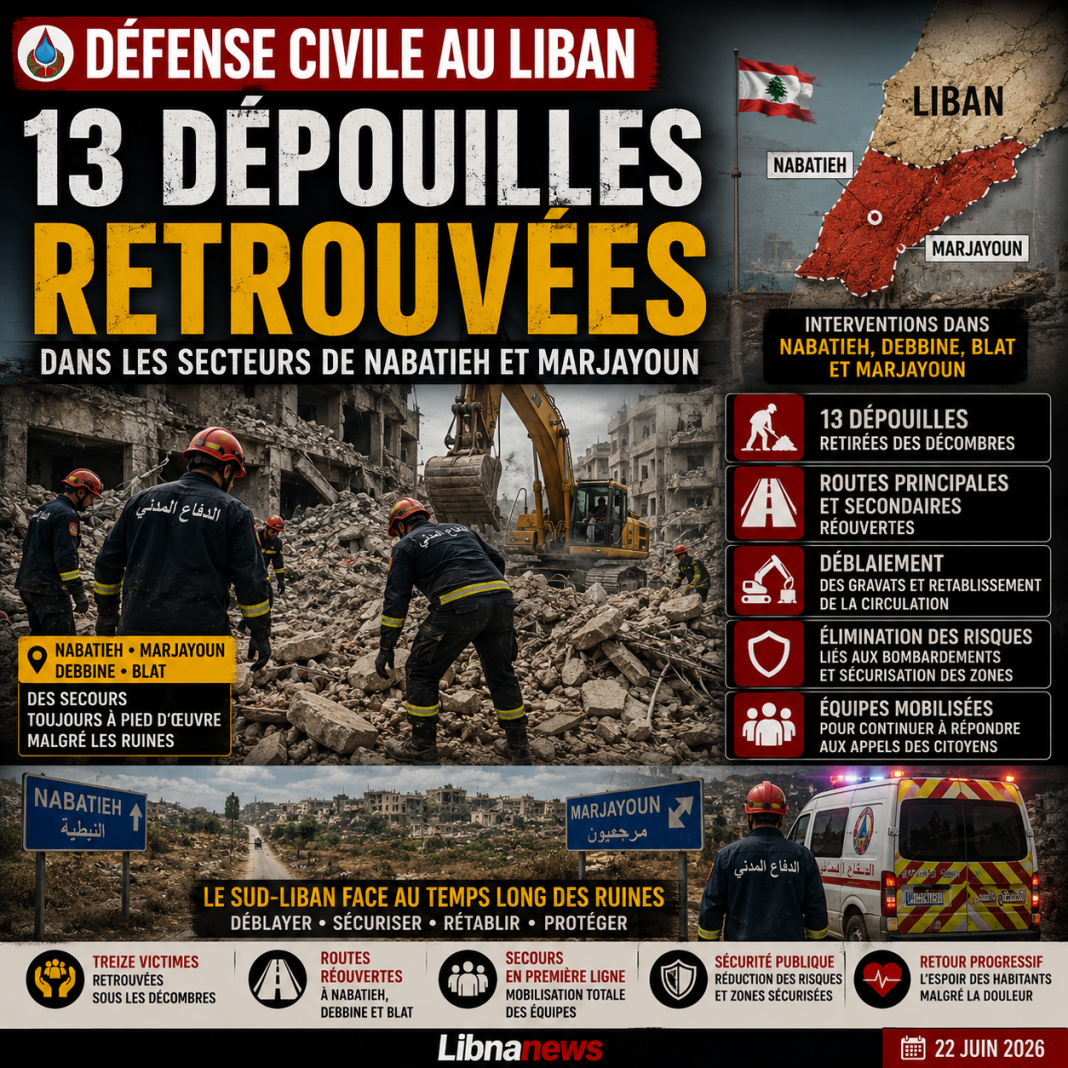
In southern Lebanon, aid continues to clear roads and remove victims from the rubble. This reality reminds us that the ceasefire is not an abstract formula. It is a condition for the return of families, the work of municipalities and the resumption of essential services. Negotiations between Iran and the United States can change the regional climate, but their first concrete step will be in villages, roads and areas still at risk.