

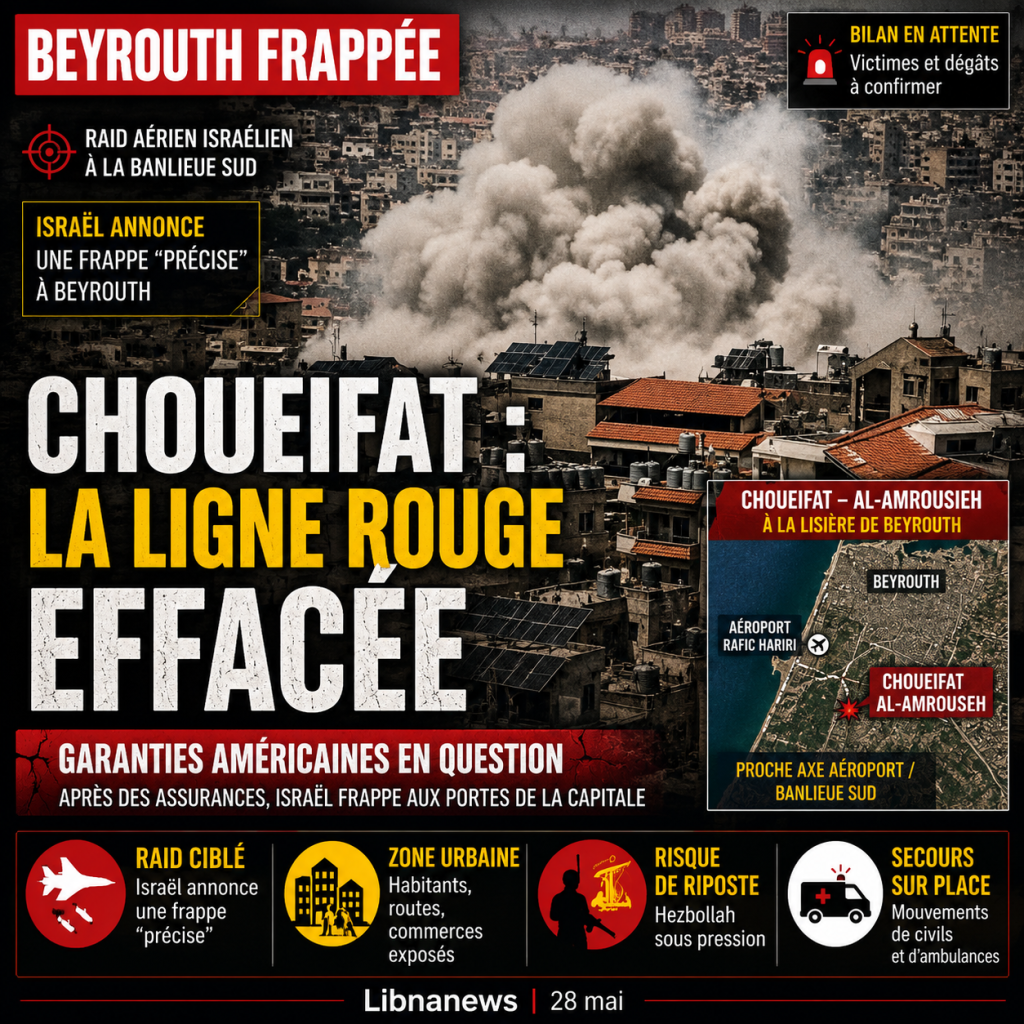
The southern suburbs of Beirut were hit by an Israeli air raid on Thursday, 28 May, which was presented by the Israeli army as a targeted operation. The first local reports point to the impact in the area of Choueifat Al-Amrousieh, near the point known as the Al-Ajniha Al-Khamsa, on the southern edge of the Beyruthine agglomeration. The Israeli army issued a brief message indicating that it had struck « precisely » in Beirut and announced further details. On the Lebanese side, the images broadcast in the following minutes show a shock scene, smoke plumes, emergency movements and a population caught between sideration and anger. The human assessment was not stabilized at the time of writing.
The raid immediately changed the reading of climbing. For several days, Lebanese officials and media have been talking about American guarantees supposed to contain Israeli strikes outside Beirut and its southern suburbs. The strike on Choueifat Al-Amrousieh thus appears, seen from Lebanon, as a political as well as a military rupture. It came after massive bombings in the south, evacuation orders south of the Zahrani and diplomatic discussions where Washington sought to preserve a minimum of framework. For Beirut, the question becomes direct: what is the value of American assurances if Israeli aviation can carry out a murder operation in the metropolitan area of the capital?
Southern Beirut: a red line crossed
The target location is not insignificant. Choueifat Al-Amrousieh is located in a dense area between the southern suburbs, the airport axis and the southern coastal towns of Beirut. It’s not a frontal battlefield. It is an urban space, with buildings, shops, families, schools, roads and important daily traffic. Even when Israel claims to target a person or military structure, the choice of such a site shifts the risk to civilians. In Lebanon, this reality already dominates the first reactions: the precision claimed by the assailant does not suppress the fear of the inhabitants or the danger of collateral damage.
The expression « killing operation » was quickly imposed in Lebanese comments. It reflects the perception of a raid designed to neutralize an individual target, probably linked to Hezbollah according to the Israeli version expected, but executed in the heart of a civilian environment. The precedent is heavy. Since the beginning of the regional war, Israel has increased the number of strikes against Hezbollah, Hamas or Iran-related networks in Beirut and its surroundings. Each strike of this type has a dual dynamic: it shows Israel’s intelligence capacity and broadens the vulnerability of the Lebanese capital.
The Lebanese institutional response should focus on three points. The first concerns sovereignty: a foreign State strikes the periphery of the capital without authorization and disregarding diplomatic channels. The second concerns the protection of civilians: the attack occurs in a inhabited area, without the inhabitants having had time to understand the exact nature of the threat. The third concerns the role of the United States: Washington encouraged negotiations and suggested, according to press reports, that Beirut remained a limit not to be crossed. But this limit has just been crossed.
Choueifat after the Zahrani
The raid on Shueifat took place in the aftermath of a sharp expansion of the Israeli offensive in Lebanon. Israel had declared the entire area south of the Zahrani River as a combat zone and had asked many inhabitants to leave north. The strikes had affected Tyre, Saida, Adlun, Nabatiyah and Western Bekaa. Civilians were among the victims. Lebanon had already seen the fear of a complete collapse of the April truce rise. The strike on the southern suburbs adds a landing. It means that the pressure no longer stops in the South and Beirut becomes an operational space for the Israeli army.
This development is of considerable psychological significance. The southern suburbs of Beirut, often referred to as Dahieh, remain associated with the political, social and military power of Hezbollah. But it is also home to a large population living in a fragile normality, between displacement, economic difficulties and the permanent threat of drones. When a raid targets this perimeter, the impact exceeds the announced target. Families wonder if other buildings can be hit. Schools are preparing to close. Shops drop their curtains. Roads to the airport and to the capital are saturating. War enters ordinary space.
Choueifat Al-Amrousieh’s choice adds a particular dimension. The area is not only identified with Dahieh in the strict sense. It is located in a more mixed social environment, close to Druze, Shiite and urban localities, at the crossroads of several political spaces. The strike therefore risks widening the feeling of exposure to neighbourhoods that sometimes thought they would stay on the margins of the usual targets. She recalled that the categories used in Israeli military messages did not always correspond to the geography experienced by the inhabitants. For them, a strike at Choueifat is not a safe abstraction. It’s an explosion in the neighborhood.
The American guarantees in question
Israeli communication remains minimalist at this stage. The formula announcing a « precise » strike in Beirut generally prepares the subsequent publication of a name, rank and operational justification. Israel thus seeks to include the attack in the register of targeted neutralization. This method is intended to limit international challenge and to present the action as proportionate. But Lebanon is mistrustful of these communications. The authorities and a large part of the opinion point out that the precision of a missile does not answer the question of the right to strike a foreign capital, nor the question of the possible civilian balance sheet.
American guarantees are at the centre of the sequence. Regional information had indicated that the United States was trying to establish a red line around Beirut, even though it accepted or tolerated an intensification of strikes in the South. This distinction was already problematic for southern Lebanese, who saw it as an implicit hierarchy between exposed citizens and protected capital. Choueifat’s raid destroys even this fragile hierarchy. If Beirut is no longer protected, then no area actually seems to be covered by the US commitment.
This perception will weigh on future discussions. The Lebanese Government needs external guarantees to stabilize the front, secure the return of internally displaced persons and achieve a reduction in attacks. But a guarantee that does not prevent a strike on the southern suburbs loses much of its value. It may also weaken Lebanese actors who still defend the diplomatic option. In the face of Hezbollah, they will have to explain why American commitments that are unable to prevent an assassination operation near the capital should continue. In the face of Israel, they will have to demand accountability without coercive means.
Hezbollah, response and risk of extension
Hezbollah is also faced with a delicate choice. A strike in the southern suburbs has a strong symbolic load. It touches a space that is one of its political and social centres. The movement might consider that a response is necessary to preserve its deterrence. But it must also measure the risk of an even wider extension of the war. For several days, its operations in the South have focused on drones, armoured vehicles, rallies of soldiers and Israeli positions in Lebanese territory. A more visible response from or on behalf of Beirut would change the level of confrontation.
The memory of the previous waves of strikes weighs on the population. With each targeted assassination, the inhabitants await the continuation: an Israeli communiqué, an announcement by Hezbollah, a review of the Ministry of Health, and sometimes a new salve. The following hours are often the most anxious. Rumors circulate faster than confirmations. Names are advanced and then removed. Old videos reappear. Families call relatives. Ambulances seek access to the site, while security forces try to keep the curious away. In this context, caution remains essential.
The immediate priority therefore concerns the human balance sheet. No unconfirmed figure can be treated as definitive. The Lebanese Ministry of Health, relief and security forces will have to determine whether civilians have been killed or injured, whether the target announced by Israel was on site and whether others have been affected. Property damage will also have to be assessed. In an urban area, a strike can damage neighbouring buildings, blow windows, touch vehicles, cut electricity and cause indirect injuries. The actual balance sheet often appears after several hours.
Images, Stories and Battle of Evidence
The images documenting the raid will also have a political function. They will set the timeline, show the angle of impact, the extent of the damage and the possible presence of civilians on the site. In today’s wars, the battle of narratives often begins before the arrival of the first official communiqué. Israel will speak of a surgical strike. The Lebanese media will insist on the neighbourhood, buildings and inhabitants. Hezbollah, if it confirms the death of a cadre, will seek to transform the assassination into a symbol of continuity. The authorities will have to produce a factual, verifiable and consistent version in order to prevent the information gap from being filled by competing accounts.
This documentary dimension is not secondary. It can be used for diplomatic complaints, insurance files, judicial investigations and reports from international organizations. It also allows families to locate missing or injured persons. However, the videos taken at Choueifat Al-Amrousieh will have to be rigorously checked. The old images of the Dahieh often circulate during the new strikes. Anonymized accounts sometimes take sequences out of context. In such a rapid crisis, accuracy protects as much as emergency informs.
Airport, sovereignty and political shock
The raid also raised a question of aviation safety and airport continuity. The Choueifat Al-Amrousieh area is located in the southern Beirut environment, not far from the axes leading to Rafic Hariri International Airport. Any strike in this perimeter raises a well-known concern: that of a disruption of air traffic, an increase in the risk to passengers and a new isolation of the country. Even if the airport is not targeted, geographical proximity is enough to create a shock wave. Companies, travellers and expatriates now follow each alert carefully.
At the political level, the President of the Republic, the Government and the parliamentary forces will have to respond to a worrying opinion. The Lebanese authorities regularly denounce Israeli violations, but face a reality: diplomatic complaints do not alter Israeli military behaviour. The raid on Choueifat can therefore reinforce calls for urgent referral to the Security Council, increased pressure on Washington and clarification of the mandate of the mediators. It can also accentuate the internal debate on the effectiveness of the State in the face of a war waged over its institutions.
The Lebanese reading will finally highlight the asymmetry of the situation. Israel claims to defend its northern localities and respond to Hezbollah operations. Lebanon notes that its villages, roads, cities in the South and now the periphery of its capital are hit, while negotiations are progressing at the pace set by the outside powers. This asymmetry feeds anger. It explains why the words « guaranteed », « truct » and « de-escalation » quickly lose their meaning when planes bomb a inhabited neighbourhood. The people judge the commitments not to their formulation, but to their ability to prevent explosions.
The timing is all the more sensitive as the regional war with Iran weighs on every decision. Tehran had warned, according to officials close to Hezbollah, that attacks on Beirut or its southern suburbs would jeopardize negotiations with Washington. If this reading is confirmed, Choueifat’s raid could go beyond the Lebanese file. It would become a message to Iran, the mediators and the United States. In that case, Lebanon would once again be used as a strategic signal theatre. This is precisely what those responsible who seek to avoid Lebanese territory being used as a currency in the regional crisis fear.
The evening will tell if the operation remains isolated or if it opens a new phase. It will depend on Israel’s eventual name, civilian record, Hezbollah’s reaction, the American position and Beirut’s ability to obtain a clear condemnation. For the time being, a certainty is required in Lebanese perception: the southern suburbs of Beirut have been hit despite the assurances mentioned in recent days, and the country enters in the next few hours with a red line that has been erased.




