

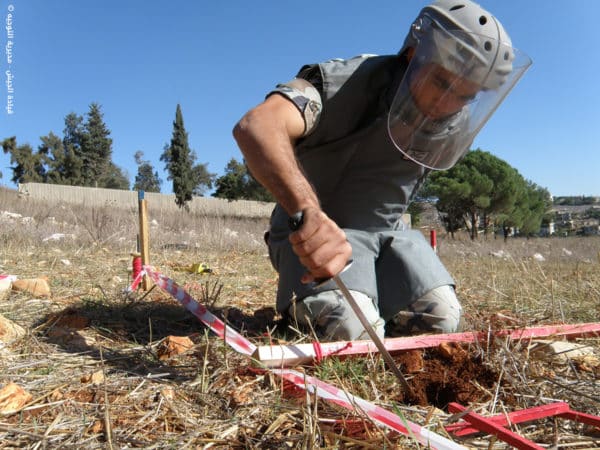
Lebanon has reached a major diplomatic and humanitarian stage by acceding to the Convention on the Prohibition of Anti-personnel Mines, better known as the Ottawa Convention. The deposit of the instrument of accession with the United Nations on 1 May 2026 puts the country on a new legal path. The Treaty will enter into force for Lebanon on 1 November 2026. From that date, Beirut will have to prohibit the use, production, transfer and storage of these weapons, and then organize the destruction of stockpiles and the clearance of mined areas under its jurisdiction.
That decision was not only a matter of international law. It is a very concrete issue for the Lebanese, especially in the South, along the Blue Line, in certain areas of the mountain and in areas marked by successive wars. Mines, unexploded submunitions and explosive remnants of war block agricultural land, threaten returns of internally displaced persons and impose heavy constraints on municipalities. Lebanon’s accession also comes at a time when recent hostilities have rekindled the risk of contamination and complicated access by demining teams.
The gesture is all the more significant as it occurs in times of crisis. For years, the Lebanese authorities had expressed political support for the humanitarian objective of the Convention, while invoking the security situation to postpone accession. The change of 2026 turned this prudence into a formal commitment. It requires the State to include in its laws, military practices and demining programmes a clear standard: anti-personnel mines can no longer be considered an acceptable defence tool.
Anti-personnel mines: regional accession
Lebanon thus became the 162nd State party to the Convention. This accession is regional in scope. Several countries in the Middle East remain outside the Treaty, including Israel, Syria, Iran, Egypt, Saudi Arabia and the United Arab Emirates. In this context, the Lebanese decision gives a political signal at a time when the global ban on mines is weakened by European withdrawals and by the return, in several conflicts, of security arguments favourable to these weapons.
The Convention on the Prohibition of Anti-personnel Mines is based on a simple idea: a weapon that continues to kill after the end of the fighting cannot be reliably controlled. A mine does not distinguish a soldier from a farmer, a fighter from a child, a military displacement from a family return. It remains active for years, sometimes decades. It turns the soil into a permanent threat. In Lebanon, this reality is not theoretical. It is part of the social, agricultural and security history of entire regions.
The text prohibits States Parties from using, developing, producing, acquiring, storing, retaining or transferring anti-personnel mines. It also prohibits aiding, encouraging or inciting anyone to engage in a prohibited activity. This formula has an important consequence. It is not just about military stocks. It governs military cooperation, transfers, training, doctrines and relations with other actors. For Lebanon, application must therefore be readable in the texts, but also in the chain of command and operational procedures.
However, the Treaty provides for a limited exception. A State may retain a minimum number of mines to train teams in detection, clearance or destruction. This exemption does not allow for the maintenance of a dormant military stock. It is aimed only at the safety of deminers and the quality of training. Lebanon will therefore have to declare the types, quantities and use of any mines retained for this purpose. This obligation introduces an additional degree of transparency in an area which has long been dealt with from the point of view of national security.
Bonds from November 2026
The entry into force on 1 November 2026 will open several specific deadlines. Lebanon shall submit a first transparency report no later than 180 days after that date. This document should detail national measures taken, stockpiles held or destroyed, known or suspected mined areas, means of marking, destruction programmes and warning measures to the population. This report will be a first test. He would say whether accession remained a diplomatic act or whether it became a verifiable action plan.
Two further deadlines now structure the Lebanese calendar. Stockpiles of anti-personnel mines must be destroyed no later than four years after entry into force, except for the quantities strictly necessary for training. Mined areas should be identified, marked, monitored and cleaned within 10 years. In fact, this sets two horizons: 2030 for stockpile destruction and 2036 for the completion of mine clearance obligations, subject to the Treaty’s extension mechanisms.
These deadlines are ambitious. They are for any contaminated state. They are more so for a country that is going through an economic crisis, security pressure in the South and a chronic weakness in its public finances. Humanitarian demining is expensive. It requires trained teams, detector dogs, mechanical means, reliable cards, insurance, fuel, protective equipment and strict procedures. A single sloping, rocky or woody terrain can mobilize weeks of work. Speed can never take precedence over safety.
The weight of Lebanese terrain
However, Lebanon has a significant achievement. The Lebanese Mine Action Centre, attached to the Armed Forces, has for years been coordinating clearance, risk education and victim assistance. National teams and specialized organizations have cleared many areas, destroyed explosive devices and installed sensitization mechanisms in villages. The country also has national mine action standards. This base explains why membership does not appear as a zero start, but as the formalisation of an already rooted practice.
However, contamination remains severe. The latest available data indicate that by the end of 2024 Lebanon declared 15.79 square kilometres of land contaminated with anti-personnel mines. To this area was added 4.67 square kilometres affected by submunition remnants. These figures do not summarize all the explosive hazards, as some areas remain suspect, inaccessible or under assessment. They nevertheless give the order of magnitude of the challenge. Behind each plot are orchards, roads, pastures, houses or access to infrastructure.
The majority of mined areas are in the South. Fields near the Blue Line often have conventional contamination, with mines laid in more structured lines or fields. Other regions, particularly in the north and around Mount Lebanon, bear the legacy of civil war, with less well documented settlements. Sectors close to the Syrian border also faced dangers related to improvised devices. This diversity complicates the work of the teams. Lebanon faces not only one category of contamination, but several historical layers.
Submunitions, returns and new risks
The 2006 war added a specific problem: unexploded submunitions. They are not anti-personnel mines in the strict sense of the Ottawa Convention, but they often have a similar effect on civilians. They disperse on agricultural land, remain unstable and explode in contact. Lebanon is already a party to the Convention on Cluster Munitions. His adherence to the Ottawa Treaty thus brings his commitments closer to two issues that cross the ground. For residents, the legal distinction is less than the ground hazard.
Recent conflicts have aggravated the equation. Since October 2023, regional war-related hostilities have led to new displacements and limited access by teams to certain areas of the South. Strikes at military depots or positions can create explosive device projections, called « kick-outs » by specialists. They disperse ammunition or dangerous fragments around the affected sites. Return of displaced persons becomes more risky, as residents find gardens, roofs, roads and fields modified by fighting.
The humanitarian issue is read in figures, but also in daily behaviour. Children play near damaged houses. Farmers are looking to join their olive groves. Shepherds move their flocks to less expensive land. Families cut wood, collect metals or recover materials from destroyed buildings. In an impoverished country, economic need sometimes pushes into dangerous areas. Risk education becomes as essential as demining itself.
Victims and agricultural land at the heart of the case
Victims are not limited to immediate deaths. A mine explosion destroys a leg, a hand, a view, a working capacity. It requires emergency care, repeated operations, long-term rehabilitation, prostheses, psychological support and social adjustment. It also affects families, often without income. The Convention obliges States parties to take into account assistance to victims. For Lebanon, this refers to a fragmented health system, high medical costs and rehabilitation services that depend heavily on partnerships.
The economic scope is just as direct. A mined land does not produce. A prohibited field deprives a family of crops. A dangerous road lengthens the journeys. A suspicious plot loses its value. Rural communities in the South, already weakened by destruction, cannot rebuild sustainably without reliable mapping and clean-up. Accession to the Convention may facilitate access to international assistance, but it will also require clear plans. Donors want priorities, timelines, indicators and control capacity.
Funding will therefore be a central issue. Mine action programmes have been affected in recent years by declining resources, inflation and insecurity. Operations in areas near the border have sometimes been suspended to protect the teams. This has slowed land release and shifted priorities to emergency response. Membership may attract new attention, but it does not automatically guarantee the necessary funds. Lebanon will have to transform the diplomatic capital of accession into operational support.
A choice of humanitarian sovereignty
The decision also raises a question of sovereignty. Lebanon affirms that the protection of civilians is part of its national security. This choice does not deny the threats facing the country. He answers by another logic: some weapons first undermine the population that lives around them. In a narrow territory, densely inhabited and crossed by moving front lines, the civilian cost of an anti-personnel mine often exceeds its military value. This analysis joins the experience accumulated by the villages of the South for several decades.
This is at a time when the international norm is fragile. Several European States had decided to withdraw from the Convention invoking the Russian threat. Other major powers have never become parties to the treaty. This sequence creates a contrast. Lebanon, a country in crisis and exposed to open conflict, chose to join the ban as other States rehabilitated mines in the name of territorial defence. The Lebanese message therefore goes beyond its borders. He recalls that security is not limited to possession of weapons.
At the regional level, this choice can fuel a broader debate. The Middle East remains a zone of weak universalization of the treaty. Unsolved arsenals, conflicts and prolonged occupation hinder the accession of several States. Lebanon alone cannot change this landscape. But it can use its new status to defend a humanitarian reading of mine clearance, seek technical assistance under the Convention and strengthen documentation on contaminated areas. His voice will be more audible in the meetings of States Parties than it was as an external State.
The first report as a test
National implementation will now have to follow. The Treaty imposes legislative, administrative and criminal measures to prevent and punish prohibited acts. The Government will therefore have to verify compliance with Lebanese law, clarify the responsibilities of the institutions, organize data collection and ensure coordination between the army, ministries, municipalities and partners. This work is less visible than an accession ceremony, but it will condition the credibility of engagement. A ban without a national mechanism remains fragile.
The first transparency report will be particularly observed. He would have to say what Lebanon had, what it did not possess, what it had destroyed, what it intended to retain for training and which areas should be treated as a matter of priority. He will also have to explain the warning measures for the populations. In a country where the contamination maps inherited from wars are not always complete, the exercise will be sensitive. It will require close cooperation between military authorities, humanitarian actors and municipalities.
The relationship with the international forces in the South will remain important. Demining operations in the Finul area protect local populations, as well as patrols and peacekeeping teams. Contamination affects more than 1,200 sectors and several million square metres in the area of operations. Past incidents show that mines and explosive remnants do not disappear as fighting declines. They create a slow, sometimes silent, war that begins when weapons are silent.
Lebanon’s accession to the Convention on the Prohibition of Anti-personnel Mines thus opens a practical phase. Dates are now known. The Treaty will enter into force on 1 November 2026. The first report is due in spring 2027. The destruction and clearance deadlines will extend over several years. In the meantime, people living in contaminated areas will mainly expect visible signs, clear messages, teams able to intervene and land made safe enough to return, work or rebuild a house.




