

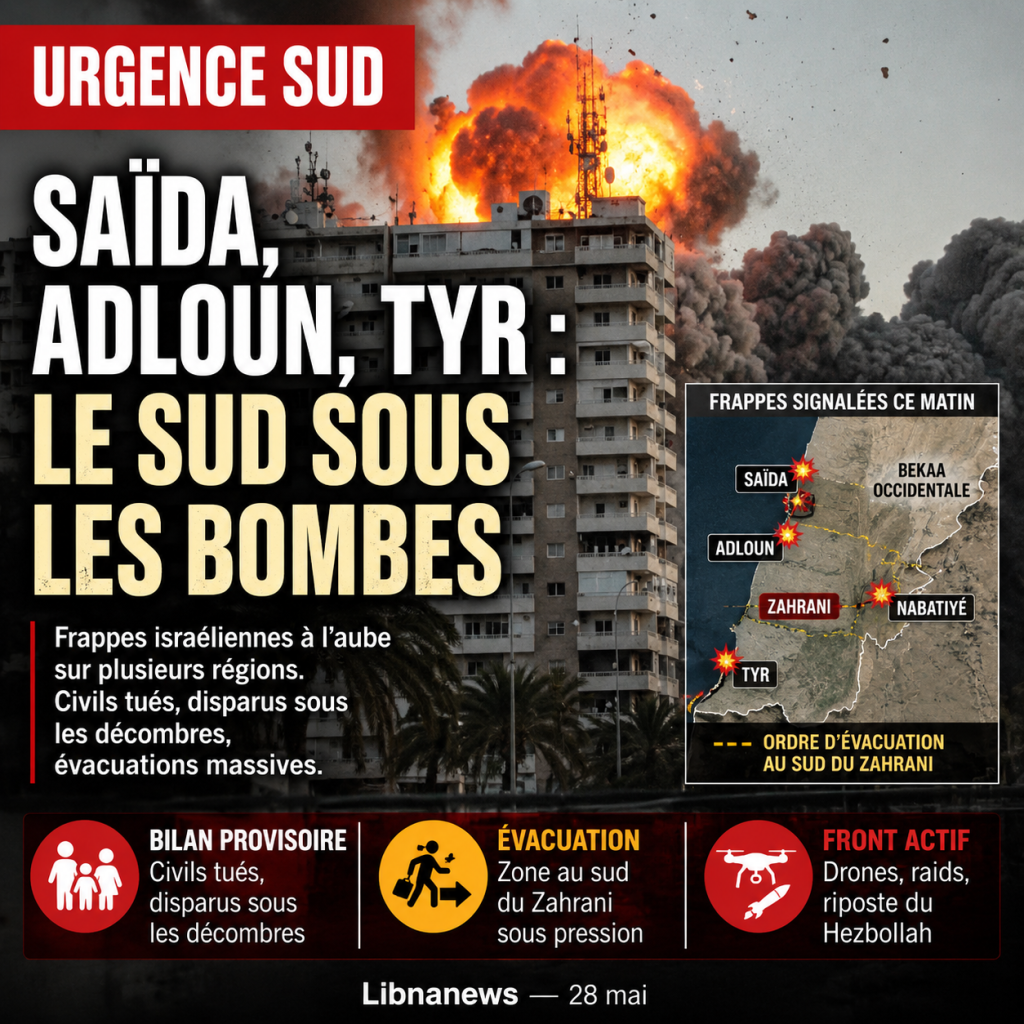
Lebanon woke up this Thursday, 28 May, under the shock of a new sequence of Israeli bombings, marked by strikes in Saida, Adloun, Tyre, Nabatiyah and the Western Bekaa. The human record remains provisional, but the first Lebanese reports already indicate that civilians have been killed, people wanted under the rubble, and increased pressure on southern roads. The war, despite the truce announced in April, is moving into a wider and more dangerous phase.
From Lebanon, the day begins with a double reality. On the one hand, Israel claims to expand its operations against Hezbollah infrastructure and declares the entire area south of the Zahrani as a combat space. On the other hand, Lebanese authorities, relief workers and media describe a campaign that strikes apartments, civilian cars, residential settlements, roads and the surrounding areas of vital infrastructure. South Lebanon is no longer just a military front. It becomes a territory under evacuation order, where each displacement exposes families.
Saida, Adloun: the human balance in the centre
The most serious point this morning concerns Saida and Adloun. In Saida, an Israeli air strike targeted an apartment in the Qiyah area. The first Lebanese reports indicate at least two deaths, while people are still under the rubble. In Adloun, on the coastal highway, an Israeli drone hit a civilian car near the Zahrani area. Available information indicates that the four passengers, one father, his wife and two children, were killed. This type of strike feeds Lebanon on the idea of extending the war beyond areas of direct confrontation.
The map of the bombings reported since dawn is not limited to these two attacks. raids also hit Kfar Joz and Habbush in Nabatiyah District, as well as the city of Tyre. Further south, Kafra, in Bint Jbeil District, was targeted. Other strikes were reported on the hill of Ali al-Taher, on Zghrine and Sejoud in Jezzine District, as well as in the vicinity of Wadi Barghaz, western Bekaa. A raid was also reported on Deir Zahrani in the early morning. This dispersal of strikes confirms simultaneous military pressure on the coast, the hinterland of Nabatiyah, the area of Jezzine and the Bekaa axis.
The national balance sheet provides the measure of escalation. The Lebanese Ministry of Health had already reported more than 3,200 deaths and more than 9,700 injuries since the resumption of the offensive on 2 March. The numbers are changing rapidly, as relief workers often work after several successive raids and in hard-to-reach areas. Since the ceasefire announced in mid-April, the World Health Organization has recorded several hundred deaths in Lebanon in Israeli attacks. These data reinforce the widely shared feeling in Beirut that the truce never offered real protection to civilians.
South Lebanon: an expanded evacuation zone
Tuesday, May 26 had already marked a shift. Israeli strikes in the south and east resulted in at least 31 deaths and 40 injuries according to the Lebanese authorities. Victims included women and children. Bourj al-Shemali, near Tyre, was one of the most affected areas, with a heavy impact in a densely inhabited area already weakened by displacement. The bombardments also reached Machghara, Maaraké, Habbush, Kouthariyet al-Riz, Selaa, areas close to the Qaraun Dam and several localities in Nabatiyah.
The Israeli army presented this wave as an operation against Hezbollah sites, depots, command posts and observation points. The Lebanese story insists on another aspect: the empty houses, the blocked ambulances, the cut roads, the families fleeing and the villages emptied by the evacuation notices. Both levels do not always exclude, but they do not produce the same reading. In Israeli press releases, the terrain appears as a military map. In Lebanese dispatches, it first appears as a succession of neighbourhoods, hamlets, buildings and families.
The Israeli order to evacuate the entire area south of the Zahrani River is the most serious change of consequence. The river flows about forty kilometres from the border. By asking the inhabitants to move north of this line, Israel is extending pressure far beyond the Litani, which was already a central benchmark of security arrangements. The area concerned covers a considerable part of southern Lebanon. It includes towns, towns, camps, farms, roads, hospitals and schools that already serve as shelters.
This decision has an immediate effect on the population. Families who had left the border villages to Tyre or Nabatiyah may have to leave further north. The shelters of Saida, the coast and the intermediate localities are coming under tension. Municipalities are looking for mattresses, fuel, water, medicines and reliable lists of displaced families. The roads to Saida and Beirut concentrate the departures. In cars, families mostly carry papers, magazines, clothing and medicine. The return has no date.
In Tyre, the evacuation order reactivated an old trauma. The city is a hospital, administrative and commercial center for much of the South. It also hosts internally displaced persons from localities already bombed. When such a city receives a threat of evacuation, the crisis goes beyond the military perimeter. Shops are closing. Taxis become a means of escape. Pharmacies are urgently selling treatments for several days. Fishermen stay at dock. Hospitals must prepare to receive injured people while seeing some of their staff and patients looking for an exit.
Zaoutar, drones and Hezbollah response
The land front remains active around Zawtar al-Sharqiyah, south of Nabatiyah and near the Litani River. Hezbollah claims to have rejected an Israeli incursion into the area. His press releases refer to rockets, artillery shells and heavy missiles fired at Israeli forces engaged in the riverbed, and then to short-distance fighting around a local scout complex. The movement claims that its fighters forced Israeli soldiers to retreat, before the Israeli army triggered fire belts in the area.
The Zawtar al-Sharqiyah area is of particular importance. It is located near the Litani, in contact with axes that connect Nabatiyah to the more southern areas. An Israeli push beyond the already controlled areas would be perceived in Lebanon as a dangerous expansion of de facto occupation. The so-called yellow line, drawn by Israel to guide its operations, does not correspond to any border recognized by Beirut or the United Nations. For the inhabitants, it means mostly forbidden villages, barred roads and goods left behind.
Hezbollah also claims the increased use of attack drones, including Ababil. The movement claims to have targeted a Merkava tank in Zawtar al-Sharqiyah, a rally of vehicles and soldiers on El-Khazzan hill, and a Hummer vehicle in Bint Jbeil during a filmed attack. Israeli media have reported in recent days casualties and injuries related to trapped drones. Israeli figures quoted in several media reports of soldiers killed since the cease-fire, a large proportion of them by explosive drones. These data partly explain the nervousness of the Israeli staff.
Hezbollah’s operational logic now seems more mobile. His press releases describe strikes against armoured personnel, bulldozers, Namer transport vehicles, newly established positions, air defence batteries and troop gatherings. The movement seeks to show that it retains a fire capacity despite the bombings. It also wants to impose a human cost on Israeli advances and prevent the peaceful settlement of a safe area. In the Lebanese account of the resistance, every drone that reaches an armoured vehicle is used to challenge the idea of total Israeli superiority.
The Israeli version remains different. Israel claims to be targeting Hezbollah’s infrastructure and justifies its evacuations by the ceasefire violations attributed to the movement. Its stated objective is to protect northern Israeli communities and repel the threat beyond the border. But in Lebanon, this justification is highly contested. The authorities and a large part of the Lebanese press point out that the strikes affect inhabited areas, that the inhabitants are driven out of entire areas and that the destruction creates a territorial fait accompli.
Infrastructure, relief and hospital pressure
The Qaraoun Dam and its surroundings add a strategic dimension to concern. The strikes near this area have rekindled the fear of damage to a vital infrastructure for water, irrigation and electricity production. Lebanese officials demand diplomatic protection of these facilities. The question is not only technical. In Lebanon, the memory of past wars always combines strikes on bridges, roads, gas stations and hydraulic structures with a country’s asphyxiation strategy. Every impact near Qaraoun revives this fear.
First aid workers work under increasingly difficult conditions. The civilian defence, Red Cross, medical scouts and local paramedics teams must enter areas where drones are still flying over the premises. Strikes have already hit or approached rescue teams in recent weeks. Delays to clear victims increase when roads are cut off or when residents fear a second shot. This fact explains why the balance sheets remain provisional several hours after an attack. It also explains the anger of families waiting for news near the rubble.
The Southern hospital system is under pressure. The settlements in Tyre, Nabatiyah, Saida and intermediate towns are managing war wounded, sick internally displaced persons, fuel shortages and blood requirements. Chronic patients become more vulnerable. Dialysis, cancer treatments, childbirth and ordinary emergencies continue in the midst of alerts. Doctors must decide who to transfer, where and by what road. In a number of sectors, medical time runs counter to military time.
Beirut in the face of an escalation beyond it
The Lebanese government is facing a known but aggravated dilemma. It calls for the cessation of attacks, respect for the ceasefire and Israeli withdrawal from the occupied areas. It must also meet Hezbollah’s international arms control requirements. Lebanese diplomacy tries to maintain channels with Washington, Paris and the United Nations, while military decisions often take place outside Beirut. This asymmetry feeds a sense of national impotence. Institutions must manage the dead, shelters and roads, without controlling the rate of escalation.
Finul is following this deterioration with concern. Its presence retains a witness value, but its action cannot prevent strikes or incursions alone. Villages near the Blue Line and villages further north now face comparable uncertainty. Residents do not know whether their locality is an immediate threat, a future evacuation order or an area that the Israeli army already considers to be prohibited. This uncertainty gradually emptys entire spaces, even when no direct strike has yet hit certain houses.
The regional dimension weighs on each movement. The war in Lebanon is part of a broader confrontation between Israel, Iran, the United States and their allies. Indirect negotiations around a regional arrangement influence the flexibility of the actors. Israel seems to want to consolidate gains in the South before any agreement that would limit its action. Hezbollah seeks to show that the Lebanese front cannot be treated as a secondary issue. For Beirut, this superimposition is dangerous. Lebanon pays the human cost of a war whose parameters exceed its territory.
This morning, therefore, the Lebanese situation is based on four elements. The human impact is increasing, with civilians killed in Saida and Adloun and victims still wanted. Israeli strikes spread over several axes, from Tyre to Nabatiyah, from Jezzin to the western Bekaa. Hezbollah claims sustained operations against Israeli forces, especially around Zawtar al-Sharqiyah and using drones. Finally, the evacuation order south of the Zahrani transforms the military crisis into a massive displacement crisis.
The next few hours will depend on the ability of relief to reach the affected buildings, the updating of the health record and the response of Hezbollah to the new strikes. They will also depend on traffic on the roads to Saida and Beirut, while families are still looking for a safe place. In the south, residents follow warnings, municipal messages and military communiqués. The next official report will tell if the bodies reported under the rubble in Saida have been found.




