

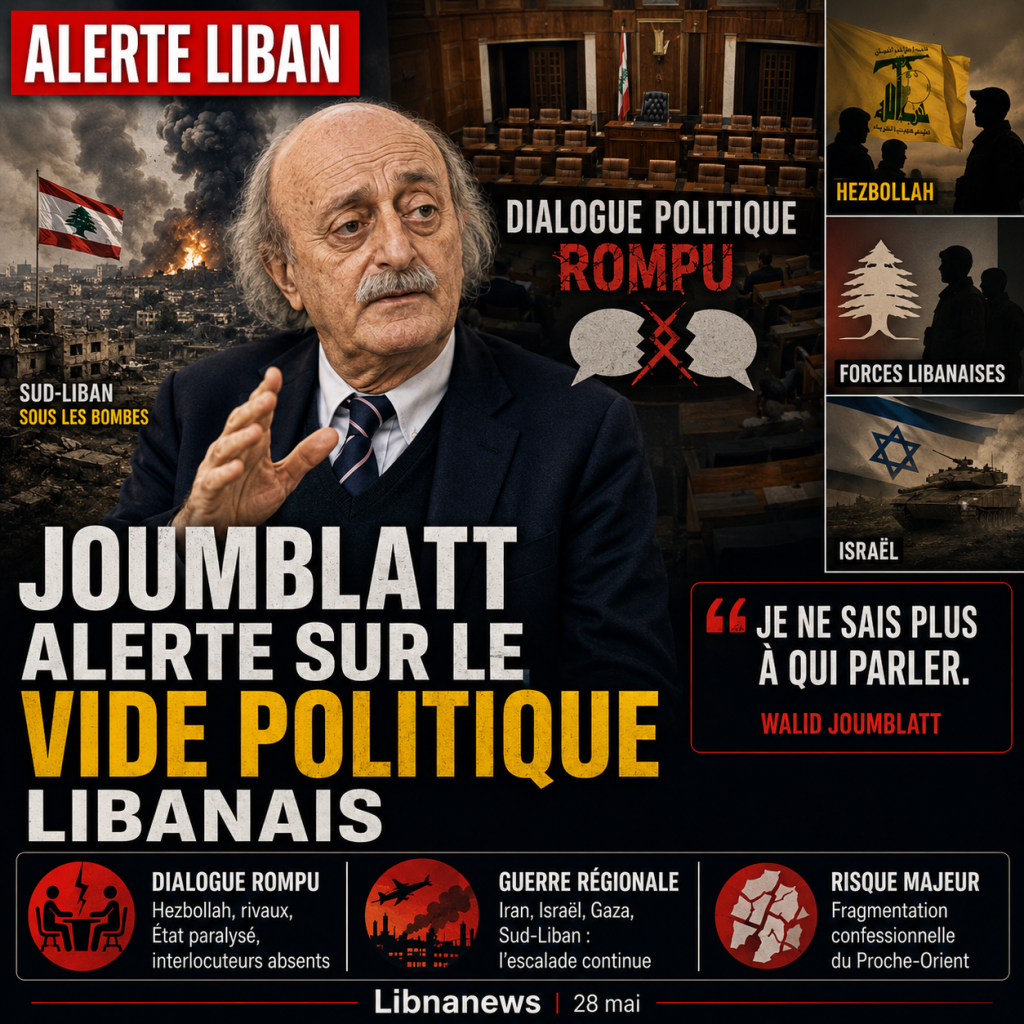
Walid Jumblatt chose a moment of strong regional tension to draw up a finding of rare severity on the state of Lebanon and the Middle East. The former president of the Progressive Socialist Party, who remains one of the most listened voices on the Druze and Lebanese scene, expressed deep pessimism in the face of the war with Iran, the Israeli escalation in Gaza and South Lebanon, and the collapse of the dialogue between Lebanese forces. His comments, reported by the Lebanese press on the basis of an interview with a French daily newspaper, are not merely a matter of criticism. They paint a portrait of a country where political channels close as military fronts widen.
Walid Jumblatt in the face of a break in dialogue
The signal is all the stronger as Walid Jumblatt has often acted as an intermediary in Lebanese crises. He faced Hezbollah, got close, and then tried to maintain lines of discussion with him, even when the disagreements were deep. This time, he says he doesn’t know how to talk to the party anymore. The formula reflects a political rupture, but also a broader concern. It means that one of the most broken Lebanese actors in compromises believes that traditional dialogue mechanisms no longer work. In a Lebanon exposed to shelling, displacement and foreign pressure, this word takes the form of a warning.
The heart of the statement is the relationship with Hezbollah. Joumblatt claims that he could dialogue with Hassan Nasrallah before the death of the former secretary-general of the party in an Israeli strike in 2024. He believes that the current leadership is now under more direct Iranian influence. This assessment remains his own. It is politically heavy because it comes from a leader who has long sought to distinguish Hezbollah as a Lebanese actor and Hezbollah as a component of a regional axis. By saying that the interlocutor has disappeared, he does not dispute only a strategic line. It describes the loss of a personal channel, therefore a mode of regulation.
In the Lebanese system, personal relations have often compensated for the weakness of the institutions. Calls, visits, discreet mediations and messages from relatives have sometimes prevented open breaks. Joumblatt implicitly recalls this method. With Nasrallah there was, according to him, a space to speak, even in distrust. After 2024, he felt that this space had been reduced. Lebanon then loses an unwritten but decisive mechanism. When parties no longer speak, crises move faster from polemic to confrontation, especially when military ground imposes its own timetable.
Criticism against Hezbollah’s opponents
This concern is not limited to the Hezbollah camp. Joumblatt also targets his opponents. It describes opponents who have become rigid, unable to produce a solution other than denunciation. His formula against Samir Geagea, leader of the Lebanese Forces, was noticed. By comparing him to a certain prophetic figure of his truth, he criticizes less one person than a political climate. Each side believes that it is the bearer of national salvation. Each accuses the other of delivering the country. Between these competing certainties, the space of the state is shrinking. The Lebanese then find themselves confronted with closed speeches, in a period that would require realistic arrangements.
The Druze chief thus calls into question a double impasse. Hezbollah, according to him, sinks into Iranian alignment. Its opponents, on the other hand, are hardening to the point of speaking only in terms of political eradication or permanent indictment. This symmetry does not erase the respective responsibilities. Rather, it shows that the Lebanese scene no longer produces common language. However, the country needs a minimum vocabulary to discuss the ceasefire, the army, Hezbollah weapons, protection of the South, internally displaced persons and international safeguards. Without this language, each meeting becomes a trial scene.
The voice of reason in the face of the cost of compromise
The formula on the voice of the lost reason summarizes this alert. It refers to a Lebanon where positions are built mainly by reaction. An Israeli raid reinforced the supporters of the resistance. An attack by Hezbollah reinforces the supporters of immediate disarmament. An American statement hardens both sides. Arab mediation is immediately suspected of serving an axis. In this spiral, political rationality does not disappear because those responsible would be unable to think. It disappears because the public cost of compromise becomes too high. No camp wants to appear like the one who gives in.
The moment chosen by Jumblatt counts. South Lebanon is undergoing a new phase of escalation, with Israeli strikes, evacuation orders and an extension of the area considered by Israel as a combat space. The southern localities from Nabatiyah to Tyre live under pressure. Displaced families move even further north. Diplomatic discussions continue, but the inhabitants first judge the facts with the noise of the drones, the roads cut off and the human balances. In this context, Jumblatt’s criticism of Israeli impunity joins a widespread perception in Lebanon.
Israel, Gaza and South Lebanon in the same diagnosis
His speech on Israel is frontal. He denounced what he saw as a green light for the destruction of Gaza, the shelling of southern Lebanon and the continuation of settlement in the West Bank. This judgment is part of a historical reading of the conflict. For Jumblatt, Benjamin Netanyahu’s government is not only conducting a short-term military campaign. It would push an old project, based on a logic of expansion, fragmentation and regional domination. This reading is shared by an important part of Lebanese opinion, including beyond the Hizbullah-friendly audience.
The central charge concerns fragmentation. Jumblatt warns against an Israeli project to encourage sectarian, religious or tribal entities in the region. Fear is not new. It has been going through Arab political thinking for decades. Today it is reactivated by Syrian fractures, the war in Gaza, violence in southern Lebanon and tensions around Druze communities in Syria. In its analysis, Israel would benefit from weakened, divided and deprived societies of central authority. Lebanon, a fragile religious state, then appears to be one of the most exposed lands.
This reading also explains its refusal to accept a purely internal Lebanese speech. For Jumblatt, the disorder of Lebanon cannot be separated from the regional war. The issue of Hezbollah’s weapons is not just a constitutional article or a government decision. It concerns the destruction of villages, the occupation of parts of the territory, the fear of Shia families in the South and the absence of a credible international guarantee. This approach does not regulate the State’s monopoly of force. It recalls, however, that a disarmament imposed in a climate of war may have the opposite effect.
The war against Iran as a background
The war against Iran is further widening this diagnosis. Jumblatt predicts his continuation and asserts that many actors have an interest in its extension. It cites the weapons, oil, technology and artificial intelligence sectors. Its formula on rising markets and gold is a classic political critique of war economies. It aims to show that local destruction can generate gains elsewhere. In this reading, people pay the human price while economic and strategic sectors benefit from chaos. Lebanon has long known this paradox.
For Beirut, the Iranian-American or Iranian-Israeli war is not a distant theatre. It directly influences South Lebanon, Hezbollah calculations, Israeli pressure, fuel prices and the position of the Gulf countries towards the Lebanese. If the Iranian front intensifyes, the Lebanese front becomes more vulnerable. If regional negotiations are opened, Lebanon can become a map in a wider bargaining. Jumblatt seems to fear both scenarios. In the first, the country undergoes escalation. In the second, it may be treated as a secondary issue, behind nuclear, Ormuz or American bases.
Fear of community enclaves
His speech is also addressed within the Druze community. Since the war in Syria and the tensions around Sueda, Jumblatt has refused the idea of Israeli protection of the Druze. He sees this temptation as a trap leading to the enclaving and dislocation of States. This position clarifies his current statements. When it speaks of regional fragmentation, it does not only target Shiites, Palestinians or southern Lebanese. He also thought of the minorities that might be separated from their national environment by powers. Its line remains that of integration into reformed states, not external protection by denominational segments.
This consistency gives its pessimism a special significance. Joumblatt is not a manager outside the system. He knows the compromises, the violence, the reversals and the limits. He himself sailed between conflicting alliances, like many Lebanese leaders. His observation therefore does not come from a distant moral position. He comes from an experience of Lebanese power. When he says he can no longer find an interlocutor, he has been speaking since an ancient practice of mediation. That is precisely what makes his statement alarming. She suggested that the informal architecture of the country was no longer enough to contain shocks.
The long line of the Lebanese Forces in question
Samir Geagea’s question illustrates this closure. The Lebanese Forces have long defended a hard line against the Hezbollah arsenal. They believe that the state cannot survive with an independent armed force linked to Iran. This position has a real echo, especially in a part of Christian and sovereignist opinion. But Jumblatt criticizes the way this line is formulated. He feared a policy of rupture that would place one part of the country against another. In Lebanese memory, the transformation of a national disagreement into a Community confrontation remains the most feared scenario.
The difficulty lies in the absence of a credible central proposal. Hezbollah claims that weapons are still needed as long as Israel is occupying, bombing and threatening. Its opponents respond that these same weapons attract war and prevent the state from deciding. Between these two statements, there is a lack of mechanism. Who protects the villages of the South during a transition? What place for the Lebanese army? What calendar? What international guarantees? What role for resolution 1701? What treatment of occupied or disputed areas? As long as these questions remain unanswered, each side keeps its story and accuses the other of bad faith.
A third political grammar still fragile
Joumblatt seems to be looking for a third political grammar. It does not deny the necessity of the State or the Israeli danger. It does not sacralize Hezbollah’s weapons, but refuses to treat them as an isolated object of war. It does not exculpate Iran, but does not reduce the conflict to Iranian influence. It did not join calls for a separate peace with Israel, but insisted on a truce, a halt to strikes and real protection of civilians. This line is difficult to sell in a polarized country. It obliges each side to recognize part of the problem that its discourse prefers to avoid.
Hezbollah’s expected response will tell a lot about the political climate. The party can ignore Joumblatt’s words, respond dryly or try to preserve a channel with the PSP of Taymour Joumblatt. The shade counts. A brutal response would confirm the idea of a broken dialogue. A measured response would indicate that wires remain, even if weakened. The Lebanese Forces will also have to choose between the personal reply and the political argument. In a period of war, the words of the chiefs never remain in the salons. They travel through media, villages, social networks and partisan meetings.
The Lebanese landscape thus enters a phase of great nervousness. Institutions are still trying to speak on behalf of the state, but parties impose their red lines. The South is waiting for the strike to stop. Internally displaced persons are awaiting shelter and guarantees of return. Diplomats expect interlocutors capable of engaging. The families expect that the war will not spread. In the midst of these expectations, Walid Jumblatt puts words on a political vacuum: he no longer knows who to speak to, nor by what language to bring Lebanese actors back to a minimal discussion.
The message finally arrives when the generational transmission of the PSP remains observed. Taymour Jumblatt is the official leader of the party, but his father’s words retain regional weight. This distribution creates a unique situation. The former leader can speak with greater freedom, while the partisan apparatus must manage the daily balances in the Mountain, in Parliament and with other formations. The words reported are therefore not only those of a concerned veteran. They are also a signal to allies, opponents and mediators who are still looking for a gateway to the Lebanese crisis.




