

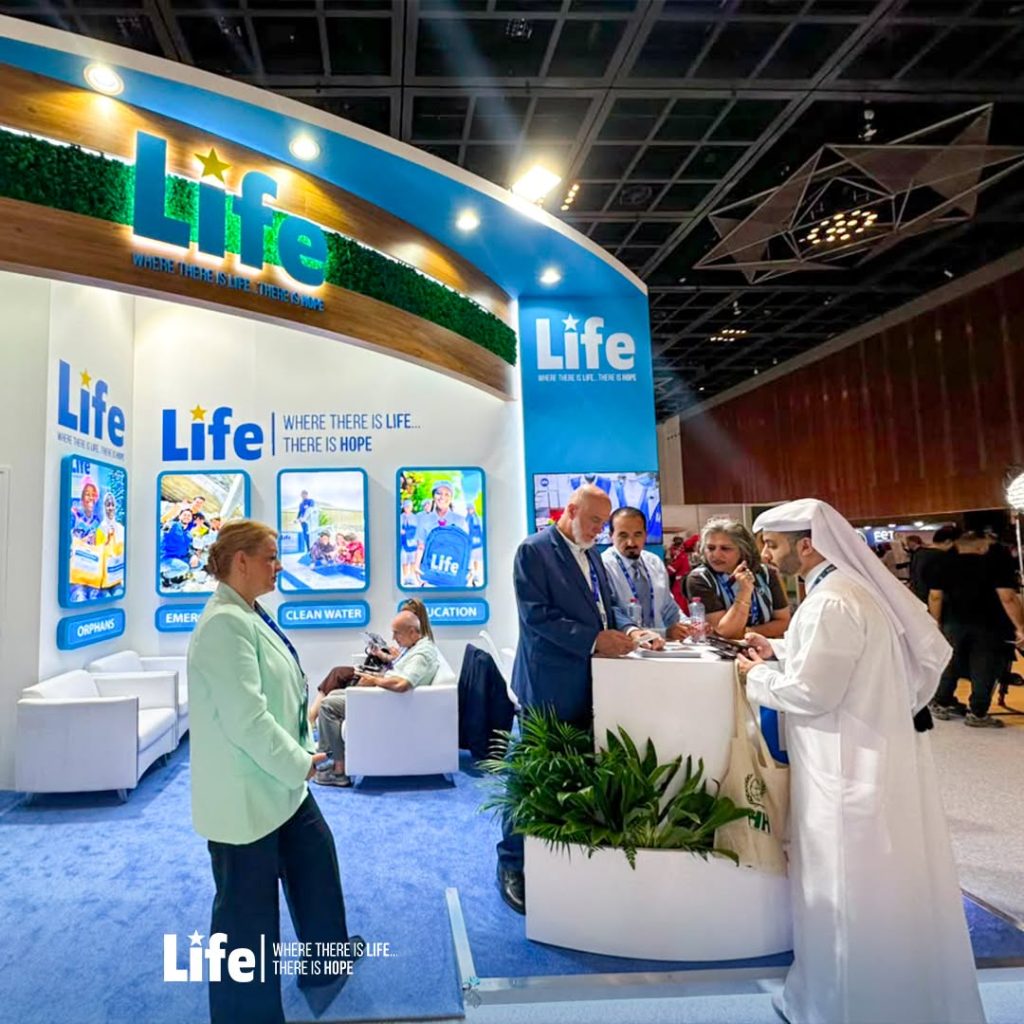
The Dubai International Forum on Humanitarian Aid and Development (DIHAD 2026) closed its activities at the Dubai World Trade Centre, under the theme« Humanity in Transition and Building the Future of Humanitarian Action ».
The event brought together many humanitarian agencies, relief organizations, government authorities and experts from around the world to discuss the growing challenges facing populations affected by wars, disasters and the worsening of humanitarian crises, particularly in the Middle East.
This edition comes at a time when the global humanitarian system is undergoing rapid transformation, driven by complex crises, increased humanitarian needs and changing operational environments. This situation forces humanitarian agencies and organizations to rethink traditional intervention mechanisms and develop more flexible, innovative and sustainable models.
21,000 participants from 165 countries
Life for Relief and Developmentwas among the main participants.Khalil Meek, director-general for the development and development of the organisation ‘ s resources, stressed that the forum aims to anticipate the future of humanitarian action in the face of the proliferation of wars, conflicts, climate disasters, economic crises and population displacements, as well as technological developments and funding gaps.
The aim is to exchange experiences, strengthen partnerships and develop practical and sustainable solutions for the poorest and most vulnerable populations.
He said:
« Life was one of over 21,000 participants and visitors from 165 countries, along with more than 1,000 organizations, partners and institutions active in the humanitarian sector. Some 320 speakers attended more than 260 sessions and workshops. The forum also brought together the International Red Cross and Red Crescent Movement, academic and research institutions, the private sector, charitable and donor organizations, financial institutions and development banks, as well as the media.
» The forum provides a forum for policy makers, experts, stakeholders, donors and organizations with innovation and technology tools. This allows for the development of more integrated responses to humanitarian crises and offers humanitarian organizations the opportunity to exchange, share experiences and explore new opportunities for cooperation and partnership. »
Life: at the heart of the terrain and the rapid response
Dr. Abdul Wahab Alawneh, Director of the Life Regional Office for the Middle East, stressed that the future of humanitarian action, in light of Life’s 33 years of experience in the field, requires continuous improvement.
He said:
» We presented our proposals on the role of leadership, innovation and partnerships in the development of humanitarian action, in order to make it more able to adapt to the rapid changes in the world. We focused on how to transform ideas into concrete realities, improve implementation and operational effectiveness, measure results and transform the ideas and commitments formulated at the forum into practical solutions with a real and lasting impact on communities in need.
« At a time when humanitarian organizations are called upon to improve their capacity to anticipate needs, prepare for crises, optimize resource management and reach affected populations more quickly and effectively, Life has been distinguished in recent years by its presence at the heart of crises from day one.
» This was particularly the case during the earthquakes and floods in Libya, Morocco and Türkiye, as well as in conflict areas, particularly in Gaza and Lebanon, where Life managed to reach remote civilian areas under bombardment, to which humanitarian aid could not reach. »
The forum also addressed the importance of developing more anticipatory humanitarian models so that the response is not limited to responding to a disaster but also includes upstream preparedness, building community resilience and reducing future needs.
This implies passing throughresponse to preparedness, isolated efforts to partnerships and temporary solutions to a sustainable impact.
More effective partnerships
Nada Haroun, Director of the Jordan Life Office, said:
» Our presence here is not a mere participation. It represents a mission, a team and a work of which we are deeply convinced of the importance. The development of humanitarian action is no longer the responsibility of a single organisation or State. It is a collective responsibility that requires continued international cooperation, more effective partnerships, more sustainable funding and responses that place the human being, his dignity and his ability to build a safer future at the heart of humanitarian action.
» Last year, Life received the Dubai Humanitarian Award for the most effective partnership, in recognition of its housing camp project in the Gaza Strip. This year, we have entered into a new partnership with the Red Crescent of the United Arab Emirates, which will help to strengthen the delivery of aid and support to the vulnerable and most deprived populations. »
Transparency: a safe bridge between donors and people in need
It continues:
» The forum addressed the issue of donor transparency through strengthening the regulation of charitable work, strengthening donor confidence and ensuring that donations reach recipients through approved channels.
» These principles distinguished Life and contributed to its ranking as the third largest humanitarian aid organization in the world and fifth among the best organizations operating in Palestine in the area of poverty reduction. These results enabled him to obtain a 100 per cent rating from Charity Navigator, in addition to his accreditation by the United States Agency for International Development (USAID) and his selection of the best humanitarian organizations in the United States by Impactful Ninja, with expenditures of $666 million. »
These principles are becoming increasingly important with the increased use of digital platforms for the collection of donations and the launch of humanitarian campaigns. Transparency and verification of donor-gathering agencies is thus becoming essential to protect donors and ensure that resources are directed to those who need them most.




