






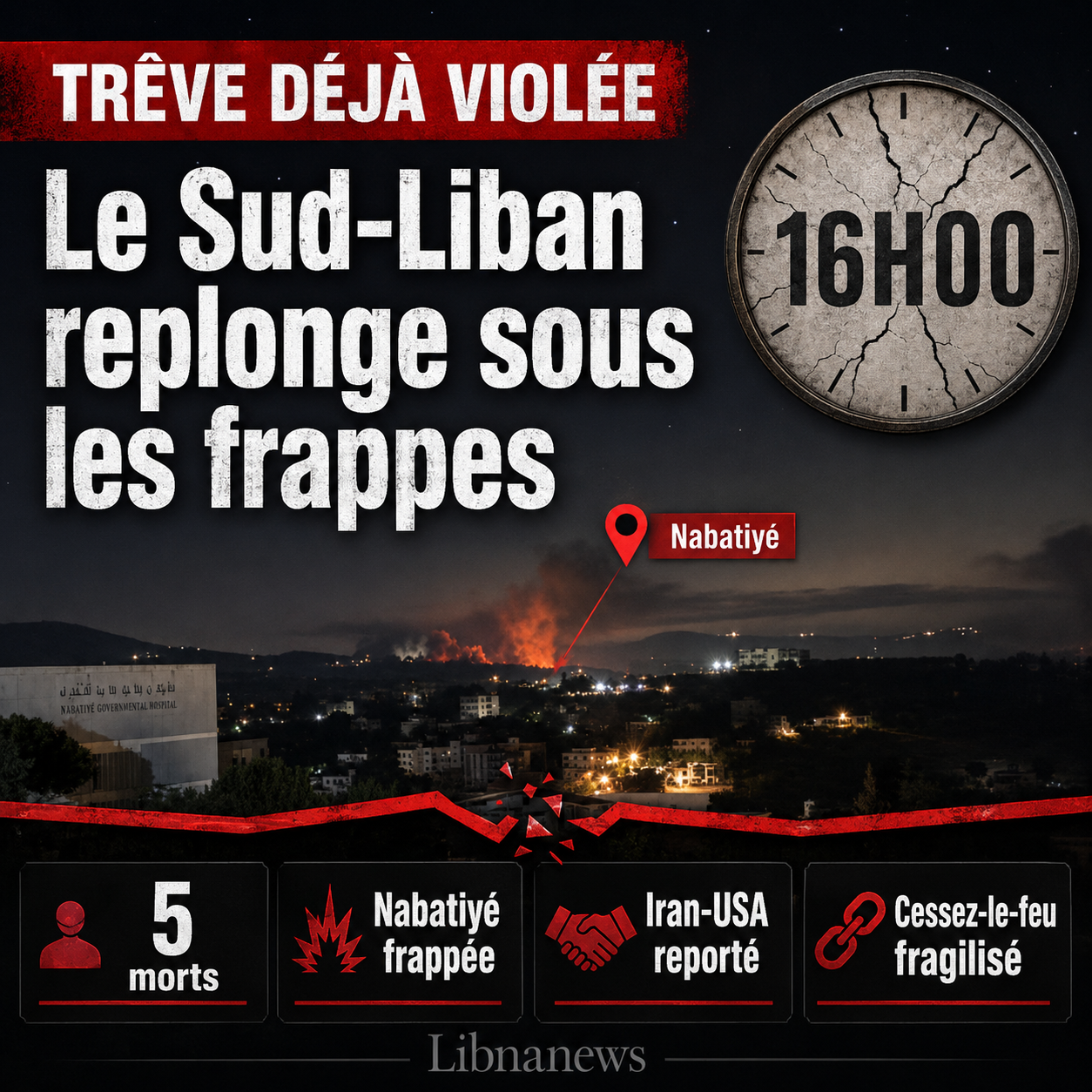
In South Lebanon, the ceasefire announced on Friday did not stand up to the early hours of its implementation. On the night of Friday to Saturday, Israeli airstrikes, artillery and drone attacks hit several areas of the Nabatiyah area, according to reports from Lebanese media and an international news agency. At least five people were killed. This new military sequence already weighs on the regional diplomatic calendar. The technical discussions between Iran and the United States, which were to open in Switzerland, have been postponed, while Tehran is now more clearly linking the continuation of the dialogue with the halting of Israeli operations in Lebanon.
An immediate fragile ceasefire in southern Lebanon
The South Lebanon was to enter a new phase of de-escalation on Friday afternoon. The ceasefire agreement between Israel and Hezbollah had been confirmed by American, Israeli and Lebanese Shiite sources. Its entry into force was announced at 4 p.m. local time. A few hours later, however, the inhabitants of several southern localities heard new explosions.
The bombings mainly targeted the Nabatiyah area. According to the Lebanese official agency, Israeli warplanes and drones carried out several attacks during the night. Residential buildings and houses were destroyed. Gunfire also hit Nabatiyah and its surroundings before dawn. These elements confirm the fragility of a ceasefire as an immediate test for American diplomacy and indirect dialogue between Washington and Tehran.
The human count reported on Saturday morning reported at least five deaths. It is still likely to evolve, as the strikes have affected inhabited areas and buildings already weakened by previous waves of bombing. In the villages of the South, relief operations remain difficult. Roads were damaged. Drones continue to fly over several sectors. The inhabitants hesitate to move to the places hit, for fear of a second attack.
Timeline is central. The ceasefire was to reduce military pressure in an area that had become one of the blocking points on the Iranian case. On the contrary, it was followed by a resumption of strikes. This situation allows each actor to challenge the sincerity of the opposing commitments. Israel claims to act against Hezbollah-related threats. Hezbollah presents its fire and actions as a response to the Israeli military presence and raids. The Lebanese Government denounces a violation of its sovereignty.
Strikes in an area already tested
This new wave does not arise in a military vacuum. In the previous days, several areas of Nabatiyah Governorate, Jezzine District and Bint Jbeil District had already been reported as affected. Mifdoun, Choukine, Rihane, Hadatha-Haris and Kfar Tebnit are some of the localities or axes mentioned in the available information. The area of Kfar Tebnit appears particularly sensitive, as it is close to the axis of movement and contact areas.
Drone strikes against vehicles have marked several recent episodes. In Mifdoun, a first attack reportedly targeted a vehicle and then a second strike occurred after people arrived at the scene. This type of chain increases the risk to rescue, residents and journalists. It also maintains the fear of approaching bombed areas, even after the apparent end of a raid.
In and around Choukin, drone attacks have also been reported. Further east, artillery fire targeted the outskirts of Rihane, in the district of Jezzine. This relief area gives access to important roads to Nabatiyah. It has already been struck since the expansion of Israeli operations in Lebanon. Further south, the Hadatha-Haris axis in Bint Jbeil District was also mentioned in local information.
These points draw a scattered confrontation map. The bombings are not limited to a single front line. They touch villages, roads, heights and secondary axes. This complicates the practical implementation of the ceasefire. A truce can be announced at the political level, but it remains difficult to translate on the ground if the contact lines are not clearly stabilized.
South Lebanon: the key word for a regional arm
South Lebanon has become more than a local military theatre. It now serves as a barometer for the balance of power between Israel, Hezbollah, Iran and the United States. Each strike has an effect that goes beyond the affected village. Each shot feeds a broader discussion on the Israeli withdrawal, the status of Hezbollah, the security of northern Israel and Washington’s ability to influence its ally.
The core of the dispute is the very definition of the ceasefire. For Lebanon, a lasting cessation of hostilities requires an end to the bombings and respect for its sovereignty. For Hezbollah, it also implies the withdrawal of Israeli forces from areas still occupied or controlled by Israel. For Israel, the truce must not prevent strikes against what its army calls immediate threats. These three readings make the agreement unstable as soon as it enters into force.
The Israeli position is based on a security logic. Israeli authorities say they want to prevent Hezbollah from rebuilding military capabilities south of Litani and near the border. They suggest the risk of rockets, anti-tank missiles, drones or infiltration. This approach leads the Israeli army to maintain the possibility of targeted actions, even during a period of ceasefire.
Lebanon sees this doctrine as an open door to repeated violations. The Lebanese authorities consider that Israeli strikes prevent a return to minimal normalcy in the South. They recall that border villages have suffered massive destruction, displacement and sustained economic paralysis. Families who try to return often find uninhabitable homes, cut roads and dangerous agricultural land.
Hezbollah uses this reality to maintain its armed legitimacy. The movement claims that it responds to the strikes and occupation. He avoids presenting his operations as an autonomous break of the truce. He puts them in a response logic. The purpose of this communication is to show that resistance remains necessary as long as Israel maintains positions in Lebanon or continues its bombing.
Iran-US talks caught up with bombs
The postponement of discussions between Iran and the United States gives immediate diplomatic significance to the strikes in South Lebanon. These talks were to open a so-called technical phase, following the announcement of a memorandum of understanding between Washington and Tehran. The planned meeting in Switzerland was intended to allow us to go into unresolved details, including Iran’s nuclear issue, sanctions, security guarantees and regional de-escalation modalities.
According to the American press, the US Vice President’s move to Switzerland was postponed. The White House invoked logistical reasons. However, several media reports link this delay to the fragility of the ceasefire in Lebanon and the resumption of Israeli strikes. This shade is important. Washington is not officially presenting the bombings as the only cause of the postponement. Tehran, on the other hand, clearly uses the situation in Lebanon to justify a slowdown in the process.
Iran claims that an agreement with the United States cannot move forward if Israel continues its operations against Hezbollah in Lebanon. The message targets two recipients. First, he addressed Washington, which was ordered to prove that he could contain his Israeli ally. He also addresses Hezbollah, which Tehran does not want to give the impression of sacrificing in bilateral negotiations with the United States.
This articulation between the Lebanese front and the Iranian-American discussions changes the nature of the crisis. The bombing of the South is no longer just a security issue between Israel and Hezbollah. They become a variable in Iran negotiations. They may slow down, harden or suspend a diplomatic sequence presented as necessary to stabilize a part of the Middle East.
Washington faced with the limits of its influence
The United States is in an uncomfortable position. They supported the ceasefire agreement in Lebanon and at the same time sought to preserve their strategic relationship with Israel. They also want to keep the path of dialogue with Tehran open. These three objectives contradict each other as soon as the bombings resume. The more Israel strikes in southern Lebanon, the more Iran can accuse Washington of not controlling the regional game.
The problem goes beyond communication. If the United States fails to guarantee an effective reduction in hostilities in Lebanon, its ability to enforce a broader agreement with Iran will be questioned. Tehran may then require additional guarantees. Israel may refuse to feel bound by a text it has not negotiated. Hezbollah can consider that only the ratio of military force allows it to preserve its positions.
The American pressure on Israel is therefore a decisive factor. Signals to this effect have been reported in recent days. Washington would have insisted on the need to respect the de-escalation framework and not compromise the negotiating window with Iran. But the strikes reported after the truce came into effect show that this pressure remains, for the time being, insufficient or contested.
Israel has its own priorities. His Government refused to let Hezbollah rebuild its capabilities in southern Lebanon. He fears that a ceasefire that is too strict will allow the movement to reorganize under cover of a return to calm. This fear weighs heavily in military decision-making. It reduces the American margin of manoeuvre, especially if the Israeli authorities consider that the text negotiated between Washington and Tehran does not sufficiently take into account their security requirements.
Lebanon caught between humanitarian emergency and regional calculations
For the people of South Lebanon, these diplomatic balances remain distant. Their immediate reality is that of bombing, displacement and uncertainty. The affected villages live at the pace of alerts, drone overflights and roadblocks. Displaced families are waiting to know if they can return. Those who have remained face the risks of further strikes and the collapse of basic services.
House destruction worsens the social crisis. In several localities, residents have already lost their agricultural income, businesses or vehicles. The resumption of the bombings prevented the repair of infrastructure. Schools, dispensaries and water systems suffer repeated interruptions. Every new strike pushes the prospect of an organized return.
The Lebanese State has limited resources. It can denounce violations, mobilize diplomacy and seek the support of international partners. But its ability to impose effective security on the South remains limited. The Lebanese army is in a delicate position. It must affirm national sovereignty without causing direct confrontation with Israel or entering into internal confrontation with Hezbollah.
This institutional weakness gives more weight to armed actors and external mediators. The United States, France, Qatar and other intermediaries can facilitate arrangements. But these arrangements remain vulnerable if military actors believe that the ground offers them better advantages than the negotiating table. South Lebanon thus becomes a space where diplomacy runs behind events.
A truce each of which tests the limits
The sequence of 19 and 20 June shows that the ceasefire works less as a net cessation of hostilities than as a grey zone. Everyone tests what’s allowed. Israel seems to want to retain the ability to hit targets it considers threatening. Hezbollah wants to prevent the truce from freezing an Israeli presence in Lebanon. Iran uses the Lebanese file to strengthen its demands against the United States. Washington is trying to save an already fragile diplomatic dynamic.
This grey area increases the risk of error. A hit on a vehicle can trigger a response. A response can lead to a new salve. A local incident may involve a diplomatic meeting in Geneva or elsewhere. The actors know this risk, but they accept it because they refuse to yield on their red lines.
The calendar increases this tension. The technical phase of the Iran-US discussions was to open a 60-day window. This period was intended to clarify the issues outstanding in the Memorandum of Understanding. The postponement of the initial meeting shows that this window can close even before producing results. South Lebanon thus becomes the first concrete test of the strength of the regional agreement.
The situation also remains dependent on how violations will be qualified. If Washington presents them as limited incidents, Iran can denounce a dual language. If Tehran suspends its participation too quickly, it will be responsible for a diplomatic blockage. If Israel continues the strikes, it may appear as the actor that prevents de-escalation. If Hezbollah intensifyes its fire, it will offer Israel an argument to expand its operations.
Next hours as the first verdict
The next few hours will say whether the ceasefire can still be saved or whether it has only been a declarative pause. The number of strikes, the scale of the responses and the American response will be decisive. A real drop in bombings could quickly reprogram discussions between Iran and the United States. A new night of attacks would make this scenario more difficult.
The Lebanese Government should continue to seize its international partners. He will seek condemnation of the strikes and stronger pressure on Israel. But Beirut knows that its influence remains limited without external consensus. Lebanese diplomacy can document attacks, alert the United Nations and demand the application of the truce. It cannot, alone, prevent drones or artillery from acting.
For Tehran, postponing discussions is a lever. Iran can condition its return to the table to a more credible calm in South Lebanon. But it must avoid completely breaking the process, because the agreement with Washington also meets its own needs. Sanctions, nuclear issues and regional safeguards remain at the heart of its interests. Lebanon is becoming a means of pressure, not just a reason for failure.
For Israel, the dilemma is the opposite. Continuing strikes can meet an immediate military requirement. But it can also build relations with Washington and complicate the Iranian case. The Israeli army maintains the initiative on the ground. The diplomatic cost of this initiative will depend on the American response and the ability of the ceasefire to produce, even late, a visible drop in fighting.
In southern Lebanon, the people are waiting mainly for the explosions to end. On Saturday morning, the truce announced the previous day had already given way to a new human balance and destroyed buildings in the Nabatiyah area. Iranian and American negotiators will now have to deal with this reality, while the next date of their discussions remains suspended from the evolution of the ground.