

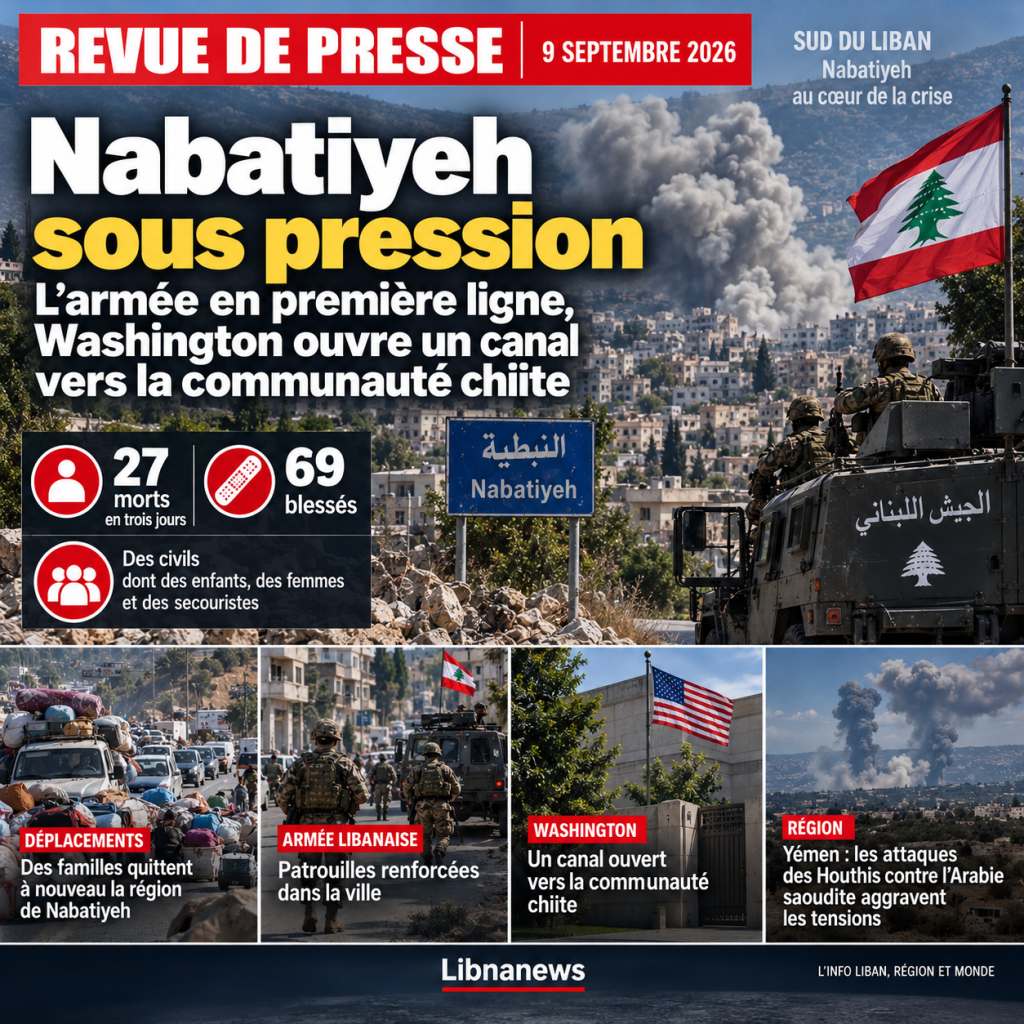
Nabatiyeh becomes the centre of gravity of the crisis in the South
The situation in Nabatiyeh and its environment is very much in control of the 9 September 2026 press. Several Lebanese publications describe the same sequence: Israeli military pressure increased after developments on the heights of Ali al-Taher, the fear of an extension of operations towards Nabatiyah settled among the inhabitants, and the Lebanese authorities intensified their political and diplomatic contacts. At the same time, the Lebanese army has strengthened its activity in the city. The newspapers therefore agree on the seriousness of the situation, but differ on the interpretation of the military movement and on the political arrangements that might accompany it. For Ad Diyar of September 9, 2026, two events mark this sequence. The first is the mobilization of the inhabitants of Nabatiyah and Arab Salim against the risk of the war gaining more from their localities. The newspaper states that a petition was signed by 400 personalities, notables, intellectuals and teachers from schools and universities. The signatories ask Nabatiyah to spare a war that could lead to destruction and occupation. The second event is political. Ad Diyar brings together the meeting between the Speaker of Parliament Nabih Berri and Prime Minister Nawaf Salam in Ain al-Tinh, consultations with President Joseph Aoun and the activities of the army. The newspaper believes that these steps have made it possible to move towards a reinforced military presence in the city. He sees it as an attempt to prevent a scenario similar to that feared after the developments on Ali al-Taher.
However, Al Joumhouriyat of 9 September 2026 provides an important clarification. According to military sources cited by the newspaper, the army did not begin to be present in Nabatiyah following the last escalation. She was already there. What has changed is the intensity of his activity. Sources indicate that the army has increased its patrols on the streets in order to reassure the inhabitants after the dissemination of alarming information on the risks to the city. They also stress that the army is present in areas not controlled by Israeli forces and that it is carrying out its tasks there. This distinction avoids presenting the operation as the sudden creation of a new military zone. However, Al Joumhouriyat gives the strengthening of this presence a wider scope. The newspaper also considers that it is responding to a growing demand that the state exercise its security authority more directly. Al Akhbar of 9 September 2026 adopts a different reading. The newspaper believes that the stakes go beyond the city itself. It considers that the events of Ali al-Taher raise the question of a possible Israeli extension to Sajd, Jabal al-Rayhan and Iqlim al-Tuffah. In this perspective, Nabatiyeh becomes a test of the depth of the Israeli operation. Al Akhbar reports that the army has strengthened its presence in Nabatiyah and Zawtar al-Gharbiyeh. He states that a force of 80 military personnel was sent to Zawtar al-Gharbiyeh church and that the strength was expected to reach approximately 180. The president of Nabatiyah municipality, Abbas Fakhr al-Din, confirms to the newspaper the arrival of an additional force in the city and its deployment in the inner quarters. According to him, this presence aims to strengthen the sense of security and encourage the return of the inhabitants.
A population facing the return of displacement
The human component occupies an important place in Nahar on September 9, 2026. The newspaper describes a phenomenon of displacement that takes place in several localities in the Nabatiyeh area. He cites Zefta, Habbush, Toul, Deir al-Zahrani, Kfar Sir, Qsaibeh and Choukin. Kfar Rummane is also affected by this concern after the strikes that resulted in many casualties. Families who had returned to a more regular life after the previous episodes of the war again left their homes. Some had already been displaced several times. Nahar stresses a consequence that goes beyond the immediate impact of strikes: every new phase of tension calls into question the possibility of a lasting return. Some of the people leaving these localities are heading towards Saida and its surroundings, including Ghaziyeh, Haret Saida, Qanarit, Wardaniyeh, Jounieh and Jiyeh. Others have family solutions. The newspaper notes, however, that travel to Beirut remains more limited at this stage. The same issue also devotes development to health facilities in the South. Nahar recalls the damage suffered by several hospitals and medical centres since the intensification of the conflict. He cites the settlements of Bint Jbeil, Mays al-Jabal, Tebnin, Tyre and Nabatiyah. The newspaper points out that attacks on medical infrastructure directly complicate the care of the injured. He also recalled that ambulances and rescue centres had been affected. This dimension reinforces the fear of the inhabitants: the question is not only whether a locality will be bombed, but also whether the essential services can continue to function in the event of escalation. In Kfar Shuba, another concern appears. The municipality asks for clarification of the fate of six inhabitants who it claims were captured by Israeli forces at different times. Nahar of 9 September 2026 reports that the municipality is demanding their release and return to their families. The case of the detainees thus joins that of the territory and the return of the inhabitants to the list of issues that the Lebanese authorities are seeking to include in the negotiations.
Michel Issa at the Shiite Council: dialogue opens on the most sensitive issue
The visit of American Ambassador Michel Issa to the Higher Shiite Islamic Council is the other major event of the Lebanese. It is of particular importance because the ambassador chooses to speak directly to the community most exposed to the consequences of the war in the South. Al Jumhouriyat of 9 September 2026 reported his statements at the end of the meeting with the Vice-President of the Council, Sheikh Ali al-Khatib. Michel Issa explains that this community is most affected by events and that he wants to hear the people who represent it. He says: « We try to understand it correctly, because we want only the good of this community, so that the South will return to its inhabitants and people will return to their villages and homes. However, he adds: « We have a problem because we cannot achieve a result with part of this community, and the interest of this community is that this part understands its responsibilities. Hezbollah is not named in this sentence, but the other elements of the discussion clearly show that it is the main object of the disagreement.
Michel Issa also goes back to his previous statements regarding a possible negotiation with Hezbollah. Al Jumhouriyat of 9 September 2026 reports exactly this clarification: « The Lebanese State is the one negotiating in the interest of Lebanon, and we are ready to negotiate with them through the Lebanese State, to convey what we can transmit. We are mediators, nothing more. This formulation is important. It does not mean that Washington recognizes Hezbollah as a diplomatic channel parallel to that of the state. On the contrary, it indicates that the United States accepts the idea of transmitting messages, but through Lebanese institutions. Sheikh Ali al-Khatib presents another sequence to arrive at a solution. According to Al Jumhouriyat of 9 September 2026, he states: « The Shiites are not terrorists and they did not carry arms out of comfort, but because of the Israeli occupation. They are now prepared to deal with this issue if guaranteed and protected so as to reassure them of their future and destiny. He therefore asked the United States to obtain from Israel a concrete measure to open a discussion on the national security strategy. Al-Khatib then directly appeals to the ambassador: « The Islamic Republic of Iran supported the resistance in Lebanon to free the land, and you support Israel by all means while it occupies the land. Why is this forbidden and allowed? He also asks: « Is it logical to ask me to hand over my weapon while you occupy my land? His position is therefore to link the settlement of the issue of arms with a security guarantee and an Israeli withdrawal.
Al Akhbar of 9 September 2026 describes the meeting with a more confrontational tone. According to Council sources cited by the newspaper, Michel Issa concentrated his intervention on an idea: Hezbollah must surrender its weapons so that Washington could then ask Israel to withdraw. The newspaper reports that Sheikh Ali al-Khatib opposed this logic and that it was impossible to demand disarmament while the territory remained occupied. Al Akhbar thus highlights the divergence on the order of stages. Washington puts the issue of weapons at the beginning of the process. The Shiite religious leader places first protection, guarantees and withdrawal. Nahar of 9 September 2026 confirms that the question dominated the meeting. According to the newspaper, Michel Issa claimed that the United States was working towards the success of the negotiations between Lebanon and Israel. Nahar reports that at the end of the discussion the ambassador presented the withdrawal of Hezbollah’s weapons as « the way to the solution ». The newspaper then gives Ali al-Khatib this answer: « You are not looking to find a solution. The published versions are therefore not identical in their details. However, they converge on one point: the visit did not remove the fundamental disagreement on the conditions and timing of a settlement.
Joseph Aoun bets on the army and external supporters
In parallel, President Joseph Aoun continues his consultations with the military command. Ad Diyar, Al Joumhouriyat, Al Bina, Al Sharq and Nahar of 9 September 2026 report his meeting with the army commander, General Rodolphe Haykal. Discussions focus on the security situation in the country and particularly in the South. They also concern preparations for the international meeting in Paris to support the army and the Internal Security Forces, scheduled for 17 September. The link between the two files is direct. The more the state asks the army to expand or intensify its role in the South, the more central the question of its financial, material and operational resources becomes. External support to the military institution thus takes on a political as well as a technical dimension.
The Arab League also supports the general orientation of the Lebanese State. Al Jumhouriyat of 9 September 2026 reports that the Council of the Arab League, meeting at the level of foreign ministers, reaffirmed its solidarity with Lebanon, its sovereignty, its independence and its national unity. It supports measures taken to restore State jurisdiction over the decision on war and peace and to limit weapons to legal forces. At the same time, it condemns the Israeli attacks and calls for a complete Israeli withdrawal from the occupied Lebanese territories. These two elements are presented together: support for the sovereignty of the Lebanese State on one side, rejection of the occupation and Israeli attacks on the other. This combination corresponds precisely to the difficulty encountered in disarmament discussions: the authorities seek to strengthen the State monopoly while obtaining guarantees on withdrawal and security.
The Presidency also spoke on the regional crisis triggered by the attacks on Saudi Arabia. Ad Diyar of 9 September 2026 reports exactly what Joseph Aoun said: « We in Lebanon are following with deep concern this dangerous escalation which aims at the security and stability of the Kingdom of Saudi Arabia. The President condemned the attacks on Abha, Khamis Mushait, Jazan and Najran and added: « The security of the Kingdom is an indivisible part of the security of Lebanon and the entire Arab region. He also affirms « the total solidarity of Lebanon, President and people, with the Kingdom of Saudi Arabia, leadership and people, in the face of this aggression. » Nawaf Salam also takes a position of solidarity with Riyadh and affirms Saudi Arabia’s right to protect its territory and population.
Climbing Yemen expands the regional framework of the crisis
The Houthis attack on Saudi Arabia occupies a significant place in the Arab newspapers of 9 September 2026. Al 3arabi Al Jadid reports that ballistic missiles and drones have targeted several areas of Abha, Khamis Mushait, Jazan and Najran. According to Saudi authorities cited by the newspaper, 73 civilians were injured, including women and children. Energy facilities have also been affected. The offensive comes as Yemeni government forces announce progress in several areas, including Al-Jawf and Al-Bayda. The newspaper presents the hypothesis that the expansion of the strikes against Saudi Arabia is also aimed at reducing the military pressure on the inner fronts of the Houthis.
Al Sharq Al Awsat of 9 September 2026 highlights the reaction of Saudi Foreign Minister Fayçal bin Farhane. He states that the Houthis « opened a door against themselves that they will not be able to bear ». He claims that the kingdom will not give up defending its security and interests. At the same time, it maintains the existence of a diplomatic channel for resolving the Yemeni crisis. US Foreign Minister Marco Rubio gives the event an explicit Iranian dimension. Al Sharq Al Awsat states: « The Houthis are Iranian instruments and agents. Rubio adds: « I think the Iranian hand is clearly behind a part of what is happening. He also recalls the solid military and defensive relationship between Washington and Riyadh.
Al Bina, 9 September 2026, directly links this new phase of confrontation with the energy issue. The newspaper notes that the Brent reached $99 in trade while some physical oil prices in Dubai and Oman exceeded the $100 threshold. It parallels the tension in the Straits of Ormuz and Bab al-Mandeb. This double pressure places two essential routes of energy trade under simultaneous threat. The publication therefore considers that the debate no longer focuses solely on the possibility of a US$ 100 barrel, but on the capacity of stocks and alternative routes to prevent a sustainable installation of prices above that level.
This regional escalation adds depth to the concerns expressed in Lebanese newspapers. Nabatiyah does not appear as an isolated file. The developments in the South are part of a period of strong tension between Israel and Iran, persistent confrontation around Yemen, American pressure on Tehran’s allies and Arab mobilization around Saudi Arabia. In this context, the Lebanese authorities are seeking to prevent the crisis in the South from shifting towards a new, large-scale war. The increased presence of the army in Nabatiyah, Joseph Aoun’s efforts, Nawaf Salam’s contacts, the intervention of Nabih Berri and Michel Issa’s visit to the Higher Shiite Islamic Council are the different dimensions of the same attempt. However, they have not yet resolved the main disagreement noted by the press on 9 September 2026: the United States emphasizes Hezbollah’s weapons and the exclusive role of the State, while the Shiite officials interviewed call for an Israeli withdrawal and guarantees of protection to make it possible to deal with this issue.
Local politics: the state faced with the challenge of the South, power under parliamentary scrutiny and political balances under tension
Joseph Aoun and Nawaf Salam place state strengthening at the centre of their response to the crisis
The Lebanese domestic policy of 9 September 2026 remains dominated by the situation in the South, but military developments now have a direct impact on the functioning of institutions and relations between the main political forces. Several newspapers highlight the activities of President Joseph Aoun, Prime Minister Nawaf Salam and Speaker Nabih Berri. Ad Diyar of 9 September 2026 reports that Joseph Aoun received the army commander, General Rodolphe Haykal, to examine the general security situation and developments in the South after the Israeli attacks continued. The meeting also focused on the preparations for the international meeting to be held in Paris on 17 September to support the army and the Internal Security Forces. The strengthening of the military institution thus becomes a central element of the presidential strategy. The meeting was also reported by Al Bina on 9 September 2026 and stressed that the President was monitoring both the operations in the South and the needs of the army. At the same time, Joseph Aoun received the Minister of Administrative Reform Fadi Makki. After the meeting, he affirmed the need to « support the Lebanese army and strengthen its presence ». This position joins the debate on Nabatiyah, where the proliferation of military patrols is presented by several publications as a response to the concern of the inhabitants. Al Jumhouriyat of 9 September 2026 reports that military sources, however, refuse to talk about a new army entry into Nabatiyah. They state that she was already there and that she only intensified her patrols. This is politically important because it avoids the impression that the city was previously entirely outside the state presence. However, it shows that the authorities wanted to make this presence more visible as the fears of a wider Israeli operation increased. The debate therefore goes beyond security alone. It affects the ability of the State to convince the inhabitants that it can exercise its authority and offer them a form of protection. This issue also appears in the statements of former Minister Rachid Derbas reported by Al Bina on 9 September 2026. After meeting Joseph Aoun, he stated that « the present phase requires more state presence in places where it may be present. » He adds that the President insists that « the Lebanese State is the sole holder of the sole and absolute authority over all Lebanese territory ». In another registry, MP Assaad Dergham takes a more critical position. Al Sharq of 9 September 2026 reports that he asked Joseph Aoun to suspend negotiations until the army obtained the necessary support, equipment and weapons. According to him, this condition would test the real will of the international community to empower the army to assume the responsibilities requested of it. Domestic politics is thus confronted with a contradiction: almost all actors invoke the role of the State and the army, but they diverge greatly on the conditions for this authority to become effective against Israel and the issue of Hezbollah’s weapons.
The dialogue between Baabda and Hezbollah appears deeply degraded
Ad Diyar of 9 September 2026 devotes substantial development to the deterioration of the relations between Joseph Aoun and Hezbollah. The newspaper believes that the political umbilical cord between Baabda and the party has been broken. According to this publication, meetings between the president and the leader of the parliamentary bloc of the Resistance Faith, Mohammad Raad, ceased, despite the personal relationship between the two men. According to Ad Diyar, MP Hassan Fadllallah, who had been in charge of monitoring the relationship with the presidency, would also not have met presidential adviser André Rahal for several months. The newspaper links this break with the government’s decision to consider Hezbollah’s military organization illegal and to the differences that have emerged around the resumption of the clashes. Ad Diyar then describes the mutual accusations. Joseph Aoun is presented as a regular challenger to the results of successive wars. The newspaper attributes this question to him: « What has collected Lebanon from war, if not destruction and ruin? He also attributes this question to him: « What’s the weapon against the Israeli destruction machine? According to the publication, the president considers that Lebanon’s involvement in a war for the interests of other actors is contrary to national interests. Hezbollah, for its part, blames the President for denying, according to him, certain commitments and for being engaged in an American orientation aimed at guaranteeing Israel’s security. Ad Diyar cites in this context the positions expressed by Hizbullah’s Secretary General, Naim Kassem. The divergence therefore no longer concerns only a tactical decision. It concerns two different conceptions of how to protect Lebanon. According to the newspaper, Joseph Aoun favors diplomacy and negotiations for an end to the attacks, Israeli withdrawal, the return of the inhabitants and reconstruction. Hezbollah officials quoted by Ad Diyar consider that the negotiations have so far provided concessions without allowing Lebanon to obtain equivalent rights. The newspaper states that no serious mediation is currently being undertaken between the two camps. He states that, although he met Joseph Aoun about two months earlier, Nabih Berri would not have offered to mediate on this issue. Ad Diyar nevertheless presents Berri as opposed to a fall of the government caused on the street. According to this reading, the President of Parliament wants to prevent the political conflict on arms and negotiations from turning into an internal confrontation. Al Jumhouriyat of 9 September 2026 gives a more cautious picture of the position of Hezbollah. A political source quoted by the newspaper states that the party has indicated that it will not give the Israeli Prime Minister what he is looking for at the time he chooses. Hezbollah’s military silence would therefore, according to this source, be calculated and linked to the conditions of the moment. The newspaper believes that the party is trying not to offer Benjamin Netanyahu an event that could be exploited in the Israeli electoral context. These different readings show that, beyond the disagreement between Baabda and Hezbollah, domestic politics remains conditioned by a central question: who decides when the confrontation should take place, when it should be stopped and when the arms file can be dealt with?
Nabih Berri seeks to contain the fractures while Parliament prepares the challenge of the government
Speaker Nabih Berri appears to be a central player in several cases. Al Binah of 9 September 2026 reports his meeting in Ain al-Tinah with Nawaf Salam. Both men examine the general situation and the political and military developments related to the intensification of Israeli attacks in the South. The meeting took place as the Prime Minister was also preparing his trip to the United States for the UN General Assembly. Al Akhbar of 9 September 2026 states that Nawaf Salam hopes to take advantage of his stay to meet American officials, including Secretary of State Marco Rubio, and possibly Donald Trump if circumstances permit. The relationship between Berri and Salam, however, takes another dimension with the prospect of a parliamentary session on government action. Ad Diyar of 9 September 2026 announces that Parliament should hold a general discussion session the following week. The newspaper recalls that government oversight sessions have been rare for several years due to successive crises, wars, pandemics and institutional blockages. This time, the accumulation of parliamentary files and issues makes control more difficult to defer. According to Ad Diyar, dozens of questions were addressed to the government, which would have answered only a limited part of them. The Lebanon Strong Block recently requested a session dedicated to questioning the government on several issues: Syrian displacement, energy, depositor money, weapons, defence policy, judicial independence and administrative decentralization. The newspaper believes that Nabih Berri is considering a general discussion session that could take place over two days. The meeting would allow MPs to question Nawaf Salam and his ministers. A parliamentary source quoted by Ad Diyar warns, however, that the sitting may be more political than decisive. According to this source, some MPs will seek to put the government in trouble, while others will act as its defenders. A third category could use the forum to attack its parliamentary opponents. The publication also believes that Samir Geagea’s recent criticism of the presidential mandate and the government, as well as Nawaf Salam’s response, should weigh on the atmosphere. The question of a vote of confidence is raised, but Ad Diyar believes that such an initiative could ultimately strengthen the government. A parliamentary source considers that Nawaf Salam still has a broad parliamentary base and significant external support, particularly from the United States and Saudi Arabia. If its opponents demanded a vote of confidence without the necessary votes, the result could give the cabinet renewed legitimacy. The announced session thus appears less as an immediate threat of government collapse than as a first major public test of its record.
Samir Geagea increases pressure but channels with Baabda remain open
Tensions between the Lebanese Forces, the Presidency and the Government are another aspect of domestic political developments. Ad Diyar of 9 September 2026 reports that Samir Geagea’s criticisms do not, according to Lebanese Forces sources, mean that relations have reached a point of rupture. On the contrary, the party sees the rising tone as a way to push those responsible to settle outstanding disputes. The sources cited by the newspaper explain that Geagea wants to put an end to what the Lebanese Forces consider a « non-institutional » situation. They argue that his speech must be understood as a pressure to move from general statements to the search for a real solution. The dialogue with Baabda therefore remains active. Ad Diyar states that MP Melhem Riachi is continuing discussions with the presidential circles in order to find a political solution and prevent a worsening of the conflict. This distinction between public escalation and discreet negotiation is important. It shows that parties continue to use two levels of politics simultaneously: media confrontation to mobilize their base and institutional contacts to avoid an irreversible breakdown. The issue is also part of a time when the balance within government is becoming more sensitive. The Lebanese Forces want to preserve their influence in the executive while distinguishing themselves from Nawaf Salam and Joseph Aoun on certain issues. The announced parliamentary session could provide new ground for this strategy. It will allow the blocs to highlight their disagreements without necessarily seeking to overthrow the government. At the same time, the Free Patriotic Current is preparing a confrontation on the legal ground. Al Sharq of 9 September 2026 reports that the strong Lebanon bloc must file an appeal with the Constitutional Council against the general amnesty law. This is in addition to his request for parliamentary oversight of the government. It allows the bloc to hold a position of opposition both institutional and political. The relations between the Presidency, the Government, the Lebanese Forces and the Free Patriotic Movement are thus recomposed around several simultaneous dossiers, without a new coherent majority being established.
Budget 2027 opens second political and social front
As the South crisis monopolizes attention, the government of Nawaf Salam also faces the preparation of the 2027 budget and the anger of the public sector. The Council of Ministers began its consideration of the draft articles after a presentation by Finance Minister Yassine Jaber. Several provisions have already been amended and discussions must continue. Prior to the session, Yassine Jaber said: « There will be no new taxes on the citizen in the budget, because we have taken into account the economic conditions in which he lives. It also indicates that the increase in salary-related expenditures represents approximately $700-$800 million. The case immediately became political because of the mobilization of former members of the armed forces and civil servants. Information Minister Paul Morcos explained after the meeting that the government was aware of the social dimension of the crisis. In particular, he mentioned wage increases and social, health and educational assistance. However, the Council of Ministers expressed surprise at the mobilization announced by former military personnel in an economic and security context which it considered particularly sensitive. A ministerial commission chaired by Deputy Prime Minister Tarek Mitri is responsible for dialogue with their representatives. Nahar of 9 September 2026 points out that civilian and military retirees plan to resume demonstrations and strikes if the government does not change the draft budget and fail to meet its commitments. Mobilization could therefore move the firm from a security front to a social front without a real transition period. This pressure also explains the importance of the next parliamentary sitting: MEPs will have a set of economic and social grievances to add to the criticisms of the South, arms and relations with Syria. The local policy of 9 September is characterized by an accumulation of mutually reinforcing crises. Joseph Aoun seeks to consolidate the army and state authority. Nawaf Salam must simultaneously manage war, negotiations, budget and social demands. Nabih Berri tries to preserve the institutional functioning while maintaining its own red lines on the South. Hezbollah remains in deep conflict with the presidential strategy on arms and negotiations. Lebanese forces increase their pressure while maintaining their channels with Baabda. Finally, the Free Patriotic Current uses Parliament and the Constitutional Council to strengthen its opposition role. None of these conflicts has yet led to an institutional breakdown. However, they are announcing a much more visible phase of political confrontation within Parliament and government.
Quotes and speeches by political figures: sovereignty, arms, negotiations and regional security at the heart of the speeches
Joseph Aoun defends the authority of the State and places Saudi security in line with that of Lebanon
President Joseph Aoun’s statements occupy an important place in the September 9, 2026 editions. They cover two interrelated levels: the Lebanese internal situation and the regional escalation. Internally, several newspapers report his exchanges with the army commander, General Rodolphe Haykal. They concern the security situation and the Israeli attacks in the South. The President is also following preparations for the international meeting to be held in Paris on 17 September to support the army and the Internal Security Forces. The political message that accompanies these activities is the strengthening of the State and its institutions. In this capacity, Al Bina, dated 9 September 2026, reports on the words of former Minister Rachid Derbas after his meeting with Joseph Aoun. Derbas states that « President Aoun is absolutely committed to ensuring that the Lebanese State is the sole holder of the sole and absolute authority over all Lebanese territory ». This formulation summarizes Baabda’s institutional orientation in a context where the debate on Hezbollah weapons remains open. The Minister of Administrative Development Fadi Makki relays a similar message after his meeting with the Head of State. Ad Diyar of 9 September 2026 reports that he insists on « supporting the Lebanese army and strengthening its presence ». The question of the role of the army is therefore placed at the centre of the presidential discourse without Joseph Aoun announcing, in today’s sources, a new timetable concerning weapons.
The President’s most direct statement, however, concerns Saudi Arabia. After the Houthis attacks on Abha, Khamis Mushait, Jazan and Najran, Ad Diyar of 9 September 2026 reports Joseph Aoun’s words: « We in Lebanon are following with deep concern this dangerous escalation, which is aimed at the security and stability of the Kingdom of Saudi Arabia. It describes hostile attacks as a violation of the sovereignty of a brother State and a direct threat to citizens and residents. The President added: « The security of the Kingdom is an indivisible part of the security of Lebanon and the entire Arab region. He also affirms « the total solidarity of Lebanon, President and people, with the Kingdom of Saudi Arabia, leadership and people, in the face of this aggression. » This statement goes beyond a mere diplomatic condemnation. It explicitly places Lebanon in a common Arab security framework. It comes at a time when the question of Iranian influence in the region and in Lebanon is already a subject of internal confrontation. The formulation chosen by Joseph Aoun, however, helps to defend solidarity with Riyadh without turning his statement into a direct attack on Tehran.
Nawaf Salam defends solidarity with Riyadh and prepares for internal political confrontation
Prime Minister Nawaf Salam takes a close position on the escalation in Saudi Arabia. Al Sharq of 9 September 2026 reports that he condemns « in the strongest terms the attacks to which the Kingdom of Saudi Arabia was exposed ». It affirms « the total solidarity of Lebanon with the Kingdom, leadership and people, and its support for any attack aimed at its security, sovereignty and security of its citizens and residents in its territory ». Nawaf Salam also recognizes « its right to take the necessary measures to defend its territory and people and to protect its security and sovereignty ». The Prime Minister adds that attacks on civilians and economic and vital facilities not only threaten Saudi stability, but can also destabilize the entire region. This statement is significant because it comes at a time when the Lebanese Government is seeking to consolidate its relations with the Arab States and to gain wider support for its decisions on State authority.
In the interior, Nawaf Salam’s words are less numerous in today’s editions than the analyses of his action. However, it remains at the centre of two files. The first is the preparation of the 2027 budget. The second is the next parliamentary oversight session. Ad Diyar of 9 September 2026 recalls that Samir Geagea’s recent criticism of the presidential mandate and the government prompted a response from the Prime Minister. The newspaper believes that the effects of this exchange could appear at the parliamentary sitting expected. Nawaf Salam must therefore simultaneously defend the government’s policy against the opposition parties, its stance on the monopoly of the decision of war and peace and its economic programme. His meetings with Nabih Berri take on additional importance in this context. They concern the South, but also the functioning of Parliament and the relations between the executive and the legislature. Al Akhbar of 9 September 2026 adds that Nawaf Salam is preparing his trip to the United States for the UN General Assembly. The newspaper states that it wishes to meet leading American officials there. This sequence should allow it to directly defend the government’s position on the South, the army and the negotiations.
Michel Issa speaks directly to the Shiite community and clarifies the limits of dialogue with Hezbollah
The most commented statements of the day are those of the American Ambassador Michel Issa after his meeting with Sheikh Ali al-Khatib at the Shiite Higher Islamic Council. They are a political event in themselves, because they explicitly address the Shiite community and directly address the issue of Hezbollah. Al Joumhouriyat of 9 September 2026 reports Michel Issa stating: « It was a very important meeting, because the Shiite community is the one affected by what is happening in Lebanon, and since this community is most affected, it is important to know the views of the people who represent it. He then explained the logic of his initiative: « We are trying to understand it correctly, because we only want the good of this community, so that the South returns to its inhabitants and people return to their villages and homes. The wording directly links the fate of the people of the South to the political settlement sought by Washington.
Michel Issa, however, immediately introduced a reservation. According to Al Joumhouriyat of 9 September 2026, he said: « But at the same time, we have a problem: we cannot achieve a result with part of this community, and the interest of this community is that this part understands its responsibilities. The ambassador does not name Hezbollah in this sentence. However, the continuation of his statements leaves little doubt about the addressee. Asked about his earlier comments that the United States would be willing to negotiate with Hezbollah, he corrected their interpretation. He states: « The statement was misunderstood. I wanted to say that the Lebanese State is the one negotiating in the interests of Lebanon, and that we are ready to negotiate with them through the Lebanese State, to convey what we can transmit. We are mediators, nothing more. This clarification sets a political line: Washington envisages the transmission of messages to Hezbollah, but refuses to substitute a partisan channel for the official role of the Lebanese state.
Nahar of 9 September 2026 brings other elements to the meeting. According to news reports from the newspaper, Michel Issa claims that the United States is working towards the implementation of the framework agreement and the success of negotiations between Lebanon and Israel. The newspaper also reports that the ambassador defended the idea that Israel « defends itself ». This formulation leads to disagreement with Ali al-Khatib, who insists on civilian casualties and calls for stronger US intervention to end the attacks. Nahar states that at the end of the meeting Michel Issa presented « the work to disarm Hezbollah » as « the way to the solution ». Sheikh Ali al-Khatib replied: « You are not looking for a solution. The difference is therefore less about the need for a political outcome than about its order of execution.
Ali al-Khatib links the issue of weapons to Israeli safeguards, protection and withdrawal
The statement of the Vice-President of the Higher Shiite Islamic Council is the most structured political and religious response to American demands. Al Jumhouriyat of 9 September 2026 reports that Ali al-Khatib asks the United States to adopt « a fair and balanced role, at least to deal with the crisis ». He then explains his reading of the origin of the weapons problem. He states: « The Shiites are not terrorists and they did not carry arms out of comfort, but because of the Israeli occupation. They are now prepared to deal with this issue if guaranteed and protected so as to reassure them of their future and destiny. So the quotation is not an absolute refusal to approach weapons. It lays down preconditions: guarantee, protection and security of the population.
Ali al-Khatib also asked Washington to put pressure on Israel to obtain at least one measure that could pave the way for Joseph Aoun’s proposed national security strategy. It considers that the framework agreement did not produce such a result. It therefore renews its call for a national dialogue under the authority of the President of the Republic. The religious leader then asked Michel Issa about the different treatment of Iranian support for Hezbollah and American support for Israel. Al Jumhouriyat of 9 September 2026 reports exactly his question: « The Islamic Republic of Iran has supported the resistance in Lebanon to free the land, and you support Israel by all means while it occupies the land. Why is this forbidden and allowed? He continued by recalling that the Arab States had accepted in Beirut the principle of a two-State solution. He asked what had become of that solution and what Washington had done to implement it. Then he asks another question: « Is it logical to ask me to hand over my weapon while you occupy my land? He concludes on this point with a clear formula: « Let Israel withdraw, and then everything will come in its time. »
Al Akhbar of 9 September 2026 presents the same exchange from a more conflicting angle. According to his sources, Michel Issa repeated during the meeting that Hezbollah had to surrender its weapons before an Israeli withdrawal could be requested. Ali al-Khatib was said to have firmly replied that it was impossible to demand such remission while the territory was occupied. The newspaper also reports that the religious leader asked the United States to lift the restrictions that complicate the arrival of aid and funds for displaced persons. The whole speech thus seeks to move the debate. Instead of presenting weapons as an isolated issue, he attached them to occupation, the protection of the inhabitants, the return of the displaced and the role of the international powers.
Naim Kassem and Hezbollah maintain charges against presidential orientation
Hizbullah’s speech appears mainly through the previous positions of its Secretary General Naim Kassem and the statements reported by party officials. Ad Diyar of September 9, 2026 describes a profoundly deteriorated relationship with Joseph Aoun. According to the newspaper, Hezbollah blames the president for being removed from his inauguration speech and the commitments that had allowed his election. The publication reports that the party’s statements and statements as well as Naim Kassem’s positions accuse the presidency of being engaged in « an American project » aimed at ensuring Israel’s security. Hezbollah officials quoted by Ad Diyar also consider that direct negotiations have so far failed to secure any concrete rights for Lebanon. They advise the President to revert to the principles on which they claim to have cooperated with him when he was army commander and then at the time of his election.
This position is accompanied by deep strategic disagreement. According to Ad Diyar of 9 September 2026, Joseph Aoun sees diplomacy as the way to save the country, while Hezbollah continues to assert its right to resistance and defence. According to the publication, the party refused to allow Israel to obtain what its army had failed to impose by force. Al Joumhouriyat of 9 September 2026 brings another element. A political source claims that Hezbollah has transmitted that it « will not give Netanyahu what he wants at the moment he wants it ». The party would regard its current military silence as a thoughtful decision. It would seek to avoid providing the Israeli Prime Minister with an opportunity to improve his political position before the elections. Naim Kassem’s official direct statements, however, are less abundant in today’s editions than the analyses of Hezbollah’s strategy. The sources therefore make it possible to establish a general line, but not to assign additional wording to the Secretary-General which is not explicitly included in the corpus.
Samir Geagea raises the tone while Melhem Riachi maintains the dialogue with Baabda
The positions of Samir Geagea are also central to the political comments. Ad Diyar of 9 September 2026 reports that the Lebanese Forces are seeking to relativize the idea of a break with the presidency or government. Sources of the party explain that the high tone of the Lebanese Forces leader does not mean that relations have reached an impasse. Instead, they describe its criticism as « a clear call to launch a serious process to deal with the existing situation ». The party wants to put an end to what it considers a « non-institutional situation ». According to these sources, Geagea did not close the door to dialogue. He wants to put pressure on officials to move « from the general position phase to the actual search for a settlement ».
This strategy is illustrated by Melhem Riachi’s activity. Ad Diyar of September 9, 2026 indicates that his discussions with the Baabda community are continuing. They aim to find a political solution preventing the dispute from getting worse and allowing an institutional method of settlement to be defined. The Lebanese Forces thus combine a more offensive public discourse with the maintenance of discreet negotiations. This method should also appear at the next parliamentary monitoring session. Samir Geagea’s criticism of the presidency and government and Nawaf Salam’s response are cited by Ad Diyar as one of the elements that could make this session particularly lively.
Yassine Jaber and Paul Morcos try to calm the social front opened by the budget
The government members’ economic statements complete this day of speeches. Prior to the 2027 budget meeting, Al Liwa He also stated that the increase in the budget after pay decisions was « within the limits of US$700-800 million. » The message is intended to reassure taxpayers while responding to the demands of public servants and retired members.
After the meeting, Information Minister Paul Morcos insists that the Council of Ministers « is absolutely not indifferent to social concern ». It recalls the measures concerning wages and social, health and educational assistance. At the same time, he said that the government was surprised by the movement announced by former members of the armed forces, given the economic, security and financial situation. He nevertheless announced the availability of the executive for dialogue and the establishment of a ministerial commission chaired by Tarek Mitri.
The political statements of 9 September 2026 thus reveal several precise lines of fracture. Joseph Aoun defends the strengthening of the state and the army. Nawaf Salam combines Arab solidarity, diplomatic action and internal tensions. Michel Issa explicitly opens the possibility of transmitting messages to Hezbollah, but only through the state. Ali al-Khatib accepts that the issue of weapons should be discussed, while demanding Israeli guarantees, protection and withdrawal. Hezbollah maintains its criticism of the presidential strategy and refuses to allow the negotiations to embody what it considers to be Israeli gains. Samir Geagea increases pressure without interrupting the dialogue with Baabda. Finally, Yassine Jaber and Paul Morcos seek to prevent the social challenge of the budget from becoming a new factor of political destabilization.
Diplomacy: Washington opens a channel by the state, Beirut mobilizes its partners and the Arab League supports Lebanese sovereignty
Michel Issa’s visit to the Shiite Council gives a new dimension to American mediation
Diplomacy occupies a central place in the 9 September 2026 editions. It is dominated by the visit of American Ambassador Michel Issa to the Higher Shiite Islamic Council and by efforts to contain the escalation in the South. Several publications describe this meeting as unusual because of its location, timing and content. It intervenes after the worsening of the situation around Nabatiyah and Ali al-Taher. It is also taking place as the issue of Hezbollah weapons remains at the centre of the discussions between Washington and Beirut. Al Jumhouriyat of 9 September 2026 reports that Michel Issa met for more than an hour with the vice-president of the Higher Shiite Islamic Council, Sheikh Ali al-Khatib. The Commission’s sources describe the discussion as « very frank. » The ambassador exposes the American position, while Ali al-Khatib presents the Shiite community’s concerns about the Israeli occupation and attacks. Michel Issa publicly explains the reason for his approach: « It was a very important meeting, because the Shiite community is the one affected by what is happening in Lebanon, and since this community is most affected, it is important to know the views of the people who represent it. He adds: « We are trying to understand it correctly, because we want only the good of this community, so that the South will return to its inhabitants and people will return to their villages and homes. The American diplomat nevertheless acknowledged the existence of an obstacle with a part of this community. He says: « We have a problem: we cannot achieve a result with part of this community, and the interest of this community is that this part understands its responsibilities. Hezbollah is not explicitly named in this sentence. However, he became the direct subject when Michel Issa was questioned about possible American negotiations with the party. « The statement was misunderstood. I wanted to say that the Lebanese State is the one negotiating in the interests of Lebanon, and that we are ready to negotiate with them through the Lebanese State, to convey what we can transmit. We are mediators, nothing more. The formula draws the diplomatic framework desired by Washington. The United States does not exclude the transmission of messages to Hezbollah. However, they want the Lebanese State to remain the interlocutor and institutional intermediary. Al Akhbar of 9 September 2026 delivers a more tense version of the discussions. According to Council sources quoted by the newspaper, Michel Issa insisted during the meeting on the handing over of Hezbollah’s weapons as a condition for further discussions with Israel on a withdrawal. Sheikh Ali al-Khatib allegedly opposed him to the impossibility of calling for disarmament as long as the territory remained occupied. The two versions thus converge on the substance of the diplomatic disagreement: Washington wants to place the issue of weapons at the beginning of the sequence, while the Shiite religious leader first demands guarantees and concrete evolution on the ground.
Ali al-Khatib asks the United States for concrete proof before any advance on weapons
Ali al-Khatib’s speech transforms the meeting into an exchange on the conditions of a compromise and not a mere diplomatic reception. Al Jumhouriyat of 9 September 2026 reports that he calls for a « fair and balanced role » of the United States in resolving the crisis. He then explains: « The Shiites are not terrorists and they did not carry arms out of comfort, but because of the Israeli occupation. They are now prepared to deal with this issue if guaranteed and protected so as to reassure them of their future and destiny. This statement contains a conditional opening. The issue of weapons can be addressed, but only if the population concerned obtains guarantees of its security. Ali al-Khatib therefore asks the US administration to put pressure on Israel to obtain « even a measure » that could pave the way for the discussion of Joseph Aoun’s national security strategy. It considers that the framework agreement has not yet produced such a concrete result. It also renews its call for a national dialogue under the patronage of the President of the Republic. The exchange becomes more direct when the religious leader compares Iranian support to Hezbollah with American support to Israel. He says: « The Islamic Republic of Iran has supported resistance in Lebanon to free the land, and you support Israel by all means as it occupies the land. Why is this forbidden and allowed? He also recalled the Arab initiative adopted at the Beirut summit and asked what became of the two-state solution. He continued: « Is it logical to ask me to hand over my weapon while you occupy my land? Then he said, « Let Israel withdraw, and then every thing will come in its time. Nahar of 9 September 2026 reports a similar confrontation. The newspaper reports that Ali al-Khatib asked the ambassador why the United States was not doing more to stop Israeli attacks and civilian casualties. According to Nahar, Michel Issa replied that Washington was working on successful negotiations and the implementation of the framework agreement. The newspaper also attributes the idea that Israel « defends itself in the end ». At the end of the meeting, Nahar reports that Michel Issa presented Hezbollah’s disarmament as « the way to the solution ». Ali al-Khatib replied: « You are not looking to find a solution. The publications therefore differ on some details, but all describe a discussion where no agreement was reached on the order of concessions. This lack of convergence is one of the main limitations of US mediation at this stage.
International contacts seek to prevent Nabatiyah from becoming the starting point of a wider war
The open channel with the Shiite Council is part of a much larger diplomatic activity around the South. Ad Diyar of 9 September 2026 reports that intensive contacts were conducted by the three Presidencies, along with Arab and international approaches. According to ministerial sources cited by the newspaper, these efforts have helped to reduce military tension around Nabatiyah and its surroundings. Concerns were expressed about the widening of the clashes and their consequences for the whole South. Contacts are not just about getting an immediate lull. They also seek, according to Ad Diyar, to maintain channels to develop more sustainable arrangements. The strengthening of the military presence is presented as one of the elements of this approach. Al Sharq Al Awsat of 9 September 2026 adopts a close reading. The newspaper believes that Joseph Aoun’s contacts with the Americans helped to « stop » the Israeli military campaign after several days of escalation. He recalls that the strikes killed at least 28 people and injured many and displaced hundreds of people in the Nabatiyeh area. According to this publication, Beirut is still waiting for Washington to set the date for the eighth negotiating session with Israel. American diplomacy thus retains a decisive role both in controlling escalation and in continuing the negotiation process. Al Joumhouriyat of 9 September 2026 considers that American activity also has a function of reinsurance towards the Shiite community. The publication presents Michel Issa’s visit as a means of conveying the American message directly to a population that bears much of the human and material cost of war. The newspaper believes, however, that mediation can only gain credibility if it produces visible results in terms of security, return of residents, detainees and Israeli withdrawal. This analysis is important because it distinguishes diplomatic dialogue from its concrete effects. The increase in meetings is not enough if the situation on the ground continues to deteriorate.
Paris prepares support for the army in a phase where its role becomes more political
France appears mainly through the preparation of the international meeting in Paris on 17 September. Ad Diyar, Al Bina, Al Sharq and Al Jumhouriyat of 9 September 2026 report that Joseph Aoun and Rodolphe Haykal reviewed the preparations for this meeting on the Army and the Internal Security Forces. The meeting took place in a particular context. The army is called upon to intensify its activity in areas exposed to Israeli attacks, while the Lebanese authorities want to make the military institution the main instrument of State authority. International support is therefore beyond the provision of equipment. Al Sharq of 9 September 2026 also presents the Paris rendezvous as a stage to support the army while consolidating the state institutions. In this context, external aid must enable the authorities to transform the principle of the State monopoly on security into real capacity. MP Assaad Dergham, however, made a more stringent requirement. Al Sharq reported that he asked Joseph Aoun to suspend negotiations until the necessary support, equipment and weapons were provided to the army. He hoped that military and financial aid would become a condition for further discussions. This position is not presented as that of the Presidency, but it shows the existence of an internal debate on the value of international guarantees. Some officials fear that the State will be called upon to assume new obligations without receiving the corresponding means. In this way, French diplomacy is associated with a test: can Lebanon’s partners quickly strengthen the army to assume the role that the negotiations want it to play?
Nawaf Salam prepares his American trip and seeks to expand support for the Lebanese position
Prime Minister Nawaf Salam is also preparing an important diplomatic sequence in the United States. Al Akhbar of 9 September 2026 reports that his trip to the UN General Assembly must be used to increase meetings with international officials. According to the newspaper, Saudi official Yazid bin Farhane promised to help organize meetings with heads of state and government in New York. Nawaf Salam would also look forward to a meeting, even a short one, with Donald Trump if the US president participated, or a special meeting with Marco Rubio. Nahar of 9 September 2026 indicates that the Prime Minister must leave Beirut on 19 September to New York, leading a delegation comprising Foreign Minister Youssef Rajji. He is scheduled to deliver Lebanon’s speech on 24 September. The newspaper also announces a meeting with Marco Rubio on 28 September. This meeting should include the security situation in the South, the role of the army and the international arrangements that will accompany the next phase. Nawaf Salam’s diplomacy therefore has several objectives. It must defend the Lebanese position on Israeli attacks, consolidate international support for the army, secure guarantees of the negotiating process and present the government’s decisions as a restoration of State authority rather than as a concession imposed from outside. The Arab support obtained at the same time reinforces this strategy.
Arab League provides political coverage of Lebanese state decisions
The meeting of the Council of the Arab League is another major element of Lebanese diplomacy. Al Jumhouriyat of 9 September 2026 reports that the Arab Foreign Ministers reaffirmed their « total solidarity with the Lebanese Republic » and their support for « its sovereignty, independence and national unity ». The Council also stresses « the exclusive right of the Lebanese State to take its sovereign national decisions, far from any external intervention or pressure ». It supports the Government’s measures to regain jurisdiction over the decision on war and peace and to limit weapons to the army and the legal security forces, on the basis of the Taif agreement and resolution 1701. The Council also approves decisions concerning the prohibition of military and security activities outside the legal framework. At the same time, it condemned the Israeli attacks, called for Israel’s complete withdrawal from the occupied Lebanese territories and rejected any attempt to impose buffer zones. This dual position is essential for Beirut. It prevents Arab support for the exclusive authority of the State from being interpreted as acceptance of Israeli operations. On the contrary, it combines the two requests: the Lebanese State’s monopoly on the security decision and the Israeli withdrawal. The Arab League also called for increased support for the army and international cooperation on the return of Syrian internally displaced persons. It also welcomes the financial and institutional reforms undertaken by the government. For Nawaf Salam and Joseph Aoun, this statement therefore constitutes significant diplomatic support before the next international discussions.
Beirut shows clear solidarity with Riyadh after Houthis attacks
The escalation in Yemen and the attacks against Saudi Arabia are finally causing an important Lebanese diplomatic sequence. Joseph Aoun and Nawaf Salam both condemn attacks against Abha, Khamis Mushait, Jazan and Najran. Ad Diyar of 9 September 2026 reports Joseph Aoun saying: « We in Lebanon are following with deep concern this dangerous escalation, which is aimed at the security and stability of the Kingdom of Saudi Arabia. He continued: « The security of the Kingdom is an indivisible part of the security of Lebanon and the entire Arab region. Finally, he reaffirms Lebanon’s solidarity with Riyadh. Al Sharq of 9 September 2026 reports a comparable position by Nawaf Salam. The Prime Minister condemns « in the strongest terms » the attacks and affirms « the total solidarity of Lebanon with the Kingdom, leadership and people ». It also recognizes the right of Saudi Arabia to take the necessary measures to defend the territory, population and sovereignty of the kingdom. These statements are taking place as Saudi Arabia plays a growing role in diplomatic efforts around Lebanon. They also allow Beirut to reaffirm its membership of an Arab framework as tensions with Iran remain at the centre of many regional issues.
Lebanese diplomacy of 9 September 2026 thus develops on several simultaneous fronts. Washington is trying to deal with Hezbollah without officially bypassing the state. The Higher Shiite Islamic Council calls for Israeli guarantees and withdrawal before a decisive advance on weapons. The three Presidencies multiply contacts to prevent the enlargement of the war around Nabatiyah. Paris is preparing a meeting to strengthen the military’s capabilities. Nawaf Salam is organizing an American sequence to gain more support. The Arab League provides political coverage to state sovereignty while demanding Israeli withdrawal. Finally, Joseph Aoun and Nawaf Salam show their solidarity with Saudi Arabia. The outstanding issue remains the order of commitments: the various actors recognise the need for a settlement, but still do not agree on the measure that should open the process.
International policy: Saudi Arabia hit by Houthis, Western pressure rises against Israeli settlements and regional crises intersect
Houthis offensive against Saudi Arabia opens new phase of war in Yemen
The attack on several cities in southern Saudi Arabia is the main international issue of 9 September 2026. Al 3arabi Al Jadid, Al Sharq Al Awsat, Al Quds, Al Liwas, Al Binas and Ad Diyar place him first. The newspapers describe an operation combining ballistic missiles and drones against Abha, Khamis Mushait, Jazan and Najran. Energy and military installations are among the objectives claimed by the Houthis. Civilian areas have also been affected. According to the Saudi report, 73 civilians were injured, including women and children. Al 3arabi Al Jadid of 9 September 2026 describes the operation as one of the most important attacks by its scope. The newspaper reports that facilities related to the Saudi oil company were targeted in Abha, Najran and Jazan. The Khamis Mushait Air Base and Abha International Airport are also among the objectives announced by the Houthis. The Saudi Ministry of Energy reports fires and temporary cessation of certain operations. However, the authorities indicate that teams have intervened to secure the sites and assess the damage. The spokesman for the coalition forces, Turki al-Maliki, claims that attacks on civilian and economic facilities pose a direct threat to the security of the inhabitants of the kingdom. Al 3arabi Al Jadid reported on his statement that the coalition will take « all operational measures necessary to deter this militia » and to respond to the sources of the threat. The Houthis have a completely different version. According to the newspaper’s report, the operation was conducted « with dozens of ballistic missiles and drones » and targeted Aramco installations as well as Khamis Mushait base. They claim that it is a response to military operations against them in Yemen. The press release adds: « We will not hesitate to carry stronger and wider strikes against the Saudi enemy. The two accounts thus show that the sequence does not involve a limited border incident. Riyadh describes it as an attack on its sovereignty and civilian infrastructure. The Houthis describe it as a direct extension of the Yemeni war.
Riyadh promises a response while keeping the diplomatic path open
The Saudi reaction occupies a central place in Al Sharq Al Awsat of 9 September 2026. Foreign Minister Fayçal ben Farhane, on his way to Moscow, claims that the Houthis « opened a door against themselves that they will not be able to bear ». He adds that Saudi Arabia « will not hesitate to defend its security, protect its interests and perform its duties in a manner that ensures security in Yemen and the region ». However, the Minister does not close the diplomatic channel. He recalls that Riyadh and the Yemeni government continue to support political solutions and the possibility of negotiations to save the Yemeni people more suffering. This combination of threat of response and maintenance of a political channel characterizes the Saudi position reported by several newspapers. Al Liwa的 of 9 September 2026 also echoes the words of Fayçal bin Farhane according to which the Houthis « opened a door against themselves that they cannot bear ». The newspaper reports that it accuses the movement of seeking to export to Saudi Arabia the difficulties it faces inside Yemen. According to the minister, the Houthis resort to violence when they find themselves in a difficult position and impose more suffering on Yemenis instead of engaging responsibly in a political process. At the same time, the Saudi Council of Ministers affirms the Kingdom’s right to defend its security and capabilities. It condemns attacks on civilian and economic installations and threats against commercial shipping in the Red Sea. Al Sharq Al Awsat reports that the coalition spokesman, Turki al-Maliki, describes escalation as « dangerous ». According to him, it confirms the Houthis « hostile and irresponsible approach ». The coalition promises to respond to the sources of the threat and neutralize them. Russia also supports Riyadh. At his press conference with Fayçal ben Farhane, Russian Foreign Minister Sergei Lavrov considered the attacks « unacceptable » and felt that they would have negative consequences. It supported Saudi efforts towards a settlement in Yemen and stressed the need to ensure the safety of international navigation.
Washington explicitly designates Iran behind a part of climbing
The American response gives the conflict a clearer regional dimension. Al Sharq Al Awsat of 9 September 2026 reports the statements of Marco Rubio. The US Foreign Minister says: « The Houthis are Iran’s instruments and agents. He adds: « I think the Iranian hand is clearly behind a part of what is happening. Rubio also recalls that the United States has a very strong military and defensive relationship with Saudi Arabia and is closely following developments. Ad Diyar of 9 September 2026 reports a similar formulation. According to the newspaper, Marco Rubio states: « The Houthis are, in many ways, agents and agents of Iranians. I think Iran is clearly behind some of these events. He then stressed the strength of the defensive military relationship between Washington and Riyadh. This charge occurs in a period of direct confrontation between Washington and Tehran described in several corpus newspapers. It turns the houthy offensive into an additional episode of a wider regional conflict. Iran is no longer presented only as a political or military support of the Houthis. The American officials cited suggest that he plays a role in the current escalation. However, the sources provided do not provide any independent evidence to establish the exact nature of any Iranian decision on the operation. The attribution should therefore be retained: this is the accusation made by Marco Rubio and not a fact established by the newspapers.
Solidarity with Riyadh extends to the Gulf States. Al 3arabi Al Jadid of 9 September 2026 reports the condemnation of the Gulf Cooperation Council. Its Secretary-General, Jassem Mohammed al-Budawi, affirms the support of the Member States for the measures taken by Saudi Arabia to protect its territory, citizens and residents. Qatar also condemns the attacks and affirms that « the security of the Kingdom of Saudi Arabia is an indivisible part of the security of the State of Qatar and the collective security system of the Gulf Cooperation Council States ». The United Arab Emirates and Bahrain adopt similar positions. Kuwait also condemns threats against commercial vessels in the Red Sea. This collective reaction gives the crisis a security dimension in the Gulf that goes beyond the only relationship between Riyadh and the Houthis.
Yemeni government forces are advancing on several fronts
The attack on Saudi Arabia comes as forces hostile to the Houthis announce progress within Yemen. This is an essential element in the interpretation proposed by Al 3arabi Al Jadid and Al Sharq Al Awsat of 9 September 2026. Al Sharq Al Awsat reports that government forces took control of the al-Yatma area in Khabb wa al-Shaaf district, Al-Jawf province, after taking over Al-Labnat. The publication highlights the importance of these positions for the Houthis traffic and supply routes. Their control could allow government forces to continue their movement towards Al-Hazm, the capital of the province. In al-Bayda province, the Giant Brigade forces also launched a large-scale operation. According to Al Sharq Al Awsat, they took several forward positions after fighting. Confrontations continue in parallel in the Taez region and on the western coast. Al 3arabi Al Jadid explicitly brings this military pressure closer to the offensive against Saudi Arabia. The newspaper quotes analysts who believe that the Houthis are seeking to move part of the conflict to Saudi territory to reduce pressure on their positions in Yemen. This analysis remains that of the newspaper’s interlocutors. It is not an explanation officially recognized by all parties. The President of the Yemeni Presidential Governing Council, Rachad al-Alimi, for his part, welcomes the progress of government forces on several fronts. He claims that the Houthis chose to climb and that they must bear the consequences. The conflict therefore enters a phase in which land operations in Yemen and long-range strikes against Saudi Arabia respond directly.
Pressure on oil roads brings the barrel closer to the $100 threshold
The Yemeni crisis is placed in the broader context of the confrontation around the energy routes, on 9 September 2026. The newspaper observed simultaneous pressure on two essential passages for Gulf exports: the eastern Strait of Ormuz and Bab el-Mandeb and the western Red Sea. He reports that Brent exceeded $99 in trade, while some oil from Dubai and Oman crossed $100. According to the newspaper, therefore, the question is no longer simply whether oil can reach $100, but how long strategic stocks and alternative supply routes will prevent a sustainable installation above that level. Al Sharq Al Awsat of 9 September 2026 also places oil among the main subjects of its headline. The newspaper refers to a barrel of 100 dollars, in a context where Riyadh and Moscow coordinate their work within the oil producer group. The attack on Saudi facilities reinforces concerns about the security of energy infrastructure. Al 3arabi Al Jadid, for his part, stresses that the strikes on energy installations in the southern part of the kingdom revive fears for global supply. The publication also points out that Bab al-Mandeb is one of the major areas of energy trade. The Yemeni file thus becomes simultaneously military, diplomatic and economic.
London and eleven other Western states tighten their position against Israeli settlements
The other major international event of 9 September 2026 concerns the West Bank. Al 3arabi Al Jadid, Al Quds, Al Liwa的 and Al Sharq Al Awsat place great emphasis on the British decision to restrict trade with Israeli settlements. British Foreign Minister Ed Miliband announces in the House of Commons London’s intention to ban the importation of products from settlements considered illegal in the occupied West Bank. According to Al 3arabi Al Jadid of 9 September 2026, the device must take several months before its implementation. The Minister also announced the creation of a new sanctions regime. It also recognizes the existence of « ethnic cleansing » against Palestinians in parts of the West Bank. Al Quds of 9 September 2026 describes a broader set of measures. London provides for sanctions against settlers, businesses and individuals contributing to the expansion of settlements. Advertising in the United Kingdom for real estate located in settlements must also be prohibited. Restrictions on certain exports likely to contribute to the continued occupation are announced. Ed Miliband claims that the Israeli occupation of the Palestinian territories is illegal and that this situation must have consequences for economic relations. However, he pointed out that the British dispute was not directed at the Israeli people, but at the policies of his Government.
The approach goes beyond the UK. Twelve states announced their intention to impose restrictions on trade with colonies: Canada, Denmark, Finland, France, Iceland, Ireland, Norway, Poland, Portugal, Spain, Sweden and the United Kingdom. Al Liwa French Foreign Minister Jean-Noël Barrot announces that France intends to adopt similar measures concerning colonial products. The Palestinian Presidency welcomes the British decision and sees it as an important step against colonization.
Israel responds to London with sanctions and closure of British representation in Jerusalem
The Israeli response is immediate. The corpus newspapers report the decision to close British consular representation in Jerusalem and to reduce several forms of cooperation with London. Al 3arabi Al Jadid of 9 September 2026 also reported the suspension of British participation in the Gaza coordination mission and the cessation of British training for Palestinian Authority security forces. British officials and citizens must be prohibited from entering Israel. Al Quds of 9 September 2026 describes the Israeli response as particularly harsh. The Israeli authorities accuse London of intervening in the Israeli elections. The British government, for its part, rejects the idea that its measures should be directed against the Israeli population and presents them as a response to settlement policy and violence in the West Bank. This diplomatic crisis is significant because it reflects the shift from essentially declarative Western criticism to concrete economic measures. The restrictions announced do not concern all trade with Israel. They target colonies and actors related to their development. Nevertheless, they create a political precedent that Tel Aviv considers serious enough to justify diplomatic reprisals.
Israeli operations in Syria raise new international charges
Syria also appears in several editions. Al 3arabi Al Jadid and Al Bina The Commission expresses « a deep concern » about Israeli operations in the south of the country. Residents of Quneitra and Deraa reported incursions, patrols, searches and arrests. Al Binas reported that the commission documented the establishment of temporary checkpoints and permanent military infrastructure on Syrian territory. Until June, she reportedly identified 49 Syrians detained by the Israeli army on Syrian territory, including two children. Commissioner Fiona Ni Aolain states that such acts « may constitute war crimes ». The commission also describes the Israeli presence as a « military occupation ». These conclusions come in a context where Syria is trying to rebuild its institutions and stabilize its regional relations. They therefore add a new case to the international dispute over Israeli operations outside its borders.
Moscow and Washington boost their exchanges on Ukraine
Finally, several publications follow the contacts between Donald Trump and Vladimir Putin on the war in Ukraine. A telephone conversation between the two presidents, described by the Kremlin as frank and constructive, was reported by Al Liwa According to Russian presidential adviser Yuuri Ouchakov, Vladimir Putin and Donald Trump discussed the results of the efforts of US envoys Steve Witkoff and Jared Kushner. Putin reportedly presented the US President with his analysis of the military situation and commended Washington’s mediation efforts. Donald Trump would have reaffirmed his interest in moving forward in resolving the conflict during his term of office. Al Sharq Al Awsat of 9 September 2026 also reports that Ukrainian President Volodymyr Zelensky is in favour of a trilateral meeting between Ukrainian, Russian and American representatives. He said: « If all parties agree, we also want to hold the meeting in the fall. If it could be organized in September, it would be great. The sooner it’ll be better. The sources of the day, however, do not allow us to say that an agreement on this meeting has already been reached.
The international policy of 9 September 2026 was dominated by several households that tended to join. The escalation between the Houthis and Saudi Arabia overlaps with the confrontation between Washington and Tehran and threatens energy roads. Western states are increasing their economic pressure on Israeli settlements, causing a diplomatic crisis with Tel Aviv. Israel’s operations in Syria raise new international accusations. Finally, Washington and Moscow are trying to maintain a political channel on Ukraine. Throughout the corpus, the common feature of these crises is the simultaneous use of force, sanctions and negotiation, without any of these major issues yet reaching a lasting settlement.
Economy: Budget 2027, Karim Souaid’s strategy and battle over the recovery of the lost billions
Budget 2027 opens debate on salaries, revenues and financial limits of the State
Draft budget 2027 is one of the main Lebanese economic issues in the press of 9 September 2026. Al Sharq and Al Liwa Minister of Finance Yassine Jaber first presented the report prepared by his department, before ministers addressed the articles one after the other. Certain provisions were amended at the first meeting. Others should be discussed at successive meetings. The context is particularly sensitive. The government must respond to public sector wage demands while avoiding further expenditure drifts. It must also preserve revenue and monetary stability. In this connection, Al Liwa, dated 9 September 2026, reports an explicit statement by Yassine Jaber: « There will be no new taxes on the citizen in the budget, because we have taken into account the economic conditions in which he lives. The Minister indicated, however, that the increases already decided have a cost. He said: « The increase in the budget was approved when we decided to increase salaries, up to a limit of US$700-800 million. The government must therefore absorb this burden without transforming it, according to the Minister’s commitments, into a new direct tax burden on households. This equation immediately provokes a confrontation with retired military and other components of the public sector. Information Minister Paul Morcos said after the meeting that the Council of Ministers « is absolutely not indifferent to social concern ». It recalls the increases granted as well as social, health and educational benefits. However, the executive considers that the state of public finances does not allow the claims to be met without limitation. A commission chaired by Deputy Prime Minister Tarek Mitri must therefore negotiate with representatives of the former military. Nahar of 9 September 2026 notes that civilian and military retirees threaten to resume demonstrations and strikes if the project is not modified. The budgetary economy is thus immediately transformed into a social and political issue. The government is no longer just trying to present accounts. It must convince employees and retirees that the recovery of public finances will not be at their expense, while demonstrating to international partners that spending remains under control.
Karim Souaid distinguishes the stability of the pound from an official return at a fixed rate
Al Sharq of 9 September 2026 devotes an important development to the monetary situation and positions of the Governor of the Bank of Lebanon, Karim Suaid. The Governor first provides clarification on the current stability of the currency. It distinguishes the observed situation from a true official fixed exchange rate policy. He says: « Today we are faced with a stable book, not a fixed book. This nuance is important. It means that the relative stability of the rate should not be interpreted as the return to the monetary model that prevailed before the financial collapse. Karim Souaid links this stability to the demand for national currency generated by taxation. According to him, the State collects approximately $6 billion in Lebanese pounds annually. This obligation creates demand for local currency and contributes to market stability. The Governor also welcomes the Department of Finance’s policy on revenue collection and expenditure control. He described this evolution as « financial discipline. » The link between fiscal policy and monetary policy is therefore clear in its reasoning: if the state resumed to finance large deficits or lost its ability to collect revenue, monetary stability would become much more difficult to preserve.
The Governor also provides an important indication of the Bank’s external assets. Al Sharq of 9 September 2026 reports that they amount to about $12 billion. Karim Souaid, however, refused to present them as a freely available reservation. He explained that this amount included, inter alia, minimum reserves deposited by commercial banks and state deposits. It cannot therefore be regarded as a stock of currencies belonging to the central bank without restriction. When asked about the minimum level below which reservations should not go down, he refused to set an intangible threshold in the current context of crisis and war. This caution contrasts with previous years’ discussions on the use of reserves to finance expenditure or imports. Karim Souaid also addresses the hypothesis of a removal of several zeros on the currency. It considers that this issue is in a later stage and is not a priority in the present circumstances. His speech therefore emphasizes the preservation of existing stability rather than an immediate transformation of the monetary system.
Over $6 billion has been paid to depositors, but the issue of losses remains complete
The file remains at the centre of concern. Al Sharq of 9 September 2026 reports that Karim Suaid is about $6.1 billion in cumulative payments made to depositors under Circulars 158 and 166. This data measures the amounts actually returned through post-crisis mechanisms. However, it does not solve the fundamental problem: the determination of the Bank of Lebanon’s actual obligations and the sums that can be returned in the long term. In this regard, the Governor refers to what he calls « anomalies » in the Bank of Lebanon’s balance sheet commitments. According to Al Sharq’s statements, these amounts could reach « 30% of the value ». The publication states that the Bank of Lebanon has already used this concept to designate claims that it considers unjustified. Examples include unidentified deposits, book-to-dollar accounting conversions after the start of the crisis without actual coverage and interest considered excessive. The question becomes particularly sensitive, since the classification of a claim among these anomalies can determine the share of losses borne by the various actors. Karim Souaid indicated that the remaining amounts due after verification could be paid to cash depositors over several years or through securities. It therefore does not provide, in the elements reported by Al Sharq, a definitive timetable for the repayment of all deposits.
The Governor also addresses the subject of gold. He claims that he does not, as a matter of principle, support his sale. However, Al Sharq reports that it does not completely close this possibility in one specific case: if the Bank of Lebanon was unable to fulfil an urgent obligation to depositors. The reasoning therefore excludes the idea of using gold simply to finance current state expenditure. The possible mobilisation of this asset would be linked to the rights of applicants. This position shows that the debate on the allocation of losses remains open. The Governor seeks to distinguish commitments that he considers legitimate from transactions that still require verification.
Al Akhbar describes a five billion dollar recovery project through court settlements
Al Akhbar of 9 September 2026 devotes its main economic investigation to a project allocated to Karim Suaid to recover about five billion dollars. The newspaper states that the Governor uses the term « mini Ritz » in some discussions, referring to the 2017 Saudi campaign in which princes, officials and businessmen were detained at Riyadh’s Ritz-Carlton and brought to the conclusion of financial settlements. According to Al Akhbar, however, the comparison is limited to the objective of fund recovery. The approaches envisaged in Lebanon would be different. The newspaper states that Karim Souaid does not provide for direct detention, but for the preparation of files, the filing of court actions and the use of financial and judicial audits. These procedures should, according to the information provided in the publication, create conditions for settlement of disputed sums.
Al Akhbar identifies three major sets of transactions that could be examined. The first concerns funds spent on subsidising products after the financial collapse. The second concerns loans repaid at lower exchange rates than the market. The third concerns certain transactions between the Bank of Lebanon, bank owners and large depositors or customers. However, the newspaper itself highlights the legal difficulties of the project. It considers that certain transactions may appear advantageous or questionable without necessarily being illegal. Some of them were executed on the basis of the powers granted to the Governor of the Bank of Lebanon by the Currency and Credit Code. The publication therefore states that suspicion is not sufficient to establish an offence. Financial investigations will have to determine whether the transactions actually constitute misappropriation or whether they have been carried out within the framework of legal powers, even when their economic opportunity can be contested.
The post-2019 grant system returns to the audit centre
Support for essential products is one of the heaviest cases described by Al Akhbar of 9 September 2026. The newspaper recalls that the mechanism began with Circular 530 of 30 September 2019 to finance imports of essential products in foreign currency. It included petroleum products, wheat and medicines. The scheme was subsequently amended and expanded by Circular 561 of 8 June 2020. The support covered 90 % of the import invoices for petroleum products and 85 % for wheat, medicines, medical equipment, infant milk and certain raw materials for the pharmaceutical industry. A further extension took place in July 2020 with the Bank of Lebanon Circular 564 and a decision of the Ministry of Economy. The scheme then involved a wider list of food and raw materials.
Al Akhbar is about $8.4 billion worth of support under the latest Ministry of Economy scheme. The newspaper estimates the overall cost of grants at approximately $14 billion. These amounts explain why the case occupies an important place in the audits desired by Karim Souaid. However, the publication highlights a major difficulty: proving that some of the funds have been stolen is much more complex than seeing the extent of expenditure. There were multiple records and insufficient stock control. The link must therefore be established between the currencies supplied at a subsidized rate, the goods actually imported, their market presence and their selling price. Al Akhbar believes that the Governor should build on the results of the judicial audit of support operations. However, the newspaper states that it is not yet clear whether this audit covers the entire period or only part of the operations. This reserve is important: the $5 billion referred to is a target allocated to the governor and not an amount already identified as recoverable by a court decision.
Loan repayments and banking are the most controversial aspect
The third area mentioned by Al Akhbar concerns borrowers who have repaid their loans under conditions made very advantageous by the collapse of the exchange rate. The newspaper cites, among other things, repayments made with heavily depreciated bank dollars. It considers that proving the existence of an offence will be difficult when the transactions have complied with the rules in force. The same difficulty arises for certain transactions between banks and the Bank of Lebanon, mergers, stock purchases and sales or large loans to large customers. According to Al Akhbar, the aim of the project would be less to systematically obtain convictions than to achieve financial settlements. The publication makes an explicit criticism of this approach: « The Governor does not intend to make any accountability or challenge but to make regulations to recover diverted financial amounts. This sentence is the interpretation of the journal of the mechanism he describes.
Al Akhbar also reports that procedures have already targeted some bank officials and large clients. However, the newspaper acknowledges that the files opened so far raise questions about the soundness of the evidence. According to the persons cited, some procedures would contain more findings or suspicions than elements that clearly establish an offence. The challenge for Karim Souaid will therefore be twofold. The claimant will have to demonstrate that the amounts claimed are based on legally questionable transactions. It should also prevent the recovery process from being perceived as selective or subject to political considerations. In this regard, Al Akhbar highlights the importance of political, religious and banking influence centres in the Lebanese system.
Solidere revives debate on the value of Beirut’s assets and shareholders’ rights
Another important economic issue concerns Solidere. Al Akhbar of 9 September 2026 states that a debate has begun on extending the company’s life as its deadline is approaching. The newspaper recalls that Solidere had been created to rebuild the city centre of Beirut, but believes that its activity has gradually moved to the purchase, sale and investment of real estate in Lebanon and abroad. According to the publication, the Government of Nawaf Salam asked the company to meet the legal and administrative conditions necessary to initiate an extension procedure. Al Akhbar states, however, that Solidere has not yet convened the necessary general meeting or provided all the requested documents.
The newspaper also gives an important place to the conflict over shareholders and the municipality of Beirut. He states that some shareholders claim that they no longer received dividends since 2006. The municipality, which also has interests in the file, reportedly raised several objections. Al Akhbar reports that the governor of Beirut, Marwan Abboud, has issued several warnings to society. The file thus becomes both financial, real estate and political. The question is not just whether Solidere should continue to exist. It also covers the conditions of this extension, the governance of the company, the rights of shareholders and the future use of assets located in the heart of the capital. The newspaper presents Joseph Aoun as directly involved in the discussions, but this claim is a matter of Al Akhbar’s own treatment and must be attributed as such.
Ogero and the Lebanon Telecom project add telecommunications to sensitive economic issues
Al Akhbar of 9 September 2026 also devotes a file to Ogero and the Lebanese Telecom project. The publication reports tensions between management and employee representatives. She states that the acting CEO of Ogero, Maroun Loundes, called the president of the employee union to question the existence of an intention to strike. The newspaper writes this episode in the concerns raised by the restructuring of the sector and the Lebanese Telecom project. The publication uses a particularly accusatory term in its title by referring to a possible « intimidation » of employees to facilitate the project. This qualification belongs to the newspaper and cannot be presented as an established fact without another source. However, the dossier shows that the reform of public enterprises and bodies should become another area of social confrontation. The telecommunications sector represents both a potential source of revenue for the State and an essential infrastructure. Any change in its structure therefore affects public finances, employment and the quality of services simultaneously.
The economic files of 9 September 2026 thus draw the same difficulty in several forms. Budget 2027 must finance social needs without recreating uncontrolled deficits. Karim Souaid seeks to preserve monetary stability while distinguishing the reserves actually available from other assets. The Bank of Lebanon must continue the repayment of depositors while the final distribution of losses is still not settled. The five-billion-dollar recovery project described by Al Akhbar could open many bank and financial files, but its strength will depend on evidence and audits. Solidere raises the issue of the governance of the real estate assets of central Beirut. Finally, Ogero and Lebanon Télécom show that the restructuring of public enterprises cannot be carried out without social conflict. The Lebanese economic recovery is thus entering a phase in which the stabilization of the figures still needs to be transformed into durable rules, effective repayments and reforms capable of resisting political power relations.
Society: repeated trips to the South, weakened public services and social protest over income
People living in the South facing a new cycle of displacement
The social consequences of the escalation in southern Lebanon are prominent in the newspapers of 9 September 2026. The resumption of strikes around Nabatiyeh, Kfar Rummane and nearby localities revived a phenomenon that many families thought had left behind: displacement. Nahar of 9 September 2026 describes a new wave of departures from several villages around Nabatiyeh. The newspaper cites Zefta, Habbush, Toul, Deir al-Zahrani, Kfar Sir, Qsaibeh and Choukin. Residents of Kfar Rummane also leave the area after the deadly strikes that hit the area. This movement does not yet take, according to the reported evidence, the form of a general displacement of the entire population. It mainly concerns families with a withdrawal solution and those with children. But its social significance is important. Some of these families had already left their homes several times during the previous phases of the war. They had then gradually resumed their regular lives. The return of the threat places them again in front of the same decision: to stay in an exposed area or temporarily abandon their housing without knowing how long this new absence will last. Nahar reports the testimony of Ayman Qobesi, a resident of Kfar Rummane. He explains: « On Monday, the locality actually began to empty itself from its inhabitants, to the point that Monday night it was almost completely empty. However, he said that the funeral procession organized the next day had temporarily brought more people back. According to him, the departures had started even before that day, when the strikes around Ali al-Taher and the outskirts of Kfar Rummane had intensified. He added: « For Nabatiyeh too, the one who has an alternative does not hesitate to leave. He himself said that he had left with his family to join his sister, who had settled in Saida after losing his own accommodation in Nabatiyeh. This sequence of displacement illustrates one of the main social effects of the war: the retreat home of one family is often that of another already displaced family. Family solidarity thus helps to absorb part of the crisis, but it also concentrates the difficulties in the shelters.
Saida and its surroundings absorb part of the departures while Beirut remains secondary
Nahar of 9 September 2026 observes that Saida and the surrounding localities are the main destination for people leaving the Nabatiyah area. The newspaper cites Ghaziyeh, Qanarit, Haret Saida, Wardaniyeh, Jounieh and Jiyeh as places of withdrawal. Municipalities are monitoring the situation and preparing for an increase in the number of displaced persons. Beirut is not the first destination at this stage. Nahar reports that only about ten families were accommodated in a Bir Hassan school complex, where other displaced persons are already living. Ali Hamada, head of the centre quoted by the newspaper, explains that it is not planned to open new centres in the capital in the absence of a massive displacement. However, it highlights the great precariousness of those already accommodated. This situation shows that the social system is still largely based on informal solutions: accommodation with relatives, temporary rental or limited reception in some collective structures. The mayor of Zawtar al-Gharbiyah, Abdel Ezzeddine, also confirmed in Nahar that some families had left the community, especially those with young children. The movement is therefore selective, but important enough to change the daily life of the villages. Departures lead to a decrease in business activity, disrupt education and make it more difficult for municipal services to function normally. The question of return is also becoming more complex. The more episodes of displacement occur, the more families hesitate to reinvest in their homes, businesses or farms. The phenomenon is therefore not limited to a few days of absence. It undermines the ability of villages to recover their population in a sustainable manner.
The desire to reassure the inhabitants partly explains the strengthening of army patrols in Nabatiyah. Al Joumhouriyat of 9 September 2026 reports that military sources insist that the army was already present in the city and that it has mainly intensified its movements on the streets. The president of the municipality of Nabatiyah, Abbas Fakhr al-Din, in Al Akhbar of 9 September 2026 states that a more visible military presence aims to « strengthen tranquillity among people and push them back to Nabatiyah ». It notes a limited resumption of returns after deployment. His main concern, however, was the duration of such protection. He feared that the army might have to withdraw if a political decision were imposed. The security felt by the population therefore remains dependent on a military and political context that is largely beyond the control of the inhabitants.
Civilian casualties in Kfar Rummane recall the family cost of climbing
Al Quds of 9 September 2026 returns to the funeral in Kfar Rummane after the Israeli strikes. The newspaper reports that hundreds of people participated in the funerals of thirteen victims. These included family members, including a three-month-old infant. The vice president of the municipality, Noureddine Noureddine, said: « We have thirteen martyrs, including the grandfather and grandmother, the spouses and wives, and their children, including a three-month-old infant. Beyond the military record, this pattern of casualties underscores the family dimension of casualties. A strike against a dwelling can suppress several generations of the same family. The social consequences then exceed the number of deaths. They concern survivors, relatives, destroyed housing and the ability of families to rebuild their support network.
Al Bina, dated 9 September 2026, also reports the death of Hiba Ali Sabbah, a worker of the Ministry of Labour, with several members of her family during a strike on Kfar Rummane. Departmental headquarters staff observe an hour of solidarity at their funeral. Minister of Labour Mohammad Haidar also asked for a minute of silence at the beginning of a meeting on employment protection, business recovery and economic resistance. It pays tribute to the victim and reaffirms its condemnation of attacks against civilians and residential areas. The event directly links the conflict to ordinary administrative life. The victims are not only described as inhabitants of a war zone. They are also employees, colleagues and family members whose absence affects professional institutions and communities.
Southern hospitals and caregivers are working under increasing pressure
Nahar of 9 September 2026 devotes great attention to the consequences of the attacks on the health system in the South. The newspaper recalls that several establishments have suffered strikes or damage in recent months. He cites the Bint Jbeil Government Hospital, Mays al-Jabal Hospital, Tebnin Hospital and several facilities in Tyre and Nabatiyeh. According to the publication, Bint Jbeil’s government hospital had benefited from modern equipment provided by Qatar after the 2006 war. He was then affected in more recent operations. The Mays al-Jabal hospital also suffered repeated attacks. In the Tyre sector, Nahar quotes Hiram, Jabal Amel and Lebanese-Italian hospitals. Nearby strikes have caused injuries among doctors, nurses and employees, as well as material damage.
The newspaper also refers to Nabatiyah institutions, including the government hospital Nabih Berri, Al-Najda al-Shaabia Hospital, Ghandour Hospital and Sheikh Ragheb Harb Institution. The problem is not limited to buildings. Ambulances and rescue centres were also destroyed or damaged. The consequence for the inhabitants is direct. A population facing strikes must simultaneously cope with a weakened medical capacity. Social risk increases when residents hesitate to return to a region where health structures are themselves exposed. Nahar points out that, despite these conditions, several establishments continue to operate. Medical teams take care of the injured while working under the threat of a new attack. The health issue thus becomes a central element in the maintenance of the population in the South.
Retired military and civil servants hand over purchasing power to the centre of the social crisis
The other major part of the social heading concerns public sector income. Draft budget 2027 triggers the mobilization of retired military personnel and civil servants. Al Liwa The Government recalls the increases already granted and the social, health and educational benefits. Information Minister Paul Morcos says the Council of Ministers « is absolutely not indifferent to social concern ». However, he stressed the constraints imposed by the state of public finances. The government is surprised by the announcement of a mobilization in a context that it describes as particularly sensitive in economic and security terms. This reaction does not end the movement. A ministerial commission chaired by Tarek Mitri is responsible for meeting the representatives of the former military and seeking a formula that could improve their situation.
Nahar of 9 September 2026 reports that the National Council of Former State Officials calls on pensioners and their families to gather in Riad al-Solh Square. The movement must join other components of the public, civil and military sector. The claims no longer concern a single occupational category. They reflect a more general concern about the real value of wages and pensions. Minister of Finance Yassine Jaber, for his part, says that no new taxes should be imposed on citizens in the budget. He indicates that the salary increases already decided represent an expense of between $700 million and $800 million. The government is thus caught between two contradictory social imperatives. It must improve incomes to avoid a further collapse of purchasing power, but it wants to prevent these increases from creating a deficit that could destabilize the currency again.
Military housing illustrates the concrete consequences of wage erosion
Al Sharq of 9 September 2026 develops a less visible aspect of this crisis: military access to housing. The newspaper recalls that the draft budget provides for funding to revive the subsidized loans from the public housing establishment. He then raised the question of specific arrangements for members of the security forces. The army housing system, which also benefits members of the General Security and State Security, is described as largely paralysed since the financial crisis of 2019 due to the cessation of bank loans. According to the publication, Defence Minister Michel Menassa is seeking to relaunch the file. The main obstacle is simple: military wages remain too low to allow large loans.
Al Sharq evokes several leads. Instead of calculating the ability to borrow only from the member’s salary, it would be possible to take into account the total income of the household or to use a guarantor. The newspaper states that the Internal Security Forces social services continue to offer some individual loans, but that their amount is limited by the level of remuneration. The above ceiling is £969 million, while the lowest level is £88 million. Loans are repaid over four years at a declining rate. This case illustrates how wage collapse produces lasting effects. Even where credit mechanisms exist, official incomes are too low to allow a family to finance housing. The improvement of the social protection of the military cannot therefore be separated from the general question of wages.
Small municipalities try to maintain services with reduced resources
Al Joumhouriyat of 9 September 2026 also devotes a dossier to the difficulties of the municipalities through the example of Marjaba. The president of the municipality, Joseph Dagher, insists on the need for sustained state support and more effective operation of the Independent Municipal Fund. According to him, the amounts paid to the municipalities must be adapted to their real value, as the deterioration of purchasing power has greatly reduced the capacity of the municipalities to finance their missions. It also calls for the extension of local competences so that municipalities can solve certain problems more quickly without being blocked by lengthy administrative procedures.
Despite these constraints, the municipality continues several small projects. Al Joumhouriyat cites a wall made with the help of the Ministry of Public Works, the replacement of traditional lighting with less consuming lamps and the installation of solar equipment in areas with poor electricity supply. Joseph Dagher sums up the municipal approach by the formula « building people before the stones ». The municipality also maintains collective activities, including preparations for a Christmas event to bring people together. These initiatives illustrate the social role taken by municipalities since the financial crisis. They are no longer solely responsible for roads, lighting or waste collection. They also try to preserve collective living spaces in a country where national public services remain fragile.
The question of Syrians entering Lebanon raises new security and social concerns
Al Akhbar of 9 September 2026 finally reports a sensitive case concerning the conditions for the entry of Syrian nationals. According to newspaper-specific information, Nawaf Salam reportedly requested that procedures be relaxed and certain obstacles removed. Al Akhbar states, inter alia, that a discussion concerns approximately 640,000 entry bans against Syrians who have previously violated residence rules, illegally crossed the border or were prosecuted for various offences. The newspaper reports that security and military officials express reservations about the general abolition of these measures. In particular, they fear a rapid increase in entry into Lebanon in a difficult economic context in Syria.
This information must remain strictly attributed to Al Akhbar, who presents it on the basis of his own sources. The newspaper also states that Joseph Aoun insisted on the principle of reciprocity with Damascus regarding formalities and fees. The issue therefore has several dimensions: bilateral relations, border control, mobility of people and Lebanon’s economic capacity to absorb new arrivals. It intervenes at a time when the Arab League calls for cooperation to ensure the safe and lasting return of Syrians to Lebanon.
The Lebanese society described by the newspapers of 9 September 2026 is thus subjected to several forms of simultaneous pressure. Families in the South are experiencing new displacements and are reluctant to rebuild a sustainable life in exposed areas. Health facilities and relief services operate in a hazardous environment. Retired civil servants and military personnel demand income that is more commensurate with the cost of living. Access to housing remains difficult even for members of security institutions. Municipalities compensate for some of the weaknesses in public services with limited resources. Finally, the Syrian question continues to produce social and security debates. Behind the major discussions on sovereignty, arms and negotiations, today’s editions therefore describe a population whose daily conditions remain directly dependent on security, purchasing power and the ability of public institutions to continue to function.




