

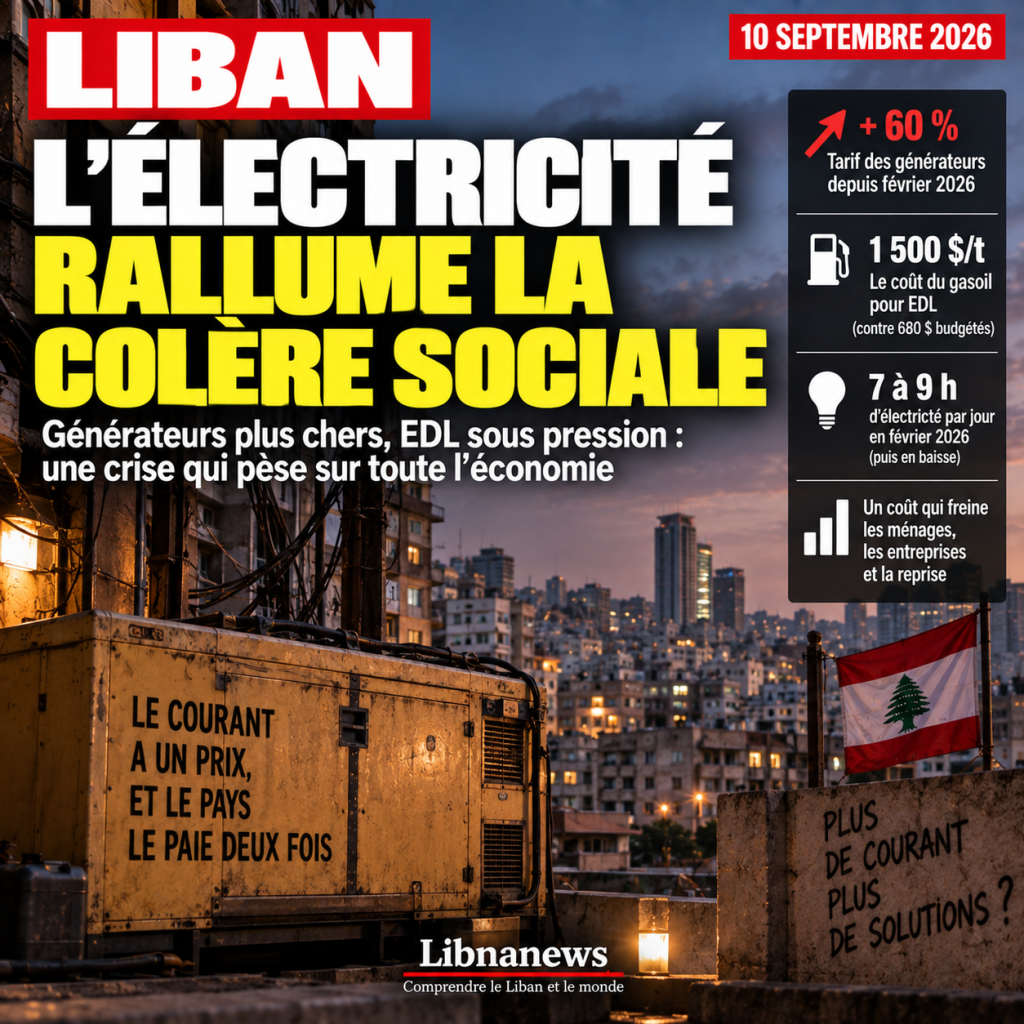
In Lebanon, the issue of electricity is again becoming a macroeconomic problem as well as a subject of public service. After a temporary improvement at the beginning of 2026, the supply of electricity from Lebanon was again contracted, returning households and businesses to private generators at a time when their official tariffs increased sharply. The kilowatt-hour of generators in urban areas increased from £30,244 in February to £48,241 in August, an increase of nearly 60 per cent in six months. At the same time, EDL must absorb an exceptional shock on the cost of diesel fuel, with a price close to $1,500 per tonne against a budget assumption of $680. Joe Saddi has embarked on long-delayed institutional reforms, but the immediate problem is more acute: the sector remains structurally underfunded, still loses a very high share of the energy injected and lacks a production model that is sufficiently robust to protect consumers from oil shocks.
The problem is no longer just the cut: it is the economic price of electricity
For years, the Lebanese electricity debate has been summed up by the number of hours of electricity supplied by EDL. This measure remains essential, but it is no longer sufficient. Since the collapse of the financial system and the explosion of the private solar system, the consumer now buys an assembly of sources: a few hours of LEDL, several hours of generator and, for households or companies that have been able to invest, a share of solar with batteries. Therefore, the relevant economic cost is no longer the LED rate taken in isolation, but the consolidated invoice required to obtain 24 hours of service.
This consolidated invoice is well above what the public tariff suggests. When EDL reduces its power, the household does not necessarily consume less electricity; It simply replaces a private source that is more expensive to the public source. In the short term, therefore, a decline in the production of EDL transfers the cost to the private sector. At the macroeconomic level, this substitution acts as a diffuse energy tax: it reduces household disposable income, reduces business margins and increases the cost of each good or service requiring electricity.
It is this mechanism that explains the rise of discontent in 2026. The consumer may hear that institutional reform is moving forward, but he considers the sector to be based on two simple variables: the number of hours received and the total monthly expenditure. However, these two variables evolved in the wrong direction during the summer. The gap between administrative reform and daily economic experience thus becomes a political risk for the ministry as well as a brake on recovery.
Generator shock: nearly 60% increase in kilowatt hour since February
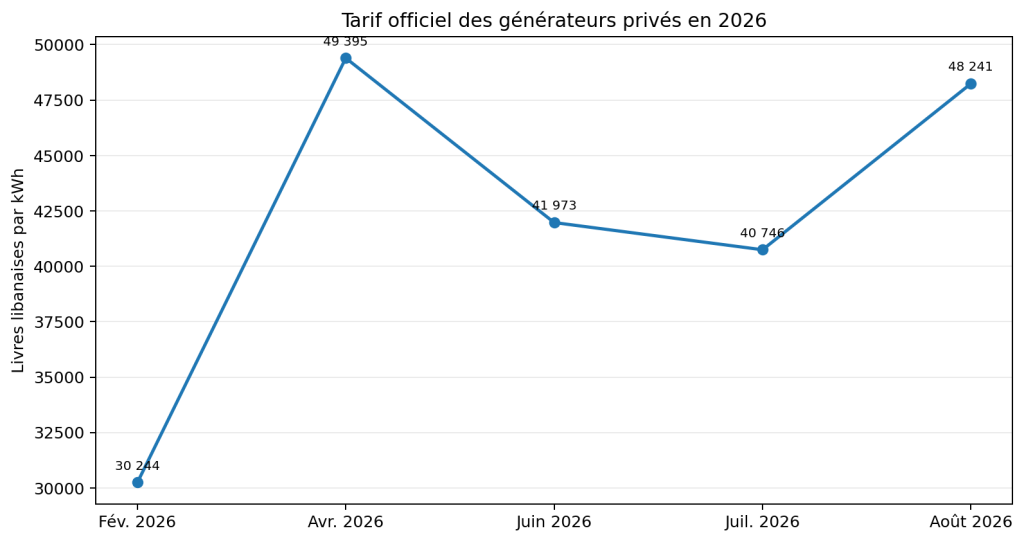
Official indicative urban rate. Source: Ministry of Energy and Water.
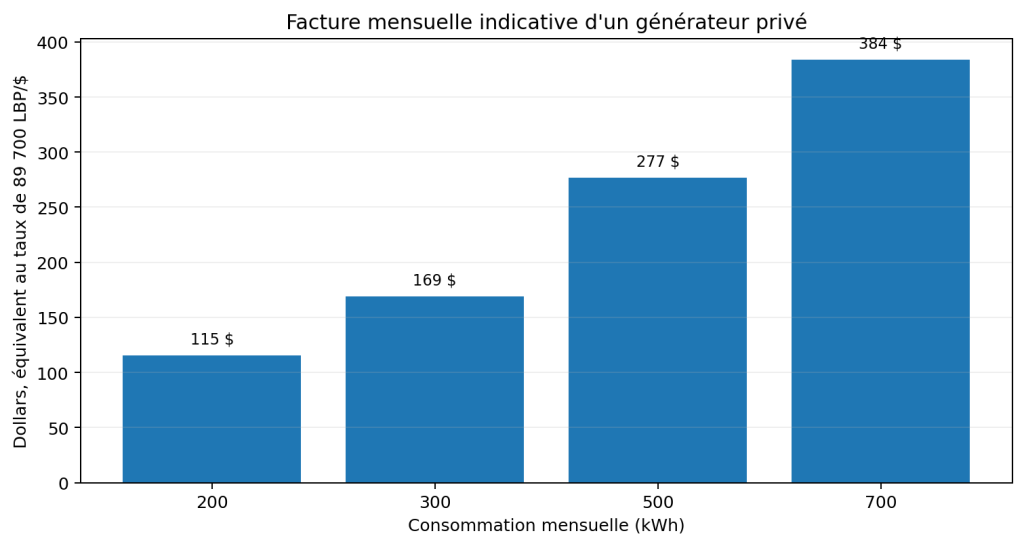
Indicative simulation: August 2026 + 10 A package, without supplements.
Official private generator tariffs show the magnitude of the shock. In February 2026, the Ministry of Energy set the indicative rate at 30,244 pounds per kilowatt hour in urban areas. He jumped to £49,395 in April, returning to £41,973 in June and then £40,746 in July. In August, it dates back to £48,241. The August level is therefore nearly 60% higher than in February. In rural or remote areas, the tariff is even higher because the official grid adds a coefficient related to the additional costs of distribution and operation.
The kilowatthour is only one component of the invoice. The scale also includes a fixed fee, including £385,000 for 5 amperes and £685,000 for 10 amperes. As an indication, a household using 300 kWh on the generator in August with a subscription of 10 amperes supports approximately Pound15.16 million, or nearly $169 at the rate of £89,700 per dollar. At 500 kWh, the bill is approaching $277; At 700 kWh, it exceeds $384. These calculations strictly use the official tariff and do not include any unauthorized surcharges.
The relative weight obviously depends on income. For a household with $1,500 per month, a generator invoice of $277 represents more than 18 per cent of the income even before the bill of EDL, water, telecommunications or housing. For a pensioner or public employee paid at a significantly lower level, the share becomes much higher. The social problem is therefore not only the absolute level of the tariff, but its relation to revenues that did not follow the rise in energy costs.
The authorities also distinguish between the increase economically justified by fuel and abusive practices. In early September, the government strengthened controls on operators that would apply additional costs, unplanned maintenance costs or increases without a regulatory basis. This intervention shows that the generator market combines two realities: an objective increase in production costs and sometimes significant local market power, since the subscriber usually does not have the possibility to freely choose his neighbourhood supplier.
EDL suffers a cost shock that no governance reform can absorb instantly
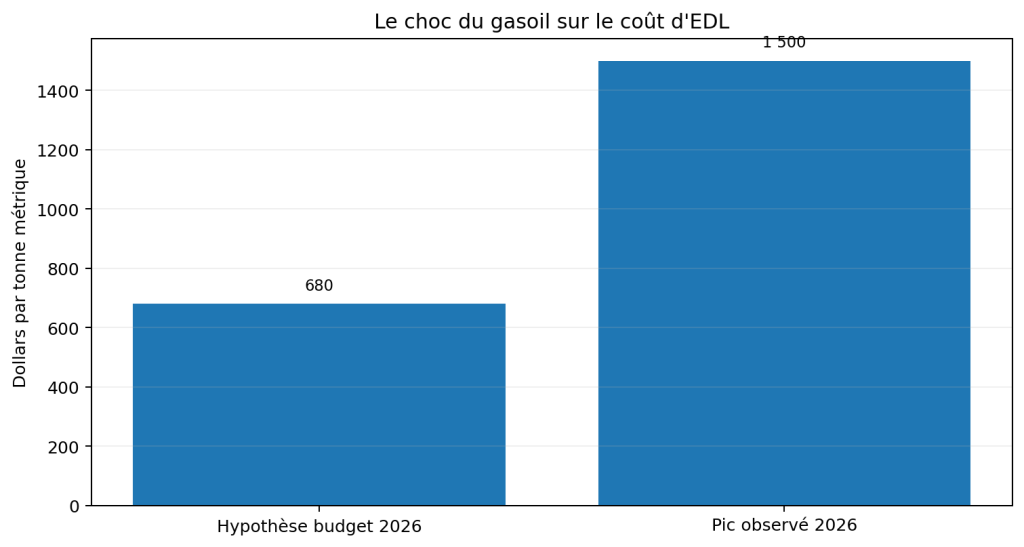
Budget Assumption 2026 of EDL compared to the world level quoted by the institution in August.
The financial situation of EDL deteriorated sharply with the gas oil spill. The institution had prepared its 2026 budget on an assumption of approximately $680 per metric tonne. In August, he reported that the world price had approached $1,500, an increase of between 88 per cent and 91 per cent over his working assumption. For a fuel- and fuel-dependent thermal producer, this difference is not marginal: it completely alters the variable cost of production and renders the budgetary balances built a few months earlier obsolete.
In a normal electric company, three mechanisms are used to absorb this type of shock: a tariff formula that quickly adjusts the selling price, fuel contracts or hedging instruments to smooth prices, or a balance sheet that is strong enough to temporarily absorb the difference. EDL does not fully have any of these shock absorbers. Rates have been substantially revised since 2022, but the establishment remains politically and socially constrained; access to financing is limited; and its balance sheet bears the legacy of decades of deficits.
Thus, arbitration becomes brutal. Producing more with much more expensive fuel increases cash flow requirements. Production reduces the need for fuel oil but pushes consumers to generators, which have an even higher unit cost. Highly raising the EDL tariff would protect its financial balance but transfer a new burden to households. To ask the Treasury to finance the differential would be to reintroduce the budgetary subsidy mechanism which has long contributed to public deficits. None of these choices is neutral.
This constraint helps to understand why the Minister cannot simply order a sustainable increase in diet. The physical question of available capacity is inextricably linked to the financial capacity to buy fuel and recover the cost of production. In such a fragile system, an additional megawatt can improve service but deteriorate cash flow if the corresponding energy is not billed and cashed.
Public unpaid payments withdraw about $50 million per month at the EDL circuit
This fuel shock adds an unusually large recovery problem. Joe Saddi reported in July that the state and its institutions owed approximately $250 million in arrears to EDL at the end of December, and that he requested payments of $50 million per month for five months. The Minister insists that it is not an advance from the Consolidated Revenue Fund, but the settlement of invoices and commitments for electricity actually consumed or exemptions granted by the State.
Economically, the distinction is important. A budget advance constitutes public funding to fill a deficit. Payment of an invoice is a normal business income of the company. If EDL supplies energy to governments, water authorities or municipalities without being paid, it acts de facto as a financer for the rest of the public sector. However, it must pay for the fuel immediately. The resulting cash flow directly limits its ability to maintain or increase production.
The problem also reveals an inconsistency in the recovery policy. The state requires households to pay bills that are now widely indexed to the dollar and seeks to reduce illegal connections. This policy is difficult to legitimize when public institutions themselves accumulate large arrears. The financial discipline of EDL therefore implies that the public sector is subject to the same budgetary constraint as private customers.
Almost 40% of the energy injected into the grid remains lost
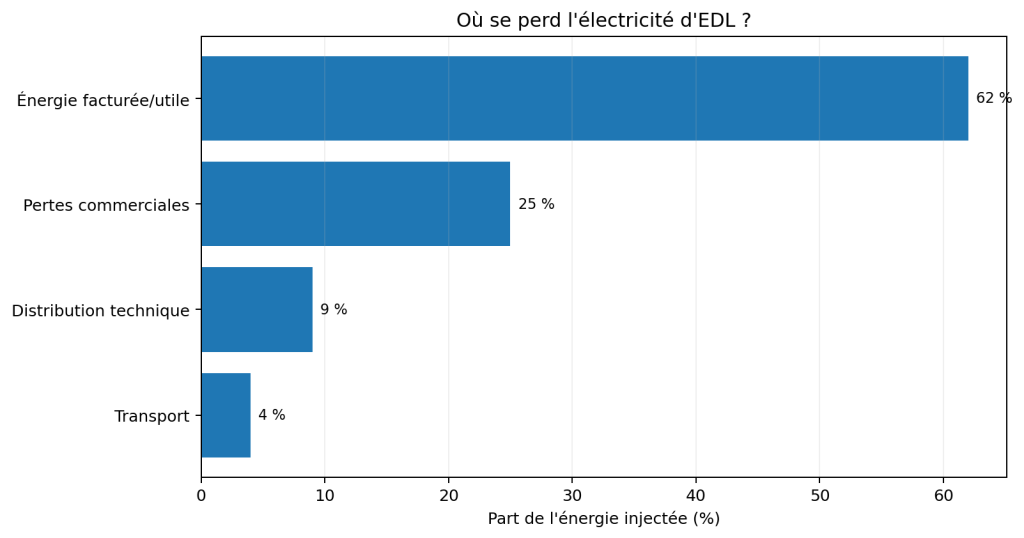
Indicative breakdown of World Bank 2023 losses.
The second structural weakness concerns technical and commercial losses. The World Bank estimated that in 2023 approximately 40 per cent of electricity injected into the EDL network did not result in normally charged and cashed energy. Approximately 4 per cent were for transportation network losses, 9 per cent for distribution technical losses and 25 per cent for commercial losses, mainly theft, illegal connections and invoicing or recovery failures. The order of magnitude means that just six out of ten units of injected energy become useful and commercially recoverable energy.
This structure transforms the tariff debate. Suppose that EDL buys or produces 100 electricity units. If 38 to 40 units disappear technically or commercially before cashing, the cost of the remaining units must cover not only their own cost of production but also that of lost energy. An increase in the price of fuel is therefore amplified by the system’s losses. As long as these losses do not decrease, a cost recovery policy requires either a higher rate or a subsidy or a deterioration in cash flow.
This is also why increasing production capacity, often presented as the central solution, is not enough. Adding megawatts to a network that loses nearly 40% of its energy can increase volumes without resolving financial viability. The reform must simultaneously address production, network, meters, billing and recovery. The economy of the sector is systemic: improving one link does not correct the losses generated by others.
Legacy: $1.8 billion in deficit in 2018 and decades of sub-tariff
The crisis of 2026 is also the result of a model built long before the financial collapse. The Ministry of Energy recalls that EDL had a financial deficit of $1.8 billion in 2018. The causes identified at the time were already known: an average price lower than the cost of production, old and inefficient plants, approximately 16% of technical losses and 21% of non-technical losses. The system therefore sold subsidized energy while losing a considerable amount before recovery.
The macroeconomic cost was not limited to the EDL profit and loss account. Fiscal transfers to the enterprise increased the government deficit and government debt needs. At the same time, poor service required households to pay a second bill to generators. The consumer financed the sector twice: as a taxpayer, through public transfers, and then as a customer, through private subscription.
The IMF further noted in 2023 that the tariff increase of November 2022, although indispensable, would not guarantee financial viability alone. Its effectiveness depended on the recovery, reduction of non-technical losses, increased power supply and the management of exchange risk between the purchase of fuel and the receipt of invoices. Three years later, these conditions remain precisely those that determine the ability of EDL to function.
The real cost to the economy far exceeds the electricity bill
For a company, electricity acts as a transversal input. An increase in its cost is passed on to almost all sectors: cold chain, catering, industry, trade, telecommunications, water pumping, hospitals, offices or warehouses. The energy bill first reduces the profit margin; When it becomes too high, the company passes it on to its prices. Electricity therefore feeds inflation by costs, even when domestic demand remains low.
This mechanism is particularly detrimental in a recessionary economy. A company faced simultaneously with lower demand and higher energy costs cannot always pass the increase on to its customers. It then reduces its margin, defers investments, decreases its staff or is firm. Energy thus becomes a channel through which an external oil shock turns into a decline in domestic investment and real GDP.
The international comparison is unfavourable. The IMF estimated in 2023 that the target price of electricity produced by private generators was around 45 to 50 cents per kWh, compared with a world average of nearly 16 cents at the time. Although these references have evolved since then, the gap illustrates a structural problem: generating electricity with thousands of small diesel units is much more expensive than getting it from efficient power plants or renewables connected to a high-performance grid.
The additional costs also affect external competitiveness. A Lebanese industrialist who exports cannot always increase his prices because he faces Turkish, Jordanian, Egyptian or European competitors who often benefit from more reliable energy and normal bank financing. Electricity is therefore not just a household expenditure; It reduces Lebanon’s ability to expand its export base and generate the currencies its economy needs.
Solar reduced dependence, but created a two-speed electric economy
The photovoltaic explosion since 2019 has profoundly changed the sector. The World Bank estimated off-grid solar capacity at around 1,000 MW by the end of 2023, and the latest national estimates show an even higher level. This capacity has enabled many households and businesses to reduce their dependence on generators and to absorb some of the cuts in EDL.
But solar is not a uniform solution. It requires a significant initial investment, especially when it must be combined with batteries to cover the evening and night. Thus, households with capital can significantly reduce their generator bills. Smaller households remain captive to expensive private electricity. The energy crisis therefore produces a form of wealth inequality: those who can invest pay less in the long term, while those who lack capital continue to buy the most expensive kilowatt hour.
Massive solar development also creates a problem of coordination with the network. A large decentralized capacity can relieve demand during the day, but it does not replace a transport, dispatching and storage system. Without investment in the network and without clear regulation, the country risks adding private assets without building an integrated electrical system.
Joe Saddi advances on regulation, but the political calendar is shorter than the electric calendar
Joe Saddi’s mandate is distinguished by several institutional advances. The Electricity Regulatory Authority, provided for by Law 462 since 2002, has finally been set in motion. The Council of Ministers adopted a new sectoral policy note in July 2026, while a low cost production plan is to be prepared with the Autorité, EDL, EDF and funding from the Agence française de développement. For the first time in a long time, the reform therefore seeks to distinguish clearly between regulation, planning and operation.
The Autorité has also launched a call for expressions of interest covering up to 350 MWc of grid-connected solar, distributed among several projects, with up to 1,000 MWh of battery storage. At the same time, it is seeking decentralised thermal projects ranging from 20 to 100 MW, mainly operating on natural gas with the possibility of using emergency fuel. The objective is both economic and technical: to diversify the mix, reduce exposure to diesel and introduce new capacities with a more legible competition framework.
These announcements should not, however, be confused with available capacity. A solar or thermal project involves studies, financing, contracts, permits, construction and connection. Even when the process is working properly, the time is in months or years. The reform can therefore be economically consistent and remain politically unpopular in the short term if the consumer continues to receive four hours of D-EDL and a high generator bill.
The minister’s challenge is precisely this timing asymmetry. Errors accumulated over two decades cannot be corrected in one year, but household income is monthly and the bill is also. The success of energy policy will therefore be judged before most new investments produce their effects.
Why simply increase the price of edl does not solve the problem
A purely accounting reading could lead to a simple solution: raise the public tariff even to cover the full cost of production. This option would theoretically improve the operating account, but could fail if it is not accompanied by a reduction in losses and an increase in the recovery rate. A higher rate applied to a customer base that does not all pay does not guarantee more revenue.
There is also a social threshold. If the price of the product is too close to the price of the generator without significantly improving the supply hours, the consumer can perceive the reform as a price increase without a service consideration. On the other hand, artificially maintain too low a tariff creates a deficit. The economic solution is therefore less to choose between low and high tariffs than to build a price reflecting the costs of a progressively more efficient system.
This logic involves reliable meters, regular billing, lower losses and a pricing formula that can react to fuel variations without having to wait for a political decision at each shock. It also requires targeted mechanisms for vulnerable households. Subsidizing evenly every kilowatt hour benefits large consumers more; directly helping low-income households preserves a more coherent price signal.
Real reform is a problem of investment and sequencing
From an economic point of view, the sector does not lack only megawatts; it lacks a credible sequencing of investments. The first is to reduce business losses and improve recovery, as every dollar recovered can finance fuel or maintenance. The second is to secure lower-cost production, including gas and renewables. The third is to modernise the network so that this new production can actually be distributed.
The order of these steps counts. Building significant production capacity before correcting losses can increase financial requirements without proportionally increasing revenues. Conversely, reducing losses without producing more improves accounts but does not respond to user dissatisfaction. The reform must therefore proceed simultaneously on several axes, but with quantified objectives: losses, recovery rates, supply hours, average cost of kWh and investments made.
Funding is the last lock. The Lebanese banking system remains largely unable to finance major long-term projects. The electricity sector therefore depends more on foreign investors, international financial institutions and independent producer-type installations. In return, these investors will demand credible contracts, effective regulator, price visibility and the ability to pay from the public buyer. Governance reform is therefore not a secondary administrative issue: it directly conditions the cost of capital.
Social risk: an energy bill that absorbs disposable income
The contestation around electricity now joins other social tensions. Retired military and civil servants are demanding revalorizations because their incomes have been destroyed by the crisis. Pharmacies and small businesses report compressed margins. Tourism was disappointing and the recession of 2026 reduced demand. In this context, a generator bill that increases by several tens of dollars per month is not a sectoral incident; It immediately withdraws purchasing power from an already weakened economy.
The effect is regressive. Affluent households can invest in solar, improve insulation, buy efficient equipment or absorb a higher bill. Smaller households have fewer options and reduce consumption, sometimes at the expense of thermal comfort, refrigeration or other essential uses. The average cost per kilowatt hour is therefore only a part of the problem: the share of energy in disposable income must also be looked at.
For companies, the same logic can speed up concentration. Large structures have better means to install solar, negotiate their purchases and amortize equipment. Small businesses bear a higher unit cost and fewer financing opportunities. In the long term, energy inefficiency can therefore change the structure of the productive fabric by favouring the most capitalised actors.
What the coming months will really make it possible to judge
Joe Saddi’s performance cannot be evaluated on a single variable. The number of hours of EDL must increase, but without recreating a deficit financed by the Treasury. Losses should be reduced, but without delaying effort only on already solvent subscribers. Rates must reflect costs, but without making electricity inaccessible. New capacities must be funded, but within a sufficiently credible framework to avoid replicating costly contracts and improvised past decisions.
Three indicators will be particularly revealing: the recovery of the approximately $250 million owed by the public sector, the evolution of the network’s losses from the level close to 40% observed in 2023, and the capacity of EDL to gradually increase supply hours despite the oil shock. In the longer term, it will be necessary to measure whether solar projects with storage and gas production are effectively moving from call for interest to financing and then construction.
The political difficulty is that this potential progress will be judged in an economy where the consumer already pays the cost of waiting. As long as public production remains low, the private generator remains assured of the system’s continuity. And as long as its cost remains linked to diesel fuel, each oil shock is transformed into an increase in bills, inflationary pressure and loss of competitiveness in a few weeks. The next evolution of generator prices and hours will therefore give a more concrete indication than the institutional announcements on the real capacity of the sector to overcome its crisis balance.
Summary table
| Indicator | Value | Economic reading |
| EDL power supply Feb 2026 | 7-9 a.m./day | Temporary improvement |
| Generator rate Feb 2026 | 30 244 LBP/kWh | Baseline |
| Generator rate August 2026 | 48 241 LBP/kWh | +60 % in six months |
| Gasoil – EDL budget | $680/t | Budgetary assumptions |
| Gasoil – peak 2026 | $1,500/t | +88 to +91 % |
| Public Arrears towards EDL | $ 250 million at end Dec. | Cash burden |
| Payment requested per month | $50 million over five months | Collection, no advance |
| Network losses 2023 | 40 per cent | 4% transport, 9% technical distribution, 25% commercial |
| EDL deficit in 2018 | $1.8 billion | Inheritance of the subsidized model |
| Solar projects EOI 2026 | up to 350 MWc | With 1000 MWh of storage |
| Decentralised thermal | 20 to 100 MW/project | Priority natural gas |
References and links
Lebanese Ministry of Energy and Water, 14 August 2026 —News release from EDL on gas oil close to $1,500/t compared to $680 budgeted, the decrease in recovery and the risk to service continuity. https://www.energyandwater.gov.lb/ar/details/101173/
Lebanese Ministry of Energy and Water, 23 July 2026 —Statements by Joe Saddi on the 7 to 9 hours of power in February, the $250 million in public arrears and the $50 million in monthly demand. https://energyandwater.gov.lb/ar/details/101156/
Lebanese Ministry of Energy and Water —Official monthly fee for private generators in 2026. https://www.energyandwater.gov.lb/ar/prices?type=2
World Bank, Lebanon Renewable Energy and System Strengthening Project —Network losses close to 40 per cent in 2023: about 4 per cent transport, 9 per cent technical distribution losses and 25 per cent commercial losses. https://documents1.worldbank.org/curated/en/099091124181525582/pdf/BOSIB-c26029b-4517-48c7-a0c1-b95eb42d17a7.pdf
IMF, Article IV 2023 —EDL tariff structure, need to improve recovery and reduce losses; high cost of private generators. https://www.imf.org/-/media/Files/Publications/CR/2023/English/1LBNEA2023002.ashx
Lebanese Ministry of Energy and Water, Sector Plan 2019 —EDL deficit of $1.8 billion in 2018 and historical causes: sub-tariff, inefficient power plants and high losses. https://energyandwater.gov.lb/ar/details/100511/
Lebanese Ministry of Energy and Water, 21 July 2026 —New policy note for the electricity sector and preparation of a East-Cost Generation Plan. https://www.energyandwater.gov.lb/ar/details/101159/
Electricity Regulatory Authority, 2 September 2026 —EOI: Up to 350 MWc of solar with 1000 MWh of storage and decentralized thermal projects from 20 to 100 MW. https://www.energyandwater.gov.lb/ar/details/101187/
World Bank, Rapid Damage and Needs Assessment —Damages and losses of the energy sector related to the previous conflict; reconstruction needs. https://documents1.worldbank.org/curated/en/099030125012526525/pdf/P506380-e58e9761-b29e-4d62-97c3-ebf5a511c4e1.pdf




