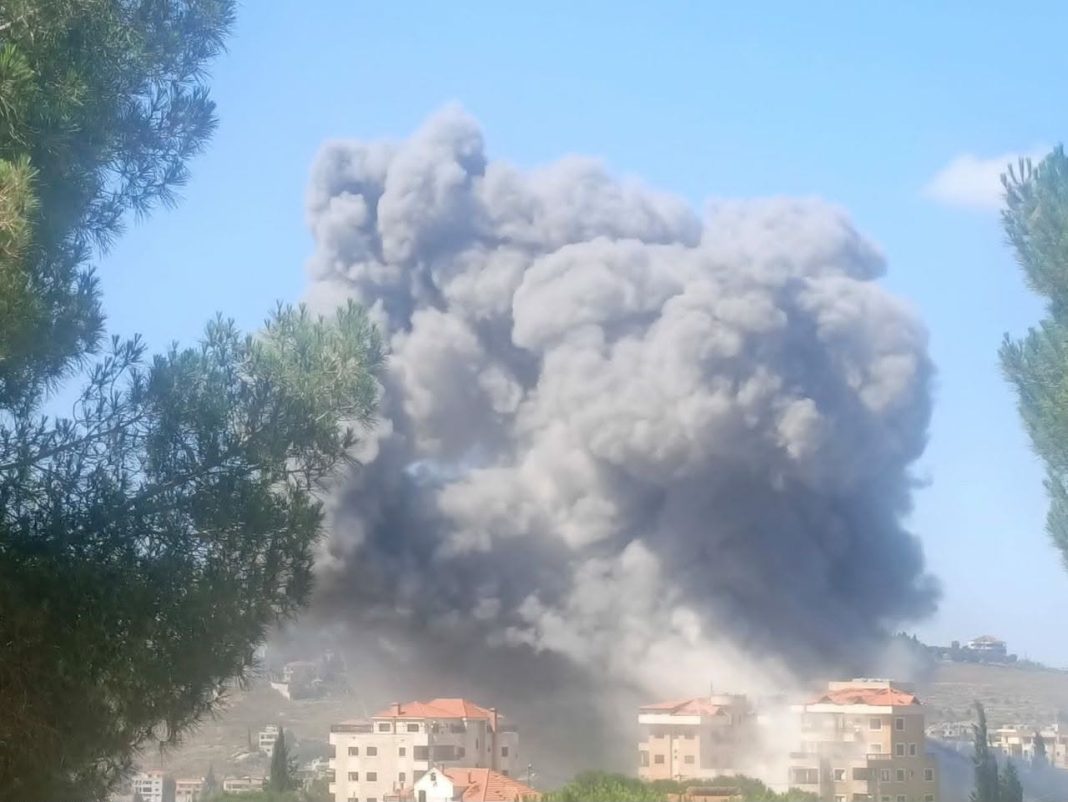






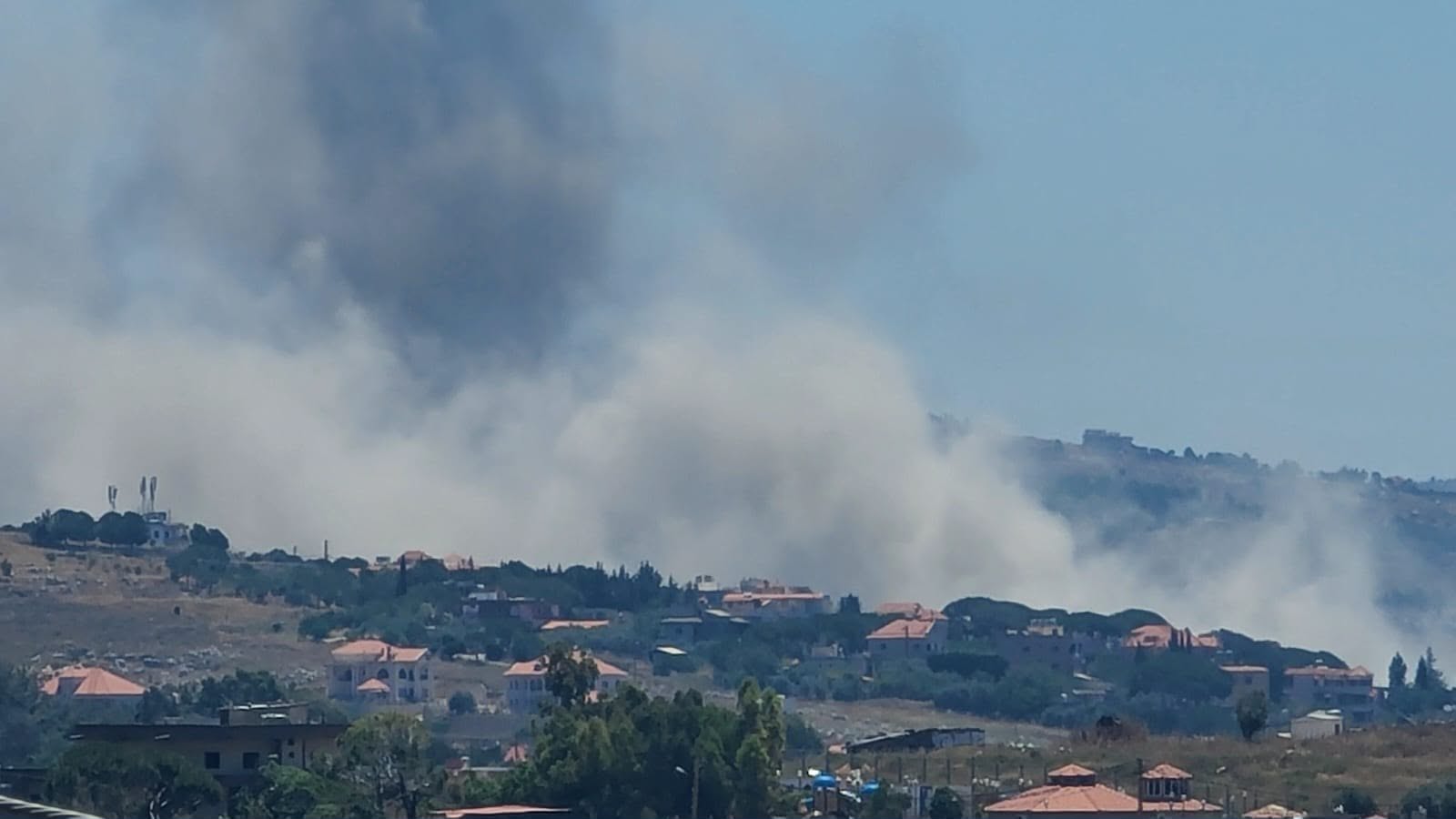
South Lebanon experienced a new wave of Israeli bombings on Friday 19 June, despite the agreement supposed to open a regional de-escalation. The Lebanese death toll is increased to 30 deaths. Israel claims to have targeted more than 80 « targets » in southern Lebanon and two command centres in the Bekaa, following an ambush by Hezbollah that killed four Israeli soldiers near Kfar Tebnit.
On Friday 19 June, South Lebanon experienced a new day of war, despite the agreement supposed to install a regional de-escalation. The Lebanese record has now reached 30 deaths following a series of Israeli strikes concentrated on Nabatiyah, its environs and several southern areas. The Israeli army claims to have targeted more than 80 Hezbollah-related « targets » in the so-called security zone and beyond. She also claims to have struck two command centres in the Bekaa, where Hizbullah members were reportedly present.
This operation occurred after the death of four Israeli soldiers in an ambush claimed by Hezbollah near Kfar Tebnit, in the area of Ali al-Taher hill. Among the soldiers killed were Dor Gedalia Ben Simhon, commander of the 52nd battalion of the 401th Armoured Brigade. Hezbollah claims to have destroyed three Merkava tanks with guided missiles, and then hit a force to evacuate the Israeli victims. The Israeli response was immediate and massive. In Lebanon, it is seen as a new challenge to the agreement and a disturbing signal of Israeli intentions in the South.
Nabatiyah hit at night and in the morning
Bombardments began in the night and continued in the morning. The Nabatiyah region was the most affected. Strikes were reported on the city, its entrances, residential areas and nearby localities. Kfar Tebnit, Kfar Sir, Harouf, al-Doueir, al-Sharqiyah, Jibchit, Adchit, Toul, al-Qsaybeh, Kfar Dajjal, Kfarjuz, Kfar Rummane, Zibdine, Nabatiyeh al-Fawqa, Habbush, Sajd and Rihan heights are among the areas mentioned in local and regional information.
This geography shows the extent of the operation. The strikes did not target a single military point of contact. They have covered a vast area, urban and village, where residents still live and where rescue workers circulate. In Harouf, a strike on a inhabited area caused a heavy impact. Between al-Sharqiyah and al-Doueir, a house was hit in the al-Achamiyah area. In al-Doueir, a drone targeted a motorcycle near the municipality. Further fire was reported on roads used by residents and emergency teams.
In Nabatiyeh, the war is taking place in a city that remains a service centre for the whole South. Hospitals, shops, roads and public buildings play an essential role. When a bombing hits this area, it not only destroys an announced target. It disrupts access to health care, delays ambulances, cuts trips and pushes new families out. The city thus becomes the symbol of an agreement contradicted by the facts.
Thirty deaths and an incomplete record
The record of 30 deaths on the Lebanese side marks a sharp worsening. The first announcements reported at least 18 deaths and dozens of injuries. The figure then increased with gradual access to the affected areas. The Lebanese health authorities also reported numerous injuries. Hospitals in the region have had to absorb a new wave of emergencies in a system already weakened by the economic crisis and months of conflict.
The number of deaths can still change. In high-intensity bombardments, the balance sheets remain provisional until the end of relief operations. Bodies can stay under the rubble. Serious injuries may succumb after transfer. Some families are also difficult to reach when networks, roads or electricity are affected. Publication of names therefore requires confirmation by municipalities, hospitals or families.
An identity has been announced: Mahmoud Choueib, a member of the Civil Defence at the centre of the Dal-Doueir region, killed with members of his family in a strike against the al-Sharqiyah area. His name gives a face to a balance sheet often reduced to numbers. It also recalls that first aid workers are not only exposed during their interventions. They live in the same villages as the inhabitants they try to save. Their death underscores the level of danger to the relief structures in southern Lebanon.
Israeli version: 80 targets and the Bekaa
The Israeli army presents the strikes as a response to repeated violations of the ceasefire by Hezbollah. In its communiqués, it claims to have struck more than 80 command centres, launching positions, fighters and infrastructure in the Nabatiyah region and other areas of the South. It also reported that it had eliminated dozens of Hizbullah operatives operating in those sites.
The Israeli army also claims to have targeted two command centres in the Bekaa, while Hizbullah fighters were there. She adds that her soldiers are continuing their mission in southern Lebanon, with an emphasis on the dismantling of strategic underground infrastructure built, according to her, by Hezbollah in the Beaufort area. This mention of Beaufort is important. It shows that the Israeli operation is not limited to a one-time response. It is part of a broader campaign against structures that the Israeli army says it wants to destroy sustainably.
Israel also claims to have identified during the night rocket fire at its troops operating in southern Lebanon. According to his version, two fighters fled the motorcycle launch zone before being killed by a strike. The launcher would then have been destroyed. These elements form the official Israeli narrative: a response to Hezbollah attacks and ceasefire violations. In Lebanon, this story is not enough to erase the other reality, that of the dead, the houses affected, the dangerous roads and the continuation of a foreign military presence.
Lebanon faces an agreement emptied of its substance
The central issue for Beirut is the agreement. Can a regional settlement remain credible if strikes of this magnitude are carried out a few days after its announcement? Can it protect Lebanon if Israel retains freedom of military action in the South and beyond, as far as Bekaa? On paper, the agreement was to contribute to the cessation of hostilities and to a reduction in regional tension. On the ground, aircraft, drones and artillery continue to define daily life.
The Lebanese position is based on a simple principle: sovereignty cannot be partial. Israel claims to be targeting Hezbollah. But the strikes take place on Lebanese territory, in towns and villages where civilians live. Lebanon cannot accept that a so-called security zone should become a zone of exception, where the agreement would no longer apply. Nor can he accept that the Bekaa, Nabatiyeh and border villages are treated as open spaces for permanent operations.
This contradiction directly threatens the overall settlement. If every attack on Israeli soldiers leads to a wave of strikes on several dozen points in Lebanon, the agreement becomes inapplicable. If every Israeli strike provokes a new Hezbollah response, de-escalation becomes theoretical. The Lebanese front may then fail a broader regional arrangement, not through official announcement, but through the accumulation of violations, deaths and acts of violence.
Kfar Tebnit’s ambuscade changes the balance of power
The ambush near Kfar Tebnit gave the day a particular military dimension. The death of four Israeli soldiers, including an armoured battalion commander, represents the greatest record recognized by the Israeli army since its attack in southern Lebanon, according to Israeli and regional media. Hezbollah quickly highlighted this operation to demonstrate its ability to strike Israeli units on the ground.
The Shiite movement claims to have ambushed a force that was advancing near Ali al-Taher at dawn. He said he destroyed three Merkavas using guided missiles. He also claims to have targeted an Israeli rescue force to evacuate the killed or injured soldiers. These statements are part of a communication war. They aim at presenting Israeli forces in the South as vulnerable, despite their aerial and technological superiority.
For Israel, this attack caused immediate political pressure. Radical right-wing ministers called for escalation. The Minister of National Security, Itamar Ben Gvir, said « all Lebanon must burn. » Finance Minister Bezall Smotrich said it was time to « talk with fire » and « open the gates of hell. » In Lebanon, these formulas are read as threats against an entire country, not as mere expressions of anger.
An Israeli rhetoric that worries Beirut
The remarks of Ben Gvir and Smotrich have aggravated the political significance of the day. They are not just targeting a Hezbollah military position. They designate Lebanon as a place of punishment. For Lebanese, this rhetoric deliberately blurs the distinction between an armed organization, the state, villages and civilians. It also weighs on diplomatic efforts, as it gives the impression that a part of the Israeli government is seeking the enlargement of the war rather than its leadership.
This dimension is central in Lebanese reading. Lebanon is divided over Hezbollah, its weapons and its place in the national decision. But these divisions do not cancel the refusal of a threat against the whole country. The inhabitants of Nabatiyeh, Harouf, Kfar Sir or d-al-Doueir cannot be reduced to military objectives. Relief workers, displaced families, hospital patients and village children are not variables in a pressure strategy.
The language of Israeli officials therefore has a concrete effect. It reinforces the fear of a wider campaign. It feeds the idea that strikes not only seek to respond to a Hezbollah operation, but to impose a collective cost on Lebanon. It also weakens Lebanese officials who defend a diplomatic outcome. When an Israeli minister calls for burning the whole country, the arguments for confidence in the agreement become more difficult to bear.
Maroun al-Ras and suspicion of a fait accompli
Fear of lasting occupation remains around Maroun al-Ras. Lebanese information reported a newly established Israeli position in this border village, located on a strategic height. Hezbollah has claimed to have targeted this site in recent days. The available evidence does not make it clear that a permanent base is already under construction. However, the reported presence of an Israeli military facility in such a sensitive area is sufficient to feed concern.
Maroun al-Ras is not an ordinary locality in the imagination of the South. Its dominant position, military history and proximity to the border make it a symbol. Any platform, forward post or consolidated infrastructure would be interpreted as a sign of maintenance, even if Israel spoke of security necessity. The people of the South know the difference between a temporary operation and a presence that settles. Their memory remains marked by the years of occupation and by the areas of control imposed in the past.
That is why the question of Maroun al-Ras goes beyond the village itself. It refers to the future of the entire South Lebanon. If Israel retains even limited positions, the regional agreement may be seen as a freeze on the balance of power rather than as a withdrawal mechanism. The internally displaced will not return for long as they see Israeli posts, drones and strikes around their villages.
Civilians pay the war price of versions
Between the Israeli version of the « targets » and the Hezbollah version on the ambush, Lebanese civilians remain at the centre of the crisis. The people of the South do not live a war of press releases. They live waiting for the balance sheets, uncertainty on the roads, fear of drones and anxiety not to find a loved one. Displaced families face impossible choices. Staying away from the village is expensive and disorganizes family life. Returning exposed to danger.
Friday’s bombings make this reality worse. They affect a region that has already been bruised by war months. Nabatiyah has seen its ceremonies, markets, schools and neighbourhoods transformed by fear. The surrounding villages have lost houses, shops and land. The South lives at the rate of emergency, with ambulances leaving as soon as relative calm permits and residents who learn to recognize the noise of drones.
The human score is not limited to the dead. Wounded people will be left behind. The children will bear the memory of the bombing nights. Families who lose their homes will join an already large displaced population. Rescue workers will have to continue to intervene in areas where signs of protection are no longer sufficient to reassure. This accumulation turns war into a lasting social crisis.
A day that threatens the entire diplomatic sequence
The day of 19 June may affect the entire regional diplomatic sequence. Discussions on the comprehensive settlement were already fragile. Climbing in South Lebanon adds a major obstacle. If the Lebanese front remains active, no regional agreement can be presented as stable. The situation is all the more sensitive as the conflict now crosses the southern border: the Bekaa has also been targeted, according to the Israeli army, which widens the perimeter of the confrontation.
For Lebanon, the challenge is not to become the sacrificed link in the settlement. An agreement that would calm other fronts while allowing Israel to act in the South would not be acceptable to Beirut. It would reinforce the idea that Lebanese sovereignty remains negotiable. It would also give Hezbollah an additional argument to maintain its operations as long as Israeli forces remained present.
The comprehensive regulation will therefore only be able to meet three specific questions. Should Israeli strikes cease throughout Lebanese territory? Should Israeli forces withdraw from all occupied positions in the South? Will civilians be able to return to their villages with real guarantees? In Nabatiyah, Kfar Tebnit, Maroun al-Ras and Harouf, these questions are not abstract. They already determine the next night.