

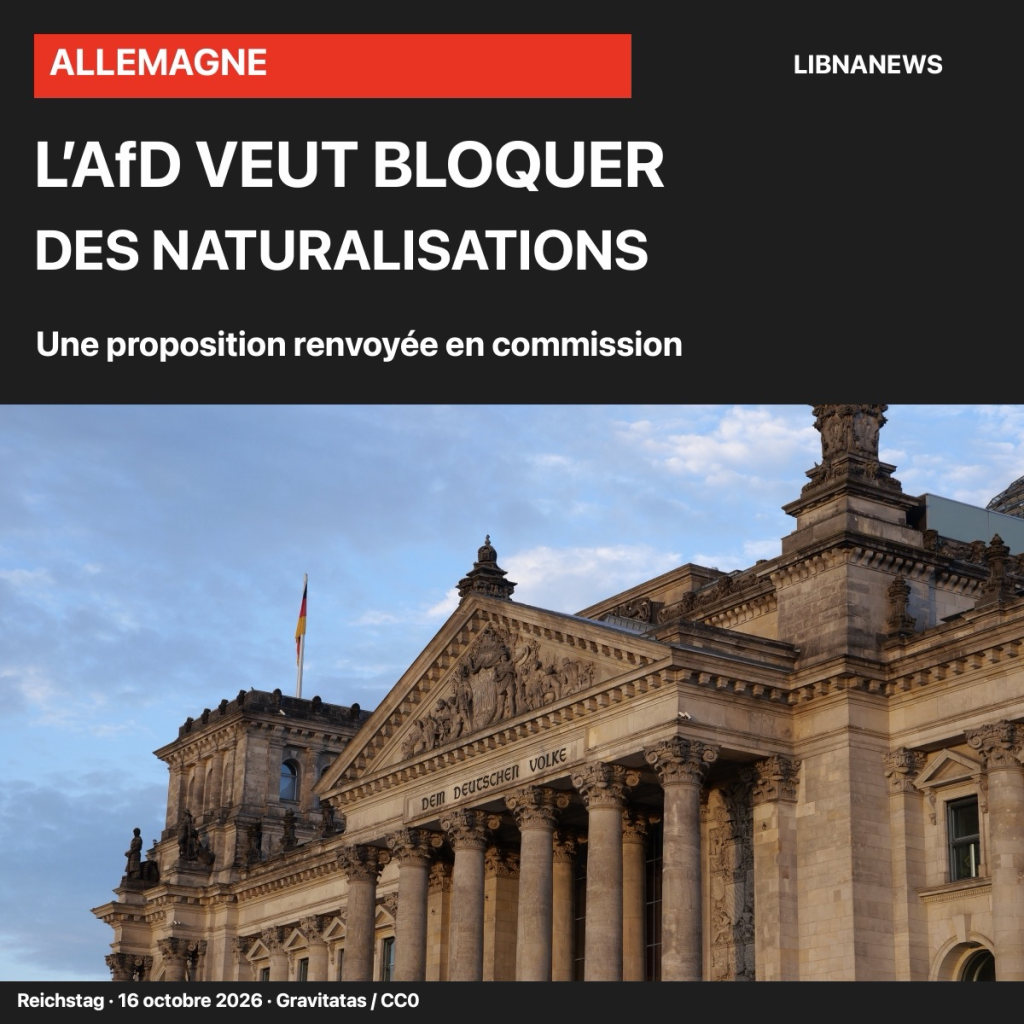
AfD wants to prevent refugees and beneficiaries of temporary protection from gaining German citizenship. The Bundestag debated its proposal on Friday 13 November 2026, and then referred it to the committees, under the responsibility of the Interior. This procedural vote does not change the naturalization conditions.
Tabled on November 10, under number 21/9077, the motion asks the government to prepare a bill. The extreme right-wing group also wants to suspend immediately the consideration of applications from persons who have been granted, or have been granted, temporary protection status.
A freeze on files claimed by AfD
The proposed scheme covers both current applications and the calculation of the length of residence. The AfD hopes that the years spent in Germany under temporary protection will no longer count to the length of stay prior to naturalisation. The text also provides transitional provisions or blocking periods for proceedings already initiated.
The authors argue for a vision of the refuge centered on returning to the country of origin. They called for the development of return and reintegration aid, particularly for Ukrainians, and for priority to be given to starting cases over those of naturalization in local administrations. A government report would be submitted after six months and annually.
Current law distinguishes residence and nationality
German legislation does not automatically give nationality to a protected person. Article 10 of the Nationality Act requires, inter alia, five years of legal habitual residence, established identity and nationality, and an eligible residence permit. The temporary protection permit issued under section 24 of the Residence Act is not one of the grounds for this legal naturalization.
The duration of presence and the nature of the security held at the time of application are therefore two distinct criteria. It adds language requirements, knowledge of the German legal and social order, adherence to democratic principles and, subject to exceptions, financial autonomy. The language level generally requested is B1.
The federal government also recalls that the accelerated path for naturalization after three years has been removed. The ordinary duration remains five years when the other conditions are met. The AfD proposal thus takes place in an already reformed framework, not in an automatic naturalisation regime.
Internal Affairs Committee seized
The November 13 sitting opened the parliamentary consideration of the motion. After a half-hour discussion, the Bundestag entrusted its continuation to the committees. Neither the AfD ban nor its moratorium were adopted at this session.
For applicants, the distinction is concrete: referral to committee does not suspend their case and does not replace the existing law. A possible change in naturalization conditions would require a legislative change, with a text defining its scope and entry into force.





Comments