






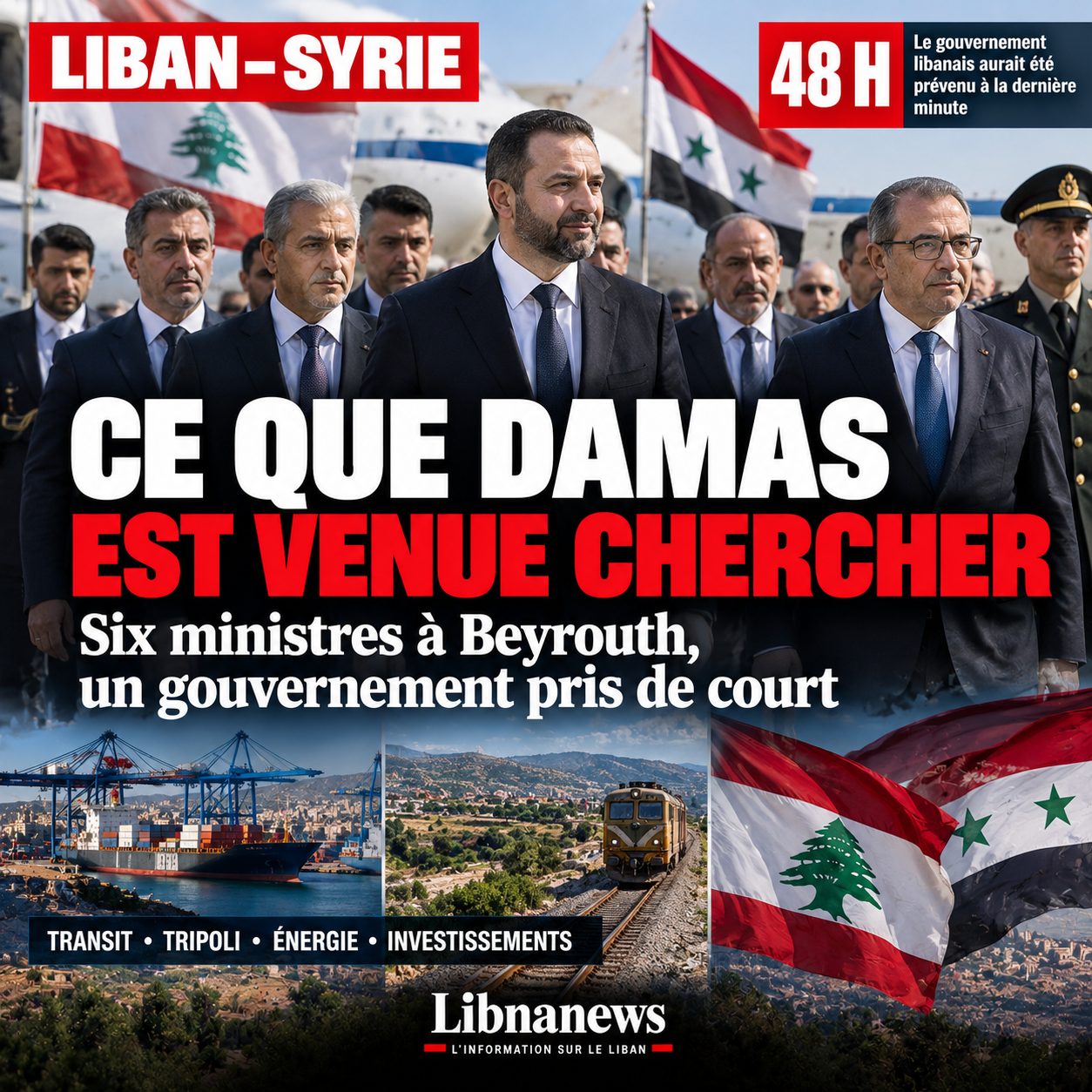
The scene was to illustrate the normalization of relations between Beirut and Damascus. She started with a paradox. The largest Syrian government delegation to Lebanon since the change of power in Damascus came to talk about cooperation between States, while the Lebanese Government was reportedly informed very late about the event. According to information gathered from government circles, Nawaf Salam had learned of the existence of the Lebanese-Syrian investment forum only about 48 hours before the arrival of the delegation. More surprisingly, some officials reportedly discovered the event through invitations to Lebanese businessmen.
Behind this protocolary episode, however, appears a much more important matter. Damascus didn’t just come looking for investors. The dossiers prepared draw up a real economic map: trucks, transit rights, movement of persons, René Moawad airport, track between Tripoli and Syria, Iraqi oil, Jordanian gas, Lebanese oil installations, electricity and revision of more than forty bilateral agreements. Taken together, these projects show what Syria is trying to rebuild: its commercial, energy and logistical access to Lebanon and the Mediterranean.
Forty-eight hours to turn a private forum into a government visit
The history of the forum makes it possible to understand the malaise that appeared at the top of the state. According to the information gathered, the initiative would have been part of Ahmad Hashmieh, president of the Beirut Development Association. After a visit to Damascus, he reportedly proposed the organization of a forum on investment between the two countries.
The Syrian response would first have been cautious. Damascus did not wish to send a large ministerial delegation to Lebanon to participate in an event without official Lebanese sponsorship.
Hashmieh allegedly then worked with Rula Harati, economic advisor to President Joseph Aoun, to obtain Baabda’s coverage. Presidential sponsorship reportedly unblocked the situation. The forum then changed its dimension: it was no longer just a matter of bringing companies together, but of hosting a Syrian government delegation at an exceptional level.
That’s where the problem would have arisen.
According to available information, Nawaf Salam was informed of the forum only about 48 hours before the arrival of Syrian officials. Nor would some concerned Lebanese ministers have been warned that their counterparts were coming to Beirut. Government officials would have even learned about the event by seeing the invitations to entrepreneurs circulated.
The problem became concrete when the delegation had to be officially welcomed to the airport. Who represents the government when a delegation of six foreign ministers lands in Beirut?
Nawaf Salam then instructed Deputy Prime Minister Tarek Mitri to intervene. He went to the airport with the Minister of Economy Amer Bisat to welcome Syrians. A dinner in their honour was then organized.
At the same time, Salam reportedly contacted Syrian Foreign Minister Assaad al-Shaibani. The message reportedly focused on the need to channel government demonstrations through Lebanese institutional channels.
The incident did not prevent the visit. But it reveals a first contradiction: the new relationship with Syria is presented as a state-to-state relationship, while its first major economic event required a last-minute protocol catch-up.
A delegation built as an economic programme
The composition of the Syrian group makes it possible to understand the objectives of displacement.
The delegation included Minister of Economy and Industry Mohammad Nidal al-Shaar, Minister of Agriculture Bassel Hafez al-Soueidan, Minister of Tourism Mazen al-Salhani, Minister of Education Mohammad Abdel Rahman Turko, Minister of Transport Yaarob Badr and Minister of Health Moussab al-Ali.
He added officials from investment, aviation and oil agencies, as well as representatives from the Syrian sovereign wealth fund. Ahmad Rawad Ramadan, the investment manager, and Omar al-Hosari, the aviation manager, were among the officials present. The Lebanese-Syrian Business Council was also represented by Leila al-Samman.
This choice is not trivial. It specifically covers the sectors that Syria needs for its reactivation: production, agriculture, tourism, transport, health, capital, aviation and energy.
On the Lebanese side, several ministers and senior officials eventually participated. Yassine Jaber, Fayez Rasamny, Rima Karami, Laura Lahoud and Amer Bisat were present, as well as a representative of the Minister of Health. The Director General of the Ministry of Economy Mohammad Abu Haidar, the Director General of Civil Aviation Mohammad Aziz, the Director of the Port of Beirut Marwan Najem and the Ambassador of Lebanon to Syria Henry Kastoun also participated.
The presence of aviation, port, transport and economic officials makes sense when examining the files prepared in parallel.
First site: blow up obstacles that slow down trucks
Transit is one of the most accurate records.
Damascus and Beirut want to examine the conditions for truck passage between the two countries. Discussions focus on transit rights, border procedures and the organization of land transport.
The problem is particularly important for Lebanon. For a large part of Lebanese land exports to Arab markets, Syria is not one of many markets: it is the forced passage.
Lebanese economic representatives identified three concrete requests.
The first concerns the abolition of the system of prior authorisation between the two countries. The second concerns equal customs treatment between Lebanese and Syrian goods, particularly with regard to Arab trade facilitation mechanisms. The third is directly concerned with carriers: Lebanese trucks should be treated in Syria in a manner comparable to that accorded to Syrian trucks in Lebanon.
These claims demonstrate the extent to which the word « integration » still covers very common obstacles: authorisations, taxes, queues, controls and differences in treatment.
The increase in trade therefore depends less on a new political slogan than on the price paid by a truck to cross the border.
René Moawad and Tripoli: the logistics map becomes much more ambitious
The most structural file is in northern Lebanon.
The discussions explicitly mention the René Moawad airport and a railway link between Tripoli and the Syrian interior. On the rail, the project is much more advanced in its definition than a simple evocation of principle suggests.
Syrian Minister of Transport Yaarob Badr reported that the connection of the Tripoli port to the Syrian railway network was part of a larger project of logistics corridors between the Gulf and the Mediterranean.
A Lebanese consulting company is currently working on the project. It must determine the cost and duration of the operation.
Above all, the route has already been recognised. A Lebanese-Syrian delegation discussed the proposed course. It would represent about35 kilometres in Lebanese territory and five kilometres in Syria.
The initial findings would be favourable: the route would be technically feasible and no major difficulties would have been identified at this stage. This does not mean that work will begin. The Syrian minister himself said that the final decision would depend on the completion of technical and economic studies.
But these figures change the nature of the project. It is no longer a matter of simply saying that one Tripoli day could be linked to Syria. A route of about 40 kilometres is already being studied.
The Syrian interest becomes obvious. A rail link with the port of Tripoli would give goods from Syria direct access to the Mediterranean. For Tripoli, the challenge would be to become a transit platform for a much larger hinterland than northern Lebanon.
The reference to René Moawad Airport supplements this logic. Rail, port and airport potentially form three doors of the same device.
Iraqi oil and Jordanian gas: the second axis goes underground
Another set of discussions concerns energy infrastructure.
The oil pipeline file has returned to the table, particularly around Iraqi oil. The information gathered indicates that a dispute related to this case would have been resolved, paving the way for further discussion.
Jordanian gas is the other branch of this network.
The project is to transport gas from Jordan through Syria to Lebanon. According to Ibrahim al-Adhan, deputy to the Syrian Minister of Energy, discussions on this issue have reached an advanced stage. The technical teams are still studying the obstacles and the necessary equipment.
At the same time, the electricity connection between Syria and Lebanon is being examined. The idea is to evaluate the lines, restore them and then consider a supply of Syrian electricity to Lebanon.
The file doesn’t stop there. Damascus also wishes to discuss the possibility of using, if necessary, certain Lebanese oil facilities and infrastructure.
Ended, these elements give another reading of the rapprochement.
Lebanon is not only interested in Syria as a market for four or five million consumers. Damascus is interested in its ports, facilities, networks and maritime opening.
More than 40 agreements inherited from the past await their verdict
Before entering into new agreements, however, the two governments must open the drawers.
More40 agreements and protocolsconcluded in previous periods are still awaiting review.
The method envisaged is to form joint committees between the ministries concerned. They will have to determine which texts can remain in force, which should be amended and which should be deleted.
This project is politically sensitive.
Keeping the old agreements automatically would extend the framework of a relationship developed under a political system that has now disappeared in Damascus. To cancel them all would, on the contrary, deprive both countries of legal instruments, some of which may still be useful.
The figure of forty shows above all the extent of the work needed before talking about a real new bilateral economic order.
Damascus wants Lebanese capital, but protects its own market
The forum also revealed a much more immediate contradiction.
Syrian officials invite Lebanese entrepreneurs to invest. Leila al-Samman presented infrastructure, reconstruction, tourism, education and services as areas in which Lebanese skills can play a role.
At the same time, however, Lebanese companies face rights, restrictions and procedures to protect Syrian production.
The justification given is clear: these measures are not directed specifically against Lebanon. They are part of a general policy of protection of Syrian industry.
This is precisely where the difficulty begins.
When Damascus seeks capital, Lebanon becomes a natural, close and experienced partner. When Lebanese companies want to sell in the Syrian market, they find the barriers to protect this market.
Mohammad Nidal al-Shaar himself acknowledged that geography was not enough to create economic integration. Clear rules, reliable institutions, efficient border crossings and banks capable of financing trade are needed.
However, many of these elements are not yet fully available.
Government almost asks investors to list barriers themselves
Another intervention at the forum summarized the current stage of the relationship.
Amer Bisat defined the role of governments as opening the way to economic activity, removing obstacles and providing a clear and stable legal framework.
But it also invited investors to explore opportunities, identify projects and communicate to both Governments the obstacles, guarantees and procedures they need.
In other words, part of the framework still needs to be built on the challenges facing the private sector.
This method can quickly identify problems. It also reveals that the system is not yet ready.
An entrepreneur must therefore consider entering a market when certain rules, guarantees and procedures will eventually be adapted after he has reported the obstacles encountered.
For Lebanese capital, the issue is particularly sensitive. Lebanon is emerging from a banking and financial collapse and must itself finance its infrastructure and reconstruction. Money available is not a surplus without destination.
The forum did not provide a clear answer to a simple question: after a Lebanese investor has committed his capital in Syria and realized his profit, what part of this activity will structurally return to the Lebanese economy?
The most explosive files were left out of the room
Lastly, the delegation would have had a clearly defined political limit.
According to information gathered from active circles between Beirut and Damascus, Syrian ministers were not charged with opening the security issues still outstanding between the two countries, even during their meetings in Baabda and Ain al-Tinah.
The Syrian leadership would have chosen to reserve these questions for the Foreign Minister’s team.
This separation is revealing. Damascus wants to advance trade, transit, energy and investment without allowing security disputes to absorb the entire bilateral relationship.
Nevertheless, it creates a relationship on two levels.
On the first floor, visible, six ministers speak of trains, trucks, electricity, gas and investment. The second, much more discreet, remains the detainees, former officials of the previous regime and other security issues that continue to poison relations between the two capitals.
The Beirut forum therefore did not only mark the economic return of Damascus. It has shown with unusual precision what Syria wants from Lebanon: a more fluid border, more efficient access to Mediterranean ports and infrastructure, transport corridors, reactivated energy networks and capital capable of contributing to its reconstruction.
The paradox remains that this ambitious attempt to build an institutional relationship began with an episode in which the Lebanese institutions themselves, according to available information, had to catch up in 48 hours with the organisation of a government visit already undertaken.