

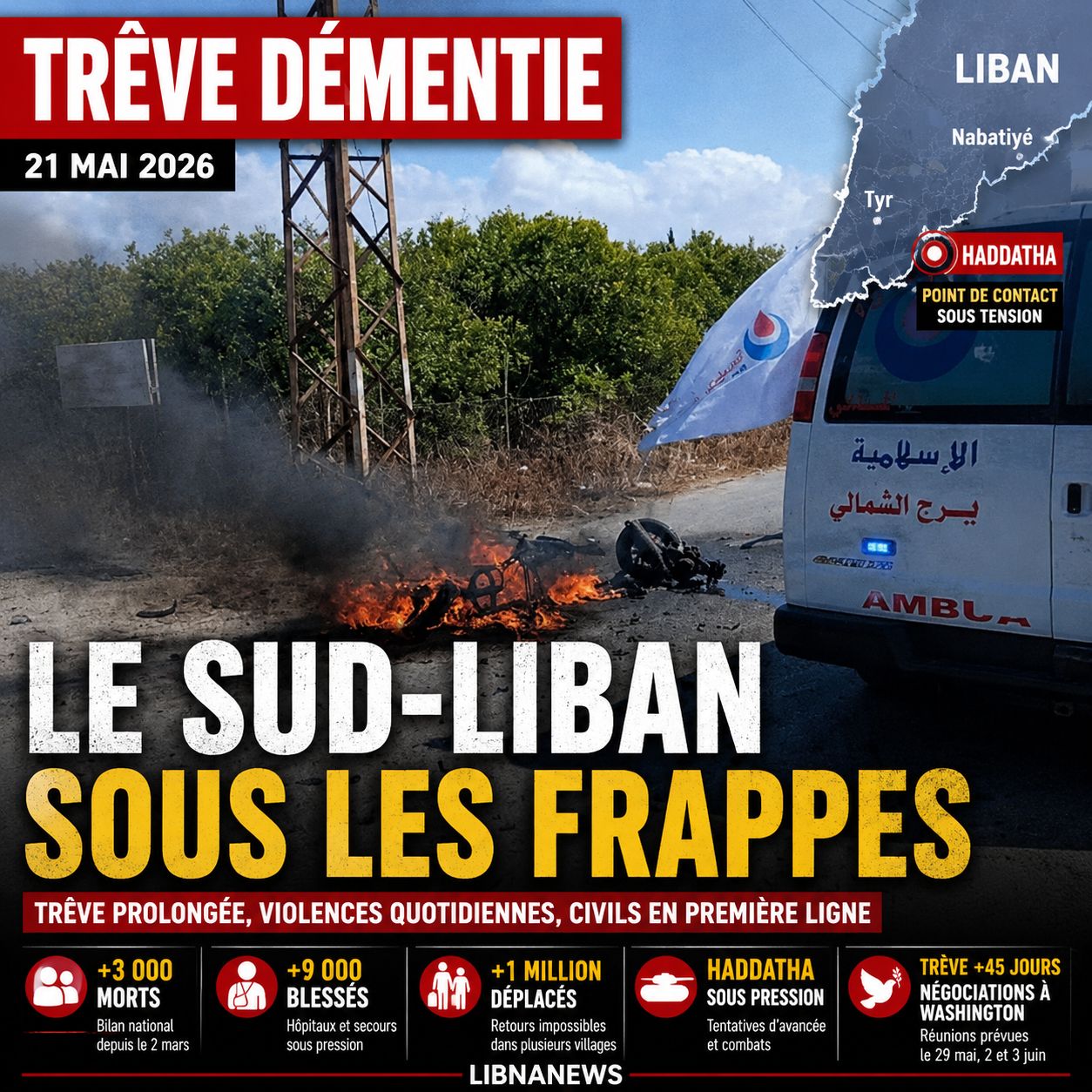
On the morning of Thursday 21 May 2026, the situation in Lebanon remains dominated by a clear contradiction. The truce has been extended diplomatically, but the terrain continues to record strikes, artillery fire, localized fighting and new human balances. The last 24 hours documented show above all a concentration of violence in southern Lebanon, around several localities affected by Israeli raids and claimed clashes between Hizbullah and Israeli forces.
This sequence does not look like a single, linear offensive. Rather, it takes the form of simultaneous pressure on several points: airstrikes, artillery bombardments, evacuation orders, operations near border villages, Hizbullah-claimed responses and military communication from each camp. For civilians, this fragmented war has a very concrete effect. Roads are becoming uncertain, villages are emptied, displaced families are delaying their return, and municipalities are managing the emergency without knowing whether the next day will be quieter or more violent.
Situation in Lebanon: the facts of the last 24 hours
The heart of the day is in the South. The Lebanese press reported a strike on several houses in Dweir, which killed five people and injured two others. Another strike on Tebnine killed two people. Several injuries were also reported in various locations in the South, with no single consolidated assessment available at the time of writing. These figures relate to the most visible incidents on Wednesday, 20 May, but they are part of a wider series of attacks launched the previous days.
In the night and morning, Israeli strikes were reported on Jebshit, Habbush, Kherbet Selem, Kafra, Toura, Ghandouriah, Burj Rahhal and Siddiqin. Artillery fire was also reported on Hariss, Aitah al-Jabal, Braashit, Shaqrah, Safad al-Battikh, Jmaijmeh, Majdel Selem, Tuline, Qabrikha and Haddatha. The list of locations cited illustrates the dispersion of risk. The danger is not limited to the villages closest to the border. It also covers axes, residential areas, heights and areas used by residents to move or reach relatives.
Israel claims to be targeting Hezbollah infrastructure and fighters. The Israeli army reported hitting more than twenty-five Shia-related sites between Monday afternoon and Tuesday afternoon. Lebanese sources referred, for the 24 hours subsequently documented, to more than 30 sites targeted in the South. These figures do not only indicate the intensity of the strikes. They also show the Israeli method of maintaining regular pressure, preventing Hezbollah from reorganizing itself and maintaining a capacity for action despite the truce.
Hezbollah claims to be responding to an Israeli presence in Lebanese territory and to attempts to advance. He said he targeted soldiers, vehicles, tanks and reinforcements. His statements speak of a logic of wear and tear. The movement wants to show that the Israeli army cannot stabilize a security zone in southern Lebanon at low cost. This communication remains that of a party to the conflict. It must therefore be read as a claim, not as an independent record of losses or land.
Dweir, Tebnine, Nabatiyé: balance sheets that add up
Dweir’s strike marked the day with his immediate record. Five deaths in several houses are enough to remind us that war is also taking place inside inhabited localities. Housing destruction has a lasting effect. They kill, hurt, move and complicate the return. Even when fighting moves elsewhere, families must then check the condition of the buildings, retrieve documents, recover medicines, protect what remains and seek a more stable shelter.
Tebnine had another heavy checkup, with two reported deaths. This locality occupies a significant place in the geography of the South, as it is located in an area where roads connect several exposed villages. Strikes in this type of area disrupt the movement of residents, ambulances and municipal teams. They can also cause rapid closures of shops, gas stations or small services that remain active despite the war.
The previous days have added other balance sheets. An international agency reported that Israeli strikes had killed at least 19 people on Tuesday in southern Lebanon, including women and children, with deaths in Deir Qanoun al-Nahr, Nabatiyah and Kfarsir. In Deir Qanoun al-Nahr, in the district of Tyre, only one strike killed ten people, including three women and three children, and injured three others, including one child. In Nabatiyah, four deaths and ten injuries were reported. In Kfarsir, five deaths were reported, including one woman.
These close reviews create a political and social accumulation. The national debate no longer focuses solely on the existence of a truce. It’s about his reality. A truce that allows deadly strikes to continue does not, in the eyes of many Lebanese, fulfil its primary function: to protect civilians. Israel replied that Hezbollah maintains military capabilities in inhabited areas and that its operations are aimed at these capabilities. But on the ground, the population first retains destroyed houses, affected families and empty villages.
Haddatha, a military contact point to monitor
Haddatha became one of the most sensitive points in the sequence. Hezbollah claims that Israeli forces have repeatedly attempted to advance from Rshaf to the outskirts of the village. The movement says its fighters hired these soldiers, targeted tanks and fired at reinforcements. He also claims that the Israeli army had to retreat to Rshaf at dawn after violent clashes. These claims were not independently confirmed in their entirety.
The Israeli army gave a different version. It reported targeting Hizbullah fighters in Haddatha through intensive airstrikes and artillery fire. It also continued to strike and bomb other areas of the South, including Yohmor, Zawtar, Ali Taher, Kfarsir, Seer, Yater, Sultaniyeh, Jibal al-Botom, Kafra and Siddiqine. This response shows that the confrontation around Haddatha is not isolated. It enters a wider area of operations.
Haddatha configuration is important. The village is in an environment where troop movements, indirect fire, drones and airstrikes can quickly combine. An attempt to advance, even if limited, can provoke a Hezbollah response, then an Israeli air response within a wider radius. Civilians from nearby localities are then exposed to a chain of events that they do not control.
Haddatha also counts as a signal. If the fighting settles there, the truce risks becoming a simple diplomatic framework without operational effect. If, on the contrary, the intensity decreases, this may indicate that mediators still have a capacity to pressure the parties. At the moment, the available information points instead to an unstable area, where each camp tests the other while at least publicly avoiding a total break in the ceasefire.
A prolonged truce, but denied by the field
The truce was extended for 45 days after discussions in Washington. This extension should provide a negotiating space and avoid a return to a larger open war. The calendar provides for a military meeting on 29 May in the Pentagon, then a political channel on 2 and 3 June in the US State Department. On paper, this sequence installs a method. On the ground, it remains fragile.
The central point of the disagreement is clear. Lebanon calls for an effective cessation of hostilities, Israeli withdrawal from occupied areas and the protection of civilians. Israel demands security assurances and places the issue of the disarmament of Hezbollah at the heart of any lasting solution. Hezbollah rejects this logic. He refused to allow his weapons to become a prerequisite, especially as long as Israel struck Lebanon and maintained a military presence in the South.
This divergence translates into an ambiguous formula. Everyone claims to respect the goal of de-escalation, but everyone retains a justification for acting militarily. Israel claims to be attacking immediate threats or Hezbollah infrastructure. Hezbollah reports responding to violations, occupation and attempts to advance. The Lebanese government, on the other hand, seeks to preserve a State role without having complete control over the weapons involved in the confrontation.
The extension of the truce therefore has a limited effect. Maybe it prevents a total burn. It gives a framework to diplomats. It allows the capitals concerned to maintain a channel of discussion. But it is not enough to make roads safe, to reopen villages, or to convince the displaced to return. For the inhabitants, the ceasefire is measured less by the signing of an agreement than by the silence of drones, the end of alerts and the possibility of sleeping at home.
A human balance sheet that has become a political fact
The national balance sheet has crossed a symbolic threshold. The available data indicate more than 3,000 deaths and more than 9,000 injuries in Lebanon since 2 March. More than one million people were displaced by the fighting. These figures do not describe the whole reality, but they give a scale. War is no longer a border episode. It affects the social organization of the country, its institutional capacity and its daily economy.
Exceeding the threshold of 3,000 deaths changes the weight of the case in the national debate. It obliges politicians to answer a simple question: who protects civilians and by what means? The government may plead the diplomatic route, but it seems distant for the inhabitants of Dweir, Tebnine, Nabatiyah or Deir Qanoun al-Nahr. Hezbollah can say that it resists an Israeli advance, but its opponents blame it for exposing the country to a war that the state does not decide.
The health system is also under pressure. Hospitals in the south and the periphery must treat the wounded in a context of insecurity and chronic shortage. Ambulances work under duress. Rescue teams may have to wait before reaching a hit area. Families seek information through several channels: municipalities, relatives, hospitals, social networks, local media. This fragmentation of information adds anxiety to the impact of strikes.
The situation of internally displaced persons increases this vulnerability. Many live with relatives, in temporary housing or in precarious conditions. Some remain near roads or coastlines due to the lack of durable solutions. Their movement is not only geographical. It affects income, school, health, administrative papers, family ties and ability to work. The more unstable the truce is, the more likely this temporary displacement will become a prolonged crisis.
The government is trying to impose a state line
In Beirut, Prime Minister Nawaf Salam reaffirmed a strong institutional position. He stressed the Taif agreement, the ministerial declaration and the idea of a single State, a single law and a single army. He also presented the exclusivity of arms in the hands of legitimate forces as an irreversible way to guarantee sovereignty throughout the territory.
This position comes at a sensitive moment. It responds to an old domestic demand, driven by a part of the political class and public opinion. It also responds to international expectations, including those of the United States, which link any lasting stabilization to the issue of Hezbollah’s weapons. But it is likely that the Shiite party, which considers that its weapons are still needed in the face of Israel, will have a stronger relationship.
Hezbollah also hardened its rhetoric before the next discussions. One of his deputies accused Washington and Israel of wanting to use the Lebanese army to weaken the movement. He warned that a unit formed to combat « resistance » would be treated as hostile. This formulation places the army in a delicate position. The institution remains one of the few poles of national confidence, but it is at the centre of cross-pressure.
The government must therefore keep several lines at once. He must call for an end to Israeli strikes. It must defend Lebanese sovereignty in the negotiations. It must avoid direct internal confrontation. It must reassure international partners. And it must show citizens that the state is not just recording the balance sheets. This equation is all the more difficult as each strike in the South weakens diplomatic discourse and reinforces confrontational discourse.
General amnesty reopens internal fracture
The crisis is not limited to the southern front. The President of Parliament, Nabih Berri, postponed a scheduled sitting on Thursday on the draft general amnesty. His entourage linked this delay to demonstrations that were called confessional. Sunni protesters had demonstrated in several areas against the project, with portraits of Sheikh Ahmad al-Assir, imprisoned after the clashes in Abra in 2013.
This file touches an explosive material. The general amnesty does not only concern detainees and legislation. It affects the memory of internal violence, community balance, the place of victims, trust in justice and the state of prisons. A formula deemed acceptable by a parliamentary majority may become politically untenable if a part of the street feels that it excludes, favours or stigmatizes certain groups.
The postponement shows the fragility of the institutional scene. Parliament must manage a criminal and community debate when the country is under military pressure. Each internal file then takes on a broader dimension. The political camps evaluate the texts not only for their content, but also for what they mean in the national balance of power. In this climate, even a legislative session can become a revealing of deeper tensions.
This fracture complicates the Lebanese posture outside. A country negotiating under pressure needs a minimum of cohesion. However, the question of amnesty recalls that the State is already carrying heavy internal crises. Prisons, justice, Islamist detainees, Abra’s memory, victim families and community balance remain open topics. War in the South does not erase them. It makes them more sensitive.
Beirut between memory of strikes and demand for justice
The capital lives another temporality. The most active fighting is concentrated in the South, but Beirut still bears the traces of previous strikes. Families of victims of a raid in the Tallet al-Khayat district in April indicated that they wanted to build up files and seek a judicial route. Their approach shows that the war is not limited to the short time of the bombings. It also opens up a long time of documentation, evidence, compensation and justice.
This demand for justice faces several obstacles. Families must gather material, testimony, medical documents, death certificates and evidence of the nature of the sites. They must also identify possible jurisdictions. In Lebanon, confidence in judicial mechanisms has remained weak since several major crises, including the explosion of the port of Beirut. Internationally, procedures are lengthy and uncertain.
However, this movement has a political effect. He turns victims into memory actors. It obliges the authorities not to reduce the balance sheets to figures. He also pointed out that urban strikes left lasting consequences: unstable buildings, insurance records, loss of income, trauma and dispersed families. Even when news comes back to the South, these issues remain in public space.
A civil economy under permanent restraint
The war adds an extra layer to an already weakened economy. In the southern villages, activity is reduced to the bulk. Shops open irregularly. Farmers are reluctant to join the fields. Carriers adapt their routes. Families retain fuel, medicine and food supplies. Schools operate at a slow pace or move their activities where possible.
In reception areas, the pressure is different. Rents rise when demand increases. Displaced families need mattresses, water, electricity, care, food and school access. Municipalities do not always have the necessary budgets. Local associations are involved, but they must choose between food emergency, psychological support, medicines, transport and housing support. Each new wave of displaced people is a little more imbalanced than that.
This crisis economy also weighs on military and political decisions. The longer the displaced stay away from home, the higher the social cost. The more the villages are destroyed, the heavier the reconstruction becomes. The more the state appears to be absent, the more partisan actors and local networks take over. The conflict thus alters the relationship of dependency between citizens, municipalities, parties, army, associations and international donors.
Households live in double uncertainty. They don’t know when security will come back. They also do not know what help will be available. Some displaced persons can still rely on relatives. Others are exhausting their savings. Still others lose their jobs because they have left their region. This precariousness can become a political factor. It feeds anger against Israel, but also criticism of the state and the armed actors who impose their logic on civilian life.
Next hours: five points to follow
The first point concerns Haddatha and the sectors close to Rshaf. If the clashes continue, this sector can become a marker of the operational failure of the truce. A decrease in intensity would, on the contrary, be a useful sign before the meetings planned in Washington. For now, the available information describes an active area, with Hezbollah demands and Israeli strikes.
The second point concerns the rhythm of the strikes. The reports of Dweir, Tebnine, Deir Qanoun al-Nahr, Nabatiyah and Kfarsir set up a deadly sequence. If new strikes hit homes or inhabited areas, pressure on the Lebanese government will increase. The mediators will then have to show that the extension of the truce has a real scope.
The third point concerns the position of the Lebanese army. Any discussion of a force, control mechanism, security zone or international verification will place the military institution at the centre. Hezbollah will monitor this case closely. International partners too. The government must avoid the army being perceived as an instrument of one camp against another.
The fourth point concerns the general amnesty. The postponement of the parliamentary sitting does not regulate anything. He’s moving the crisis. The file can return quickly if a compromise is redrafted. It may also remain frozen if protests continue. In both cases, it will weigh on political cohesion as the executive seeks to speak with one voice against the mediators.
The fifth point concerns displaced civilians. The number of families returning, staying or leaving again will give a more reliable indication than the press releases. If the villages remain empty and the shelters full, the truce will remain perceived as insufficient. If the roads reopen and the inhabitants test a cautious return, the negotiations will gain some credibility. For the time being, in several southern localities, the bags remain ready near the doors.




