

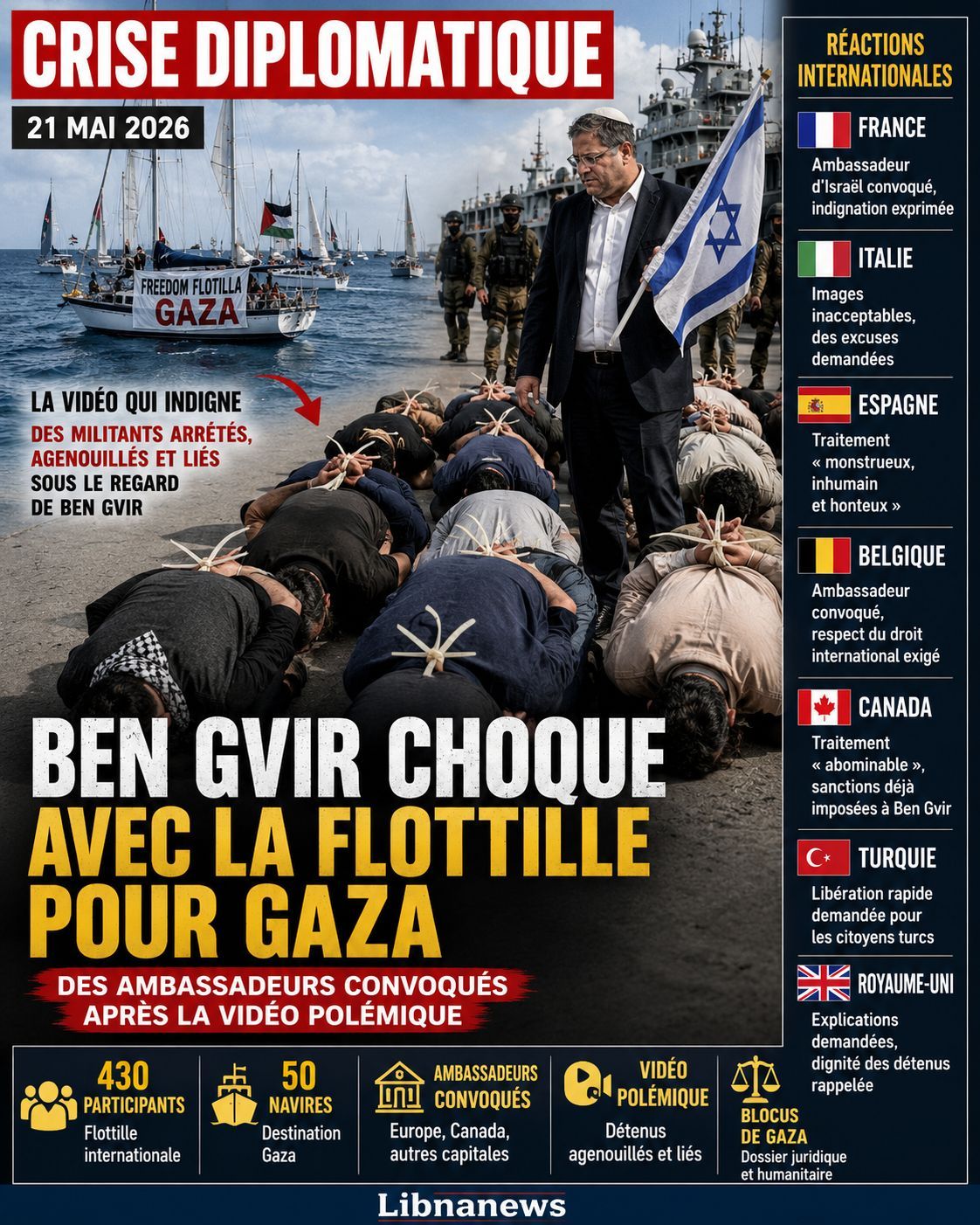
The controversy surrounding Ben Gvir and the flotilla for Gaza took on a major diplomatic dimension in less than 24 hours. The release of a video showing arrested activists, kneeling and hands tied, under the eyes of the Israeli Minister of National Security, resulted in convictions in Europe, Canada and several other capitals. Several Israeli ambassadors or representatives were convened to explain the treatment of passengers. The Ben Gvir flotilla file is now a diplomatic test for Israel.
The case now goes beyond maritime boarding. It affects three sensitive issues: the legality of the Gaza blockade, the treatment of detainees by the Israeli authorities and the international image of Benjamin Netanyahu’s government. It also intervenes in a tense regional context, where the humanitarian crisis in Gaza remains central and where each incident involving foreign nationals quickly becomes political.
A video that turns interception into a diplomatic crisis
The sequence that triggered the crisis is short, but its effects are considerable. Itamar Ben Gvir posted a video shot on the X network after the flotilla was intercepted. There are militants on the ground, on their knees, with their hands tied behind their backs by plastic ties. Some of them appear on the ground. The minister travels among them with an Israeli flag. In the video, he mocks them and presents their arrest as a demonstration of force.
The scene was reportedly filmed in an Israeli port facility after the transfer of passengers. The images also show armed forces in the immediate environment. The Minister’s political message is explicit. He wants to show that those who presented themselves as humanitarian activists are now under Israeli control. This set-up provoked a rapid reaction, including within the Israeli government.
The controversy is not just about interception. Israel had already stopped ships heading towards Gaza. What has changed this time is the public humiliation of prisoners and the decision of a minister to distribute the images himself. Several Governments considered that the visible treatment on the video violated the dignity of arrested persons. Critics also targeted Ben Gvir’s language, which called for long-term detention of activists.
The fleet, its objectives and boarding
Global Sumud Flotilla presented itself as an international civilian initiative to break the maritime blockade of Gaza and deliver symbolic humanitarian aid. The organizers evoke about 430 participants from around 40 countries, spread over about 50 boats. Several European, North American, Turkish, South Korean and New Zealand nationals were among the passengers.
The ships had left southern Turkey to attempt to reach the Gaza Strip. Israeli forces intercepted them in the Mediterranean, in waters described by organizers and several governments as international. Israel maintains that its naval blockade is legal and has the right to prevent any unauthorized crossing to Gaza. This legal divergence is old. It comes back to every flotilla operation.
After interception, the passengers were transferred to Israel. Lawyers from a rights organisation reported that they had been able to access some detainees at Ashdod port. The organizers then claimed that the activists should be taken to Ketziot prison in the Negev desert. The Israeli authorities also indicated that detainees could meet with their consular representatives.
Israel presents the fleet as a communication operation in the service of Hamas. The Israeli Ministry of Foreign Affairs states that the aid carried was symbolic and that the main purpose of the organizers was to challenge the blockade. The activists reject this reading. They say they want to draw attention to the humanitarian needs in Gaza and the restrictions imposed on the delivery of aid.
Ben Gvir flotillas: the heart of controversy
The heart of the controversy lies in the way Ben Gvir spoke of the flotilla prisoners. The minister was not content to attend or comment on the operation from his office. He staged himself in front of the inmates. He called them defeated militants, opposed them to the Israeli state and demanded that they be imprisoned for a long time in what he called terrorist prisons.
This exit corresponds to Ben Gvir’s political line. The minister has long defended a very harsh prison policy, particularly with regard to Palestinian prisoners. It regularly combines internal security, national sovereignty and balance of power. In this case, he applied the same register to foreign nationals arrested during a maritime action. It is precisely this slippage that has led to indignation among several governments.
The distinction between activists, administrative detainees, offenders and convicted prisoners is essential. The fleet passengers had not, at the time of the images, been convicted by a court. Instead, the Israeli authorities were talking about detention, control and deportation procedures. By publicly presenting them as people to be locked up for long, Ben Gvir turned a legal and consular file into a political confrontation.
The word « prisoners » is itself loaded. Organizers talk about activists being abducted or illegally detained. Israel speaks of passengers arrested after an attempt to violate a naval blockade. The countries concerned mainly speak of their nationals, whose protection, consular access and early release they demand. This difference in vocabulary structure the entire crisis.
Netanyahu and Saar take their distance
The video generated an unusual reaction within the Israeli government itself. Benjamin Netanyahu defended Israel’s right to stop the fleets he considered provocative. But he felt that the way Ben Gvir treated the activists did not meet Israel’s standards and values. The Prime Minister also requested that detainees be expelled as soon as possible.
Israeli Foreign Minister Gideon Saar was more direct. He blamed Ben Gvir for damaging the state and its international image. This criticism is notable. It shows that the ministry responsible for managing the relationship with foreign capitals immediately perceived the diplomatic cost of staging. In a crisis involving nationals of many countries, the communication of a minister can aggravate the case as much as the operation itself.
Ben Gvir didn’t step back. He accused his critics of weakness and defended a line of firmness. His reaction reveals internal tension to the Israeli government. Netanyahu is politically dependent on radical right-wing allies, but it must also preserve Israel’s relations with its Western partners. The conflict between external image and coalition calculations is particularly clear here.
This sequence weakens Israeli diplomacy. It gives foreign chanceries a concrete reason to protest. It also provides opponents of the Israeli government with a new argument on the place taken by the most radical ministers. Within Israel, therefore, the issue is not only moral. It becomes strategic: who speaks on behalf of the state and who bears the cost of his statements?
Israeli ambassadors convened: Europe reacts
France summoned the Israeli ambassador to express its outrage and ask for explanations. Paris recalled that it disapproved of the fleet’s initiative, but insisted that French citizens should be treated with respect and released quickly. This formulation is intended to separate two files: the political judgement on the fleet and the obligation to protect detained nationals.
Italy also announced the convening of the Israeli ambassador. Council President Giorgia Meloni and Foreign Minister Antonio Tajani found the images unacceptable and asked for an apology. Italy had several citizens among the passengers, including one parliamentarian and one journalist according to available information. Rome therefore placed its protest in a consular as well as a political framework.
Spain summoned the Israeli Chargé d’affaires. Foreign Minister José Manuel Albares used particularly harsh terms, describing the treatment of monstrous, inhuman and shameful activists. Madrid also requested a public apology. The Spanish position is part of an already tense relationship with Israel since the European debates on Gaza, the recognition of Palestine and humanitarian restrictions.
The Netherlands, Portugal and Belgium also protested. Brussels summoned the Israeli ambassador after images deemed very worrying. Belgium called for respect for international law and the protection of detainees. In several countries, the purpose of the diplomatic convocation was the same: to obtain information on the nationals concerned, to recall Israel’s obligations and to publicly express disapproval.
Canada, United Kingdom, Turkey, Greece: a wider indignation
Canada has adopted one of the strongest tones. Prime Minister Mark Carney described the treatment of the militants of the abominable and unacceptable fleet. Ottawa said the Israeli ambassador would be summoned. Canada also recalled that it had already imposed sanctions on Ben Gvir, including an asset freeze and a travel ban, because of its repeated incitement to violence.
In the United Kingdom, the Chief of Diplomacy asked for explanations and denounced a violation of basic standards of dignity. London insisted on the treatment of detainees, without necessarily using the language of the flotilla organizers. This position reflects a common line of Western governments: criticism of the treatment of nationals, prudence over the exact legal status of the maritime operation.
Turkey condemned the treatment of activists and announced that it was working with other countries to secure the speedy and secure release of its citizens. Ankara is directly concerned, since the fleet was part of southern Turkey. The issue therefore has an internal dimension for the Turkish Government, which presents itself as an active support for the Palestinians and as a regional actor engaged in the Gaza crisis.
Greece also protested. His Department of Foreign Affairs found Ben Gvir’s actions unacceptable and condemnable. Ireland, South Korea, Australia and New Zealand also expressed concerns or convictions. New Zealand indicated that it wished to convey its serious concerns directly to the Israeli Ambassador. This multiplication of reactions further isolates Ben Gvir, although it does not mean a general break with Israel.
European Union raises tone
The European Commission has found the treatment shown in the video completely unacceptable. His spokesman recalled that all detained persons should be treated with security, dignity and in accordance with international law. This formulation remains institutional, but it provides a common framework for Member States. It emphasizes the obligations of detention, more than the political debate around the fleet.
The President of the European Council, Antonio Costa, expressed dismay at the treatment of the members of the fleet and called for their immediate release. This gives a more political dimension to the European response. It comes as the European Union divides itself regularly over Israel, Gaza, sanctions and the recognition of Palestine. Here, the video created a point of convergence, even between countries with different positions on the conflict.
However, this convergence remains limited. The European states do not all propose the same measures. Some favour diplomatic convocation. Others are asking for an apology. Others insist on consular access or release. But the common message is clear: the public humiliation of foreign detainees by an Israeli minister creates a problem that capitals cannot ignore.
For Israel, the cost is immediate. The government must manage not only the procedures of embassies, but also the global circulation of images. In a perception war, Ben Gvir’s video moved the focus of the debate. Instead of talking only about the blockade, fleets or aid to Gaza, the chancelleries are now discussing dignity, detention and ministerial responsibility.
Charges of ill-treatment
Lawyers and rights organizations made serious accusations. Detainees were reportedly subjected to physical and psychological violence, humiliating positions, restrictions on legal access and degrading treatment. Some people were reportedly injured by non-lethal projectiles, according to testimony from lawyers. These elements remain, for one part, to be independently confirmed.
An Israeli legal organization representing activists claims to have documented procedural violations and abuses. Lawyers say they met inmates at Ashdod Harbour, but not all. The fleet organizers denounce illegal arrests in international waters. Israel challenged that reading, defended the legality of its blockade and claimed to have acted in accordance with international law.
The legal debate focuses on several points. The first concerns the exact location of the interception. The second concerns the validity of the naval blockade of Gaza. The third concerns the treatment of persons arrested after boarding. Even when a State considers that it has the right to intercept a ship, it must respect the safeguards applicable to detainees. It is this aspect that today feeds the most immediate controversy.
The images broadcast by Ben Gvir reinforce the accusations. They do not prove all allegations of ill-treatment, but they show a situation of coercion and humiliation. They therefore give visual support to diplomatic protests. This dimension explains the speed of the international response.
A crisis that reinforces the debate on the blockade of Gaza
The purpose of the fleet was to challenge the maritime blockade imposed on Gaza since Hamas took control of the territory in 2007. Israel affirms that this blockade is necessary to prevent the entry of weapons and protect its security. Activists and many human rights organizations believe that it contributes to the isolation of the civilian population and the humanitarian crisis.
Since the 2025 ceasefire, humanitarian aid has remained a central issue. International organizations regularly alert to the needs of the people of Gaza, mass displacement, destruction of infrastructure and logistical obstacles. In this context, each fleet becomes both a symbolic humanitarian operation and political action.
Israel is critical of this strategy. The authorities say that aid can go through controlled channels and that the fleets are mainly used to cause an incident. The organizers replied that these channels remain insufficient and that they want to break a normalization of the headquarters. Ben Gvir’s video gave their cause additional visibility, even to governments that do not necessarily support the fleet method.
The paradox is there. Israel wanted to prevent the ships from reaching Gaza. The operation succeeded. But Ben Gvir’s communication has moved the debate on Israeli detention practices. She gave activists a world stage. It has also forced Israel’s allies to publicly distance themselves.
What this case can change
In the immediate future, the issue is the fate of prisoners. The countries concerned want to check the status of their nationals, obtain consular access and speed up expulsions or releases. Administrative hearings or procedures may determine the timing of departures. The lawyers will seek to document the alleged ill-treatment, while Israel will try to close the case with prompt deportations.
Diplomaticly, ambassadorial convocations reflect a formal protest, but they do not yet constitute a rupture. However, they can pave the way for other measures if serious injuries, denial of consular access or new videos exacerbate the crisis. Canada is already recalling its sanctions against Ben Gvir. Australia and New Zealand have also taken restrictive measures or travel bans against it in a broader context.
For Netanyahu, the problem is political. He must preserve his coalition without letting Ben Gvir dictate the country’s external image. He must also reassure Western partners, whose citizens had been arrested. The margin is narrow. Any conviction that is too weak feeds foreign outrage. Any too much distance can provoke a response from the Israeli radical right.
The follow-up will depend on three concrete elements: the state of the detained activists, the speed of their release or expulsion, and the ability of the capitals to obtain credible explanations. The Ben Gvir flotilla controversy is no longer a video. It is becoming a test of responsibility for Israel, a test of firmness for its partners and a new point of fixation in the political war around Gaza.




