

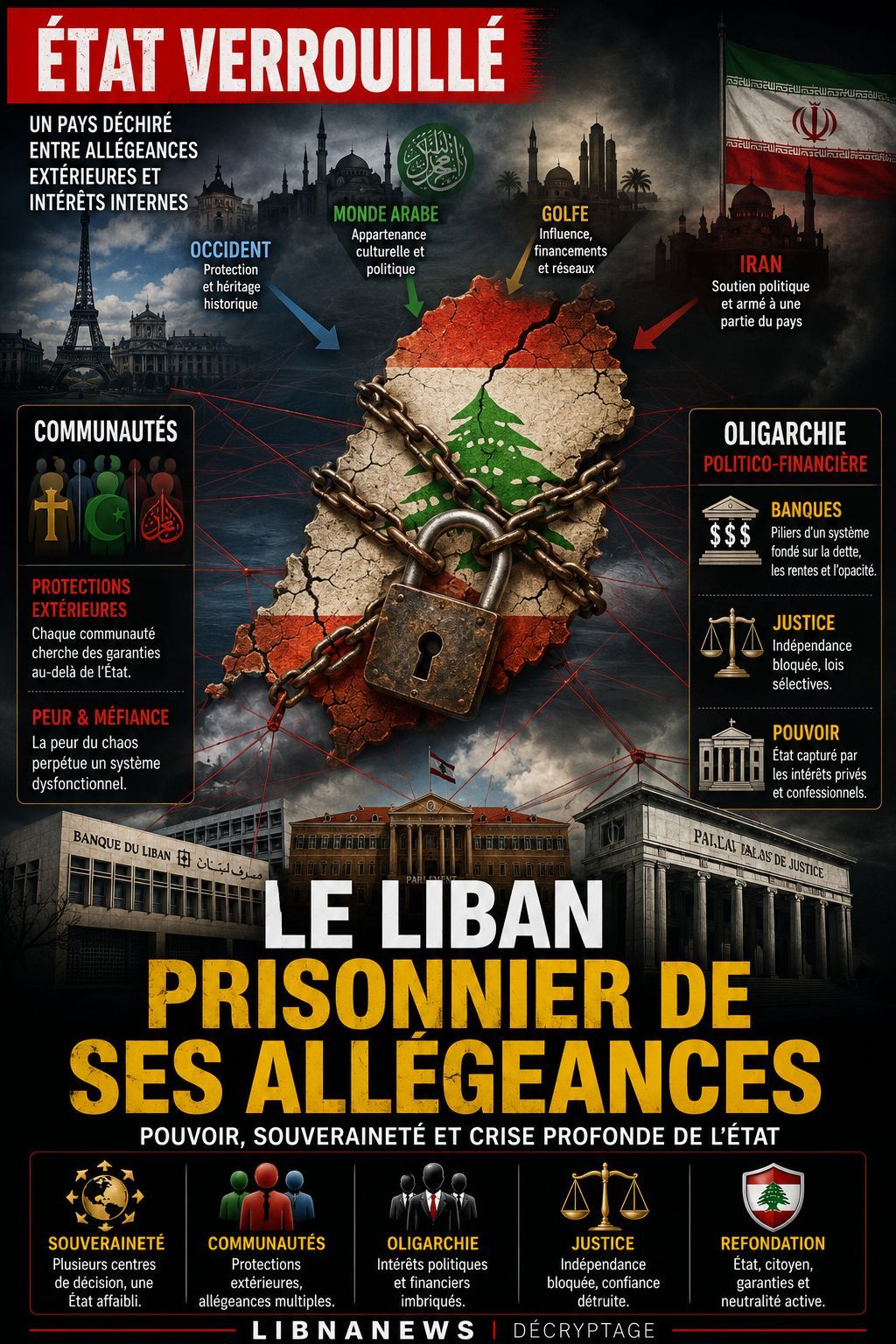
Lebanese State power, sovereignty, communities and crisis
Lebanon has been in a crisis for several decades, far beyond economic or financial issues. Behind the monetary collapse, institutional paralysis and political blockages hide a much deeper reality: that of a state that has never completely succeeded in becoming the only centre of sovereignty in the country.
Modern Lebanon has been built at the crossroads of many worlds. Its geography, religious diversity and history have always been crossed by external influences. The problem is therefore not new. From the Ottoman era, the different communities sought protection from foreign powers capable of ensuring their safety and survival in an unstable region.
A significant part of Maronite Christians gradually developed privileged ties with France and more broadly with the Catholic West. The religious missions, French-speaking schools and European cultural networks played an immense role in the formation of the Christian elites of Mount Lebanon. Gradually a vision of Lebanon was built as a Mediterranean area linked culturally and politically to Europe.
The creation of Greater Lebanon under French mandate further strengthened this direction. For many Christians, France appeared to be a strategic guarantee in the face of a predominantly Arab and Muslim regional environment. Conversely, a significant part of Muslims naturally viewed Lebanon as belonging to the Arab world.
This fracture broke out during the 1958 crisis. The rise of Nassarianism, the Suez War and the cold war tensions plunged Lebanon into extreme polarization. Some of the Christians supported a pro-Western orientation, while a large part of the Sunnis recognized themselves in Gamal Abdel Nasser’s pan-Arabism. When the American Marines landed in Beirut in July 1958 at the request of President Camille Chamun, many saw confirmation of the Western anchoring of Lebanese Christian power.
Over the decades, Sunni allegiance also evolved. After the decline of Nassarianism, the centre of gravity of Lebanese political Sunism gradually moved towards Saudi Arabia and the Gulf monarchies. Saudi financing, economic networks and the rise of Rafik Hariri consolidated this new regional orientation.
For its part, Lebanese Shiism underwent a major transformation from the 1979 Iranian Revolution and the 1982 Israeli invasion. For a long time marginalized economically and politically, an important part of the Shiite community developed an organic relationship with revolutionary Iran. Hezbollah gradually became both a Lebanese force and an actor integrated into a larger regional axis.
Thus, the large Lebanese communities were each linked, to different degrees, to external centres of gravity:
— Christians to the West,
— sunnis towards the arab-sunni world,
— a large part of the Shiites towards revolutionary Iran.
Lebanon then became a kind of miniature mirror of the Middle East fractures.
This fragmentation of allegiances has profoundly prevented the emergence of a fully sovereign state. For in a modern state, sovereignty normally presupposes one legitimate authority, one diplomacy, one army and one justice. However, Lebanon has gradually worked on balances of partial sovereignty and cross-protection.
The problem is not simply international relations between different communities. All countries have alliances. The problem arises when some external belongings become more powerful than the allegiance to the national state itself.
This largely explains why structural reforms have been blocked for decades. Blockages do not come solely from conventional political divisions. They also come from an extremely intertwined system of power where there are intertwined Community interests, financial interests, regional protections and clientelism networks.
Since the end of the civil war, Lebanon has gradually been organized around a confessionalised political-financial oligarchy. The state has become a mechanism for allocating resources, jobs, public procurement and influences.
In this system, reform becomes dangerous because it still threatens someone.
The real independence of justice is probably the most sensitive point. A truly autonomous justice system could monitor financial flows, examine public procurement, investigate conflicts of interest and trace accountability chains. This would directly affect the foundations of the system.
The banking sector has long been the second pillar of the Lebanese model. For decades, the country’s economy was based on deposits, high rates and public debt financing. A close relationship developed between banks, central bank and political power. Many policy makers were directly or indirectly linked to the financial sector.
When the system collapsed, the question was no longer only economic but existential: how to reform a system when those who should transform it themselves participated in its construction?
To this added the gradual disappearance of counter-powers. The institutions responsible for controlling the state ended up being absorbed by religious balances and political power relations. Laws often existed, but their application remained selective.
Lebanon thus suffers less from a lack of texts than from a lack of institutional autonomy.
The deepest paradox in Lebanon is probably the following: the system simultaneously produces oppression and protection.
Many Lebanese denounce corruption, but also depend on community networks to survive. In a country marked by civil war and regional instability, community membership is often perceived as existential guarantees.
This is why fear plays a central role in the survival of the system. Fear of chaos, domination of another group or total collapse often pushes communities to accept structures that are deeply dysfunctional.
Lebanon then finds itself trapped in a paradoxical mechanics: everyone demands a strong state, but everyone fears that a strong state will be captured by another group.
As this mistrust grows, society enters a vicious circle. The more people lose confidence in the institutions, the more they retreat to their community networks. And the more powerful these networks become, the weaker the state.
However, the financial collapse began to change some historical perceptions. The destruction of savings, the collapse of the currency and the mass exodus of youth revealed the extent of the structural fragility of the country. A growing part of the population is now beginning to understand that the problem is beyond the communities themselves and affects Lebanon’s collective survival.
But exiting the crisis requires much more than just economic adjustment. It requires a refounding of the relationship between the state, communities and citizens.
The solution to the Lebanese problem probably requires a historic exchange between Community security and national sovereignty.
Communities will never give up their external protections if they do not believe that the Lebanese State can really protect them. Conversely, no modern state can operate sustainably with several strategic decision-making centres and several competing geopolitical allegiances.
Thus, Lebanon should gradually move towards:
— one sovereignty,
— one military authority,
— one diplomacy,
— one independent court,
— but with strong constitutional guarantees for all communities.
The spirit of article 22 of the Lebanese Constitution could serve as the basis for this transition: a deconfessional parliament charged with the national interest and a Senate representing communities in order to protect existential balances.
The active neutrality of Lebanon would also be a fundamental element. The country cannot survive for a long time as a platform for confrontation between regional and international powers. It should gradually become an area of stability, refusing to be both Iranian forward base, Western outpost or area of compensation for regional conflicts.
At the same time, the fight against political-financial oligarchy requires several major changes:
— total independence of justice,
— autonomy of the supervisory bodies,
— bank transparency,
— prohibition of conflicts of interest,
— complete digitisation of public procurement,
— and strict separation between political functions and financial interests.
The real challenge is to move Lebanon from a system based on Community protections and political annuities to a system based on institutional guarantees.
In other words, the Lebanese question is not just that of reform.
It is that of the refoundation.
Refoundation of sovereignty.
Refounding justice.
Refounding responsibility.
Rebuilding the relationship between citizen, community and state.
And as long as this profound transformation does not really begin, Lebanon risks continuing to oscillate between temporary survival and chronic collapse, without ever finally getting out of the historical cycle that has consumed it for so many years.




