

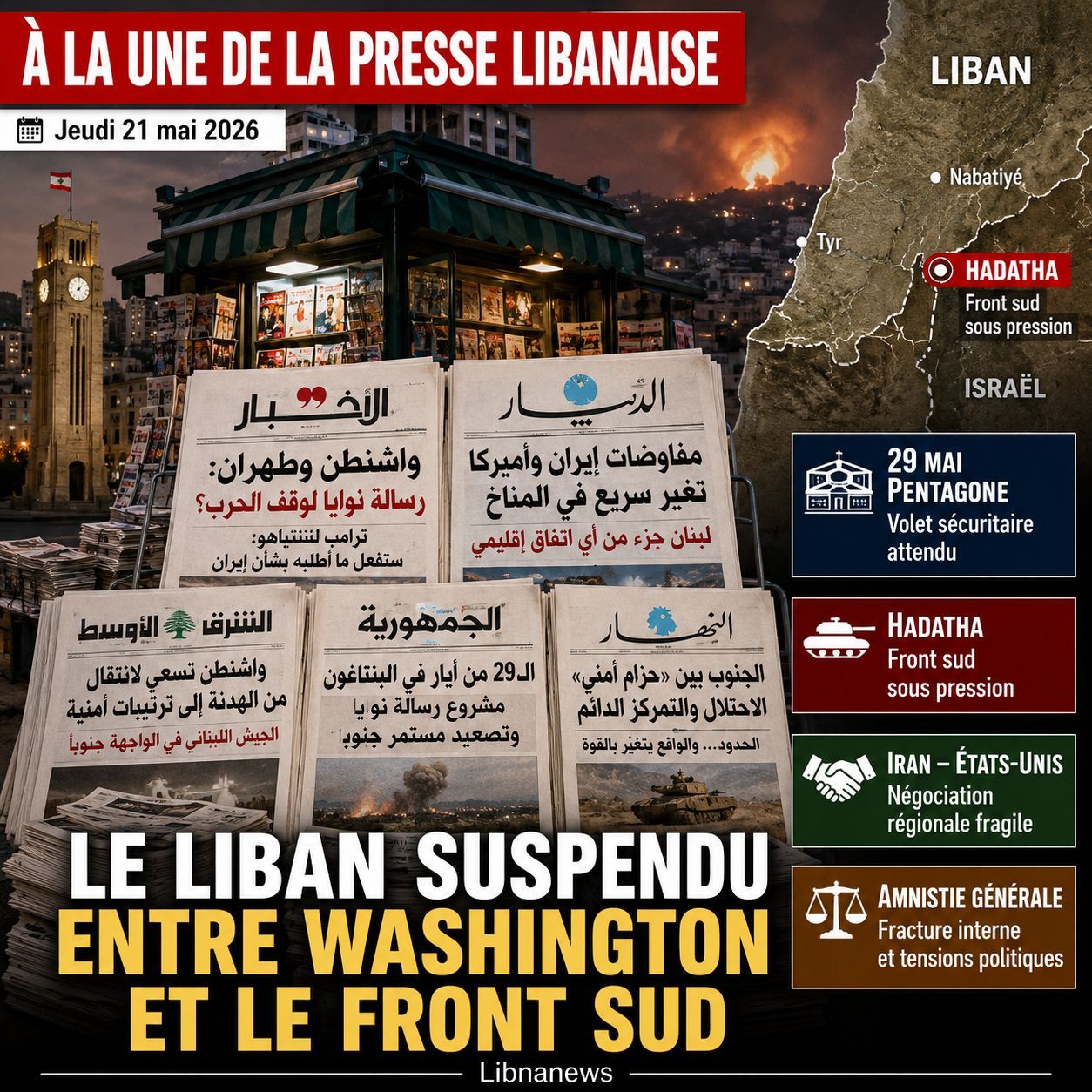
A fragile diplomatic respite around Iran
The press on Thursday 21 May 2026 puts Lebanon at the crossroads of two dynamics. On the one hand, negotiations between the United States and Iran seem to slow down the risk of regional burning. On the other hand, the southern front remains active, with strikes, Israeli attempts and preparations for security talks in Washington. Ad Diyar writes on 21 May 2026 that the climate around the American-Iranian conflict has changed rapidly. The newspaper refers to indirect exchanges under Pakistani mediation, with pressure from the Gulf to avoid a new war. According to this reading, Tehran also seeks to include the Lebanese issue in any regional agreement, as Lebanon’s stability remains linked to the land where Iran retains influence.
Al Akhbar reported on 21 May 2026 that Donald Trump and Benjamin Netanyahu had a tense exchange about Iran. The newspaper reports that the US president said Netanyahu would do what he asked him to do on this file. He also cites sources that Washington and Tehran are working on a letter of intent to end the war. This data places Lebanon in a heavy wait. If an agreement becomes clear, the south front could be included in a logic of decreasing tension. On the other hand, if the discussions fail, Ad Diyar believes that Lebanon could enter into a war of long wear and tear, without a clear horizon.
Al Quds Al Arabi reported on 21 May 2026 that Saudi Foreign Minister Fayçal bin Farhane welcomed Donald Trump’s decision to give the negotiations an additional chance. He called on Iran to seize this opportunity to avoid a serious escalation. The same newspaper states that Pakistan’s interior minister, Mohsen Naqvi, visited Iran for the second time in less than a week. These movements show that the current sequence is not limited to Washington and Tehran. It also mobilizes Riyadh, Islamabad and capitals concerned with the security of the Strait of Ormuz.
Washington prepares a safe passage on the Lebanese file
On the Lebanese level, 29 May dominates some. It corresponds to the planned launch of a security component at the Pentagon. Al Quds Al Arabi, May 21, 2026, reports that Washington is seeking to move from a simple truce to broader security arrangements. These arrangements would affect the future of southern Lebanon, the deployment of the Lebanese army and the form of coordination between Beirut and Tel Aviv. The newspaper quotes Alan Sarkis’ analysis that it is not just political talks but a process with a high security dimension. This process is scheduled to begin officially in the Pentagon on May 29.
Al Quds Al Arabi adds that the negotiating route would make the Lebanese army the main actor in the south. Hezbollah would not be a direct partner of the expected agreement. The responsibility for security would be placed on the Lebanese State. The same newspaper recalls that the mandate given to the future process is to strengthen military coordination between Lebanon and Israel under American sponsorship. This formulation creates an internal tension. Some officials see it as a way to stop the strikes. Another sees it as an attempt to impose political and military facts under pressure of war.
Al Sharq writes on 21 May 2026 that the United States is committing its diplomatic and security means to push for a lasting agreement between Lebanon and Israel. The newspaper mentions a team of officials from the US State Department and the Pentagon. It must follow developments and react to possible upheavals in the process. Al Sharq adds that President Joseph Aoun is following the case personally, in connection with the Lebanese representation in Washington and the capitals concerned. The newspaper also highlights the existence of coordination between Joseph Aoun, Nawaf Salam and Nabih Berri.
The southern front keeps pressure on the state
Diplomacy is advancing as the military situation remains tense. Asharq Al Awsat reports on 21 May 2026 that Israel is trying to deepen its presence in southern Lebanon. The newspaper states that the continued Israeli violations of the ceasefire make Lebanese participation in the security process more difficult. Beirut therefore hesitates between the presence at the Washington table and the requirement of a clear halt to the strikes. Joseph Aoun and Nawaf Salam face a difficult choice. They need the American channel, but they can’t ignore the attacks to the south.
Al Quds Al Arabi details the fighting around Hadatha on 21 May 2026. According to the newspaper, Hezbollah claims to have rejected another Israeli attempt. It evokes the destruction of a fourth tank and the withdrawal of Israeli force towards Rchaf. The same article mentions reports from the Israeli Walla site of the wounding of the 401 Armoured Brigade Commander and several soldiers by a drone launched by Hezbollah. These evidences show that the southern front is not a mere residual tension. There is still a space for direct confrontation.
Annahar, May 21, 2026, expanded military reading. The newspaper questions the transition from a « belt » to a possible sustainable installation logic in the south. He believes that the Israeli debate on southern Lebanon cannot be reduced to religious fiction or a marginal statement. The risk, according to the newspaper, lies mainly in the political and military environment that makes these ideas possible. This is in line with concerns expressed by other sources. The question is no longer just the ceasefire. It becomes the border, the control of the ground and the ability of the Lebanese State to prevent a lasting reality imposed by force.
Joseph Aoun seeks a balance line
Ad Diyar reports on May 21, 2026, that Joseph Aoun claims that the restoration of confidence begins from within. The President considers that the Lebanese crisis is not only economic. It is also a crisis of confidence between the state and the population, and between Lebanon and the outside world. He therefore insisted that the real reform should start from the country itself. This message targets two fronts. It is addressed to the Lebanese, tired of crises. It also targets Arab and international partners, whose assistance depends on minimum institutional credibility.
The same newspaper reports that sources close to Baabda emphasize Joseph Aoun’s desire to preserve the role of the State. They claim that the President insists on the arms monopoly by the institutions. They also note that this position has cooled the relationship with Hezbollah in recent months. However, these sources do not describe a rupture. Rather, they talk about an attempt to reorganize the relationship and keep channels open. According to Ad Diyar, Baabda believes that the objectives of the negotiations do not differ from those of Hezbollah, namely the Israeli withdrawal, the return of prisoners, the reconstruction and the return of the inhabitants.
This line is difficult to maintain. It assumes that the state speaks on behalf of all, without appearing as mere relays of external pressure. It also assumes that Hezbollah accepts a negotiation of which it would not be the direct actor. Al Akhbar, on 21 May 2026, has a more tense climate. The newspaper refers to officers who refuse to attend the Pentagon meetings. He also writes that the army does not want to speak political in Washington. This reading highlights the fear of confusion between military mission, political mandate and American demands.
General amnesty adds internal shaking
Regional tension not only blocks security decisions. It also weighs on the interior stage. Annahar, on 21 May 2026, reported that the sitting on the draft general amnesty law had been overturned by protests, despite broad agreement in Parliament. The newspaper explains that the blocks sought to satisfy their audiences, from north to south through the Bekaa. The efforts of the Vice-President of the House, Elias Bou Saab, were not enough to stabilize the formula. The objections therefore dropped the adoption session.
Al Sharq, May 21, 2026, gives a more political reading of this episode. The newspaper believes that the agreements remain fragile as long as the strength of denominational affiliations exceeds that of the institutions. He noted that the Speaker of Parliament, Nabih Berri, had postponed the sitting after the anger on the street. This file has therefore joined the other crises of the moment. It revealed the weakness of the state at the very moment when Washington asked Beirut to incarnate a single interlocutor on the safe ground.
Al Joumhouria, 21 May 2026, summarizes the dilemma by referring to preparations for the Pentagon, a draft letter of intent between Lebanon and Israel and a truce still violated by Israel. The newspaper points out that any concession, if perceived as political or security, can provoke a strong internal reaction. Conversely, failure of the process can rekindle the risk of rapid military escalation. Lebanon therefore finds itself in a narrow area. He tries to buy time, limit the domestic political cost and avoid an explosion in the south.
Local politics: the Lebanese state between negotiation, sovereignty and internal divides
Joseph Aoun places trust at the centre of public debate
The local political scene is dominated by double pressure. The first is from the South Front and the security negotiations planned in Washington. The second comes from within, with the crisis of trust between institutions, parties and citizens. Al Sharq reported on 21 May 2026 that President Joseph Aoun had received members of the Economic, Social and Environmental Council in Baabda. He claimed to continue his efforts to reopen Arab markets, especially those in the Gulf, to Lebanese products. He also stressed the need to restore confidence in Lebanon. In the same exchange, he felt that reform was starting from within rather than from outside. This sentence summarizes the angle chosen by the Presidency. It aims to show that foreign aid cannot replace a local order. It also aims to respond to criticisms that accuse the state of moving under US or regional pressure.
Al Joumhouria, 21 May 2026, also places this crisis of confidence on the front page. The newspaper headlines about an internal crisis, but also about a crisis between Lebanon and the outside world. He took Joseph Aoun’s formula to the Economic, Social and Environmental Council, according to which « reform begins from within ». The choice of this title gives political significance to the presidential speech. This is not just about economy. This is a method message. The President seeks to make the restoration of the State a compulsory passage before any aid, negotiation or reconstruction. This is particularly important at a time when Lebanon is being invited to participate in security meetings in Washington, D.C., even as Israeli attacks continue in the south.
However, this presidential line remains difficult to maintain. On one side, Baabda wants to appear as the natural decision center. On the other hand, Hezbollah challenges negotiating choices and warns against any formula that would put resistance out of political calculus. In this tension, Joseph Aoun tries to keep an open channel with all the actors. Annahar reported on 21 May 2026 that the Presidency was watching with interest Hezbollah’s decision to instruct Deputy Hassan Fadllallah to resume dialogue with the Head of State. According to the newspaper, Joseph Aoun is open to any attempt to resume dialogue. The doors of the presidential palace would remain open to all Lebanese. This posture seeks to avoid a complete break with the party, while maintaining the institutional heading of the presidency.
Nawaf Salam defends the single state and the choice of negotiation
Prime Minister Nawaf Salam also occupies a central place in the local sequence. Al Sharq reported on 21 May 2026 that he had declared that his government was advancing in an institutional way to save the country. It affirms its respect for the national constants, the Taif agreement and the commitments of the ministerial discourse. He insists on the existence of a single State, a single law, a single army and the monopoly of arms by the legal forces. This statement is a direct response to the debate on Hezbollah, war and the decision on peace or conflict. It puts government action in a clear framework. The decision on war and peace must not be left to an autonomous armed actor.
The same statement also provides a political justification for the choice of negotiation. Nawaf Salam asserts that negotiations are the way to end the war against Lebanon, in order to restore stability, security, growth, prosperity and reconstruction to the country. This sentence is important. It shows that the government does not portray negotiation as a concession of weakness, but as an exit tool. At the same time, she puts the firm before a difficulty. The negotiation must produce a visible result. Otherwise, it may be presented by its opponents as a cover given to external pressures. It is precisely on this point that Hezbollah and its relatives are concentrating their attacks.
Nawaf Salam also pursues a more traditional institutional activity. Al Sharq reported on 21 May 2026 that he had received the World Bank representative, with an exchange on projects financed in Lebanon and on the assessment of the damage caused by the war in 2026. He also received Deputy Charbel Massaad, who gave him the final text of a national meeting in Jezzine on the protection of civil peace in the context of political pluralism. These meetings show that the government seeks to preserve an image of administrative continuity, while the national agenda is dominated by war, negotiations and partisan divisions.
Hezbollah between resumption of dialogue and campaign against negotiation
The relationship between the Presidency and Hezbollah remains one of the nodes of local politics. Annahar writes on 21 May 2026 that the party considers that the options for negotiating the presidency did not produce the expected results. The newspaper presents Hezbollah’s position as a conditional offer. The party says it is ready for a new coordination phase if the power reviews its choices and conduct. He also remained ready for political confrontation with the Presidency. This double posture allows him to present himself as still master of the game. It also allows him to recall that he remains an actor that the State cannot rule out.
Ad Diyar reported on 21 May 2026 that the Al Wafaa Lil Muqawama bloc had sent a note to Arab and foreign embassies concerning the Israeli attacks on Lebanon. The text accuses direct political negotiations of covering requirements imposed by the enemy. He described Israeli violations of the ceasefire as the core of the problem. He called for the cessation of violations of national sovereignty, the Israeli withdrawal, the return of the inhabitants to their villages, the reconstruction and release of Lebanese detainees in Israeli prisons. This approach gives Hezbollah a direct diplomatic expression, parallel to that of the State. It also shows that the party wants to talk to chanceries, not just its local audience.
Al Sharq, on 21 May 2026, published a very critical reading of Hezbollah. The newspaper believes that the party is conducting an indictment campaign against Joseph Aoun and Nawaf Salam to defeat the negotiations. It presents this position as a desire to retain the exclusive right to decide on negotiation, rather than an absolute refusal to discuss with Israel or the United States. This analysis reflects the tightening of the local debate. It shows that the issue is not just the content of the talks. It also concerns the authority that can speak on behalf of Lebanon.
The Army at the Heart of an Arm of Arm at Washington Meetings
The preparation of the Pentagon meetings places the Lebanese army in a sensitive position. Al Akhbar reported on 21 May 2026 that several officers refused to attend meetings in Washington. The newspaper headlines on a strong formula: the army tells the government that it will not speak political in Washington. According to this reading, the military institution refuses to be placed in a mission that would go beyond the technical framework and could expose it to internal political consequences. The newspaper also states that Washington is not satisfied with Joseph Aoun’s performance, which is still considered reserved in the execution of certain American requests.
Al Joumhouria, 21 May 2026, addresses the same issue in the light of a Lebanese refusal to accept the « military architecture » and the « battoon » lent to certain scenarios. The newspaper reports that the regional climate remains uncertain between war and settlement. In this context, Lebanon is described as an active secondary front scene. The mention of a military mechanism and a supposed battalion feeds local fears. It reinforces the idea that the Washington talks can go beyond simply following the ceasefire.
Al Quds Al Arabi, May 21, 2026, stresses that Washington wants to move from a provisional truce to broader security arrangements. These arrangements would cover southern Lebanon, the deployment of the army and coordination between Beirut and Tel Aviv. The paper quotes an analysis that the process would not be a mere political negotiation, but a negotiation with a clear security component. He is scheduled to officially start at the Pentagon on May 29. This scoping explains the embarrassment of Lebanese institutions. They must participate to defend the country’s demands. But they must avoid appearing as engaged in a process that would normalize a security relationship under military pressure.
Nabih Berri postpones the amnesty and reveals the fragility of the balances
The general amnesty dossier acts as a revealing of internal fractures. Al Bina reported on 21 May 2026 that Nabih Berri had announced the postponement of the project session. He explained that the objective of the text was to restore the principle of justice, in the context of chronic delays in criminal judgements. He added that the efforts of parliamentary committees were aimed at reaching a national agreement. But the movements observed in several regions, with a climate of confessional and community mobilization, led to the postponement of the session. Berri’s slogan is « consensus ».
Asharq Al Awsat reported on 21 May 2026 that the postponement of the parliamentary sitting showed the extent of the political and denominational division around the text. The newspaper notes that protests have denounced a project presented as a consecration of injustice. That is crucial. Amnesty, supposed to be a calming instrument, becomes a stressor. Families of detainees, parliamentary blocs, faith groups and actual or alleged victims of the crimes concerned do not start from the same narrative. Parliament is therefore faced with a text whose amendments produce new dissatisfaction.
Annahar, on 21 May 2026, states that the agreement reached in the joint committees did not resist objections. The newspaper recalls that each block sought to satisfy its audience, from north to south through the Bekaa. He also noted that the formula discussed excluded some drug traffickers, particularly those who had recidivated. This exclusion has provoked reactions in the circles concerned. The newspaper adds that some MPs have multiplied the overbidding during the debate, either on the length of sentences or on specific cases. The case therefore goes beyond the legal framework. It becomes a mirror of local power relations.
Daily administration tries to survive the political crisis
Local politics is not limited to the major issues of war, arms and amnesty. Al Sharq reported on 21 May 2026 that Interior Minister Ahmad Hajjar held a meeting on traffic in Beirut. The meeting was held with the Director General of the Internal Security Forces, General Raed Abdallah, the Governor of Beirut, Judge Marwan Abboud, the Secretary of the Central Internal Security Council, Brigadier Sami Nassif, and several relevant officers. It focused on measures taken to reduce traffic congestion and to organize traffic in the capital. The Minister asked to continue efforts, adopt additional measures and strengthen the presence of officers at the crossroads and on the main axes.
This administrative aspect seems secondary to the debate on war. He’s not totally there. He pointed out that the State still had to deal with the concrete problems of citizens. Traffic, public order, the functioning of services, reconstruction and schools remain subjects of power. They’re also trust tests. When Joseph Aoun spoke of internal reform, he aimed at this type of action as much as the major strategic arbitrations. When Nawaf Salam defends an institutional method, he also seeks to give a framework to this daily administration. But this method remains fragile. Each case faces national polarization. Any decision can be read as an alignment, concession or provocation.
The local section of May 21, 2026 thus draws a power that tries to take over. Joseph Aoun wants to reopen the dialogue with Hezbollah without abandoning the state logic. Nawaf Salam defends the monopoly of legal weapons and negotiation as a result of the war. Nabih Berri postpones the amnesty to avoid a confessional explosion. The army seeks not to be drawn into a political role in Washington. Hezbollah, finally, contests the talks while sending signals of renewed contact with Baabda. The landscape remains moving, but a common line crosses the sources: the Lebanese crisis is both a crisis of sovereignty and a crisis of confidence.
Quote and speech by political figures: State, war and confidence at the heart of speeches
Joseph Aoun sets the word trust in the center of presidential discourse
Ad Diyar reported on 21 May 2026 that Joseph Aoun had chosen a direct formula before the members of the Economic, Social and Environmental Council. The President states that « the restoration of confidence in Lebanon begins from within ». He pointed out that the current crisis was not only economic. It is also a crisis between the state and the people, and between Lebanon and the outside world. The message is simple. Before seeking help from outside, the country has to put his house in order. The sentence takes on particular importance in a phase in which Lebanon still depends on Arab, European and American support. It also responds to criticism of a power accused of yielding to external pressure.
In the same intervention, Ad Diyar, on May 21, 2026, reported that Joseph Aoun wanted to reassure. He said that « we must not be afraid for Lebanon despite the crises ». He added that the Lebanese « does not break » and that he « remains ». This formula plays on a moral register. It does not deny the seriousness of the situation. Rather, it seeks to place the crisis in a narrative of civil resistance. The President then linked this speech to concrete action. He said he was continuing efforts to reopen the Arab and Gulf markets to Lebanese products. It therefore links political confidence with the real economy. The presidential speech thus mixes sovereignty, reform and return to the Arab circuits.
This presidential speech is not limited to a speech of crisis. It is also used to frame the expected negotiations with Israel under American sponsorship. Joseph Aoun’s message wants to avoid two opposite readings. The first would be a Lebanon without a margin of decision. The second would be a Lebanon that refuses any diplomatic process. The president is looking for a medium way. It insists on internal reform, while keeping external channels open. It therefore follows a state logic. The vocabulary used remains voluntary institutional. It speaks of trust, reform and markets, more than confrontation. This caution reveals a political line. The Presidency wants to make the State the main interlocutor, in a country where several actors are still speaking in the name of sovereignty.
Nawaf Salam transforms state defence into political online
Al Sharq reported on 21 May 2026 that Nawaf Salam’s speech on the state had been read as a clear political declaration. The newspaper points out that his speech at an Al Maqassed association ceremony was not only protocolary. It was presented as a definition of the state, patriotism and national courage. This framing is important. It shows that the Prime Minister seeks to give a moral basis to an institutional line. His speech is not limited to the management of departments. It is aimed at the heart of the Lebanese debate. Who holds the national decision. Who speaks for the country. Who bears responsibility for peace and war.
Al Sharq, on 21 May 2026, indicates that Nawaf Salam’s speech appeared as a call to the State in a country where this call was no longer obvious. In a stable country, this idea would be normal. In Lebanon, it becomes a political battle. The Prime Minister defends the idea of a single public power. It insists on the authority of the institutions. It places the notion of national courage in the refusal of dual power. This logic is in line with the government’s position on the monopoly of legal weapons. It also responds to Hezbollah, without always naming it. So Nawaf Salam’s speech takes on a demarcation function. He claims that patriotism is not about bypassing the state, but about restoring it.
This single-state rhetoric complements that of Joseph Aoun. The president talks about trust and reform. The Prime Minister speaks of courage and public legitimacy. Both approaches converge. They seek the acceptance of a centralized political decision. They also seek to make negotiation possible. But this strategy remains exposed. It may be considered too slow by foreign partners. It can also be considered too conciliatory by internal opponents. That’s why Nawaf Salam’s speech takes a test value. It measures the government’s ability to defend the state without seeming to ignore the military power ratio in the south.
Youssef Raggi connects peace with complete sovereignty
Al Sharq reported on 21 May 2026 that Foreign Minister Youssef Raggi defended direct negotiations with Israel as a choice assumed by Joseph Aoun and Nawaf Salam. He claims that Lebanon has taken « the courageous decision » to enter this process in order to achieve a complete and lasting ceasefire. He added that the aim was to guarantee the release of all Lebanese lands. The minister therefore puts the negotiation in a logic of sovereignty. It is not described as standardization. It is presented as a means of recovering the territory, ending the occupation and freeing the State from any illegal armed presence.
Annahar reported on 21 May 2026 another formula by Youssef Raggi. The minister says « peace is not a natural state. » He adds that it « builds », that it « defenses » and that it « sinvents ». He finally talks about a collective duty. This sentence gives a broader dimension to its diplomatic line. It does not reduce peace to a text or a meeting. It presents it as an ongoing effort. The word « invent » is central here. He suggested that Lebanon could not only repeat the old formulas. It must seek a new form of security, under regional pressure and under internal pressure.
Youssef Raggi’s speech remains more offensive than Joseph Aoun’s. It more clearly identifies the objectives. He speaks of a peace that implies a State free from foreign occupation and any illegal armed organization. This expression touches the heart of the Lebanese crisis. It refers to Israel by the notion of occupation. It also targets weapons outside the state. The minister places diplomacy at the service of double withdrawal. Withdrawal of occupant. Withdrawal of any parallel authority. This symmetry explains the reactions that such a discourse can provoke. It gives the government coherence. But it exposes him to direct political confrontation.
Nabih Berri favours consensus on the amnesty issue
Asharq Al Awsat reported on 21 May 2026 that Nabih Berri postponed the parliamentary session on the general amnesty law. The Speaker calls for « consensus » after street protests. The newspaper presents this decision as an indicator of the political and denominational division surrounding the case. Berri’s speech here takes on an arbitration function. He’s not closing the file. He temporarily removes it from the agenda to avoid rising tensions.
Al Quds Al Arabi reported on 21 May 2026 that the session had been overturned by confessional objections and demonstrations by inhabitants of Islamist detainees. The newspaper states that the postponement was placed under the slogan of consensus. Berri’s choice translates an ancient method. He prefers to suspend a text rather than impose it in an explosive climate. This position responds to a reflex of stability. But it also shows the weakness of public decision-making. A parliamentary agreement can be reached as soon as the streets and denominational affiliations are mobilized.
Berri’s speech contrasts with that of the executive. Joseph Aoun and Nawaf Salam want to restore the state. Youssef Raggi defends a clearer diplomatic line. Berri acts as guardian of fragile parliamentary balances. His reference to consensus does not regulate the substance. It avoids the immediate explosion. In the current context, this caution has political value. It shows that the Lebanese power is moving forward by thresholds. Each file is subject to an implicit rule. Nothing can pass if a community feels that its story has been ignored.
Hezbollah chooses diplomatic note and lexicon of sovereignty
Ad Diyar reports on 21 May 2026 that the Al Wafaa Lil Muqawama bloc sent a note to Arab and foreign embassies. The text considers that direct political negotiations can become a « cover to the dictates of the enemy ». He claims that the first duty of any responsible person committed to the independence of his country is to stop all forms of infringement of national sovereignty. The note also calls for the return of the inhabitants to their villages, the reconstruction and release of prisoners detained by Israel.
This is important in its form. Hezbollah is not just talking to its audience. He addresses the embassies. It therefore adopts the codes of diplomacy, while contesting the content of the process under way. The vocabulary is that of sovereignty, withdrawal and national protection. The party is trying to move the debate. He doesn’t want to be locked in the arms issue alone. He wants to return the Israeli attacks and ceasefire violations to the centre. He affirms that other protection issues in Lebanon must be addressed through internal dialogue. This formula allows it to refuse direct international pressure, while leaving the door open for a Lebanese debate.
On 21 May 2026, Al Bina reported another tone close to this axis. MP Ihab Hamadeh criticises a Lebanese authority who, according to him, would not move enough against the aggression against Lebanon. The same page quotes Minister of Health Rakan Nassereddine, who from Geneva calls for international action to protect health personnel and facilities. He claims that health must not be a target, but a bridge to peace, dignity and humanity. This juxtaposition shows two registers. The former accuses the state. The second seeks the support of international law.
Trump, Qalibaf and Ben Gvir feed the regional verbal scene
Ad Diyar reports, on May 21, 2026, that Donald Trump said he wanted to give a « last chance » to negotiations with Iran. He also claims not to be in a hurry on the Iranian case, while calling for the rapid opening of the Strait of Ormuz. In the same vein, he was certain that Benjamin Netanyahu would support the path chosen by Washington. He added, with reference to the Israeli Prime Minister, that he would do whatever he asked. This sentence places the relationship between Washington and Tel Aviv in an explicit hierarchy. It also shows that Trump is seeking to keep control of the regional calendar.
In front of him, Al Quds Al Arabi reported on 21 May 2026 that Mohammad Bagher Qalibaf accused the United States of preparing for a new war. He claims that the declared and hidden movements of the adversary show that he did not renounce his military objectives. He adds that Washington still hopes for a surrender of the Iranian nation. The Corps of Revolutionary Guards has an even harder language. He warned that any further aggression would move beyond the war beyond the region. The Iranian word therefore combines military challenge with a message of deterrence.
Al Quds Al Arabi also reported on 21 May 2026 the sequence caused by Itamar Ben Gvir after the interception of the militants of the Al Soumoud fleet. The Israeli minister appears in a video in the midst of activists held on land. The newspaper reports the discomfort of Benjamin Netanyahu and Gideon Saar, who criticize the staging. But the debate is not just about image. It concerns the brutality assumed in the Israeli political discourse. Ben Gvir’s words and Israeli reactions show a fractured facade. Disagreement is less about the treatment of activists than about the public exposure of this treatment.
Diplomacy: regional mediation, American pressure and the battle of international cadres
Pakistani mediation at the centre of the game between Washington and Tehran
The diplomatic sequence of 21 May 2026 was dominated by the attempt to reopen a road between the United States and Iran. Al Quds Al Arabi reports on 21 May 2026 that Pakistan’s interior minister, Mohsen Naqvi, visited Iran for the second time in less than a week. The displacement is part of an urgent mediation, as Donald Trump claims to have repelled an attack on Iran at the request of Gulf leaders. The same newspaper reports that Riyadh, Doha and Abu Dhabi weighed in that decision. This scoping shows that diplomacy is not limited to a bilateral discussion between Washington and Tehran. She goes through several relays. Pakistan plays the role of channel. The Gulf countries are trying to avoid an extension of the war. The United States retains control of the military calendar.
Al Quds Al Arabi stated on 21 May 2026 that Saudi Foreign Minister Fayçal bin Farhane welcomed the US decision to give the talks an additional chance. He linked this opportunity to an agreement to stop the war and restore the safety of navigation in the Strait of Ormuz. The choice of words is revealing. Riyadh is not just talking about regional peace. He talks about a vital axis for the world economy. The Strait of Ormuz thus becomes a central diplomatic issue. It links war, energy, trade and security in the Gulf States. In this context, the Saudi appeal to Iran aims to avoid the effects of a new military rise. It also aims to maintain an Arab mediation position, without breaking with Washington.
Asharq Al Awsat published a broader reading of Pakistan’s role on 21 May 2026. The newspaper believes that the Iranian war has put Islamabad back in a closer relationship with Washington. However, it notes that this role remains risky. If Pakistan seems too close to the United States, Tehran could lose confidence in its mediation. If discussions fail, Islamabad could also be accused of mishandling a sensitive channel. Pakistani mediation is therefore useful, but fragile. It works because it is difficult to bypass. However, it can become a source of tension if both sides seek a responsible person to fail.
United States alternates military threat and negotiated openness
Ad Diyar reports, on May 21, 2026, that Donald Trump says he wants to give Iran a last chance. He claims not to be in a hurry, while demanding the immediate opening of the Strait of Ormuz. He also states that Benjamin Netanyahu will follow the path chosen by Washington. This statement presents a dual American position. On the one hand, Trump maintains the threat of a resumption of military action. On the other hand, he leaves a door open to an agreement. The chosen vocabulary keeps the pressure on Tehran, but also on Tel Aviv. Washington wants to appear as the power that decides the regional rhythm.
Al Quds Al Arabi reports, on 21 May 2026, that US Vice President J.D. Vance spoke of progress in the talks, while recalling that the US Army remains ready if no agreement is reached. The same newspaper mentions an initiative of the US Senate to regulate the President’s war powers against Iran. This data adds an internal dimension to American diplomacy. The debate is not just about Tehran. It also focuses on the ability of the US executive to decide a new war alone. The signal sent to Iran is therefore ambiguous. The White House is threatening. But part of the American political system seeks to limit the military option.
Al Quds Al Arabi added on 21 May 2026 that Mohammad Bagher Qalibaf accused Washington of preparing a new war. The President of the Iranian Parliament claims that the American movements, public or hidden, show that the United States has not abandoned its military objectives. The Corps of Revolutionary Guards goes further. He warns that a new attack on Iran could extend the war beyond the region. These statements show that Tehran does not present negotiations as a sign of weakness. It surrounds them with a language of deterrence. Iran wants to negotiate, but does not appear to be an actor forced to yield.
Lebanon becomes a matter of security diplomacy
Regional diplomacy directly affects Lebanon. Al Quds Al Arabi reported on 21 May 2026 that Washington was seeking to move from a provisional truce to broader security arrangements. These arrangements would cover southern Lebanon, the deployment of the Lebanese army and a form of coordination between Beirut and Tel Aviv. The paper quotes Alan Sarkis’ analysis, for whom it is not a classic political negotiation, but a process with a clear security dimension. It is scheduled to open officially at the Pentagon on May 29. This formulation transforms the Lebanese file. It’s not just about stopping the shooting. The aim is to redefine a security framework in the south under American sponsorship.
The same newspaper reports that the Lebanese delegation, which took part in the third round of negotiations in Washington on 14 and 15 May, spoke of tangible diplomatic progress for Lebanon. The delegation also announced an extension of the truce by 45 days from 17 May. This period will allow for the launch of a US-led security route, followed by a new political round in Washington on 2 and 3 June. Lebanese diplomacy is therefore locked in a tight schedule. It must calm the front, define the conditions for military participation and preserve an acceptable national line.
Ad Diyar reports on 21 May 2026 that the future dossier of 29 May could be limited to a ceasefire if the escalation continues. The newspaper refers to a group of five Lebanese officers, with the military attaché in Washington. He adds that the army should recall three impossibility. The first is to preserve national unity. The second is to refuse direct cooperation or coordination between the Lebanese and Israeli armies. The third is to keep the army as one institution under Lebanese command. Security diplomacy is therefore seeking a narrow formula. It must obtain a halt to Israeli attacks without giving the image of direct military normalization.
Paris and the United Nations in the shadow of the South Lebanese dossier
Al Liwa writes on 21 May 2026 that the Lebanese State favours diplomatic choice and maintains a dynamic with the United States. The newspaper presents Washington not only as a mediator, but also as a guarantor of any possible agreement. This reading is based on a simple observation. Other options are considered uncertain. Legal action against Israel, for example, is described as a path to unsecured results. The newspaper therefore believes that Beirut keeps the American channel because it is the only one able to exert real pressure on Israel. This position does not erase internal criticism. But she explains why Lebanese institutions remain committed to contact with Washington.
Al Quds Al Arabi reports, on 21 May 2026, that Joseph Aoun followed with the Lebanese Ambassador in Washington, Nada Hamadeh Moawad, the steps taken with the United States to calm the situation before the Pentagon military negotiations and the political discussions scheduled for early June. The same article mentions the continuation of fighting and strikes in the south. This simultaneity gives meaning to Lebanese diplomacy. It does not take place in a closed room. It takes place under military pressure. Every Israeli bombardment reduces the state’s margin. Each meeting in Washington can, in turn, be presented as a way to contain the terrain.
Al Quds Al Arabi also reports on 21 May 2026 that Nabih Berri received the French ambassador to Lebanon, Hervé Magro. Both men addressed the Lebanese situation, political and military developments, Israeli ceasefire violations and bilateral relations. This meeting shows that Paris remains present in the monitoring channels, even though Washington retains the main role. France mainly acts around the stability of the south, the international presence and the political link with the Lebanese authorities.
The question of international force opens a new site
On 21 May 2026, Al Joumhouria reported that a version of a diplomatic project already referred to the post-United Nations Interim Force in Lebanon. According to the newspaper, the end of the force’s mandate as of December 31, 2026 would be treated as a data acquired in the document. Alternative surveillance and security assistance options would be explored from 1 June. The newspaper mentions a European and Arab force, with countries like Egypt, France, Germany and Italy. This trail, if confirmed, would change the international framework of the south. Control of the ground would no longer depend solely on the current United Nations force, but on a mechanism more directly linked to a political and security agreement.
On 21 May 2026, Al-Joumhouria added that the same version of the project provided for the handover of the Lebanese land occupied by Israel to the Lebanese army. It would then assume full security responsibility, in parallel with reconstruction allowing the return of the displaced to the southern villages. The United States and its international partners would support a broad military training and equipment programme. This architecture shows how diplomacy now mixes security, reconstruction and economic assistance. The Israeli withdrawal, the role of the army, the return of the inhabitants and the financing are seen as elements of the same package.
Al Sharq reports on 21 May 2026 that Foreign Minister Youssef Raggi, at a ministerial conference in Rabat on peacekeeping in the French-speaking area, defended the choice of direct negotiations with Israel in order to achieve a complete and lasting ceasefire. He also stressed the liberation of Lebanese lands, the sovereignty of the State and the need for a country free from foreign occupation and any illegal armed organization. This intervention places Lebanese diplomacy in a double register. It targets Israel through the question of occupation. It also aims at internal debate through the issue of weapons outside the State.
The Al Soumoud fleet case provokes an international diplomatic reaction
The diplomacy of 21 May 2026 is not limited to Iran and Lebanon. Al Quds Al Arabi, Al Arabi Al Jadid and Asharq Al Awsat place a great deal of emphasis on the affairs of the Al Sumoud fleet activists. Asharq Al Awsat reported on 21 May 2026 that Italy, France, the Netherlands and Canada had summoned Israeli ambassadors after a video showing Itamar Ben Gvir walking among grounded activists. The newspaper reports that the Israeli authorities arrested 430 activists and transferred them to Ashdod port after their ships were intercepted. This case immediately becomes a case of chanceries. It puts Israel in the face of a criticism that comes not only from its usual opponents.
Al Sharq reported on 21 May 2026 that the French Foreign Minister, Jean-Noël Barrot, had requested the convening of the Israeli ambassador in Paris. He called for explanations and immediate release of French nationals on board. The newspaper also notes that several European states have summoned Israeli representatives to protest the treatment of activists. This European response is significant. It shows that the humanitarian issue around Gaza continues to affect relations between Israel and some Western partners.
Al Quds Al Arabi reports on 21 May 2026 that the Netherlands and Belgium also summoned the Israeli ambassador. Turkey condemned the verbal and physical violence attributed to Ben Gvir. The Office of the United Nations High Commissioner for Human Rights has called for the protection of the rights of the detained activists and their immediate release. The diplomatic dimension is therefore expanding to include international organizations. The case is no longer just a shocking image. It becomes a matter of the law, detention and treatment of civilians in international waters.
Beijing and Moscow Post Block Diplomacy
Asharq Al Awsat reports on 21 May 2026 that Xi Jinping and Vladimir Putin insisted in Beijing on the strength of the relationship between China and Russia. The Chinese President spoke of mutual political confidence and sustainable strategic coordination. The Russian President described the bilateral relationship as a model of global partnership and strategic cooperation. This discourse is part of a world where the crises of the Middle East, energy and security are putting the blocs at the forefront. The Beijing meeting thus offers a counterpoint to American diplomacy. Washington is trying to manage Iran, Israel and Lebanon. Beijing and Moscow have, in parallel, a stable and assumed power relationship.
Al Bina, May 21, 2026, gives a more ideological reading of this sequence. The newspaper believes that Beijing’s joint declaration announces the birth of a multipolar world, with new security and economic mechanisms. According to this reading, China and Russia are no longer only in a phase of defence against Western pressures. They would move on to a diplomatic and geopolitical offensive phase. This vision joins the idea of a broader challenge to American domination. It also resonates with the crises in the Middle East, where Washington remains central, but no longer on its own.
International policy: regional order under tension between Iran, Israel, China, Russia and Arab recompositions
Washington and Tehran between threat and negotiation
The international policy of 21 May 2026 is dominated by the face-to-face between the United States and Iran. Ad Diyar reports on May 21, 2026, that Donald Trump announced that he wanted to give a « last chance » to the negotiations with Tehran. The U.S. president says he is not in a hurry, but he demands the rapid opening of the Strait of Ormuz. This double formula translates a controlled pressure line. Washington maintains the threat, but leaves the door open for an agreement. The Strait of Ormuz becomes the central point of the debate. It is no longer just a strategic sea route. It becomes the concrete measure of the balance of power between Iran, the United States, Gulf countries and world markets.
Al Quds Al Arabi reported on 21 May 2026 that the American position seemed hesitant. Donald Trump alternates between the threat of a strike against Iran and the postponement of a military operation, claiming that the agreement would be within reach. The newspaper notes, however, that the signs of regulation remain limited. Pakistani diplomats confirm the continuation of the discussions, but without announcing any breakthrough. Both countries exchange draft agreements, while Trump says he is dissatisfied with Iranian proposals. This sequence shows diplomacy under extreme tension. Each public message is used to negotiate. Each threat is also used to test the adverse reaction.
In this crisis, Iran refuses to give the image of a country forced to give in. Al Quds Al Arabi reported on 21 May 2026 that Mohammad Bagher Qalibaf accused Washington of preparing for a new war. He believes that the American movements, visible or hidden, show that the United States has not abandoned its military objectives. The Corps of Revolutionary Guards adopts an even harsher tone. He warns that a new aggression against Iran could broaden the war far beyond the region. The Iranian message therefore has two functions. It maintains an openness to discussions. But he also recalls that any attack would have a regional and global price.
Israel under pressure after the flotilla affair
The other major issue concerns Israel and the reactions caused by the treatment of the militants of the Al Sumoud fleet. Al Arabi Al Jadid reported on 21 May 2026 that Itamar Ben Gvir had published a video in which he appeared in the midst of militants detained at Ashdod port. The newspaper describes people on the ground, handcuffed and blindfolded. Ben Gvir addressed them in a challenging tone, saying that Israelis are the « owners of the house. » This staging targets its inner audience. It also seeks to transform maritime interception into a political demonstration. But it opens a broader diplomatic crisis.
Asharq Al Awsat reported on 21 May 2026 that several states reacted with anger. Italy, France, the Netherlands and Canada convened Israeli representatives. South Korea and Turkey also protested. According to the newspaper, the Israeli authorities arrested 430 activists on board ships carrying aid to Gaza. The ships were intercepted at sea off Cyprus and the militants were transferred to Ashdod. This data gives an international dimension to the case. Those arrested are not just activists. They become foreign nationals whose governments demand accounts.
Al Quds Al Arabi reported on 21 May 2026 that the Office of the United Nations High Commissioner for Human Rights had requested the protection of the rights of detained activists and their immediate release. Turkey condemned the verbal and physical violence attributed to Ben Gvir. The same newspaper reports that Benjamin Netanyahu distanced himself from his minister’s method, while defending Israel’s right to prevent fleets. The shade is important. The Israeli disagreement focuses on the form of public humiliation. It does not mean a challenge to interception itself. The crisis thus reveals a hardening of Israel’s international image, but also the limits of criticism from within its government.
Beijing and Moscow have a power relationship
The meeting between Xi Jinping and Vladimir Putin offers another axis of reading. Asharq Al Awsat reports on 21 May 2026 that the two leaders insisted in Beijing on the strength of the Sino-Russian relationship. Xi Jinping spoke of mutual political confidence and strategic coordination that is resistant to testing. Vladimir Putin claimed that the relationship between the two countries reached an unprecedented level, despite unfavourable external factors. The declaration goes beyond the bilateral relationship. It seeks to show that China and Russia can offer a stable pole in a world shaken by wars, sanctions and rivalry with the United States.
Al Quds Al Arabi reported on 21 May 2026 that Putin’s visit to Beijing came after Donald Trump’s visit to the Chinese capital. This calendar gives a particular meaning to the meeting. Both leaders adopted a joint communiqué on a multipolar world and a new model of international relations. The ceremonial itself is emphasized by the newspaper. Xi Jinping welcomed Putin with a guard of honour and gunshots. The mechanism recalls that the two countries do not only want to discuss technical dossiers. They want to project a block image.
The relationship is not without limits. Asharq Al Awsat reports that Xi Jinping and Vladimir Putin have criticized the American missile defence project called « gold dome » and Washington’s nuclear policy. But the newspaper also highlights the failure of an agreement on a new gas pipeline to double Russian gas volumes to China. This lack of agreement shows that the strategic alliance does not erase economic calculations. Russia needs the Chinese market, especially since the war in Ukraine. China is moving with caution. Al Arabi Al Jadid also notes that several observers see Russia increasingly as the more dependent partner in its relationship with Beijing.
Syria and the United States: the diplomacy of the symbol
Syria appears on international pages through a very symbolic scene. Al Quds Al Arabi reports on 21 May 2026 that Syrian President Ahmad Al Charaa thanked Donald Trump for two bottles of perfume sent to Damascus. He published an image of the gift, accompanied by a card signed by the US President. The message evokes their meeting at the White House in November and thanks Trump for this gesture. The scene is light in appearance. However, it is politically important. It recalls the gradual normalization of the link between Damascus and Washington after the change of power in December 2024.
Annahar reports on 21 May 2026 that Ahmad Al Charaa was the first Syrian president to visit the White House since the country’s independence in 1946. The newspaper recalls that Trump had already offered him two bottles of the same brand at this meeting qualified historical. This sequence shows very personalized diplomacy. The gift becomes a political sign. It serves to recall the direct relationship between the two men. It also serves to show a desire to build a stronger link between Syria and the United States. The formula of Ahmad Al Charaa, according to which some interviews leave a trace, reflects this desire to transform the image of the country after years of isolation.
This is an important issue for the region. Syria in the process of rapprochement with Washington is changing several balances. It can affect relations with Turkey, Iran, the Gulf countries and Israel. It can also become a space for reconstruction, security, refugee return and American influence. The setting of perfume should not therefore mask the depth of change. It shows a diplomacy of signs, in which the personal image of the Head of State becomes an international repositioning tool.
Europe, migration and security
Annahar reported on 21 May 2026 that the European Union was moving towards major changes in its migration policy. Member States remain divided. Some call for accelerated evictions. Others are more reserved. The reform would pave the way for the establishment of centres for migrants outside Europe. Countries such as Denmark, Austria and Germany strongly support such centres. They would have already started proposing places and timetables, even before the final green light of the European Union.
This debate illustrates a fundamental movement. Migration is no longer treated only as a humanitarian or administrative issue. It becomes a matter of security, borders and internal policy. European governments are seeking visible solutions. They want to show their public opinion that they control arrivals and returns. But this strategy raises legal and moral questions. The centres outside Europe could keep democratic control away. They could also shift the human cost to third countries. The dossier therefore reveals a tightening of the European report on migration, in a context marked by the rise of the right and by electoral pressure on several governments.
The Gulf, Iraq and trade are reshaping priorities
Asharq Al Awsat reported on 21 May 2026 that the Iraqi government had announced measures against any person or group involved if the use of Iraqi territory in attacks against Saudi Arabia and the United Arab Emirates was confirmed. Baghdad formed a special commission to cooperate with the authorities concerned in both countries and to monitor investigations. Prime Minister Ali Faleh Al Zaidi says his government will not tolerate any threat to the security of Iraq or the countries of the region. It also insists on the state monopoly of arms.
The same file is linked to drone attacks reported in the Gulf. Asharq Al Awsat reports that the United Arab Emirates Ministry of Defence has announced the interception of two out of three drones entering its airspace by the west. The third hit an electric generator located outside the inside perimeter of a nuclear power plant, without damage inside the facility. This type of incident shows the continuing vulnerability of strategic infrastructure in the Gulf. He also explains why the countries of the region are strongly involved in the decline in tension between Washington and Tehran.
In a less military register, Asharq Al Awsat reported on 21 May 2026 the announcement of a free trade agreement between the Gulf Cooperation Council countries and the United Kingdom. The agreement would be valued at nearly $5 billion per year in the long term. London thus became the first G-7 country to sign such an agreement with the Gulf bloc. This information complements the regional image. The Gulf is not just trying to avoid war. It also consolidates its economic ties with the great powers. Security and commerce are moving forward together.
Sudan remains a major humanitarian home
Asharq Al Awsat reported on 21 May 2026 that the war in Sudan had displaced a large proportion of the children. According to United Nations data cited by the newspaper, more than 58,000 children arrived alone in neighbouring countries after being separated from their families during their flight. The same passage mentions more than 21 million Sudanese facing acute food insecurity, of which 6.3 million are under the harshest conditions. These figures place Sudan among the most serious humanitarian crises of the moment.
The newspaper believes that the end of the war requires negotiations between the Sudanese parties. It presents dialogue as the only realistic way, rather than eliminating one side by the other. This position recalls that the Sudanese crisis remains between military logic and humanitarian urgency. Armed actors continue to reason in terms of victory. People suffer from hunger, flight and collapse of services. In the international news hierarchy, Sudan is often at risk of being overshadowed by Iran, Gaza or China. However, the figures published do recall the extent of a tragedy that goes beyond the national framework.
Economy: confidence, currency and tourism under pressure from war
Economic confidence is at the heart of public discourse
Ad Diyar reports on 21 May 2026 that Joseph Aoun presented the Lebanese crisis as a crisis of confidence before being a crisis of numbers. Before the members of the Economic, Social and Environmental Council, the President affirmed that the restoration of confidence in Lebanon begins from within. He also felt that the current crisis was not only economic, but that it affected the relationship between the State and the population, as well as the relationship between Lebanon and the outside world. This formulation places the economy in a political framework. Recovery depends not only on financial flows, aid or exchange rate stability. First, it depends on the state’s ability to become credible again.
On 21 May 2026, Al Sharq reported on the same axis, stressing Joseph Aoun’s call to reopen Arab markets, especially those in the Gulf, in front of Lebanese products. The Head of State associates this openness with confidence-building and internal reform. In the same exchange, Charles Arbid, President of the Economic, Social and Environmental Council, said that the Lebanese are not only waiting for the treatment of an old financial and economic crisis. They also await the return of the sense of the State, equality of opportunity and dignity of life. This intervention gives a social dimension to the economic debate. It recalls that the crisis is not perceived as a mere variation of indicators, but as a loss of collective protection.
This reading is central in today’s press. Economic issues are rarely dealt with in isolation. They are linked to the war, south of the country, Arab confidence, external markets and reform. The export issue illustrates this link. Reopening Arab markets means restoring an opportunity for agriculture, the food industry and several productive sectors. But this reopening implies a stable image of the country. It also requires institutions capable of ensuring quality, timeliness, controls and logistical continuity. In this context, economic diplomacy becomes a component of sovereignty.
War weighs on commercial seasons
Annahar reported on 21 May 2026 an alarming appeal by Mohammad Choucair to approach Eid Al Adha. According to the newspaper, the available data show the lack of positive economic momentum before the party. Sales are falling sharply, as is activity in tourism-related sectors. The text cites hotel reservations, restaurants, plane tickets and car rental. It also mentions a decline in industry, agriculture and services. Even key sectors would have experienced a decline of between 15 and 20 per cent.
The same article from Annahar, on May 21, 2026, puts this alert in a longer sequence. After a partial improvement in 2025, Mohammad Choucair estimated that Lebanon had begun a gradual return to recovery. But the war broke that trajectory. The country has already lost the seasons of Eid Al Fitr and Easter. He is now threatened with losing the Eid Al Adha. This succession is heavy for the Lebanese economy. Religious and family seasons play a strong role in consumption. They activate travel, restaurants, gifts, transport, hotels and local shops. When these moments disappear, the loss spreads quickly in household and business incomes.
The press therefore shows an economy taken in between two stages. The first is slow reforms. It concerns money, confidence, Arab institutions and markets. The second is short shocks. It affects tourist seasons, holidays, reservations and sales. One cannot compensate the other. Even if the state announces reform measures, traders and tourism professionals need immediate security. They need customers, flights, bookings and minimum visibility.
Tourism tries to adapt to a worried customer
Al Akhbar reports on 21 May 2026 that the Lebanese tourism sector is entering the summer season with concern. The newspaper refers to modest reservations and activity below expectations. However, the idea of an unprecedented collapse is nuanced. According to this reading, Lebanese tourism had not yet emerged from the economy of war and displacement over the past two years. The current decline is therefore not an isolated accident. It is part of a prolonged fragility. The newspaper adds that some Lebanese in the diaspora choose to send money to their families rather than travel, or turn to cheaper and more stable destinations.
On 21 May 2026 Al Joumhouria reported a more commercial response from travel agencies. The newspaper describes companies that reinvent their offers in order to respond to a very cautious demand. The Lebanese or expatriate client seeks comfort, rest, the lowest possible cost and security guarantees. The agencies therefore focus on nearby destinations, which are less complex for formalities and less expensive, such as Turkey, Cyprus or Egypt. They also offer payment facilities. This adaptation shows that the market does not disappear. He’s changing shape. Travel becomes more calculated, shorter and more risk sensitive.
On 21 May 2026, Al Joumhouria added that companies had introduced a flexible insurance option. Offers more often allow cancellation or modification without charge, or with reduced fees, in case of unforeseen event. This detail is important. It shows that fear has become an economic cost. To get purchased, agencies must first reduce concern. They therefore sell as much flexibility as tickets or stays. This strategy can support early bookings, but it also reduces the margin and requires more complex contract management.
Trade fairs and congresses as an activity relay
Ad Diyar reports on 21 May 2026 that the congress and exhibition sectors remain one of the hopes for recovery, despite the impact of the war. One sector official explained that Lebanon had worked to become a convention destination, with only one event attracting approximately 2,000 participants. She adds that a salon can gather between thirty and forty thousand visitors. This reflects the economic role of professional events. They are not just about organizers. They include hotels, restaurants, transportation, suppliers, printers, technicians and shops.
The same source states in Ad Diyar on 21 May 2026 that several events are still in preparation. There is talk of a fair in Saudi Arabia in Riyadh in June, followed by a trade fair in Oman in September, the Chocolate and Pastry Fair in Dubai, a trade fair in Lebanon related to industry, and another event in the hospitality and catering sector. The year should also end with a great week of hospitality in Saudi Arabia, combined with several specialized fairs. This programming shows a regional strategy. Lebanese companies are not limited to the internal market. They seek Arab scenes to maintain their commercial presence.
This dynamic complements Joseph Aoun’s speech on Arab markets. Trade shows, exports and business tourism are the same logic. Lebanon needs to return to its natural economic environment. It must sell its products, services, know-how and brands. But this ambition is met with security instability. The organizers interviewed by Ad Diyar acknowledged that exhibitions in Arab countries, especially in the Gulf, had been affected by the war. The maintenance of projects therefore becomes an act of economic resistance, but also a bet.
The new currency, practical tool and sensitive signal
Annahar reports on 21 May 2026 that further cuts of the Lebanese pound are expected to enter circulation after about a year. The values mentioned are 500,000 pounds, one million, two million and five million pounds. The newspaper cites sources according to which monetary stability continues and these new cuts will not add money supply or additional inflation. Their aim would be to replace a large number of small denominations with higher banknotes in order to facilitate the daily use of the pound and to reduce the cost of transport, storage and handling for banks, businesses and the state.
The same article from Annahar, on 21 May 2026, states that the Bank of Lebanon is working with specialized companies, some of them in the United States and Sweden, to produce notes with high security standards. Future cuts should incorporate falsification protection and features that allow visually impaired people to recognize them to the touch. Final drawings would not yet be finalized. Some options could include Lebanese landmarks rather than traditional images.
This file is both technical and symbolic. From a practical point of view, the new denominations respond to an economy where nominal amounts have become very high. They reduce the physical mass of banknotes in circulation. They facilitate current payments. But their announcement remains sensitive. Part of the opinion can be seen as a sign of past devalorisation rather than a standardisation tool. The challenge of Karim Suaid at the Bank of Lebanon will therefore also be educational. He will have to convince that the transaction is aimed at the efficiency of payments, not a further monetary leak.
Energy prices recall external dependence
Al Quds Al Arabi reports, on 21 May 2026, that oil prices fell sharply after Donald Trump’s statements about the postponement of an attack on Iran. The newspaper quotes a decrease of about 6 percent, with US oil around 97 dollars and a Brent around 104 dollars. This international information also weighs heavily on Lebanese reading. Lebanon does not set world energy prices. He’s going through them. Any tension around Iran, the Strait of Ormuz or regional shipping results in higher costs for households, transport and businesses.
Asharq Al Awsat reports on 21 May 2026 that the American and Israeli war against Iran has already changed inflation expectations in other economies, notably in the United Kingdom, due to the shock on energy prices. This data shows that the impact of the regional crisis exceeds the countries directly affected. For Lebanon, the effect is even more severe. The economy depends on imports, fuel, transport and external transfers. As a result, a sustained increase in oil prices, business costs and purchasing power are under pressure.
The economic picture of 21 May 2026 is thus dominated by a contradiction. Leaders talk about reform, Arab markets and monetary stability. Private sectors, for their part, describe an activity hampered by war and uncertainty. Travel agencies invent more flexible offers. Exhibition organizers maintain regional projects. The Bank of Lebanon is preparing new notes. But all these efforts remain suspended on a simple condition: the reduction of the security risk. Without it, trust will remain a goal more than an acquis.
Justice: General amnesty exposes the fractures of law, street and parliament
A text rejected despite an apparent parliamentary agreement
The judicial record of Thursday, May 21, 2026 is dominated by the provisional failure of the general amnesty bill. Annahar reported on 21 May 2026 that the amended wording was not easy to establish in Parliament. Members were faced with a narrow choice. They could agree on a formula before the legislative session, or let the debate be settled in the Chamber. The Vice President of the Chamber, Elias Bou Saab, had tried to bring the positions of the blocs closer together. However, the challenges ended up bringing down the session for the adoption of the text.
Al Sharq reports, on 21 May 2026, that religious considerations reversed the dynamics. The newspaper believes that the agreements reached in Parliament have remained fragile, as the strength of Community membership remains more powerful than that of the institutions. After the adoption of the draft in joint committees, anger on the street led Nabih Berri to postpone the legislative session. This postponement shows that amnesty is not only played before judges or in the texts. It is also played in neighbourhoods, villages, families of prisoners and political clienteles.
Al Joumhouria also placed this postponement at the top of his priorities on 21 May 2026. The newspaper headlines the postponement of the amnesty law for review. This formulation is conservative. She’s not talking about giving up. Rather, it indicates a pause imposed by the balance of power. Parliament did not close the case. He removed it from the immediate fire. This method aims to avoid a political and social explosion. It also confirms that criminal justice remains one of the most sensitive areas of the Lebanese system.
Amnesty as a mirror of political clientele
Annahar explains on 21 May 2026 that each parliamentary bloc sought to satisfy its public. The newspaper cites a political geography that goes from north to south, passing through the Bekaa. This precision is essential. The debate is not just about criminal categories. It covers human groups linked to regions, families and political networks. The general amnesty therefore becomes a form of symbolic redistribution. Every camp wants a piece of the text. Each camp is also dreaded to appear as the one who abandoned his detainees or wanted.
The same article in Annahar recalls that the general amnesty has been absent for more than three decades, after the law adopted under Elias Hrawi in 1991 and after the special amnesty granted in July 2005 to Samir Geagea and Islamist detainees. This memory weighs on the debate. Amnesty is never seen as a purely technical measure. It refers to war, post-war balances, confessional compromises and the relationship between justice and civil peace. She can calm down some circles. It can also revive in others the feeling that justice is negotiated according to the political strength of the groups.
Al Bina, on 21 May 2026, presented the dossier from the point of view of consensus. According to this reading, the postponement decided by Nabih Berri aims to restore a national agreement around a text that directly affects civil peace. The newspaper points out that the stated objective was to correct certain imbalances related to delays in the courts. But the rise of regional and denominational mobilizations made the session politically risky. The idea of justice is thus caught between two requirements. We need to correct old delays and situations. But we must also avoid giving the image of organised impunity.
Islamic prisoners at the heart of an organized protest
Annahar reports on 21 May 2026 that the families of the Islamist detainees challenged the formula. The newspaper mentions the expression « one hundred and eighty Islamist prisoners » and describes the text as a trap that would consecrate injustice, according to the opponents. Their anger was not isolated. She joined the family of convicted persons and wanted persons in the Bekaa. These two circles do not always defend the same dossiers, but they have found themselves around a common demand: a broader, more inclusive and less restrictive text.
The protest against the families of Islamist detainees is based on an old critique. It is aimed at lengthy detentions, delays in the investigation, delays in judgements and the perception of political treatment of certain cases. In this context, amnesty is not only a possible release. It becomes a response to an accumulated sense of injustice. But this reasoning comes up against another logic. Political forces and part of the opinion refuse to confuse judicial slowness with automatic removal of responsibilities. That’s where the debate becomes explosive. The same word, justice, does not mean the same for all parties.
Al Akhbar reported on 21 May 2026 that some actors had tried to keep vague passages in the text in order to allow more detainees to enter the amnesty field. The newspaper also mentions the hope of further amending the text in general session. According to this reading, pragmatic actors wanted to broaden the scope of the text without facing the military institution in front of it. This point shows that the issue of Islamist detainees remains linked to that of the army, internal security and past armed events.
Drug crimes divide the Bekaa and parliamentary blocs
The issue of narcotics crystallized another part of the crisis. Annahar reported on 21 May 2026 that the project’s formula excluded drug trafficking crimes, particularly for repeat offenders. It also excluded all drug-related offences committed by military or security personnel. On the other hand, it maintained the inclusion of crimes of drug cultivation. This distinction sparked the anger of the families concerned, especially in the Bekaa.
This dividing line reveals an attempt to compromise. The drafters wanted to distinguish between culture, often presented as a social and economic fact in some areas, and trafficking, associated with heavier criminal networks. But this distinction does not satisfy all families. For them, the exclusion of traffickers or recidivists keeps a large proportion of detainees and wanted persons out of amnesty. It therefore gives the feeling of an incomplete text. For other actors, on the contrary, including drug traffickers would weaken the state and trivialize a criminal economy that destroyed families and regions.
On 21 May 2026, Annahar quoted a Bekaa MP stating to journalists that he was not enthusiastic about the amnesty and that he refused to release people who had committed drug crimes. The newspaper notes, however, that this position has not always been forcefully carried out publicly in closed meetings. This restraint illustrates the unease of elected officials. Many know that drug trafficking cannot be treated as a mere social fault. But many also know that their electoral bases include families affected by prosecutions, convictions and arrest warrants.
Excluded from text, sensitive names and military limit
Al Akhbar reported on 21 May 2026 that the text had been crossed by discussions about very sensitive names and categories. The newspaper mentions Ahmad Al Assir, Nouh Zeaiter and Abu Takiyeh. He claims that the veto was clear and that he enjoyed the support of influential regional forces. The newspaper adds that some cases have not yet resulted in a prosecution decision and are still before Baabda’s investigating judge, while the majority of these cases fall under the charge chamber of Mount Lebanon.
This clarification gives the debate a concrete legal dimension. Some cases are not just a matter of final judgment. They are still in the stages of investigation or prosecution. The amnesty could therefore interrupt ongoing proceedings. This is one of the most sensitive points. A general law, if too broad, can make sense of investigations, indictments and judicial efforts. Conversely, if it is too narrow, it no longer responds to the political demands that justify its adoption. Parliament is therefore trying to strike a balance between judicial efficiency, civil peace and street pressure.
The military institution appears as a red line. Al Akhbar said that some actors could not stand up directly to the army. This comment sheds light on the difficulty of the file. Cases involving attacks on military personnel, armed clashes or violent networks cannot be treated as ordinary litigation. They concern the authority of the State and the memory of the security forces. Any amnesty in this area can be seen as an abandonment of victims, soldiers and their families. But any refusal can also feed, in the families of prisoners, the idea of closed justice.
Criminal justice in the face of delays and civil peace
The amnesty debate reveals a deeper problem. This is the relationship between judicial delays and the demand for political settlement. When trials last too long, amnesty becomes a tempting solution. It helps to clear files, reduce prison pressure and calm some areas. But it raises a question of principle. The slow pace of justice should lead to the elimination of sentence or reform of the judicial system. Sources of May 21, 2026 show that this issue is not resolved.
Annahar reported that some Members of Parliament had overbid the debates of the joint committees. These overbiddings related to the length of sentences held or attempts to shape the text for specific accused. This information is important. It shows that the text was not only discussed as a general rule. It was sometimes read through special cases. However, an amnesty law loses its legitimacy if it appears carved for appointed persons or for protected groups.
Lebanese justice is therefore at the centre of a contradiction. Families are asking for a way out. The regions are asking for relief. The parties want to satisfy their audiences. But the State must preserve the coherence of the law. It must prevent amnesty from becoming a signal of weakness. It must also prevent prison and interminable procedures from becoming a source of radicalization, resentment and rupture with institutions. This debate explains why Nabih Berri favoured postponement. He preferred to save time rather than have a text adopted in a climate of cross accusations.
Financial affairs remind the other face of justice
The day of 21 May 2026 also offers a more limited but useful signal on the functioning of financial justice. Ad Diyar publishes a note from the management of Banque de Crédit expressing thanks to the Attorney General of the Court of Cassation, Judge Ahmad Hajj, the Attorney General of the Beirut Court of Appeal, the General Directorate of General Security, the Directorate General of Internal Security Forces, the Beirut Police and the Intelligence Branch. The note thanks them for the speed of their action and the follow-up that has enabled them to recover stolen money and to enforce the law.
This case remains little detailed in the source. However, it makes it clear that justice is not limited to amnesty. It also covers financial crimes, theft, police investigations, cooperation between prosecutors, General Security and Internal Security Forces. In a country where trust in institutions remains weak, this type of case has symbolic value. It shows that the judicial and security chain can act quickly when actors cooperate. It also shows that financial affairs are being monitored with strong expectations of concrete results.
However, this signal is not enough to compensate for the heavier picture given by the amnesty file. On the one hand, institutions can recover stolen funds in a specific case. On the other hand, Parliament is struggling to produce an acceptable criminal law for the broad categories of prisoners and convicts. Justice therefore appears at two speeds in public perception. It can be effective in a targeted case. It becomes slow, negotiated and conflictual as soon as it touches political groups, regions and communities.
A day dominated by amnesty, more than by trials
The review of the sources of 21 May 2026 shows that corruption, murder or specific judicial proceedings are not present in the available titles. The Justice section therefore focuses on the general amnesty, because this case absorbs almost all political and media attention. This choice also reflects the state of the country. The major judicial debate is not that of a large hearing or a verdict. It is a law capable of removing, reducing or requalifying criminal responsibility.
This domination of the amnesty speaks much of the Lebanese crisis. Justice is called upon to redress the effects of the slowness of the courts. It is also required to meet the expectations of families. It must provide for regions, confessions and security institutions. Finally, it must preserve the idea of individual responsibility. These goals do not always go together. That is why the text was rejected. Justice, this 21st May 2026, appears less as an autonomous power than as a battlefield between law, memory, security and political calculus.
Society: displacement, mutual assistance and civil vulnerabilities in a protracted crisis
Displacement to the south becomes a lasting social crisis
The press of 21 May 2026 shows that the war not only produces military balance sheets and diplomatic calculations. It also transforms the daily lives of thousands of families. Al Quds Al Arabi reported on 21 May 2026 that Israeli attacks had caused large waves of displacement in Lebanon. Thousands of families live in tents or temporary reception centres. Many are increasingly dependent on individual initiatives and solidarity networks to meet their basic needs. The newspaper notes that internally displaced persons face difficult living conditions, with destroyed homes, lost sources of income and continued insecurity that prevents many returns to villages.
Annahar writes on 21 May 2026 that the destruction continues in many southern localities, particularly in the area near the border. The newspaper also refers to attacks in the south and as far as the western Bekaa. These strikes result in further movement to more remote areas. They create a demographic and economic burden for the host regions. Displacement is therefore not only an immediate humanitarian issue. It changes the balance of cities, villages, rents, schools, services and housing families.
This social crisis is taking place in a long time. Displaced families do not only live out of their homes. They also experience uncertainty about the duration of their absence. The return depends on security, the condition of the houses, the presence of basic services and possible demining in certain areas. Al Jumhouria reported on 21 May 2026 that the diplomatic projects discussed around the south provided for a wide-ranging reconstruction to allow the return of the displaced to a safe environment under the authority of the Lebanese State. This statement shows that return is no longer a simple spontaneous movement. It becomes part of a future security and political arrangement.
Self-help often replaces public schemes
Al Quds Al Arabi dedicated on 21 May 2026 a story to Umm Mohammad Zeaiter, an elderly Lebanese woman who turned what remains of her oven destroyed in the southern suburbs into a humanitarian initiative. From a tent on the Beirut seafront, she prepares bakery products and distributes them free to the displaced. The newspaper reports that she starts her work before dawn, lights fire, prepares dough and tries to support families who had to leave their homes because of Israeli attacks.
This story gives a concrete face to displacement. Umm Mohammad is not just a recipient of aid. She herself is displaced, deprived of home and income. Yet she chooses to act for other families. Al Quds Al Arabi believes that popular solidarity has softened the hardness of internal exile for thousands of families who cannot return to their villages. This formula summarizes a common social reality in Lebanon. When the state delays or lacks resources, people, associations and informal networks take over. They do so with limited resources, but with a strong adaptability.
However, mutual assistance cannot replace a sustainable public policy. Tents, free meals and donations respond to the emergency. They do not regulate the education of children, the health of the elderly, rents, job losses or the reconstruction of houses. The case of Umm Mohammad thus shows a social strength, but also an institutional weakness. It reveals the capacity of internally displaced persons to organize. At the same time, it shows that aid remains largely driven by fragile initiatives. In a long crisis, this solidarity can run out. It needs a public framework, stable funding and serious coordination.
The capital facing camps and reception tensions
Displacement to Beirut also raises a sensitive urban issue. Al Quds Al Arabi reported on 21 May 2026 the existence of objections around a camp of displaced persons on the seafront of the capital. Annahar reported that the government presidency had considered moving families from several waterfront sites to a single location in the municipality of Beirut, in the so-called Biel area. This file creates tensions. It combines humanitarian needs, public space management, land issues and concerns of residents.
The debate on the camp shows that Lebanese society is under double pressure. It often expresses strong solidarity with the displaced. But it also fears the sustainable installation of settlements, especially in strategic urban areas. The provisional word quickly becomes ambiguous. Families fleeing the bombing only want to survive and protect their children. The inhabitants of the receiving areas fear the saturation of services, the urban disorder and the transformation of certain sites into permanent realities. This tension is not unique to Lebanon. But it takes on a special responsibility in the country because of the history of displacement, camps and community balances.
This file cannot therefore be treated as a simple administrative decision. It requires clear information to families and residents. It also requires health standards, health services, minimum safety, waste management, temporary schooling and exit mechanisms. Without this, the camp becomes a symptom of more public impotence. With transparent management, on the contrary, it can become a worthy interim solution, pending reconstruction and return.
School, university and knowledge security
The social crisis also affects education and training. Annahar reports on 21 May 2026 that the Arab University of Beirut signed a three-year memorandum of understanding with the Samir Kassir Foundation. The aim is to strengthen the concepts of safety and security in journalistic education. The newspaper states that the foundation will provide educational units specializing in the safety of journalists. Students will be able to participate in trainings, workshops and sessions organized by the Foundation. The university will incorporate this content into its curricula and training.
This initiative is presented as a first at Lebanese universities. It takes a strong sense in a country where journalists cover repeated political, security and social crises. Journalistic security is not just about war reporters. It also covers the coverage of demonstrations, local violence, judicial cases, corruption or hate speech. Training students at these risks means recognizing that the profession is not limited to writing. It requires protective reflexes, an understanding of the terrain and an ethic of prudence.
Education thus becomes an area of social prevention. In a country affected by rumours, tensions and violence, the training of journalists can help to limit coverage errors and the risks to respondents. It can also enhance the quality of public information. This dimension joins the crisis of confidence described in the political sections. A society that no longer believes in its institutions needs solid information. It also needs journalists who can work without aggravating tensions.
Young people between creativity, image and social pressure
Annahar reports, on 21 May 2026, on the spread in Lebanon of a phenomenon from American schools: spectacular invitations to graduation balls. The newspaper explains that this practice, initially limited to American establishments, has become globalised with social networks. In the Arab world, it sometimes becomes a competition of ideas, costs and staging. Some invitations include music shows, luxury car parades, large panels or even the rental of entire locations. In Lebanon, these videos generate strong online reactions and sometimes reach millions of views.
The newspaper adds that critics see this as an increasing social pressure on adolescents. The obligation to make larger, more expensive and more visible can turn a simple invitation into a public competition. Others believe, on the contrary, that this practice encourages creativity and offers young people a space for emotional expression. This opposition is indicative of a broader debate. Lebanese youth live in a country in crisis, but remain exposed to global image codes. Social networks create models of success, beauty, expense and recognition. Adolescents are looking for a place, sometimes at the cost of high pressure.
This phenomenon may seem light in the face of war and displacement. It’s not entirely. It shows another side of Lebanese society. Some young people try to live normal rites of passage, despite the uncertainty. Families seek to maintain moments of joy. But these rites can also reflect social differences. Not all students can spend on staging. Not everyone can participate in this competition. The festival then becomes a mirror of inequalities.
Regional crises recall the fragility of essential services
Al Arabi Al Jadid published an investigation on 21 May 2026 into the risk of a water crisis in the Gulf. The newspaper states that the water shortage threshold is further removed for several countries due to the risk of pollution of the water used in desalination plants. He pointed out that the Gulf Cooperation Council countries were almost entirely dependent on seawater desalination and produced about 40 per cent of the world’s desalinated water. The same file cites $76 billion in water infrastructure investment projects to increase storage capacity.
The file goes beyond technique. It shows that water is becoming a human security issue. An expert quoted by Al Arabi Al Jadid speaks of an existential turning point, as desalination plants are no longer just economic assets. They become vulnerable targets in regional military doctrines. The newspaper also highlights the interest of water connections between Gulf countries, so that states with abundant production can support those who lack resources. This logic reminds us that modern societies depend on very sensitive networks. When war approaches the seas, ports or water installations, daily life becomes immediately exposed.
This question resonates with Lebanon, although the context is different. In both cases, civilian infrastructure becomes vulnerabilities. Water, electricity, roads, schools, hospitals and housing are social bases. When they are fragile, the military or political crisis quickly turns into a crisis of daily life.
Sudan illustrates educational collapse in wartime
Al Arabi Al Jadid reported on 21 May 2026 that several Sudanese universities closed the teaching centres established abroad during the war and asked teachers and students to resume the courses in the country ‘ s premises. The newspaper believes that this decision ignores the reality of the Sudanese higher education institutions, as well as the situation of students and teachers displaced by a war entering its fourth year.
The same newspaper states that eight government universities operate partially in Khartoum State, while others have ceased their activities. Private universities have transferred their activities outside the Sudan, such as the University of Medical Sciences and Technology to Rwanda. A student from Al Nilain University finds the reopening decision difficult to understand, as many refugee students cannot return. This situation highlights a major social risk. A war that destroys universities not only destroys buildings. It cuts a generation of its future.
The Sudanese case makes it possible to read, in contrast, the Lebanese issues. When education is interrupted, the effects last long after the fighting has ended. Diplomas are delayed. Quarries are blocking. Young people leave the country or drop out of school. Teachers are losing their income. Families must choose between safety and training. In any region at war, protecting school and university becomes a central social issue.
Public health, crowd and risk management
Asharq Al Awsat reports on 21 May 2026 that Mecca is preparing for exceptional human pressure during the pilgrimage season. The number of people in the city is increasing from about 2.5 million to nearly 4.5 million in a short time. The newspaper quotes local authorities, who say they want to make Mecca a safe and human-friendly city, with an emphasis on pilgrims’ safety, food control and environmental hygiene. The stated objective is to achieve zero cases of food poisoning and to preserve a season without epidemics.
The same newspaper reports that the number of pilgrims from the Omra increased from 8.5 million in 2019 to over 18.5 million in the previous year. The authorities also claim that the satisfaction rate of pilgrims reached 91 per cent. These figures show another form of social challenge: managing the crowd, health, transportation and safety in a very short time.
The lesson goes beyond the Saudi case. Companies in crisis must learn to predict risks before they arise. Lebanon, faced with displacement, camps, strikes and the fragility of services, needs this culture of prevention. Society is not only protected by solidarity. It is also protected by organization, planning and ability to act before the emergency becomes a disaster.
Culture: memory of Lebanese cinema, Arabic screens and Arabic language knowledge
Lebanese Cinematheque reopens scattered memory
Asharq Al Awsat reports on 21 May 2026 that Lebanon has recovered part of its film memory with the reopening of the Lebanese Cinematheque, presented as the national archive dedicated to the history of the moving image. The event was announced at the Beirut National Library. The newspaper describes a room where old cameras, reels with manuscript numbers, film posters, yellow magazines and editing devices were exposed as fragments of a heritage long threatened by oblivion, wars and abandonment. This reopening therefore has a wider scope than just an administrative act. It puts at the centre the idea that Lebanon has not only a troubled political history, but also a visual, artistic and popular memory that demands to be saved.
Asharq Al Awsat stated on 21 May 2026 that the Minister of Culture, Ghassan Salameh, had relaunched a project which he had already inaugurated when he occupied the same ministry in 2002. At the time, the archive had only 15 films. It then developed through donations and cooperation, including an Italian contribution linked to a assembly machine. But the project, thought as a house of memory of Lebanese cinema, then suffered from neglect and dispersion. The return of the file shows a willingness to repair a broken chain. It involves finding films, classifying documents, preserving fragile media and restoring public visibility to a heritage that the country has often treated as secondary.
The symbol is strong in the current context. As the war weighs on the south and safe spaces shrink, culture becomes a way to hold a thread over time. The objects on display in the National Library are not mere antiques. They are reminiscent of film professions, theatres, actresses, actors, technicians, posterists and spectators. They also recall a time when the image was cut, glued, mounted and preserved by hand. In a country where public archives have often been damaged or lost, the Lebanese Cinema Library appears as a tool for cultural sovereignty. It protects a memory that cannot be rebuilt if it disappears.
Archive as a place of research and transmission
Asharq Al Awsat reported on 21 May 2026 that Ghassan Salameh wished to make the Lebanese Cinematheque a living space. The project must not only store documents. It must become a place of research, consultation and viewing, open to those interested in studying old films. The newspaper also mentions the ambition to create a cinema club and a screening room when conditions permit. This perspective gives an educational function to the archive. It does not only preserve the past. It allows new generations to study and discuss it.
This orientation is important for Lebanese cinema. Films produced during and after the civil war often documented damaged cities, separated families, conflicting memories and forms of social survival. Asharq Al Awsat recalls, on 21 May 2026, that the camera became, from 1975 onwards, a tool to follow a city transformed by violence and a society seeking its image in the midst of accumulated ruins. This sentence summarizes a major role of cinema in Lebanon. He didn’t just entertain. He kept track of what political discourse tended to cover.
The revival of the Cinematheque can therefore serve several audiences. It can help researchers establish a more accurate history of local cinema. It can provide young directors with a basis for understanding the forms, themes and limitations of their predecessors. It can also give viewers access to a story that is no longer visible in commercial channels. In a country where rooms have declined, platforms dominate usage, and war reduces cultural mobility, this space can become a rare place of continuity.
The Cannes Festival, between art, politics and the Arab industry
Annahar reported on 21 May 2026 that the Cannes Film Festival remains a place where art and politics intersect. The newspaper places in one subject dedicated to the festival, from the perspective of the relationship between creation and political issues. This presence of Cannes in the Lebanese press shows that the festival continues to play the role of a global mirror. It allows us to read the tensions of time, war stories, image debates and the relationship between cinema and power. In the Lebanese context, this reading resonates with the broader question of the role of artists in dealing with crises.
Al Quds Al Arabi reports on 21 May 2026 that a discussion organised in the Cannes film market focused on the future of Arab cinema. The meeting, organized by the Arab Film Centre, focused on the development of co-productions between countries. According to the newspaper, this trend allows projects to leave the limited local framework to access new funding, wider distribution and an international audience. This point concerns Arab cinemas, which are often fragile in the face of production costs, the weakness of national markets and the limits of broadcasting.
This reflection on co-production also sheds light on the Lebanese situation. Lebanon has talents, subjects and a strong image tradition. But there is often a lack of stable financing, strong structures and sufficient internal market. Regional or international partnerships can therefore offer a partial solution. They allow to share risks, access funds, participate in festivals and give works a longer life. However, they also raise a question of freedom. A co-produced film often has to satisfy several expectations, several windows and several audiences. The challenge is therefore to gain in means without losing the singularity of the look.
An American film read as a family tragedy
Al Quds Al Arabi published an analysis on 21 May 2026 of James Gray’s film « Namer Min Waraq », presented in official competition at the Cannes Film Festival. The newspaper describes a work where tragedy comes not only from poverty, city or crime, but from the family itself. The film follows a New York home in the 1980s, with a father seeking to offer his family life and the signs of success associated with the middle class. This social promise is gradually becoming a trap.
Al Quds Al Arabi points out, on 21 May 2026, that the film does not first seek suspense. Rather, it functions as a moral and psychological dissection. The Russian mafia would not be the true heart of danger. The deep danger comes from the connection between two brothers, the need to prove its worth, easy money and the male pressure associated with the role of provider. The newspaper insists on the feeling of loss. What the characters lose is not just money. They lose the idea that the house protects and that the family keeps the outside world away.
This reading is echoed in Arab societies, including Lebanon. Economic crises and wars have damaged the protective function of the family. Men and women often have very heavy roles in this area, linked to money, exile, housing and security. James Gray’s film is not Lebanese, but his reception in the Arab press shows that international cinema is read from local wounds. The issue of value, home and decommissioning speaks to societies where material security has become fragile.
Lebanese TV fiction seeks a calendar outside Ramadan
Al Quds Al Arabi reports on 21 May 2026 that the series « Momken », with Nadine Nassib Njeim and Dhafer L的Abidine, is to be broadcast from 31 May after being withdrawn from the Ramadan competition. The newspaper states that this withdrawal had been explained by the production company because of the lack of time and the willingness to deliver a complete job, although other information had referred to the bold nature of certain themes. This sequence shows the importance of the calendar in the Arab fiction industry. The month of Ramadan remains the great moment of dissemination, but not all the stories are easily inserted.
Al Quds Al Arabi states on 21 May 2026 that the series is presented as a social and romantic drama. Dhafer L Nadine Nassib Njeim embodies Miraj, a character surrounded by mystery, whose relationship with Ziad alternates between attraction and confrontation. The newspaper also cites the distribution, including Rola Hamadeh, Georges Chalhoub, Anjo Rihane, Zeina Makki, Malak Kanaan and other names. The series is directed by Amin Dora and written by Mona Al Chimi.
This dossier is fully within Lebanese audiovisual culture. It shows that local production continues to weigh in Arab space despite the crisis. Lebanese actors, directors and production companies remain able to create works expected beyond the country. But the report outside Ramadan also reveals an evolution. Fiction is no longer entirely captive for a single month. Platforms and new viewing habits open other windows. This flexibility can give works more time and less pressure. It can also alter competition between productions.
Arabica and the Battle of Knowledge in Arabic
Al Arabi Al Jadid devotes on 21 May 2026 a large dossier to the project « Arabica », presented at a meeting at the Doha Book Fair. The newspaper reports that more than thirty million words have already been produced, with the participation of one thousand five hundred authors and more than two hundred scientific writers from the Arab world. The project presents itself as an encyclopedia designed to give the Arabic language a tool of knowledge commensurate with contemporary needs.
Al Arabi Al Jadid states on 21 May 2026 that these thirty million words still represent only four per cent of the final plan. The first phase, scheduled for early 2027, is expected to form ten percent of the project. The newspaper compares this volume to the Encyclopaedia Britannica, which has about seventy million words. This comparison gives the measure of ambition. Arabica doesn’t just want to collect articles. She wants to create a method, a production chain and a learned authority in Arabic.
The same file describes a strict editorial process. Each entry passes through steps of command, initial reading, scientific evaluation, feedback to the author, language revision, encyclopedic formatting, and then adding media before publication. The network of reviewers would have eight hundred reviewers. Al Arabi Al Jadid reports that project leaders insist on the balance between academic accuracy and accessible clarity. This is a major point. An encyclopedia should not be a closed treaty. It must allow a curious reader to enter a solid knowledge without being excluded by jargon.
Arab culture facing the digital challenge
Al Arabi Al Jadid reports, on 21 May 2026, that the officials of Arabica link their work to the weakness of Arab online content. The newspaper quotes an estimate that Arabic content on the Internet would not exceed 0.6 per cent, while Arabs would be about 500 million. This data gives the project a political and cultural significance. It is not just about publishing an encyclopedia. The aim is to correct an imbalance in access to knowledge, artificial intelligence and the ability of the Arabic language to carry science, medicine, mathematics and technology.
Al Arabi Al Jadid also reports, on 21 May 2026, that Zahia Jouirou sees in the project a resumption of a revival interrupted by colonization in the 19th century. It considers that the production of scientific, medical and mathematical entries in Arabic refutes the idea that the Arabic language is incapable of producing technical and scientific knowledge. This reading gives the project a symbolic repair dimension. It places language at the heart of cultural sovereignty.
This question goes beyond the academic world. In schools, universities and the media, the lack of reliable resources in Arabic often pushes readers to other languages. It can also widen the social gap between those who speak English or French and those who do not. A great Arab encyclopedia can therefore become a tool of equality. It can help students, journalists, researchers, teachers and citizens. It can above all recall that culture is not only made of works of art. It also includes the production of knowledge.
A cultural agenda present, but little Lebanese in the sources
Sources of 21 May 2026 provide little information on a specific Lebanese cultural agenda. Exhibitions, concerts, public readings and literary encounters in Lebanon are not documented with sufficient detail in the available files. The only clearly exploitable major Lebanese event remains the revival of the Lebanese Cinema Library in Beirut. This relative absence is itself an indicator. In a day dominated by war, negotiations, amnesty and the economy, local cultural life appears less visible in the newspapers.
Al Arabi Al Jadid mentions, however, on 21 May 2026, several cultural events outside Lebanon, including a meeting in Cairo about a literary series by Egyptian author and translator Israeli Hamdi, as well as an open-air festival in France mixing street theatre, contemporary dance and circus arts. This information shows that Arab and international cultural activity continues, but does not directly address the need for a Lebanese agenda focused on local audiences.
The cultural section of the day is therefore based on three solid lines. The first is Lebanese memory, with the Cinematheque. The second is the image industry, with Cannes, Arab co-production and Lebanese fiction. The third is knowledge in Arabic, with Arabica. These three axes form the same observation. Culture remains active, but it moves to places of backup, platform and cooperation. It is no longer limited to the event. It becomes a struggle to preserve archives, circulate stories and produce knowledge in a language capable of staying alive.
Technology: artificial intelligence, digital banks and new uses under surveillance
Artificial intelligence between massive use and psychic risks
Ad Diyar reports on 21 May 2026 that the debate on artificial intelligence is no longer limited to its capabilities. It also deals with its psychic effects. The newspaper devotes an article to a direct question: is the spirit of artificial intelligence real. The text refers to alerts about situations where some users can develop a troubled relationship with conversation systems. He quotes Sam Altman, leader of OpenAI, according to which nearly one billion people use ChatGPT, some of whom may be in a very fragile mental state. This data changes the scale of the problem. Even a rare risk becomes important when use becomes massive.
Ad Diyar also states on 21 May 2026 that a study conducted by Anthropic attempted to measure cases of loss of control related to trade with artificial intelligence. Researchers would have found serious cases in less than one in a thousand conversations. However, the newspaper points out that these low rates can produce significant absolute numbers, due to the global volume of use. This point introduces a new stage in the public debate. It is no longer just a question of whether artificial intelligence responds well. It is about how it works on individuals alone, anxious, vulnerable or seeking validation.
This approach requires overcoming technical enthusiasm. The tools of conversation become companions of work, study and sometimes privacy. They can help to write, summarize, translate or organize. But they can also reinforce certain beliefs, prolong obsessive thoughts or give an impression of presence. The question asked by Ad Diyar is therefore not abstract. It affects mental health, the ethics of designers and corporate responsibility. Platforms must think about their safeguards. States must also understand that mass use is not neutral.
Training students in the use of technology
Al Sharq reported on 21 May 2026 that the Lebanese Minister of Information, Paul Morcos, supported the idea of integrating media education into school curricula. It announces, in cooperation with the Minister of Education, the launch of a training campaign for pupils and students. This campaign focuses on the use of technology, the good use of artificial intelligence, the way to express yourself on social networks and the way to be adopted in the digital space. The Ministry of Information made 11 videos available to the Ministry of Education. Partnerships with international organizations are also needed to produce new training materials.
This initiative is important for Lebanon. The country cannot treat artificial intelligence as a mere subject of specialists. Students already have access. Students use it to search, write and learn. False images, manipulated content and violent discourse also circulate very quickly. In this context, media education becomes a form of civic protection. It makes it possible to distinguish verified information from manufactured content. She also learns how to use digital tools without delegating any judgment.
Al Sharq states on 21 May 2026 that Paul Morcos also refers to cooperation between the Ministry of Information and the Arab University of Beirut. A room called the Lebanese Radio Cultural Fair is to be inaugurated on 3 June, with the participation of the national orchestra and students. This cooperation adds to media and technology training. It shows an attempt to link public culture, university and new digital uses.
Digital banks redesign the regional financial sector
Al Sharq reports on 21 May 2026 that the International Commercial Bank of Egypt is planning to launch a digital bank named Yomo in the last quarter of 2026. The newspaper presents this announcement as a sign of the extension of the race to digital banks in the region. The movement mainly concerns Saudi Arabia and the United Arab Emirates. It is part of a banking competition where digital services become essential to attract younger customers and reduce costs.
According to Al Sharq, this digital bank must offer comprehensive services without traditional agencies. Customers could open an account, make transfers, pay and access funding via digital channels. The project comes almost two years after the publication by the Central Bank of Egypt of the rules governing the licensing of digital banks. This clarification shows that banking transformation also depends on regulation. Private actors can innovate, but they need a clear legal framework.
This case goes beyond Egypt. He also speaks in Lebanon, although the Lebanese banking system remains marked by the deposit crisis and by distrust. A digital bank does not restore confidence alone. But it changes the expectations of clients. Citizens want fewer queues, fewer hidden fees and more real-time control. Young audiences demand quick, telephone-accessible services that are integrated into daily payments. For banks, digital technology promises lower costs. It also requires heavy investments in cybersecurity, compliance and data protection.
Nvidia and the expected evidence of the artificial intelligence market
Al Sharq wrote on 21 May 2026 that Nvidia remains a major test for the wave of artificial intelligence. The newspaper reports that investors are looking to see if the story of artificial intelligence remains solid. Above all, they want to check whether the company continues to record sufficient growth in its income to justify its high valuation. According to the analysis cited by the newspaper, Nvidia’s expected financial results must demonstrate that the equity market has not overestimated the potential of artificial intelligence.
This focus on Nvidia shows that technology is also a global financial issue. Electronic chips are no longer a product reserved for engineers. They have become a measure of economic power, computing capacity and competition between States. Data centres, artificial intelligence models and digital services depend on these components. When a company like Nvidia publishes its results, investors read the state of an entire sector.
Al Sharq puts this expectation in a heavy geopolitical context. The newspaper mentions tensions between the United States and Iran, discussions around the Strait of Ormuz and Vladimir Putin’s visit to Beijing. This neighbourhood of information is significant. Artificial intelligence does not evolve in a separate world. It depends on energy, supply chains, relations between major powers and market stability. A regional crisis can move energy prices. Sino-American tension can affect fleas. A war can transform investment priorities.
Technology as a tool for managing religious crowds
Asharq Al Awsat reports, on 21 May 2026, that Saudi authorities rely more on artificial intelligence in services related to the pilgrimage. The newspaper quotes Osama Al Zamil, adviser to the Presidency of Religious Affairs of the two holy mosques. According to him, the system of hajj and omra has experienced an extension of the use of artificial intelligence in religious and awareness-raising services. Examples include the translation of the sermon of the day of Arafat into more than five languages and the use of robots to answer questions of the faithful in the Great Mosque and the Mosque of the Prophet.
This case illustrates a very concrete use of technology. The management of the pilgrimage requires rare coordination. Millions of people arrive in one space over a short period of time. They speak different languages. They need guidance, care, security and religious information. Artificial intelligence can help translate, guide and respond. It can also reduce the burden on human teams. But it must remain controlled. Religious, medical or practical responses must be reliable, clear and responsive to situations.
Asharq Al Awsat also recalls that Saudi officials regard the safety of pilgrims as the foundation of all other services. The technology is therefore not presented as a gadget. It is integrated into a prevention logic. Robots, translation and digital tools are used to reduce the risks of crowding, disorientation and lack of information. This approach can inspire other countries. Major political, sporting or religious gatherings all need more precise management tools.
Arab work in the face of a breakdown in skills
Al Arabi Al Jadid reported on 21 May 2026 that artificial intelligence could affect 41 per cent of current jobs in the Arab region by 2030, according to World Economic Forum estimates quoted by the newspaper. The text adds that 39 per cent of workers’ current skills could lose value by the end of the decade, according to McKinsey estimates. Egypt would be the leading Arab and world leader in the skill disruption index, with 48 per cent. It would be followed by Bahrain, the United Arab Emirates, Saudi Arabia, Morocco and Tunisia.
These figures give a social dimension to the technological debate. Artificial intelligence not only changes office tools. It changes the value of training, diplomas and trades. What students are learning today may become less useful when they enter the labour market. The problem is not just unemployment. It is also due to the gap between education systems and future needs. The Arab countries will therefore have to adapt the curricula, train teachers and create retraining pathways.
Al Arabi Al Jadid points out that future jobs in the region are already emerging around artificial intelligence, data processing and digital skills. This perspective imposes an emergency. Universities must integrate this knowledge without reducing education to mere technical training. Students must learn to code, analyze and use data. But they must also learn to judge, verify and understand the social consequences of the tools they use.
Artificial intelligence as a strategic issue between Israel and the United States
Al Quds Al Arabi reported on 21 May 2026 that the relationship between Israel and the United States should evolve towards a broader technology partnership model. The text refers to a relationship that would no longer be limited to conventional security, aircraft and tanks, but would also include artificial intelligence, quantum computing, electronic chips, energy, biological materials and the convergence between biology, software and artificial intelligence.
The same newspaper reports that the next memorandum of understanding between the two countries should cover artificial intelligence. According to the analysis cited, such a step would place Israel with Washington in technological competition with China. It would also open new areas of cooperation between Governments, universities, the private sector and civil society. This passage shows how artificial intelligence becomes a strategic alignment tool. It is no longer just an economic sector. It becomes part of the alliance between states.
This case also shows the politicisation of innovation. Countries do not develop artificial intelligence in vacuum. They are part of alliances, rivalries and security interests. Chips, data, models and computing infrastructures become strategic assets. States that control them gain economic and military influence. Those who depend on it risk suffering the standards, costs and decisions of others.
Biotechnology and artificial incubation
Asharq Al Awsat reported on 21 May 2026 on scientific work on an artificial incubation system designed by Colossal. The newspaper reports that researchers placed fertilized eggs in an artificial system before transferring them to an incubator. They added calcium, normally absorbed from the shell, and filmed embryo development in real time. The company would also have designed an artificial shell with a membrane allowing the entry of an appropriate amount of oxygen.
This type of innovation shows that the boundary between biology and engineering is shifting. Researchers try to reproduce natural conditions in controlled systems. There are many promises. They concern research, species preservation, medicine and understanding of embryonic development. But the newspaper also notes reservations. Some essential elements, such as temporary organs that feed the embryo and dispose of waste, would not yet be fully guaranteed in the artificial system.
Caution therefore remains necessary. Scientific innovation advances in stages. It raises hopes, but also ethical questions. As soon as it is necessary to reproduce or modify processes in life, the debate goes beyond the laboratory. It affects the law, health, the environment and the limits societies want to give themselves. The technology of 21 May 2026 thus appears in all its dimensions. She helps, she promises, she worries and she redraws power relations.




