

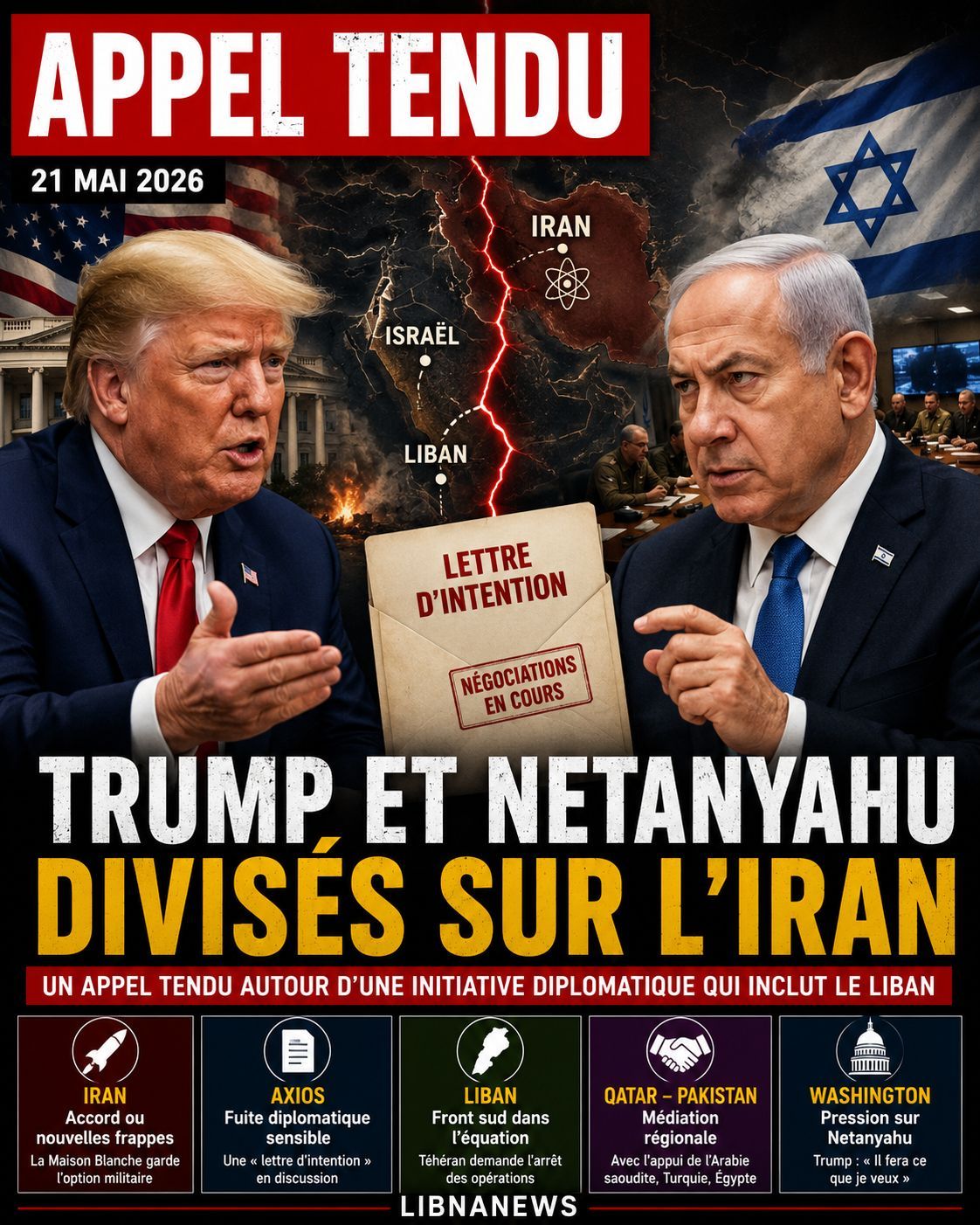
According to Axios, the Trump Netanyahu appeal went wrong because it focused on a new diplomatic initiative around Iran. The American media reports that the President of the United States informed the Israeli Prime Minister of the work of mediators on a « letter of intent » to open a negotiating phase. The document would aim to frame an exit from the war with Tehran, after several weeks of regional confrontations and threats of new strikes from the United States.
A tough call between Trump and Netanyahu
The exchange would have taken place on Tuesday, 19 May. It was not publicly presented as a break between Washington and Tel Aviv. The two capitals did not, in the immediate future, provide detailed reports confirming the exact content of the statements. But several American and Israeli media describe a tense conversation. An official quoted by the American press claims that Benjamin Netanyahu came out very worried about the appeal. Israeli sources put this formula into perspective and explain that the head of the Israeli government is often alarmed as soon as negotiations with Iran resume.
Disagreement would be less about the stated objective than the method. Donald Trump wants to keep open the option of an agreement with Tehran, while threatening to use force again if discussions fail. Benjamin Netanyahu defends a harder line. He considered Iran unreliable, believed that military pressure should continue and feared that a compromise too rapid would leave nuclear, ballistic or regional capabilities considered dangerous by Israel intact.
The tone of the call was also confirmed by other American media. The Wall Street Journal evokes a difficult exchange on a possible agreement to end the war with Iran. According to this account, Netanyahu expressed doubts about the possibility of enforcing a new arrangement in Tehran. Trump would have defended diplomacy, while recalling that Iran could be hit again in case of refusal or default.
Trump Netanyahu: An alliance under tension
Trump Netanyahu has long been described as one of the strongest axes of the American and Israeli right. However, the current sequence shows a divergence of interests. Trump is looking for a way out that he can present as a personal success. Netanyahu wants to prevent any agreement that would limit Israel’s freedom of action before it has achieved a deeper degradation of Iranian capabilities and those of its regional allies.
This difference does not mean that the covenant is defeated. Both leaders remain aligned with the refusal of a nuclear-weapon Iran and Israel’s defence. But their calendar diverges. For Washington, every week of war increases military, economic and political risks. For Israel, too early a diplomatic break can give Iran time to recover, protect its sensitive sites and reorganize its networks of influence.
Donald Trump sought to display his authority after the appeal. Asked by journalists, he said Netanyahu would do « what I want » on Iran. The formula is intended to show that the White House holds hands. It can also embarrass the Israeli Prime Minister, whose coalition is based on an image of firmness and strategic independence. In Israeli politics, appearing as forced by Washington can be expensive, especially on the Iranian issue.
The presidential sentence illustrates a method. Trump customizes the balance of power. He presented the relationship with Netanyahu as a direct exchange between two leaders, without locking up in conventional diplomatic protocols. This method can speed up some decisions. It can also cause tension when national interests no longer overlap exactly.
For Netanyahu, the risk is double. He must convince Washington not to accept a compromise which he considers insufficient. He must also avoid giving the impression that he is frontally defying an American president on whom Israel depends militarily, diplomatically and financially. This constraint explains the cautious tone of official reactions. The leaks say the tension. Press releases, where they exist, seek to preserve the image of strategic coordination.
The content of the Iranian proposal
The proposal which would have triggered the call is not a final agreement. It would take the form of a framework for discussion. According to the reports, Qatar and Pakistan played a central role in its preparation, with contributions or exchanges also involving Saudi Arabia, Turkey and Egypt. The aim would be to bring American and Iranian positions closer together without immediately imposing a full text.
The core of the document would be the Iranian nuclear programme. Tehran should make explicit commitments on its sensitive activities. The United States, in return, would indicate how it could progressively release some frozen Iranian funds. The economic issue occupies an essential place. Iran wants real relief of financial constraints. Washington wants measurable guarantees before any lasting concessions.
Another aspect concerns ships and trade flows. Tehran called on the United States to stop seizing Iran-related buildings and to release the frozen assets on a verifiable schedule. The question of Ormuz Strait also remains central. The maritime passage concentrates a significant part of the regional tension. Its opening or partial closure may affect the markets, insurance, energy routes and security of the Gulf States.
Lebanon appears in this equation. According to reports, Tehran is also waiting for an Israeli military action to stop in Lebanon. This request gives the Lebanese file a place in a broader negotiation. It shows that the southern front is not only treated as a bilateral crisis between Israel and Hezbollah. It becomes a lever in a regional discussion where Washington, Tehran, Tel Aviv and several Arab or Muslim mediators each seek to preserve their priorities.
This joint explains Netanyahu’s nervousness. If an Iranian agreement requires, directly or indirectly, a reduction in Israeli military activity in Lebanon, Israel could see this as a limitation of its freedom of action against Hezbollah. In Beirut, the stake is different. Any clause that would lower strikes in southern Lebanon would have an immediate impact on civilians, internally displaced persons and local authorities. But it could also place Lebanon in a negotiated arrangement elsewhere.
Why Netanyahu refuses to release pressure
Benjamin Netanyahu sees Iran as the main strategic threat. This position goes through several Israeli governments, but it takes on a particular intensity in the current war. The Prime Minister wants to prevent Tehran from emerging from the conflict with a rapid reconstruction capability. He feared a scenario in which Iran would accept vague terms, obtain financial relief, and then save time.
Israeli mistrust is not just about nuclear power. It also covers missiles, drones, regional networks and Hezbollah. For Israel, negotiations that would not reduce those capacities would be incomplete. Netanyahu therefore wants to maintain sufficient military pressure to weaken Iran before stabilization. This approach explains the reservations he would have expressed to Trump.
The Israeli dilemma is known. A long war can use Iran and its allies, but it also increases the risk of explosion. It exposes Israel to responses, losses, growing international pressure and tensions with Arab partners. A diplomatic break reduces these immediate risks, but it can be seen as an opportunity for Tehran to rebuild its margins.
Netanyahu must also manage its coalition. The harshest components of the Israeli right often call for a line without concessions. They could criticize any agreement that does not guarantee full neutralization of Iranian threats. In this context, the Prime Minister cannot appear as the one who accepts a pause under American pressure. He must therefore express his objections forcefully, even if the alliance with Washington remains indispensable.
White House hesitates between threat and agreement
Donald Trump maintains a strategy of maximum pressure, but he does not necessarily want to prolong the war. The day before the appeal, he had said that the United States could strike Iran again. He had also indicated that he was close to deciding on an attack before reporting it. This sequence shows diplomacy on the brink of military action. The threat serves to speed up Iranian concessions. But it can also make any compromise more fragile.
Trump is looking for a visible victory. A signed agreement or letter of intent would allow him to say that he imposed a negotiation on Tehran after using force. A new strike would allow him, on the other hand, to show that he is not going back. Between these two options, the White House tries to retain the initiative. It is this oscillation that irritates Netanyahu, for Israel wants to know the real degree of American engagement.
Regional mediators play an important role here. Turkey publicly commended the efforts to extend the truce between Washington and Tehran. Ankara believes that disputes can be resolved and calls for preventing further escalation in Lebanon. Qatar and Pakistan, already active in indirect exchanges, are seeking to transform conflicting messages into negotiable ones. Saudi Arabia, Egypt and other actors want to avoid an extension of the war that would threaten their economic and security interests.
The American position remains deliberately ambiguous. Trump says he hopes for an agreement, but he lets the threat of a quick strike run. This combination can work if Iran believes that a refusal entails an immediate cost. It can fail if Tehran believes that Washington only wants to impose a capitulation. In this case, negotiation becomes another form of confrontation, and each leak on a tense appeal may affect the calculations of the parties.
Lebanon caught in wider negotiations
For Lebanon, the Trump Netanyahu appeal is not a mere diplomatic episode between allies. It can have direct effects on the war in the South. If Washington favours an agreement with Tehran, the Lebanese question can be integrated into a regional package. If Netanyahu gets strong military pressure maintained, the strikes in South Lebanon can continue despite the truce announcements.
The Lebanese government is trying to avoid this trap. He wants the Israeli withdrawal, the cessation of the strikes and the return of the displaced to be treated as demands of sovereignty, not as ancillary concessions in an Iranian-American agreement. This distinction is essential. If Lebanon becomes a map in nuclear negotiations, Beirut loses part of its ability to set its own priorities.
Hezbollah, for its part, follows the sequence carefully. The movement is linked to Iran, but it operates in a Lebanese context. Regional de-escalation could reduce military pressure in the South. It could also open a tougher debate on its weapons, its border role and the place of the Lebanese army. Conversely, the failure of diplomacy could reinforce its discourse of resistance, especially if the Israeli strikes continued.
The calendar adds additional tension. Military and political discussions are expected in Washington on the Lebanese-Israeli issue. The call between Trump and Netanyahu thus comes at a time when the United States is also trying to frame an exit from the crisis in Lebanon. There’s a risk that the files will get messed up. A concession on Iran may be refused by Israel on behalf of Hezbollah. A Lebanese request may be referred to a broader discussion with Tehran.
This interlocking makes diplomacy more complex. It can give more weight to mediators, because each front influences the other. But it can also block progress. If all files become interdependent, none progress as long as the most difficult remains open. For the people of South Lebanon, this logic is hardly acceptable. They expect a regional architecture less than a concrete halt to the bombings.
What the Axios leak reveals
The flight reported by Axios has a political function. She pointed out that the debate existed at the summit. It prepares public opinion to ensure that an agreement with Iran remains possible. She also put pressure on Netanyahu by showing that he is not completely in control of the American calendar. In crisis diplomacy, a leak is never neutral. It is often used to test a reaction, frame a narrative or weaken an adverse position.
For Washington, filtering the existence of a proposal can help create a dynamic. If Iran, Israel and regional partners know that a text is circulating, each has to clarify its position. Mediators can then measure the red lines. Markets and allies can anticipate a drop in tension. But this method involves a risk. A proposal submitted too early can be publicly rejected even before it has been worked out.
For Netanyahu, the leak may appear as a pressure. She reveals her skepticism as Trump wants to show that he is exploring a diplomatic exit. It places Israel in the role of the reluctant partner. This scoping may displease Jerusalem, especially if the government considers that the proposal does not meet its security requirements. He can also push Netanyahu to quickly request a direct meeting in Washington to defend his position.
The episode finally recalls that the American-Israeli relationship is not limited to automatic solidarity. It is based on shared interests, but also on arbitration. When Washington considers that a war becomes too expensive or too uncertain, it can look for a way out. When Israel considers that a strategic enemy is not sufficiently weakened, it can plead to prolong the pressure. The tension arises precisely from this difference of horizon.
A weak but decisive signal for the future
At this point, the tense call does not prove a break. Rather, it shows a competition between two readings of the same crisis. Trump wants to keep control of a possible deal. Netanyahu wants to prevent a compromise he would consider premature. Both leaders can still post their agreements in public, while engaging in close private negotiations. This is often how the relationship between Washington and Israel works when a strategic issue reaches a critical point.
The next few hours will say whether the « letter of intent » becomes a real negotiating document or remains an instrument of pressure. They will also say if Netanyahu gets a meeting in Washington to weigh directly on Trump. For Lebanon, the stake is immediate. Any American decision on Iran can result in a lull in the South, a continuation of strikes or a new phase of uncertainty around the truce.
The central point therefore remains operational. As long as discussions do not reduce strikes, evacuation orders and forced displacement, they remain far away for civilians. The call Trump Netanyahu takes on its importance because it can influence Israel’s military choices, Iran’s calculations and Washington’s margin. Both in Beirut and in southern Lebanon, attention is now focused on the signals sent by the White House before the next diplomatic meetings.




