

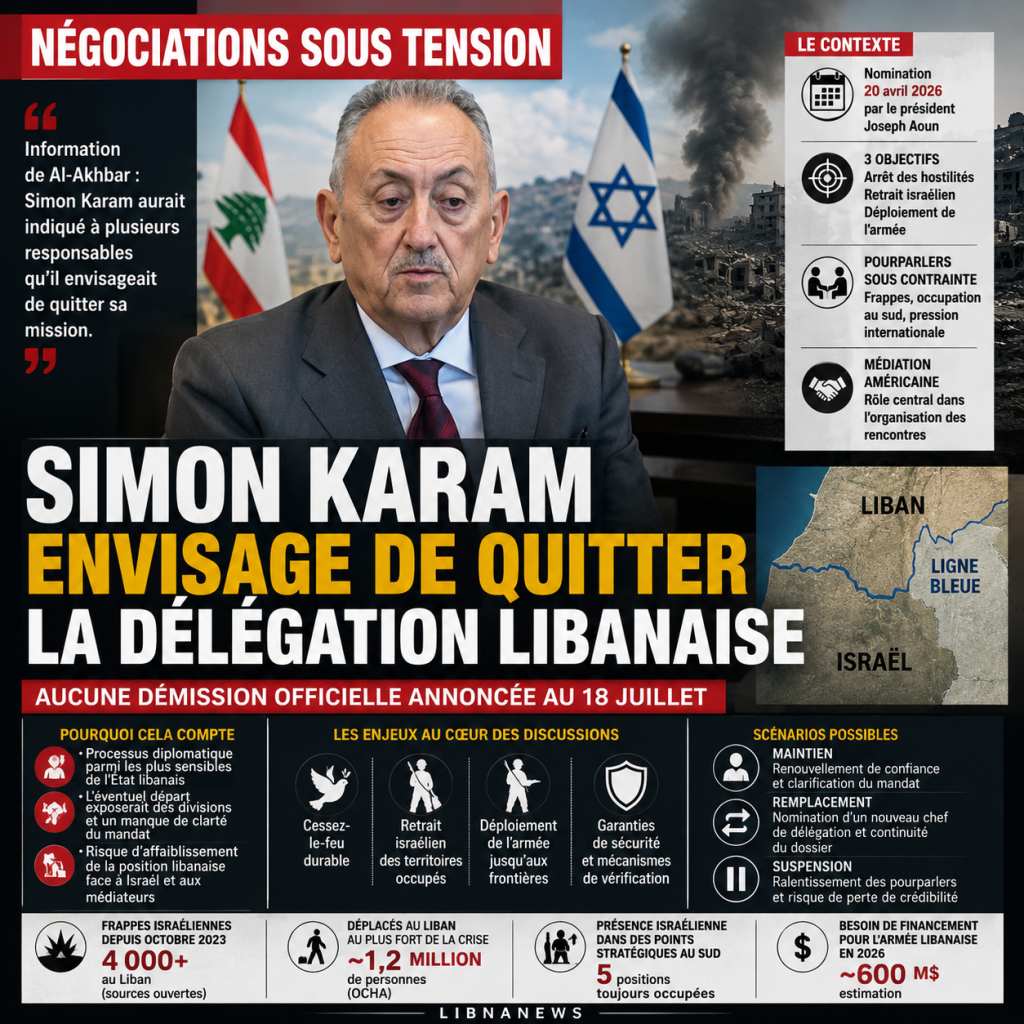
A report published on Saturday, July 18, raises questions about the conduct of negotiations between Lebanon and Israel. DailyAl-Akhbarformer Ambassador Simon Karam, who chairs the Lebanese delegation, informed several officials that he was planning to leave his mission. However, no official act of resignation was announced. At this stage, the case remains conditional. However, the possibility of a departure is sufficient to reveal the tensions surrounding a process presented since April as one of the most sensitive diplomatic choices of the Lebanese State. The question is not just about keeping a man at the head of a delegation. It also concerns the mandate given to the negotiators, the results achieved, the coordination between the institutions and Beirut’s ability to defend a coherent position vis-à-vis Israel and the American mediators.
Simon Karam plans to leave his mission
For the time being, information is based on an informed source quoted by the Lebanese press. She said that Simon Karam had discussed with State officials the possibility of giving up the delegation’s chairmanship. The term used is important. It is neither a letter of resignation made public, nor a decision announced by the Presidency of the Republic, nor the appointment of a successor. Simon Karam reportedly expressed an intention or a reflection. This difference distinguishes a political malaise from an effective start.
The Lebanese Presidency did not publicly confirm a resignation at the time this information was disseminated. No official communiqué indicated that the mission of the former Ambassador had ended. Nor did the Government announce a change in the composition of the delegation. Caution therefore remains necessary. In such a sensitive case, a withdrawal hypothesis can also serve as an alert to politicians, an instrument of internal pressure or a request for clarification of the mandate.
The official silence, however, holds the questions. Simon Karam does not hold a protocol function. He leads a team responsible for direct dialogue with Israel in a context of conflict, occupation of positions in southern Lebanon and international pressure. Its continuation or departure would immediately alter the perception of Lebanese continuity. A resignation would also signal the real state of the talks, beyond the often measured public statements.
An appointment desired by Joseph Aoun
President Joseph Aoun announced on 20 April that Simon Karam would lead the Lebanese delegation. The former Ambassador of Lebanon to the United States had been chosen for his diplomatic experience, his knowledge of American mechanisms and his political profile. The decision placed a civilian at the head of a process that exceeded the technical framework of military meetings held for years around the Blue Line.
The Head of State then set three objectives. Lebanon was to have the cessation of hostilities, the end of Israeli occupation of Lebanese areas and the deployment of the army to internationally recognized borders. This roadmap sought to present negotiations as a means of restoring sovereignty, not as immediate political normalization. It also responded to the internal criticisms of those who feared a shift towards broader discussions.
Simon Karam’s choice took the Chair directly. Joseph Aoun stressed the Lebanese character of the mission, saying that no other party would negotiate in the place of the country. This position gave the head of the delegation strong institutional legitimacy, but it also expounded it. In the event of failure, blocking or disagreement over possible concessions, responsibility could not be dissociated from the direction given by the Baabda Palace.
The presence of the former ambassador finally allowed to speak directly with the American administration. Washington plays a central role in organizing meetings, transmitting proposals and possible guarantees. This diplomatic proximity was an advantage. It could also become a source of tension if American expectations diverged from the limits set by the Lebanese authorities.
Talks under heavy pressure
Negotiations have never started in an ordinary climate. They are being carried out against the backdrop of Israeli strikes, destruction, displacement and military presence in areas claimed by Lebanon. Beirut is seeking a lasting ceasefire, while Israel links any stabilization to broader security demands. This asymmetry places the Lebanese delegation in a difficult position as soon as the discussions begin.
Lebanon is also negotiating with limited means. The state is experiencing a prolonged financial crisis, its institutions remain fragile and its territory remains subject to internal power relations. The army is the official instrument of deployment to the south, but its action depends on resources, political decisions and a regional environment that it does not control alone. Each commitment made at the negotiating table must therefore remain applicable on the ground.
The delegation must also avoid two pitfalls. The first would be to accept a framework that transforms a discussion on the Israeli withdrawal into a general negotiation on the political future of Lebanon. The second would be to maintain such a rigid position that it would not produce any concrete results for the inhabitants of the affected areas. This narrow line requires a clear mandate and constant support from the main institutions.
In this context, a head of delegation can hardly act without regular arbitration. The issues of timing, guarantees, border security and sequence of measures are a matter for political power. If Simon Karam considers that the instructions remain contradictory, that the negotiating margins are insufficient or that the expected results do not correspond to the available means, his possible withdrawal would be wider than a personal choice.
The mandate, the possible heart of malaise
No official explanation was provided for the reasons why Simon Karam would consider his departure. It would therefore be imprudent to give him specific reasons. However, several questions arise from the very nature of its mission. Has the mandate evolved since April? Do Lebanese officials share a common definition of objectives? Does the delegation have written instructions and a clear chain of decision?
These questions are decisive. Direct negotiations require the head of delegation to know what he or she can propose, refuse or return to Beirut. A prolonged ambiguity weakens its credibility vis-à-vis the other party. It also allows mediators to increase pressure by seeking different responses from several power centres. The Lebanese political system, based on complex balances, increases this risk.
The President of the Republic leads the policy of defence and sovereignty within the constitutional framework, but the government also has central responsibilities. The President of Parliament and the main political forces weigh on any agreement in the south of the country. The absence of a public coordination mechanism does not mean that it does not exist. However, it makes it difficult to assess its effectiveness.
A possible resignation could thus reflect a request for political protection. The head of delegation may wish that the State collectively assumes the choices made. It may also refuse to bear sole responsibility for a contested compromise. As long as Simon Karam does not express himself and the authorities do not specify their position, these scenarios remain assumptions and not established facts.
The question of results achieved
Three months after the announcement of his appointment, Lebanese public opinion has little detailed information on the progress of the discussions. Such discretion may be justified by the confidentiality necessary for any negotiation. However, it becomes problematic when information refers to the possible departure of the main negotiator. The public then asks whether the malaise concerns the method, content or lack of results.
The targets announced in April remain easy to identify. Lebanon calls for the cessation of attacks, the Israeli withdrawal and the deployment of the army. However, implementation requires a sequence. Should Israel withdraw before the Lebanese system is strengthened? Should the measurements be simultaneous? Who checks their application? What guarantees prevent a resumption of hostilities? These questions determine the strength of a possible agreement.
The role of the United States adds another dimension. Washington can facilitate contacts and put pressure on the parties. It may propose monitoring mechanisms, mobilize assistance to the Lebanese army or support an arrangement with the Security Council. But American mediation is not perceived as neutral by any part of the Lebanese political class. The negotiator must therefore use this channel without giving the impression that national priorities are dictated from outside.
The lack of visible breakthrough does not prove that the discussions are useless. Sensitive negotiations often progress in stages, through non-public exchanges. But a possible withdrawal of Simon Karam obliges the authorities to explain whether the process is still following the initial roadmap. Without this clarification, each rumour may become the substitute for insufficient official information.
A resignation with immediate effects
If Simon Karam confirmed his departure, the first consequence would be institutional. The Presidency should accept or refuse his resignation, and then decide quickly on the next steps. It could appoint a new head of delegation, change the team or temporarily suspend meetings. Each of these options would send a different message to foreign partners and Lebanese actors.
The appointment of a successor would raise the question of the profile sought. A diplomat who knows Washington would ensure some continuity. A member would focus discussions on security and border issues. A political figure may have a broader mandate, but his choice would cause more controversy. The government should also determine whether the roadmap remains unchanged.
An unprepared departure would weaken the Lebanese position. Israel could interpret it as a sign of internal division or inability to make decisions. The US mediators may fear a slowdown in the schedule. Political forces opposed to the negotiations would use the episode to challenge the process. Conversely, supporters of an agreement would call for a rapid recovery in order to avoid further escalation.
The continuity of the technical dossiers would, however, limit the risk of a complete breakdown. A delegation is not based on one person. Diplomats, lawyers, military and advisers prepare positions and keep records. The replacement of the team chair could therefore be managed. But the relationship of trust established with the interlocutors and the knowledge of previous exchanges are not instantly transferred.
A case that exposes Lebanese divisions
Negotiations with Israel deeply divide the political landscape. Some officials see them as a necessary tool for ending hostilities and recovering the occupied territories. Others fear that they will pave the way for an imposed normalization, without a comprehensive settlement of the regional conflict or sufficient protection of Lebanese interests. Between these two positions, several forces accept the principle of dialogue while contesting its format.
Simon Karam is at the centre of these fracture lines. His diplomatic background and past positions feed on opposite readings. His support highlights his experience and ability to engage with Washington. Its critics can see in its profile the sign of a particular political orientation. This personalization may divert the debate from the official mandate and guarantees required.
However, the key issue remains that of the State. A delegation could only succeed if it spoke on behalf of institutions capable of implementing their decisions. Lebanon still has to solve the problem of the unity of strategic decision-making, arms control and the role of the various forces present in its territory. These subjects go beyond Simon Karam, but they directly influence his room for manoeuvre.
The episode also reveals a public communication deficit. In a context of war and strong tensions, the authorities can preserve the confidentiality of trade without allowing speculation. They can confirm the status of the negotiator, recall the objectives and distinguish the points acquired from the topics still discussed. A minimum official word would reduce conflicting interpretations.
The risk of a confidence crisis
The possibility of resignation comes at a time when confidence in the institutions remains weak. Lebanese people have experienced several years of economic crisis, political blockages and collapse of public services. Any divergence at the top of the state on a sovereignty issue is therefore rapidly fuelling suspicion. Some see it as a lack of strategy. Others fear commitments made without sufficient debate.
Confidence also affects the people of the south. First, they expect lasting security, the possibility of returning, rebuilding and resuming normal activity. For them, the value of negotiations is less measured by diplomatic formulas than by the cessation of strikes and the withdrawal of Israeli forces. A change of negotiator should not delay these objectives or turn their situation into a political rivalry.
International partners are also observing Lebanese cohesion. Assistance to the army, support for reconstruction and guarantees of an agreement will depend in part on the credibility of the institutions. An open crisis around the delegation could complicate the mobilization of such support. Conversely, quick clarification would show that decision-making mechanisms work despite disagreements.
The main risk would be to allow an intermediate situation to settle. Simon Karam would remain officially in office while being politically fragile. Its interlocutors could then doubt its ability to engage the State. Such ambiguity would harm more than a clearly organised departure or a continuation explicitly confirmed by the authorities.
What the Presidency must now specify
The first clarification expected concerns the status of Simon Karam. The Presidency may indicate whether it has made a formal request, merely expressed reservations or decided to continue its mission. This response does not require disclosure of the confidential content of the talks. It concerns the normal functioning of an official delegation.
The second concerns the mandate. Do the three objectives announced in April remain the sole basis of the discussions? Were additional subjects introduced? Does Lebanon still refuse to allow negotiations to take the form of political normalization before its territorial and security demands are met? Specific responses would reduce concerns.
The third concerns coordination. The government, the presidency and security officials must show that they have a common mechanism to examine proposals. A negotiator cannot receive competing instructions. Nor can it be responsible for deciding on matters that are the subject of a national choice alone.
Finally, the authorities must prepare all scenarios. If Simon Karam remains, they will have to publicly renew their confidence and clarify its negotiating margins. If he leaves, they will have to explain the institutional reasons for this change, quickly designate a successor and ensure continuity of the files. By 18 July, no formal decision has yet closed the debate, while the next presidential or negotiator’s statement is now expected.




