

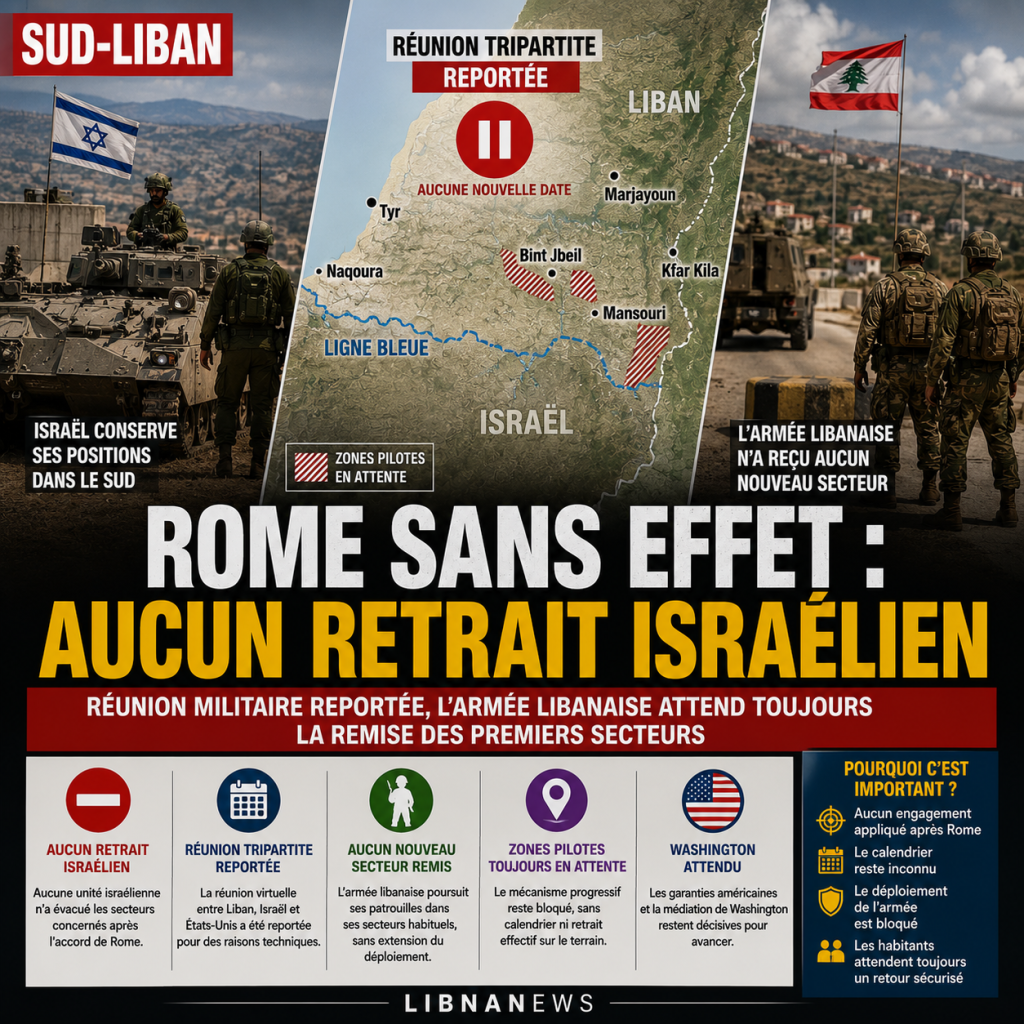
No Israeli withdrawal has yet been made in southern Lebanon after the commitments discussed at the recent Rome meeting. According to a Lebanese military source quoted by an Arab media, the Israeli army has not evacuated any of the sectors concerned and the Lebanese army has not received any new sites. At the same time, a tripartite military meeting to be held on Friday by videoconference between Lebanese, Israeli and American representatives was postponed to an unspecified date. The source attributes this postponement to technical reasons related to the American and Israeli sides. Both have doubts about the actual timing of the process. They also stress the gap between the agreements in principle referred to in the diplomatic discussions and their concrete translation on the ground.
No Israeli withdrawal after Rome meeting
The statement by the Lebanese military source provides an important clarification. Despite the agreement in principle referred to in Rome, no Israeli unit would have left the occupied areas in southern Lebanon. The Lebanese Army is therefore continuing its patrols in areas where it was already present, without receiving any new positions. This lack of movement currently prevents any extension of the official Lebanese deployment to the points concerned.
The Rome meeting was intended to bring together positions around a progressive mechanism. The principle was based on the choice of locations or pilot areas. Israel was to withdraw from a specific area and then the Lebanese army was to enter and ensure a full presence. This formula was to test the ability of the parties to implement limited commitments before considering a broader scheme.
The fact that no withdrawal has yet taken place does not necessarily mean that the mechanism is abandoned. However, it shows that no visible first step has been taken. In such negotiations, the transition from political agreement to military order is often the most delicate moment. Contact information, time of withdrawal, succession arrangements and safety rules to avoid an incident should be defined.
For Beirut, the stakes go beyond mere chronology. The State wants to avoid pilot zones becoming a substitute for a global withdrawal. It also seeks to prevent temporary arrangements from devoting a lasting Israeli presence elsewhere. Lebanese prudence is therefore explained by the need to preserve the stated objective of restoring State authority throughout the territory and achieving an end to the occupation of areas still under Israeli control.
Tripartite meeting postponed without new date
The virtual meeting scheduled for Friday was to bring together Lebanese, Israeli and American military delegations. It should have dealt with the practical aspects of the commitments discussed in Rome. Its postponement deprives participants of a coordination space at a time when technical details become decisive. The Lebanese military source indicated that no new date had yet been set.
According to the same source, the postponement results from technical difficulties on the American and Israeli sides. The wording remains limited. It does not mention political disagreement, a breakdown of contacts or a Lebanese decision to suspend trade. It would therefore be excessive to present this delay as a definitive failure. However, it intervenes in a phase where each delay feeds questions.
The tripartite meeting was likely to specify the sectors concerned, the modalities of withdrawal and the conditions for Lebanese deployment. It was also intended to enable the United States to play its role as mediator and guarantor of the timetable. Without such coordination, the Lebanese army cannot move towards positions that are still occupied or exposed. Any unsynchronized movement could create a risk of confrontation.
The delay therefore has a concrete effect, even if it is officially technical. It is delaying the eventual release of new sites and maintaining the status quo. It also leaves unanswered several questions: which localities will be selected, in what order, with what guarantees and under what verification mechanism? Until the meeting takes place, these parameters remain suspended.
Pilot zones at the centre of the device
The principle of pilot zones aims to reduce the level of risk. Instead of immediately negotiating a general withdrawal, the parties select a limited number of sectors. The Israeli army withdrew, the Lebanese army entered and a monitoring mechanism verified the absence of unauthorized armed forces. If the experiment works, it can be replicated in other areas.
This approach offers an operational advantage. It testes the communication procedures, the timing of movements and the ability of the Lebanese Army to hold positions. It can also produce a first visible result for the inhabitants. A locality freed from any Israeli military presence could initiate the return of civilians, the assessment of damage and the resumption of certain services.
But the formula also carries risks. Israel can seek to select secondary sectors while maintaining strategic positions. Lebanon can then obtain limited withdrawals without progress on the most sensitive points. A pilot zone can also become permanent if the transition to the next stage is continuously postponed.
The Lebanese position is therefore to link the experimental mechanism to a broader timetable. Beirut wants the selected areas to include areas actually occupied or under Israeli fire. The latter concept concerns territories where the Israeli army does not always maintain a fixed presence, but which it can monitor or strike from dominant positions. For the inhabitants, this control severely limits any normal recovery of life.
The Lebanese Army remains in its usual areas
The military source indicates that the Lebanese army continues to patrol the usual areas. No new points were given to him. This precision is used to measure the actual situation. At this stage, there is no visible redeployment corresponding to the Rome talks. Lebanese units perform their missions within the current limits, without any extension related to the negotiated mechanism.
The army plays a central role in any agreement. It must take a stand after an Israeli withdrawal, secure the sectors and prevent the appearance of any armed arrangements beyond the authority of the State. It must also work with international mechanisms in the south and maintain contact with American mediators.
This mission requires human, logistical and technical resources. Sustainable deployment requires sufficient staff, accessible roads, secure posts and monitoring capabilities. Several localities suffered significant damage. Military and civilian infrastructure may require work prior to full installation. The Israeli withdrawal is therefore only the first step in a broader process.
The army must also receive clear political instructions. It cannot negotiate the scope of an agreement alone or define acceptable concessions. Its role is to implement the decisions taken by the constitutional authorities. The postponement of the tripartite meeting shows precisely the importance of the link between political negotiation and military planning.
A gap between diplomacy and the field
Diplomatic meetings often produce general formulations. Officials may announce an agreement in principle, a common will or a breakthrough. In the field, these expressions must become specific orders. The units concerned, routes, schedules and safe areas must be identified. Any disagreement on a card can block the whole.
The current case illustrates this discrepancy. The Rome meeting opened up the prospect of withdrawals in pilot sectors. Two days later, no evacuation had been observed. The military meeting to prepare for implementation was subsequently postponed. The process therefore remains at the preparatory stage, despite the expectations created by the initial agreement.
This delay may have several explanations. The parties may still discuss the choice of localities. Israel may request additional guarantees. Lebanon may refuse a perimeter deemed too limited. The United States can seek to reconcile calendars. None of these assumptions has been officially confirmed. The only explanation reported for the deferral remains technical.
The facts should therefore be distinguished from interpretations. The established fact is the absence of withdrawal. The postponement of the meeting was also reported. However, the political reasons for a possible blockage are not known. This distinction is essential in a case where each party tries to present the process from a favourable perspective.
The pressure remains on the people of the south
The absence of withdrawal continues to be a difficult situation for border populations. In several areas, residents cannot resume normal life until Israeli positions remain in place or the threat of strikes persists. Return depends on safety, but also on access to roads, electricity, water, schools and agricultural land.
Fire-controlled areas pose a particular problem. Even without permanent occupation, the possibility of an attack prevents reconstruction work and discourages the return of families. Farmers cannot always access their plots. Municipalities are reluctant to engage costly construction projects. Local enterprises remain deprived of a stable activity.
For these people, the debate on pilot areas has an immediate dimension. A limited withdrawal may allow a return to a locality. But it can also create inequality between villages if some are included and others pushed back to a later stage. Sector selection must therefore be based on transparent criteria linked to sovereignty and civilian needs.
The Lebanese Government will also have to prepare the phase following a possible withdrawal. The presence of the army alone will not suffice. Buildings will have to be evaluated, hazardous areas cleared, services restored and aids organized. Without this civilian component, military success would remain incomplete.
The American role under the test of the calendar
The United States plays a decisive role in the process. They facilitate exchanges, transmit proposals and seek acceptance of a timetable. Their participation in the tripartite meeting was to provide a channel of communication between two parties that remained formally in conflict. Washington can also exert political pressure on Israel and mobilize support for the Lebanese army.
However, the postponement attributed to technical reasons concerning the American and Israeli parties places mediation under observation. Even a minor logistical incident can become politically sensitive when it delays an expected action. The Lebanese authorities need a US commitment to produce verifiable results, not just new meetings.
The credibility of the mediator will depend on the next appointment. A new rapid date would show that the delay remains limited. The announcement of a first withdrawal would enhance confidence. Conversely, a succession of postponements would fuel the idea that the Rome Agreement did not create a real obligation for Israel.
Washington must also address Lebanese concerns about the extent of withdrawal. A mechanism limited to a few localities cannot replace the settlement of the occupied points. The mediator will have to avoid pilot zones becoming an end in themselves. Their usefulness depends on their inclusion in a progressive, measurable and time-bound plan.
Israel retains the advantage of fait accompli
As long as no withdrawal is carried out, Israel retains control of the positions concerned. This fact gives him an advantage in negotiation. It may condition each transaction with new warranties or requests. Lebanon, for its part, seeks evacuation without accepting that its sovereignty should be subject to permanent conditions.
The balance of power remains asymmetric. Israel has military superiority and can maintain direct pressure on the ground. Lebanon relies primarily on international law, American mediation and the legitimacy of its army. This difference explains why Beirut insists on specific commitments and a verification mechanism.
The continuation of Israeli positions also risks changing the nature of the discussions. Instead of the principle of withdrawal, they may focus on the conditions laid down by the occupant. Lebanon seeks to avoid this displacement. It considers that withdrawal should constitute an obligation of departure, not a reward granted after each concession.
The question of deadlines then becomes central. An agreement without a deadline can remain a dead letter. A too vague calendar allows for successive postponements. In order to be credible, the mechanism must specify the date of each transaction, the authority responsible for verifying its execution and the measures provided for in the event of non-compliance.
The Lebanese authorities face a need for clarity
The government and the presidency must now explain what was actually achieved in Rome. A precise communication does not require publication of all the details of the negotiation. It may confirm the principle of pilot areas, indicate whether localities have been selected and specify the status of the calendar.
This transparency is all the more necessary as the process raises high expectations. After months of conflict and displacement, any announcement of withdrawal is interpreted as a possible improvement. If no action is taken, disappointment increases mistrust of institutions and mediators.
The authorities must also avoid two contradictory speeches. They cannot present the Rome meeting as a major breakthrough while explaining that nothing was yet decided. Nor should they minimize any progress for fear of internal criticism. A factual presentation would distinguish between political agreement, military planning and execution.
Parliament and the main political forces will also follow this issue. Negotiations concern sovereignty, security and the role of the army. They cannot remain permanently enclosed in a small circle. A minimum level of national consensus will be required to implement any agreement over time.
A process now judged on acts
The absence of an Israeli withdrawal turns the next step into a test. The content of the Rome meeting can only be assessed from visible measurements. The handover of a first sector to the Lebanese army would be a concrete signal. It would show that the mechanism exists and that commitments can be fulfilled.
The postponement of the tripartite meeting does not yet condemn the process. Its impact will depend on its duration and the speed with which contacts resume. A meeting in the coming days could relaunch implementation. A prolonged delay would raise the question of a deeper disagreement, even if no official breakup was announced.
The Lebanese side will have to maintain its demands without losing the opportunity to obtain actual withdrawals. It will probably start with sectors of strategic and civilian value. The army must be ready to enter as soon as a site is released. The mediators will have to ensure that this first step opens the way for other movements.
As at 18 July, the situation on the ground remains unchanged. The Israeli forces did not leave any of the areas discussed, the Lebanese army did not receive any new positions and the tripartite military meeting remained without a new date. The next indicator will therefore not come from a diplomatic declaration, but from an order of withdrawal actually applied in southern Lebanon.




