





A strike that surpasses its announced target
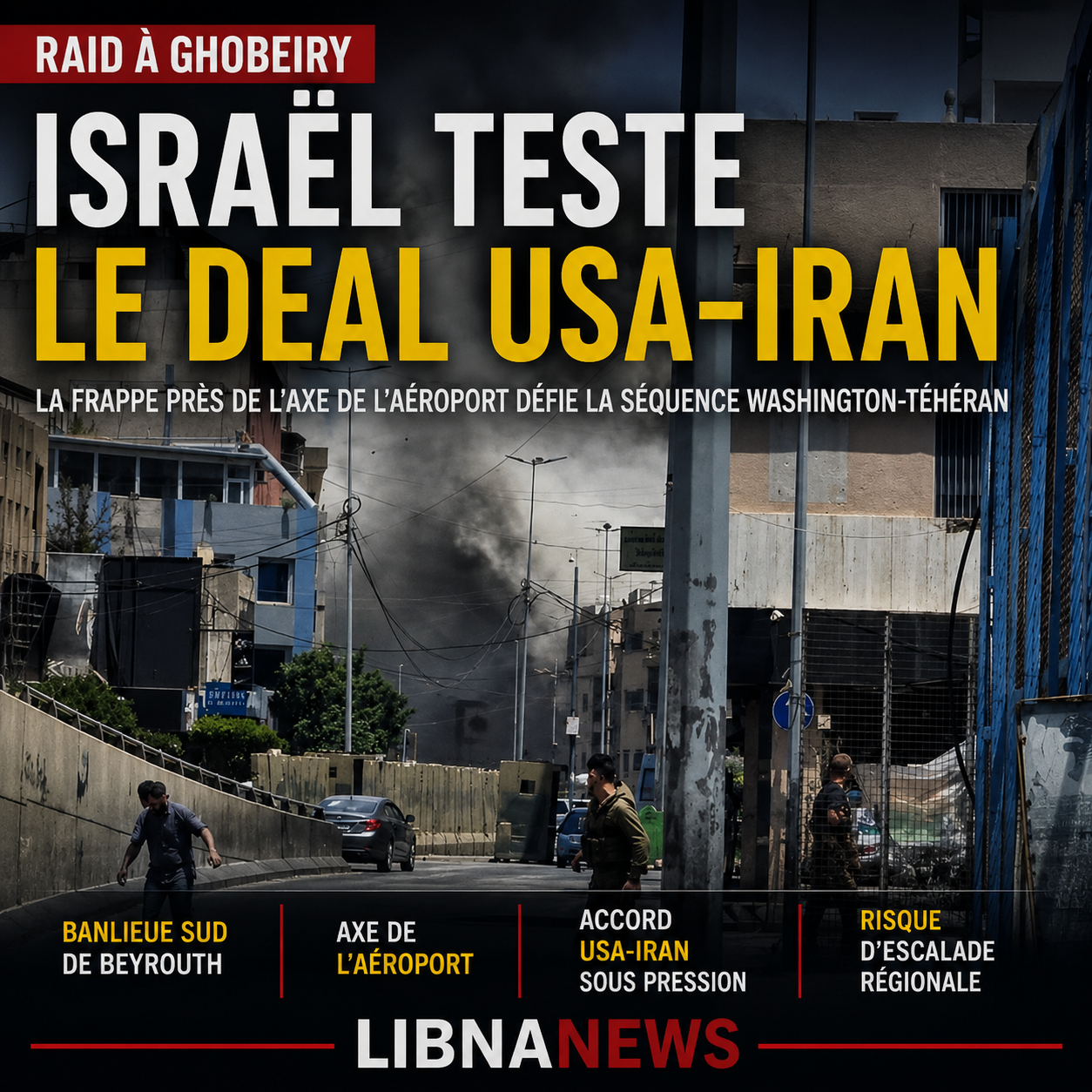
The Israeli strikes against Ghobeiry, in the southern suburbs of Beirut, do not only weigh on their announced target. They intervene at a time when Washington and Tehran say they are approaching an agreement to suspend the regional war and open a new phase of negotiations. Officially, Israel claims to have targeted Hezbollah infrastructure. But the location of the raid, its timing and the absence of prior warning from local sources give it a wider reach. The raid became a direct test of the agreement under discussion between the United States and Iran.
The first available information points to the strikes in the area of Ghobeiry, near the axis leading to Rafic Hariri International Airport from Hadath. It is a dense, sensitive area, already marked by destruction and fear of further attacks. The airport axis is more than just a road. It connects Beirut with its main door to the outside world, the diaspora, diplomatic flights, possible evacuations and flows still vital for a weakened Lebanese economy. The choice of such a symbolic sector adds a political message to the military operation.
The immediate challenge is not only to know which building has been affected, nor even the exact extent of the damage. It is to know what this strike produces in the diplomatic sequence. For several days, information on a memorandum between Washington and Tehran has increased. The text under discussion would include a cease-fire period, the reopening or securing of energy roads and a resumption of negotiations on the Iranian nuclear issue. Several sources also refer to the inclusion of Lebanon, at least in the form of an extended cessation of hostilities. Israel, which refused to link its freedom of action in Lebanon to an agreement with Iran, therefore had an interest in preventing that clause from becoming binding.
Beirut precedent and Iranian reaction
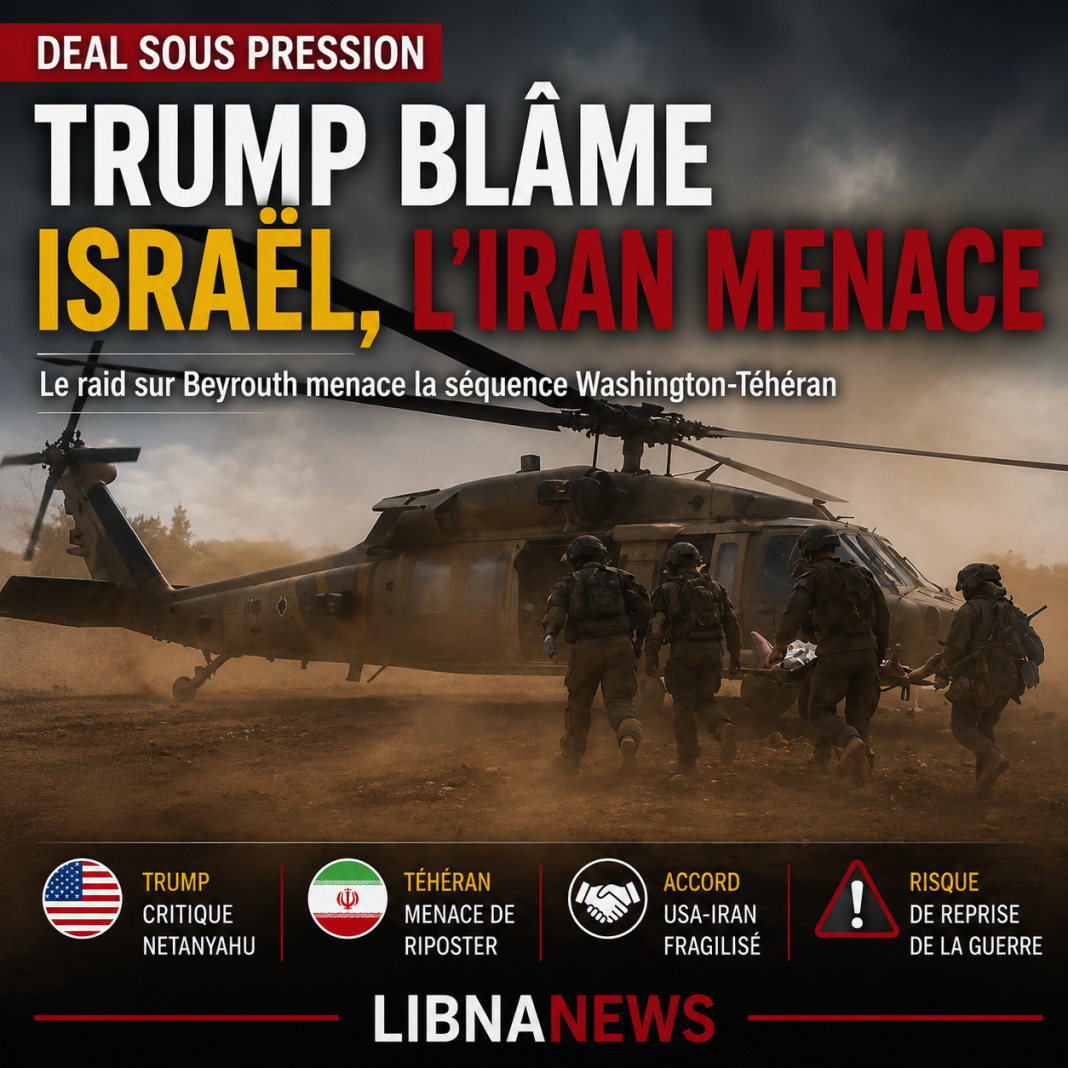
Ghobeiry’s strike comes after a precedent that illuminates his range. On 7 June, an Israeli attack on the southern suburbs of Beirut had provoked an Iranian missile response against Israel. Tehran then presented this response as a direct consequence of the strike on Beirut. Washington immediately sought to contain the escalation. Donald Trump called for a ceasefire and tried to preserve an agreement with Iran. This precedent created a new political rule: a strike on Beirut can become an Iranian trigger. Israel knows that. Washington knows that. Iran knows that too.
That is why the central question becomes that of strategic intent. Israel does not claim to seek to sabotage the American-Iranian agreement. He claims to be targeting Hezbollah infrastructure. But in fact, every strike against the southern suburbs of Beirut puts Iran before a dilemma. If he responds, he endangers the agreement with Washington and offers Israel an argument that Tehran remains aggressive. If he does not respond, he lets one of his main regional allies take strikes on a territory that has become symbolic. The raid thus becomes a calibrated provocation, capable of producing a cost in both scenarios.
The Israeli position with regard to the agreement in preparation is based on an old concern. Tel Aviv fears that a compromise between Donald Trump and Tehran will stabilize Iran without dismantling its regional relays. For Benjamin Netanyahu’s government, an agreement that would include Lebanon could reduce Israeli freedom of action against Hezbollah. It could transform every strike in southern Lebanon or in the suburbs of Beirut into a violation of a regional arrangement guaranteed by Washington. Israel therefore prefers Lebanon to remain a separate issue, limited to Hezbollah and northern Israeli security.
Iran defends the opposite reading. For Tehran, there can be no end of regional war if the Lebanese front remains open. Hezbollah remains one of the pillars of its strategic framework. A truce that would leave Israel free to strike Lebanon would weaken Iranian credibility with its allies. That is why the sources close to Tehran insist on the inclusion of Lebanon in the agreement. According to the Lebanese press, discussions would not only concern a limited ceasefire, but the end of the state of war in Lebanon, the cessation of operations, the Israeli withdrawal, the cessation of destruction and the release of prisoners.
Shabble the chord without saying
Ghobeiry’s strike specifically targets this architecture. If it remains without diplomatic consequences, Israel will have demonstrated that the American-Iranian agreement does not protect Beirut. If it provokes an Iranian reaction or a Hezbollah response, Israel will be able to assert that the Iranian camp is itself sabotaged by de-escalation. In both cases, Tel-Aviv tries to resume the initiative by moving the diplomatic paper test to the field. This is the method of fait accompli: hit first, let the mediators then run behind the crisis.
The timetable reinforces this reading. The United States is trying to finalize a compromise with Iran. Trump seeks to present the agreement as a diplomatic victory, capable of avoiding a wider regional war, reopening energy roads and containing risks for US forces. Netanyahu must respond to an Israeli opinion that demands security guarantees in the north and a coalition that refuses to let Hezbollah come out politically alive from the war. The interests of Washington and Tel Aviv are therefore increasingly diverging.
In this divergence, Lebanon becomes a lever. Israel strikes in Lebanon to recall that its security demands cannot be sacrificed to an agreement between Americans and Iranians. Washington wants to reduce regional tension. Israel wants to prevent this reduction from limiting its campaign against Hezbollah. Tehran wants to protect Lebanon in agreement. Beirut wants only the Lebanese state to negotiate on behalf of the country, but it is subject to decisions taken by others. The Ghobeiry raid summarizes this contradiction: Lebanon is at the centre of the text, but remains peripheral in the decisions of war.
The absence of prior warning, if confirmed, further increases political pressure. The warning strikes allow Israel to say that it is seeking to limit civilian casualties. Strikes without warning send another message. They resettle the surprise effect and remind that the capital can be affected without delay. In a diplomatic sequence, this creates an additional tension: civilians become hostages to the demonstration of force, and mediators are called upon to react before the crisis overflows.
Lebanon as a weak clause in a regional compromise
The choice of Ghobeiry also has a Lebanese inner reach. It puts the Lebanese government in a difficult position. Beirut claims that negotiations must go through the state and that no one speaks on behalf of Lebanon outside its institutions. But when the southern suburb is hit, the question of the answer does not depend solely on the government. It depends on Hezbollah, Iran, Washington and Israel. The Lebanese State is called upon to preserve its sovereignty, but this sovereignty is tested by foreign aircraft and by regional calculations.
This situation also complicates the position of Hezbollah. The movement cannot ignore a strike in its political and social environment. But an immediate response could serve the Israeli strategy by causing the collapse of the American-Iranian process. Overly visible restraint could, on the contrary, be presented by its opponents as a step backward or as evidence of dependence on Iranian decision-making. The raid therefore forced Hezbollah to choose between military logic, regional discipline and domestic political cost.
For Iran, arbitration is even more sensitive. Tehran is seeking an agreement with Washington, but it does not want to appear as having abandoned Lebanon at the decisive moment. Iranians have already used the 7 June strike to establish a symbolic red line around Beirut. A new Israeli strike on the southern suburbs obliges the Islamic Republic to measure what it loses by not responding, and what it risks by responding. Israel uses this dilemma to weaken the text in preparation.
It should also be recalled that the agreement under discussion is not limited to Iranian nuclear power. The information available shows that it is a broader package, linked to regional security, navigation, sanctions, Iran’s allied fronts and the guarantees requested by Washington. In this type of text, Lebanon can be included without being named as the lead actor. It becomes a stability clause, a theatre to calm down, a front to freeze. For Israel, this formulation is dangerous because it gives Iran an indirect right of control over Israeli freedom of action in Lebanon. For Lebanon, it is insufficient if it is not accompanied by written, verifiable and public guarantees.
Ambiguity, ideal terrain for the resumption of strikes
The risk is that of an agreement drawn up with intent in ambiguity. Washington could announce a de-escalation including Lebanon, while Israel would claim that only certain categories of operations are involved. Tehran could say that any strike on Beirut violates the agreement, while Tel Aviv would answer that it is a targeted action against Hezbollah. Such ambiguity would not stabilize anything. It would simply move the conflict to the battle of interpretation. Ghobeiry becomes a school case: if this strike is tolerated, what strikes will be prohibited?
That is why the American reaction will be observed as much as the Iranian reaction. If Washington simply calls for calm without qualifying the raid, Israel may consider that the margin remains open. If Trump publicly imposes a stop to strikes on Beirut and on sensitive civilian axes, the balance of power will change. The credibility of the US President now depends on his ability to control his ally as much as to convince his Iranian opponent. An agreement with Tehran that Netanyahu could sabotage with a strike on Ghobeiry or elsewhere would be a weak agreement from the moment he was born.
This is one of the probable objectives of the sequence. Shaping an agreement does not always mean making it fail by a public announcement. This may involve creating incidents that are serious enough to make its application impossible. If the agreement provides for a truce including Lebanon, each Israeli strike before signing seeks to define exceptions. If the agreement is not clear, Israel will show that it can continue. If the agreement is clear, Israel will seek to impose a crisis before it becomes binding. In both cases, Ghobeiry becomes an act of negotiation by force.
The United States is therefore facing a credibility test. Washington can view the strike as an Israeli operation against Hezbollah and try to preserve the deal with Iran by minimizing the incident. But this option amounts to depriving Lebanon of its meaning. She told Tehran that the Lebanese front remained exposed despite the guarantees. She told Beirut that the United States could not prevent Israel from hitting the capital. She finally told Netanyahu that military pressure can continue without immediate diplomatic costs.
Washington versus Netanyahu
The other option would be to treat the raid as a direct obstacle to agreement. In that case, Washington should call upon Israel to stop the strikes in Lebanon, especially around Beirut, and explicitly link respect for the Lebanese front to the implementation of the memorandum. This line would be more consistent with the idea of a regional agreement. She would also be more in conflict with Netanyahu. It would force Trump to choose between the success of his agreement with Iran and Israeli freedom of action in Lebanon.
The strike near the airport road shows that this choice can no longer be delayed. An agreement that claims to stabilize the region while leaving Beirut under threat will not be credible. A ceasefire that does not protect Lebanon will not be regional. A de-escalation that still allows strikes on Ghobeiry will only be a pause between two crises. This is exactly what Israel seems to be testing: how far can it go without Washington considering that the deal is threatened?
Lebanon pays the price for this ambiguity. His quarters are hit to send messages to Tehran. His roads were hit to remind Washington that Israel was keeping the initiative. Its civilians live waiting for an Iranian reaction as a variable alien to their immediate security. His sovereignty was invoked in meetings and violated on the ground. The difference between a real agreement and a bank agreement will be measured by this: Will Ghobeiry be the last warning before a total stop, or the first example of an agreement that lets Israel continue the war in Lebanon?
The next few hours will therefore be decisive. They will say whether Iran absorbs the strike to preserve the deal, whether Hezbollah responds on the north front, whether Washington imposes a limit on Netanyahu, or whether the US-Iran negotiations are already beginning to crack. The Ghobeiry raid is not just a military event. It is a diplomatic test. It forces everyone to reveal what it really means by a ceasefire, by including Lebanon and by the end of the war.