

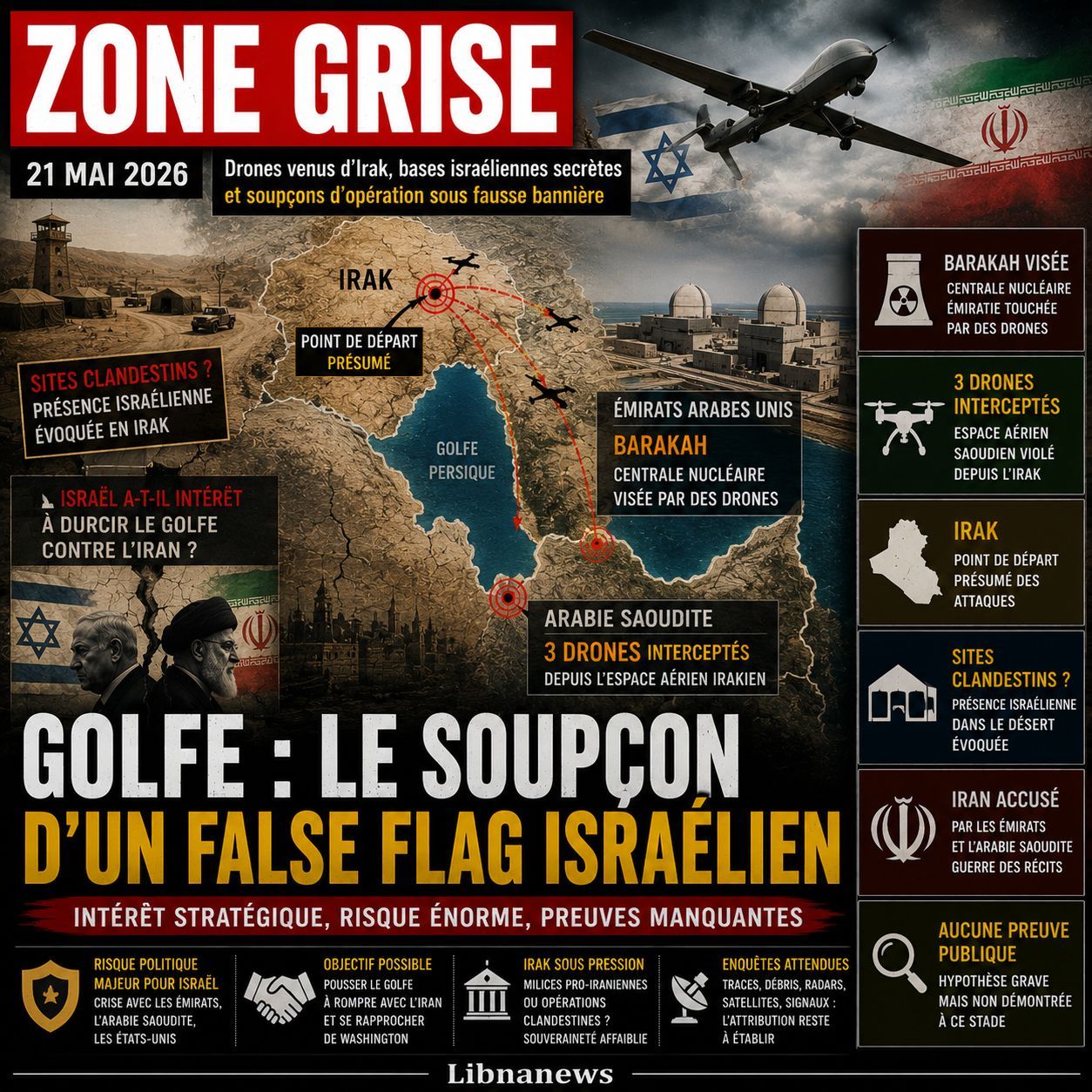
The trail of afalse israeli flagin the Gulf has been circulating since the revelation of two sensitive cases. On the one hand, American and regional media reported that Israel had used clandestine facilities in the Iraqi desert to support its war against Iran. On the other hand, the United Arab Emirates claims that the drones targeting the Barakah nuclear power plant came from Iraq, while Saudi Arabia claims to have intercepted three drones arriving from Iraqi airspace. The juxtaposition of these elements feeds a heavy question: could Israel have mounted, facilitated or operated an operation designed to cause a rupture between Iran and the Arab monarchies in the Gulf?
Such a hypothesis cannot be treated as certainty. At this stage, there is no public technical evidence that Israel launched drones against the Emirates or Saudi Arabia. The most direct accusations come from the Iranian camp and are part of a war of narratives. They therefore deserve careful reading. But they cannot be ruled out with a turnaround, as the region has a long history of clandestine operations, undeclared bases, false identity actions and scrambled responsibilities.
The political motive of an Israeli false flag
The political reasoning is clear. Israel would have a strategic interest in seeing the Arab Gulf countries tighten their position against Iran. An attack on an emirati civilian nuclear power plant or Saudi airspace can change the regional climate. It can push Abu Dhabi and Riyadh to ask for a stronger response, to move closer to Washington and to reduce their margin of mediation with Tehran. It can also reinforce the Israeli story of an Iran capable of threatening the entire Middle East through its armed relays.
But the same reasoning reveals an immense risk to Israel. If a false banner operation were demonstrated, it would cause a major political crisis with the United Arab Emirates, Saudi Arabia, the United States and all Western partners. Israel therefore has every interest in having the Gulf countries attribute the attacks to Iran or pro-Iranian militias. It would also be in the best interest that such manipulation, if it existed, never be discovered. It is precisely this dual interest that makes the hypothesis politically plausible, but legally unproven.
Evidence remains more limited. The Emirates reported that drones had targeted the Barakah power plant without causing radioactive leakage or casualties. One of the devices reportedly affected a generator or electrical installation located outside the safety core of the power plant. The International Atomic Energy Agency has expressed concern about threats to nuclear facilities. Saudi Arabia, for its part, announced the interception of three drones that had entered its airspace from Iraq. No armed group has clearly and verifiablely claimed responsibility for all these attacks.
Iraq, point of connection of suspicions
Iraq therefore occupies a central position. The territory of Iraq is presented by the Emirates and Saudi Arabia as the source of the drones. It is also presented by several media as a space used by Israel for operations against Iran. This double reading places Baghdad in a very difficult situation. If pro-Iranian militias have fired from Iraq, the Iraqi state appears unable to control its territory. If Israeli forces have operated underground, Iraqi sovereignty is equally affected. In both cases, Iraq becomes the ground for a war that exceeds it.
Information on Israeli installations also remained to be handled accurately. The Associated Press reports, on the basis of Iraqi and American officials, that an Israeli force had established a temporary camp in the Nukhaib desert. Some officials describe a brief presence, perhaps less than 48 hours, used as a logistical or intelligence point in the war against Iran. Other accounts, attributed to the American press, evoke two clandestine sites prepared in western Iraq since the end of 2024. Israel does not confirm this information. Iraqi officials have sometimes denied the existence of sustainable foundations.
The word « base » is therefore important. A base requires infrastructure, relative permanence, supply chain and protection. A temporary camp assumes a short presence, but remains politically explosive. In both cases, the stakes are the same: if Israel used Iraqi territory without public authorization, it introduced an element of hiding which then makes more credible, at least politically, suspicions of manipulation. This does not prove a false flag. This creates an environment conducive to prosecution.
A serious accusation, but still without technical proof
The thesis of false flag is based on a known pattern. A power leads or facilitates an attack, and then suggests that an opponent is responsible. The aim is to achieve a political effect that is impossible to achieve openly: the entry into war of an ally, the tightening of sanctions, the mobilization of opinion, diplomatic breakdown or the legitimization of a response. In this case, the desired effect would be to push the Gulf monarchies to consider Iran not only as a strategic rival, but as a direct threat to their vital infrastructure.
The problem lies in the level of evidence. Such a serious charge requires technical elements such as drone debris, components, radar trajectories, satellite data, interception of communications, electronic signatures, exact launch areas and chains of command. Without these elements, suspicion remains a political tool. It may be useful to understand the interests involved. It is not enough to establish responsibility.
The most direct explanation remains that of Iraqi militias close to Iran or of a network aligned with Tehran. These groups have drones, mobile launch capabilities and experience in regional attacks. They may wish to send a signal to the Gulf countries, punish their cooperation with Washington or show that the region’s energy and nuclear infrastructure remains vulnerable. This scenario corresponds to regional precedents. It does not exclude partial autonomy of armed groups, nor an Iranian will to maintain a margin of denial.
But the pro-Iranian scenario also has its shadow zones. The absence of a claim is notable. An attack on an Arab nuclear power plant exposes its perpetrators to a very broad condemnation, including among Israel’s critical states. Silence can therefore be tactical. It can also translate a more complex, misallocated or intentionally blurred operation. In a drone war, actors often seek to produce the maximum effect with the lowest possible responsibility.
The precedents involving Israel
This is where the historical precedent becomes useful. The most documented example of a false banner operation involving Israel remains the Lavon case, or Operation Susannah, in Egypt in 1954. Israeli military intelligence personnel had placed bombs on civilian targets related to United States, British and Egyptian interests, including cinemas, libraries and cultural centres. The aim was to sabotage the rapprochement between Egypt and the Western powers, creating a climate of instability due to other actors. The operation failed and caused a lasting political crisis in Israel.
The Lavon case shows that such an operation is not only theoretical. It also shows that a state may find it useful to create a controlled crisis to influence the behaviour of allies or partners. But it reminds us above all of the cost of a discovery. When the operation becomes public, the expected strategic benefit becomes a scandal. External credibility is affected. Internal institutions are divided. Political leaders are forced to defend themselves for years.
Other cases involving Israel are often cited, but should not be confused with false flag in the strict sense. The Lillehammer case, in 1973, saw Mossad agents mistakenly kill Ahmed Bouchikhi, a Moroccan server based in Norway, whom they had taken for a black September official. Several officers were arrested and sentenced by the Norwegian courts. The operation was clandestine and conducted undercover. It was not, strictly speaking, an operation designed to accuse another State. However, it illustrates the political risk of a secret action exposed to the open.
The 2010 assassination of Mahmoud al-Mabhouh in Dubai belongs to the same category of operations under false identity. Dubai authorities had accused a Mossad-related commando of using fraudulent or usurped passports from several Western countries. Israel did not formally claim the operation. Several Western governments had protested after the use of documents related to their nationals. Again, this is not a classic false flag. But the episode shows that a tactically successful clandestine operation can be expensive if methods become public.
These precedents are important for a specific reason. They show that the Israeli services have already conducted bold clandestine operations, sometimes under false identity, and that the discovery of such actions can create diplomatic damage that exceeds operational gain. They don’t prove anything about Barakah or the drones intercepted by Riyadh. They only provide a reading grid: in intelligence, motive, capacity and political interest are never enough to establish the author.
A huge political risk for Israel
The central issue therefore remains risk. Israel may have an interest in expanding the regional front against Iran. But Israel would also have a great deal to lose if the Emirates or Saudi Arabia found out that they had been manipulated. For Abu Dhabi, a simulated or orchestrated attack on Barakah would be a direct attack on his national security. For Riyadh, a violation of its airspace organised by a potential or indirect partner would be a strategic humiliation. For Washington, the discovery of such a scenario would open a major confidence crisis with its Israeli ally.
The difference between causing a political reaction and risking a nuclear accident must also be measured. Even though Barakah has not experienced a radioactive leak, an attack near a nuclear power plant crosses a threshold of danger. An operation designed to manipulate the attribution of such an incident would expose its perpetrators to considerable international condemnation. This level of risk makes the thesis even more serious. It does not cancel, but it imposes a higher level of evidence.
For the Gulf countries, the priority now is to establish a technical allocation. The Emirates may publish elements on debris and trajectories. Saudi Arabia may provide data on intercepted drones. Iraq can clarify launch areas and investigate alleged foreign facilities. The United States can indicate what they knew about the Israeli presence in the Iraqi desert. Without this data, controversy will remain dominated by competing narratives.
Caution also applies to vocabulary. An operation under false banner is not only defined by secrecy. It presupposes a will for deceptive attribution. An underground base, a robbery under false identity or an unclaimed assassination is not enough to constitute a false flag. It must be shown that the actual author sought to bring responsibility to another actor. In the current case, this demonstration is still lacking.
This distinction also protects the analysis against two excesses. The first is to believe too quickly the Iranian accusation, because it inserts into a coherent account of Israeli interests. The second is to remove automatically, because it comes from a camp engaged in conflict. Intelligence services are exploiting these reflexes precisely. They operate in areas where technical truth comes late, sometimes after political decisions have already been taken.
Lebanon in the impact zone
For Lebanon, this case is not far away. Any escalation between Iran, Israel and the Gulf monarchies has an impact on the southern front. Israel presents Hezbollah as an extension of Iran’s strategy. Tehran often integrates Lebanon into its de-escalation requirements. If the Gulf attacks are attributed to the Iranian axis, pressure on Hezbollah may increase. If the thesis of Israeli manipulation progresses, Hezbollah will find a political argument to denounce a regional provocation strategy.
The debate must therefore remain specific. To say that Israel would benefit from a break between Iran and the Arab Gulf countries is a plausible analysis. To say that Israel should never be discovered if such an operation existed is a strategic evidence. To say that Israel has actually carried out drone attacks is an unproven claim at this stage. Between these three levels, journalistic rigor dictates not to cross the line without proof.
The expected survey will not only focus on drones. It will also cover suspected clandestine sites, Iraq’s ability to control its desert space, intercepted communications and the interests of regional actors. The grey zone will remain open until the capitals concerned publish verifiable data. With this in mind, the Israeli false flag hypothesis remains a political path to be monitored, not an established conclusion.




