

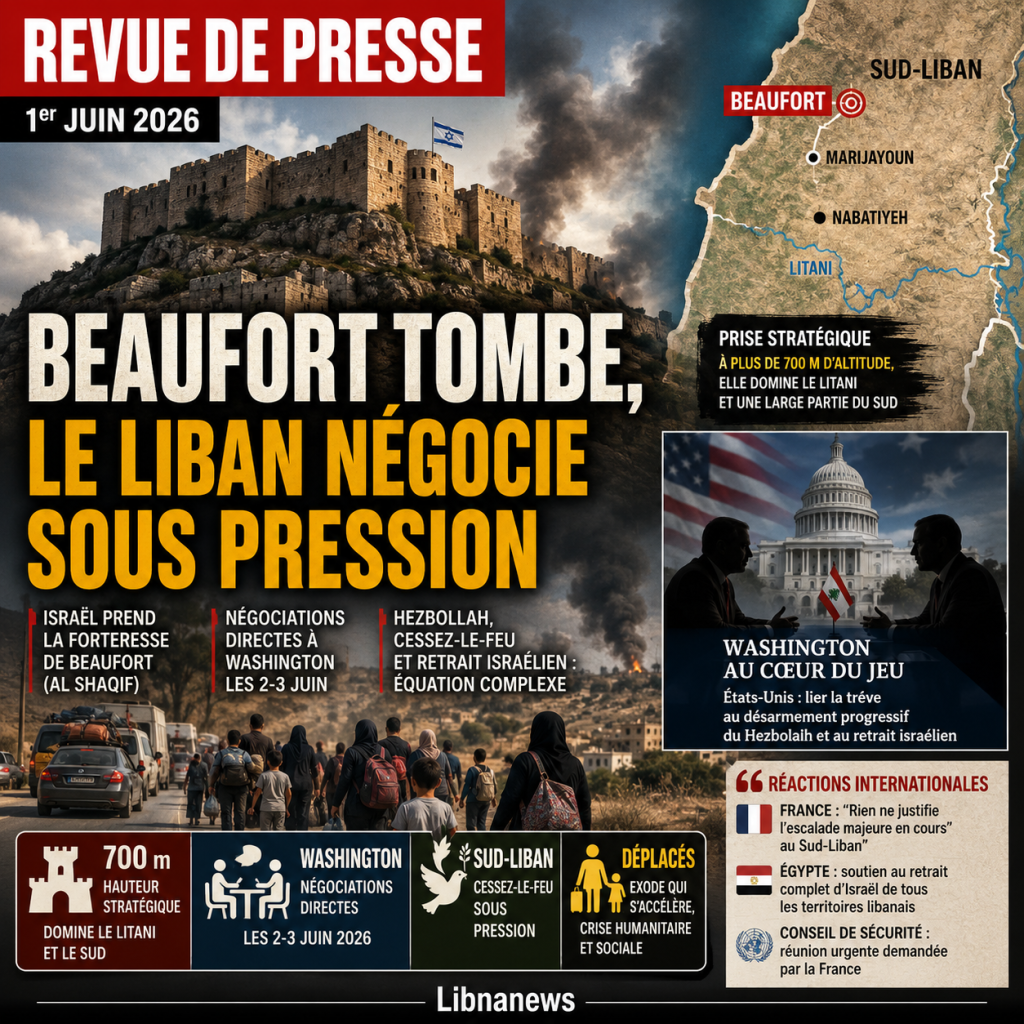
The fortress as a picture of war
The press of 1 June 2026 places the capture of the fortress of Beaufort, also known as Al Shaqif, in the center of Lebanese news.Ad Diyar of 1 June 2026presents the event as a reversal of the conflict. The newspaper points out that the Israeli army has announced its takeover of a historic site that dominates large areas of southern Lebanon. He adds that this progress comes with Israeli commitments to expand military operations. The same newspaper believes that the negotiation process is now subjected to a difficult test, while the Lebanese State seems embarrassed by its inability to obtain a stop to fire or a stop to incursions.Al Jumhouriyat of 1 June 2026the same central fact. The newspaper writes that the Israeli army has taken a strategic hill surmounted by the cross fortress of Beaufort, as part of one of the largest Israeli incursions into Lebanon for decades.Al 3arabi Al Jadid of 1 June 2026insists on the military value of the site. It recalls that the fortress is more than 700 meters above sea level and dominates the Litani, the plain of Marjayoun, Nabatiyeh and large areas of the South.
The scope of the event therefore exceeds the military map alone. ForAl Sharq AL Awsat of 1 June 2026Tel Aviv gave this catch a double dimension, both military and symbolic. The newspaper quotes Israel’s defence minister, Israel Katz, who described the capture of the fortress as a return of Israeli soldiers to a summit marked by the 1982 fighting. The same article states that the fortress also paves the way for progress towards the Nabatiyah region.Al 3arabi Al Jadid of 1 June 2026reports that Israeli officials see this operation as an image of tactical victory, but without any profound change in the nature of the battle. This reading is reinforced byAl Quds of 1 June 2026, which quotes the former head of Israeli military intelligence Tamir Hayman. According to this analysis, the capture of Beaufort is a temporary tactical gain, but it does not address the threat of drones or the threat of firing north of Israel.
Washington becomes the heart of the balance of power
The military sequence overlaps with a very dense diplomatic sequence.Al Sharq AL Awsat of 1 June 2026reports that the United States has advised Lebanon to participate in the fourth round of direct negotiations with Israel, scheduled in Washington on 2 and 3 June, despite the acceleration of the terrain and the capture of Beaufort. The paper presents the central issue as a two-pronged equation: stabilizing the truce and linking the Israeli withdrawal from the South to a timetable for the progressive disarmament of Hezbollah.Al Jumhouriyat of 1 June 2026writes that Lebanon is entering into these discussions under very complex conditions, as Israel seeks to transform its military advance into political and security demands. The same newspaper notes that the political process continues after a security and military meeting in the Pentagon.
This link between war and negotiation is one of the leading threads of the press.Nahar of 1 June 2026reports that Israeli military sources view the operation as an additional pressure card on the negotiating table, more than a strategic turning point. The newspaper added that the aim would be to separate the Lebanese file from the Iranian file and to push for broader measures against Hezbollah in southern Lebanon.Al Sharq of 1 June 2026develops a close angle by quoting a report according to which Israel regards the control of Lebanese territories as a means of pressure intended to achieve two results: detach the Lebanese issue from the American-Iranian negotiations and reduce the military presence of Hezbollah in the South. In this reading, the battlefield becomes a direct extension of the negotiating table.
Lebanese positions between fire stop and sovereignty
In Lebanon, press statements show an official line of negotiation, but under heavy pressure.Al Sharq of 1 June 2026reports that Prime Minister Nawaf Salam considers negotiations to be the least costly option to protect Lebanon and that ending the war is a priority. This formula reflects a desire to limit civilian, economic and territorial losses without abandoning the claim of sovereignty. The same newspaper also reports that the President of Parliament, Nabeh Berri, claims to be able to guarantee a complete, comprehensive and immediate commitment by Hezbollah to a ceasefire, while also asking the central question: who will force Israel to stop its aggression by land, sea and air, as well as the destruction of villages and houses.Al Jumhouriyat of 1 June 2026reiterates Nabeh Berri’s position and believes that she can support political and diplomatic efforts if she finds an echo with the US administration and international mediators.
International diplomatic pressure also appears in several titles.Al Jumhouriyat of 1 June 2026states that the Security Council should hold an urgent meeting at the request of France, following the expansion of the Israeli operation and the seizure of the fortress. The newspaper quotes Emmanuel Macron, according to which nothing justifies the major escalation in South Lebanon. He also reports that French Foreign Minister Jean-Noël Barrot assured his Lebanese counterpart Youssef Raggi that Paris was continuing its action in favour of Lebanon, its sovereignty and its direct negotiations.Al Bina of 1 June 2026stresses also the French role, with the request for an urgent meeting of the Security Council and the denunciation of the dangerous nature of the Israeli advance.Al Quds of 1 June 2026egypt, in a call from Minister Badr Abdel Aaty to Nawaf Salam, expressed its solidarity with Lebanon and its support for Israel’s complete withdrawal from all Lebanese territories.
A local war in the regional agreement
The press of 1 June 2026 does not treat the Lebanese front as an isolated file.Al Akhbar of 1 June 2026places on the front page the return of the Lebanese file at the heart of the American-Iranian discussions. The paper links the delay in the agreement between Washington and Tehran to Donald Trump’s desire to achieve a presentable political victory. In the same issue,Al Akhbar of 1 June 2026considers that the parties are seeking more to freeze the conflict than to resolve it, with a given US priority to calming energy markets, an Iranian priority given to time and resources, and an Israeli concern at an agreement that could reduce its room for manoeuvre. This reading puts Lebanon at the crossroads of wider negotiations on nuclear, the Strait of Ormuz, sanctions and regional balance.
Al Bina of 1 June 2026in the same vein, the gravity of the scene goes beyond Lebanese borders. The newspaper writes that the negotiations between Washington and Tehran on the end of the American-Israeli war against Iran are accompanied by Iranian and regional signals that any attempt to impose facts on Lebanon could broaden confrontation.Al Sharq of 1 June 2026notes also that the fate of the war could be played out in the negotiations between the United States and Iran, while quoting Mohammad Baqer Qalibaf, who claims that Tehran will not trust adverse promises without tangible results.Ad Diyar of 1 June 2026sum up this block by observing that none of the diplomatic tracks opened in Washington, Islamabad or Doha seems capable, at this stage, of stopping the Israeli escalation in South Lebanon.
The social and civil terrain is darkening
The extension of military operations directly affects civilians.Al Sharq of 1 June 2026reported that the Israeli army had contacted Lebanese civil defence centres to request the evacuation of localities such as Bourj el-Shemali and Saghbine, while the Bekaa governor had issued an appeal to open more reception centres for internally displaced persons in Western Bekaa. The same newspaper describes a day marked by air raids on several localities, phosphorous artillery fire on Arnoun, bombardments around Beaufort, and strikes on the vicinity of Nabatiyah.Al Jumhouriyat of 1 June 2026gives this dynamic a clear social title, evoking a Lebanon on the brink of the social explosion. The war is no longer confined to a front line: it affects the roads of exodus, services, displaced families, the local economy and the state’s ability to absorb a crisis that is spreading.
The press also reports a clear internal challenge.Al Quds of 1 June 2026reports a debate around a call from Southern personalities calling for a halt to the war, the protection of cities and villages, and the removal from Lebanon of the policies of the Lebanese that charge the price of blood, livelihoods and the future. This text, quoted by the newspaper, affirms that the inhabitants of Nabatiyah and the South have the right to ask why their cities and villages are repeatedly destroyed, and to demand that the State assume all its responsibilities for the protection of persons, territory and sovereignty. At the same time,Al Akhbar of 1 June 2026insists on the material cost of the war, including water, energy, rents and services in the regions hosting displaced persons. Thus, the military event of the day, the capture of Beaufort, opens a wider sequence: Lebanon is caught between occupation of land, negotiation under pressure, displacement of civilians and the risk of a regional bargaining of which it does not control all the terms.
Local politics: Lebanese state seeks a line of authority between negotiation, army and pressure on Hezbollah
The Executive in the face of the choice of negotiation
The military crisis in southern Lebanon dominates the local political scene.Al Liwa of 1 June 2026reports that President Joseph Aoun and Prime Minister Nawaf Salam jointly assessed the security situation, following a period of strong Israeli escalation. Nawaf Salam defended a clear line. According to the newspaper, he said that Lebanon will pass the test when all actors gather under the flag of a single State, with one decision and one army. This formula places state sovereignty at the heart of internal debate. It also aims to provide a political framework for the role of the Lebanese army in threatened areas, but without causing a direct break with Hezbollah.Al Sharq of 1 June 2026said that Nawaf Salam considered negotiations to be the least costly option to protect the country. The newspaper adds that the Prime Minister gives priority to ending the war, in a context where civilians, displaced persons and infrastructure pay the highest price. This position does not mean abandoning the balance of power. Rather, it reflects a desire to prevent the state from being trapped between two risks: military escalation and political erasure.
The heart of the debate is the state’s ability to negotiate without appearing to yield.Al Sharq AL Awsat of 1 June 2026indicates that the meeting between Joseph Aoun and Nawaf Salam addressed the relationship between a possible cessation of fire, an Israeli withdrawal schedule and the issue of Hezbollah’s progressive disarmament. The newspaper points out that this link places the Lebanese power in the face of a difficult choice. It cannot refuse negotiation if it opens a way to stop the fire. Nor can he accept a formula that would make the state appear to be simply executing an agenda imposed by Washington or Tel Aviv.Nahar of 1 June 2026gives more precise insight into this government line. According to its information, the State does not intend to give guarantees in the form of direct engagement on the negotiating table with Israel. Rather, it would seek to provide evidence of what the Lebanese army is already carrying out, or what it can carry out, within the framework of the arms monopoly mission. This shade is important. It allows the government to defend a gradual policy, based on acts, without placing itself in a logic of public promise that could trigger an internal crisis.
Nabeh Berri occupies space between Hezbollah and the state
Nabeh Berri’s speech weighs heavily in this sequence.Al Sharq of 1 June 2026reports that the President of Parliament states that he can guarantee a complete, comprehensive and immediate commitment by Hezbollah to a ceasefire. He asked a direct question, however, which would oblige Israel to stop its aggression by land, sea and air, as well as the destruction of villages and houses.Ad Diyar of 1 June 2026this is the same position and places it in a climate of distrust of the ongoing negotiations. The newspaper also reports the words of MP Ali Fayyad, a member of the resistance loyalty bloc, who believes that the results of the meetings of the security process in the Pentagon confirm, in his view, the failure of the bet on direct negotiations with Israel. This criticism is aimed at the government line, but it does not completely close the door to a truce. Above all, it seeks to prevent Israeli military pressure from becoming a tool of constraint on Lebanese domestic policy.
The position of Nabeh Berri therefore plays a dual role. She speaks to Hezbollah because she says that the ceasefire commitment can be achieved. She also speaks to the State, as it places responsibility for escalation on Israel.Al Sharq AL Awsat of 1 June 2026presents this equation as one of the nodes of the ongoing discussions. Washington would seek a stop to fire before the negotiations continued, but Israel would link this stop to a withdrawal schedule and a process of withdrawal of Hezbollah weapons. In this context, Berri appears to be an internal mediator more than just a parliamentary leader. It can open a political path, but it cannot guarantee the Israeli side alone. The local question then becomes a matter of authority: who speaks on behalf of Lebanon, who guarantees security, who decides the war, and who can engage the country in a lasting compromise.
The army at the centre of a gradual strategy
The place of the Lebanese army is one of the most sensitive subjects.Al Quds of 1 June 2026reports that Joseph Aoun and Nawaf Salam discussed the results of the security meeting between the Lebanese and Israeli military delegations in the Pentagon. The newspaper notes that discussions focused on a ceasefire monitoring mechanism and the areas that the Lebanese army should take over after an Israeli withdrawal. He added that the United States was insisting on that mechanism, which was considered essential for launching a arms monopoly process. This formulation places the army in a complex position. It is called upon to reassure foreign partners, protect the inhabitants and avoid internal confrontation with Hezbollah.Nahar of 1 June 2026notes that the government wants to build on the Beirut model, where a city decision without weapons is implemented with the army and internal security forces. The aim would be to transpose this model into other areas, including in the South, in stages.
This stepwise strategy reveals the prudence of the executive.Nahar of 1 June 2026stresses that Hezbollah’s refusal to negotiate directly with Israel is not perceived by the government as an obstacle capable of completely blocking its objectives. The power relies on a progressive implementation of the arms monopoly, without frontal shock. This reading joins the comments attributed to Nawaf Salam inAl Liwa of 1 June 2026When he speaks of a single State, a single decision and a single army. The government therefore seeks to establish a firm principle while avoiding a brutal method. The difficulty is real. Too slow an application may appear as a weakness. Too fast an application can open up a political and security crisis. The army is thus at the center of an equation where each step must be readable abroad, but acceptable inside.
South brings the issue of arms into civilian debate
The local debate is not limited to institutions.Al Quds of 1 June 2026reports that two appeals by militants in Tyre and Nabatiyeh, to declare the two cities open and without weapons, have been highly controversial. The newspaper reports that these texts have collected hundreds of signatures, notably among independents and opponents of Hezbollah, including the deputy for change Firas Hamdan. But he also reports hostile reactions. Some voices questioned the sincerity of the signatories or denounced an amendment to the text. Some have withdrawn their signatures in a climate of pressure and suspicion. Opposite press releases have claimed that Tyre is a civilian city, inhabited by its inhabitants and institutions, not a square of weapons. They also warned that the slogan of a city without weapons could, in their view, join the Israeli story without wanting it.
The same newspaper, however, quotes another passage from the debate, which shows a real demand for state protection.Al Quds of 1 June 2026reports that the signatories of the Tyre appeal say they want a definitive end to the war, the liberation of the land, and the end of the use of the South as a map in regional negotiations that do not depend on the inhabitants. They call on the government to launch an urgent Arab and international diplomatic and political initiative to protect the historic city of Tyre. They also call for the deployment of the army and official security forces in and around the city. This controversy is politically major. It shows that the issue of arms is no longer only discussed between parties, ambassadors and ministers. It now crosses local societies in the South, under direct pressure from war, exodus and fear.
A political scene between social emergency and power calculations
Local politics are changing under increased social pressure.Al Jumhouriyat of 1 June 2026dedicated its one to a Lebanon on the brink of the social explosion, in the same issue where the newspaper deals with the capture of the fortress of Beaufort and the rise of military risks. This scoping shows that the war does not remain a defence case. It affects rents, wages, accommodation for displaced persons, roads, public services and state finance.Al Sharq of 1 June 2026for its part, the official discussions also focused on the daily monitoring of displaced persons forced to leave their homes and property. Thus, political decision-making can no longer be thought only in terms of abstract sovereignty. It must respond to displaced families, exhausted municipalities and areas where their capacity to receive services is being reduced.
In this context, local actors are each seeking to preserve their position. The government wants to show that there is a state way. Nabeh Berri wants to remain the channel capable of talking to Hezbollah and laying the terms of the ceasefire. Hezbollah refuses to allow negotiations to become a guardianship of its military record. Opponents of Hezbollah are seeking to advance the idea of an effective state monopoly on weapons. The people of the South first want to survive the war and protect their cities.Ad Diyar of 1 June 2026reports that Lebanon should adopt a firm position in the meetings planned in Washington, by refusing to continue negotiations as if the ground had not changed. The newspaper adds that the United States promised to put pressure on Tel Aviv to reduce the intensity of operations and then freeze them. This promise places the Lebanese authorities before a concrete test: getting quick effects, or seeing the negotiation lose credibility in opinion.
Citation and speech by political figures: words of ceasefire, sovereignty and military pressure
Nawaf Salam defends negotiation as lower cost
The speech of Nawaf Salam occupies a central place in the newspapers of 1 June 2026.Al Sharq of 1 June 2026reports that the Prime Minister considers the negotiations to be « the cheapest choice » to protect Lebanon. The newspaper also states that it places the end of the war a priority. This formula gives the framework of his speech. She doesn’t promise a quick result. Rather, it presents negotiation as a less destructive path than open confrontation. In a context marked by the capture of the Beaufort fortress, Israeli raids and population displacements, Nawaf Salam sought to establish a line of caution. He speaks in chief of government, which must count human, social and economic losses. His vocabulary does not glorify confrontation. It highlights the cost of war. This approach can irritate supporters of a harder line. But it responds to a practical emergency: to avoid the state being swept away by an escalation that it does not control.
The same speech appears inAl Bina of 1 June 2026which reports that Nawaf Salam justified the choice of negotiations as the least burdensome path for Lebanon and the Lebanese. The newspaper adds that he stressed one important point: this choice does not guarantee the results in advance, but it does not mean a capitulation. This clarification is political. It aims to separate two ideas that its opponents tend to confuse. Negotiating does not mean accepting Israeli conditions. Negotiating means trying to get a stop to the fire, a withdrawal and a security framework, avoiding more destruction. The Prime Minister’s speech is therefore based on a distinction between realism and renunciation. It seeks to reassure those in favour of state sovereignty, while limiting the risks of an internal divide with Hezbollah.
Nabeh Berri formulates the guarantee equation
Nabeh Berri’s most widely used sentence in the newspapers remains.Ad Diyar of 1 June 2026reports that the President of Parliament says he can guarantee a complete, comprehensive and immediate commitment to a ceasefire. However, he added a question that summarized the Lebanese dilemma: which would force Israel to stop its aggression by land, sea and air, as well as the destruction of villages and houses. This formula has a specific political function. It transfers the focus of the discussion to the international guarantee. Berri does not deny the need to stop the fire. On the contrary, he claims that a Hezbollah commitment can be obtained. But he refuses to demand this promise on one side. His speech therefore seeks to put Israel in the equation, at a time when external pressure is focused on Hezbollah’s weapons.
Al Jumhouriyat of 1 June 2026gives the declaration a diplomatic scope. The newspaper reports that informed sources believe that Nabeh Berri’s position can support political and diplomatic efforts, especially if he hears from Washington and the mediators. Berri’s sentence then serves as a bridge between Hezbollah, the state and foreign capitals. It shows that a path exists, but that it implies reciprocity.Al Sharq AL Awsat of 1 June 2026washington wants to set a stop to fire before the negotiations, but Israel links this stop to a withdrawal schedule and the gradual disarmament of Hezbollah. Berri’s speech thus becomes a response to this conditionality. He accepts the idea of a commitment. He refuses to dissociate this commitment from a real constraint on Israel.
Lebanese Ministers speak of urgency and responsibility
In addition to the major institutional figures, other officials give the debate more sectoral content.Al Liwa of 1 June 2026reports the words of the Minister of Agriculture Nizar Hani. Lebanon ‘ s priority was to stop the fire and seek durable solutions. He also stressed that the Lebanese effort was focused on stopping wear and tear, while Israel imposed negotiations under fire and continued its attempt to gain ground on the heights of the South. His speech links two realities. The first is military: Israel advances and seeks high positions. The second is economic and social: war uses regions, land and livelihoods. As Minister of Agriculture, Nizar Hani introduces a concrete concern into the public discourse. Southern villages are not just military maps. They are also land, families, agricultural seasons and local markets.
The speech of Wadie Khazen, former minister, gives another register.Al Sharq of 1 June 2026reports that he praised the positions of Nabeh Berri, presenting them as national words in a delicate phase. He claims that they reflect a concern to protect internal stability and constitutional institutions. It also calls for dialogue and understanding rather than division and auction. His remarks refer to the old Lebanese vocabulary of stability, Taif, parity and national partnership. This register is not part of military detail. Rather, it aims to prevent the Southern crisis from becoming a regime crisis. In this reading, political speech is used to contain internal tension. It recalls that Lebanon cannot face an external war by adding an institutional rupture to the security crisis.
France raises tone against Israeli advance
French declarations take an important place in the sequence.Al Sharq of 1 June 2026reports that Jean-Noël Barrot, French Foreign Minister, has requested an urgent meeting of the Security Council on Lebanon. It recognizes Israel’s right to defend itself, but affirms that there is no justification for the expansion of Israeli military operations in Lebanon or the increasing occupation of Lebanese territory. It describes this progression as a serious error, as it contradicts ceasefire commitments and international law. The French discourse wants to be balanced in its form, but firm in its conclusion. Paris does not deny the Israeli security framework. But Paris refuses this framework to cover a territorial extension to Lebanon. This nuance gives weight to the French position before international bodies.
Al Bina of 1 June 2026also reports that Jean-Noel Barrot considers the Israeli advance as a serious mistake and that Emmanuel Macron claims that there is no justification for the ongoing escalation in South Lebanon. These two statements reinforce the French line. They give Lebanon useful diplomatic support, but still limited by the United States and Israeli power relations. Macron’s vocabulary is brief, but it carries a clear message: climbing is not legitimate. Barrot’s is more legal. He speaks of commitments and international law. Together, the two speeches form a French sequence in two stages. The President laid down the political principle. The Minister gives the diplomatic and legal framework. For Beirut, these words matter. But they are not enough without a mechanism of restraint.
Donald Trump, Benyamin Netanyahu and the language of pressure
The American discourse reads mainly through Donald Trump.Ad Diyar of 1 June 2026reports that the President of the United States claims to be close to a good deal with Iran. He adds that if the agreement is not good, it will return to the military option. He also said that he preferred the diplomatic route, since an agreement would mean the immediate reopening of the Strait of Ormuz to navigation. This speech directly links three issues: Iran, energy and Lebanon. It shows that Washington is seeking a regional result that can be presented as a political victory. Lebanon then becomes a part of a broader arrangement. In this context, Trump’s speech does not only speak in Tehran. He also talks to Israel, markets, Gulf allies and Lebanese actors.
On the Israeli side, the vocabulary is more military.Al Akhbar of 1 June 2026reports that Benyamin Netanyahu presented the entry of his forces into the Beaufort fortress as an essential step to secure the northern communities of Israel.Ad Diyar of 1 June 2026notes that Netanyahu appeared in a press conference with a tone of victory, considered illusory by the newspaper after the occupation of the fortress. This speech seeks to transform tactical capture into a political image. It targets Israeli opinion, American partners and regional opponents. But several newspapers point out that the image does not solve the bottom of the crisis. The warnings in the north of Israel and the continued shooting show that the Beaufort symbol is not enough to impose security.
Lebanon’s partisan voices harden the debate
The words of Hezbollah and its allies are relayed through several statements.Ad Diyar of 1 June 2026reports that Ali Fayyad, Member of Parliament for the Resistance Loyalty Block, judges the results of the security meetings held at the Pentagon empty. According to him, they confirm the failure of the bet on direct negotiations with Israel to obtain Lebanese demands, starting with a total ceasefire. It also believes that continuing negotiations under the campaign of destruction of the South gives indirect coverage to Israeli practices. His speech aimed at the government line. He seeks to say that negotiations under fire do not protect Lebanon, but normalize military pressure.
Al Bina of 1 June 2026also publishes a speech by Marwan Abdel Aal, who claims that resistance is not only a weapon, but an existential position and a national consciousness. He cites the logic that peace presupposes preparation for war. This register is ideological. He’s not just responding to the battle of the day. It places the conflict in a long term, as a struggle for existence and not as a border dispute. This type of speech reinforces polarization. In the face of the governmental discourse of cost and negotiation, he opposes the discourse of resistance and the permanence of the conflict. The day of 1 June thus shows a political scene where each word prepares an option: to negotiate, contain, guarantee, resist or internationalize the crisis.
Diplomacy: Lebanon seeks guarantees between Security Council, Washington and regional negotiations
Paris is trying to put the Lebanese case in the international context
French diplomacy appears to be one of Lebanon’s most active relays in the newspapers of 1 June 2026.1 June 2026reported that France had requested an urgent meeting of the Security Council, following the Israeli advance to southern Lebanon and the capture of the Beaufort fortress. The newspaper states that the French Foreign Minister, Jean-Noël Barrot, described the Israeli movement as a serious mistake, believing that it contradicts international law and the commitments related to the ceasefire. In the same sequence,Al Jumhouriyat of 1 June 2026highlights Emmanuel Macron’s sentence that there is no justification for the great escalation in South Lebanon. This French word aims to put the Lebanese issue within a legal and multilateral framework. It withdraws from Israel the argument of a strictly defensive operation, as the military advance is accompanied by a deeper presence on Lebanese territory. It also provides the Lebanese Government with useful diplomatic support at a time when negotiations are under military pressure.
Al Quds of 1 June 2026states that Jean-Noel Barrot has stated that nothing can justify the continuation of Israeli military operations in Lebanon or an occupation that is deeper into Lebanese territory. This formulation goes beyond mere concern. It introduces a concept of political and legal legitimacy. The same newspaper reports that Paris has linked its approach to the convening of the Security Council, which shows a willingness to move the crisis from military ground to the United Nations. But the limit of this action remains visible. France can put strong words on climbing. She may request an urgent meeting. It can support Lebanese sovereignty. However, the press points out that the effectiveness of this line depends on the American position and the Security Council’s real ability to produce binding pressure on Israel.
Washington pushes Beirut to stay in the negotiations
The American role is more direct and operational.Al Sharq AL Awsat of 1 June 2026reports that American officials who exchanged with President Joseph Aoun advised him not to suspend Lebanese participation in the fourth round of negotiations with Israel, even if the truce was not stabilized before the meeting. The newspaper added that these officials hoped for a positive development before the discussions. This recommendation puts Beirut before a dilemma. Boycotting the table would amount to protesting Israeli escalation, but would risk letting the United States and Israel define the sequence alone. Participate, on the other hand, maintains a Lebanese presence in the process, but exposes the state to the accusation of negotiating under fire. American diplomacy therefore calls on Lebanon to preserve the Washington Canal, even when military events weaken confidence in this channel.
Nahar of 1 June 2026gives a more critical reading of this sequence. The newspaper reports that the security meeting in Washington did not result in a stop to fire, and that the file was transferred to a Lebanese-Israeli political meeting under American sponsorship. He adds that the Israeli escalation, with the land advance north of the Litani and the Beaufort capture, aims to impose a new equation on the negotiating table. This analysis shows that Washington is not just a mediator. The American framework also becomes a space where Israel attempts to convert its military gains into security and political conditions.Al Sharq of 1 June 2026reports reports that US Foreign Minister Marco Rubio is making efforts to establish a ceasefire in Lebanon. If these efforts succeed, an announcement could be made after the June 2 negotiating session. Thus, the United States appears to be both the sponsor of the process, the holder of the pressure on Israel and the actor on which much of the diplomatic credibility of the sequence depends.
Arab support seeks to strengthen Lebanese sovereignty
The Arabic part is less massive than the French or American part, but it is not absent.Al Quds of 1 June 2026reports that Prime Minister Nawaf Salam received a call from the Egyptian Foreign Minister, Badr Abdel Aaty, to examine developments in Lebanon. The head of Egyptian diplomacy affirmed Egypt’s complete solidarity with Lebanon in the face of current challenges. He also stressed the need for a full Israeli withdrawal from all Lebanese territories. The same article emphasizes that Cairo regards any violation of Lebanon’s sovereignty, unity and integrity as a clear violation of international law and Security Council resolution 1701. This position joins the Lebanese official line, as it focuses on withdrawal, sovereignty and the UN framework. It also offers Arab coverage to Nawaf Salam, as his government defends negotiation as the least expensive option.
This Egyptian support is of particular political significance. He recalls that the Lebanese case is not limited to a relationship between Beirut, Washington and Tel Aviv. It also concerns the Arab order, the security of the Eastern Mediterranean and the regional balance after several months of escalation. In practice, Badr Abdel Aaty’s appeal does not change the balance of power on the ground. But it gives Lebanon an additional argument in international forums. Beirut can say that its request for withdrawal is not an isolated position. It is shared by a central Arab State, which refers to resolution 1701 and the principle of sovereignty. In a phase in which Israel seeks to link any withdrawal to conditions on Hezbollah, this distinction becomes essential. Egypt supports withdrawal as an obligation under international law. Israel presents it as an element of negotiation. This difference forms part of the diplomatic battle.
The Lebanese issue enters into the American-Iranian negotiations
Several newspapers of 1 June 2026 show that diplomacy around Lebanon cannot be separated from the American-Iranian channel.Al 3arabi Al Jadid of 1 June 2026reports that Donald Trump hardened his conditions in discussions with Tehran. The US President reportedly called for firmer changes to Iran’s nuclear commitments and the reopening of the Strait of Ormuz, which extended the negotiations. The newspaper adds that Tehran continues to say that it does not trust its opponent and that it refuses an agreement that does not guarantee its rights.Al Sharq AL Awsat of 1 June 2026it also reports that Washington and Tehran are continuing to exchange proposals for an end-of-war framework. The newspaper reports that an Iranian trip to Doha involved an agreement with the United States and the release of frozen Iranian funds. Lebanon therefore finds itself in a broader architecture, where nuclear, Ormuz, sanctions, energy and regional fronts are linked.
Al Sharq AL Awsat of 1 June 2026quoted the Iranian Speaker, Mohammad Baqer Qalibaf, who said that Iran would not accept any agreement with the United States without a full guarantee of its rights. The same passage states that Tehran places among its conditions the lifting of sanctions, frozen funds, the Strait of Ormuz and the nuclear issue.1 June 2026goes further by presenting Lebanon as one of the sensitive elements of the Iranian equation. The newspaper reports that signals from Tehran and regional forces indicate that an attempt to impose facts on Lebanon could lead to an increase in confrontation. He also referred to the thesis that Iran could not treat Lebanon as a secondary issue in an end-of-war agreement. This reading gives a regional dimension to the diplomatic battle. Lebanon is becoming both an Israeli lobby, a map in the American negotiations and a point of sensitivity for Tehran.
Diplomacy under fire and without immediate guarantee
The press describes an active diplomacy, but still unable to produce a net halt to the escalation.Ad Diyar of 1 June 2026reports that Donald Trump says he prefers the diplomatic option, because an agreement would immediately reopen the Strait of Ormuz to navigation. This sentence shows that the US administration wants to transform de-escalation into a strategic outcome, especially on the economic and energy front. But the same context reveals a contradiction. If Washington seeks a regional exit, Israel continues to create military facts in Lebanon. The negotiations therefore do not stop the war. They take place while the terrain changes. This fuels Lebanese mistrust and strengthens the voices that believe that negotiations under fire give Israel time, space and means of pressure.
Al Quds of 1 June 2026proposes a strategic wait reading in the negotiations between Washington and Tehran. The newspaper believes that both sides do not seem rushed to conclude, as each believes that time can improve its position. This logic of waiting is dangerous for Lebanon. The slower the regional settlement, the more the Lebanese terrain becomes exposed to the calculations of others.1 June 2026stresses this risk by saying that the region is at a sensitive crossroads: neither the war produces a settlement nor the negotiations go fast enough to close the files. The newspaper adds that Lebanon remains one of the most threatened scenes by fire, due to Israeli escalation and Iranian warnings. The diplomacy of 1 June therefore appears dense, but fragile. It multiplies channels, without yet offering Lebanon the guarantee it lacks: a verifiable stop to fire, a clear Israeli withdrawal and a framework that prevents the transformation of the South into a regional currency of exchange.
International policy: Washington, Tehran, Gaza, Baghdad and Kiev in a sequence of related crises
The Washington-Theran Arm dominates the regional agenda
The press of 1 June 2026 places negotiations between the United States and Iran at the centre of international politics.Al 3arabi Al Jadid of 1 June 2026reports that Donald Trump delayed the expected agreement with Tehran by demanding tougher changes to the text under discussion. According to the newspaper, the US president wants a stronger language on Iran’s nuclear commitments and the reopening of the Strait of Ormuz. He also allegedly expressed concern about the amount of financial support planned for Iran under the agreement. This position shows a willingness to present the arrangement as an American success, not as a concession imposed by military or economic exhaustion. In front, Tehran maintains a line of mistrust. The same newspaper reports that Iranian officials report continuing the exchange of messages, while leaving open the possibility of failure. Negotiations are therefore moving forward in a grey area. Both sides want to avoid a complete break, but each seeks to preserve its political margin.
Al Quds of 1 June 2026stresses the same blocking. The newspaper writes that the exchange of messages continues between Washington and Tehran in order to arrive at an understanding note that would end the war against Iran and open discussions on outstanding issues. He reports, however, that Donald Trump has tightened his terms, while Mohammad Baqer Qalibaf, President of the Iranian Parliament and leading negotiator, claims that Iran will not sign any agreement without guaranteeing the rights of the Iranian people. This sentence is essential. It reflects an internal line of defence, because any agreement with Washington must be justified before an Iranian opinion marked by war, sanctions and mistrust of the United States.Ad Diyar of 1 June 2026donald Trump, who said he preferred the diplomatic option because an agreement would immediately reopen the Strait of Ormuz to navigation. Diplomacy is therefore linked to energy, maritime trade and the risk of global inflation.
Energy and markets weigh on US strategy
The economic dimension is clearly reflected in the treatment ofAl-Akhbar of 1 June 2026. The newspaper believes that the Trump administration is seeking to produce trigger signals on the path of negotiations with Iran, in order to reduce the tension in oil and bond markets. He explains that the longer the Gulf crisis and the higher oil prices, the more the fear of inflation increases. This concern then affects the returns demanded by investors. International policy is therefore also based on the cost of money and market stability. Washington is not just negotiating to avoid a wider war. It also negotiates to prevent the regional shock from weakening its domestic economy.
Al Sharq AL Awsat of 1 June 2026gives details on the issue of Ormuz Strait. The newspaper reports, according to American officials quoted by Axios, that the memorandum of understanding would provide for unrestricted navigation in the Strait. This would mean the absence of taxes or pressure on vessels passing through it. The text would also refer to the withdrawal of Iranian mines within 30 days. In return, the United States would start gradually lifting the naval blockade imposed on Iran, depending on the resumption of commercial shipping. This architecture shows that negotiation is built in stages. It links visible Iranian gestures to progressive American gestures. But Donald Trump would have asked to change some of the wording on the reopening of Ormuz before returning the text to Tehran. The blockage therefore concerns not only the principle of agreement, but also the words that will allow each camp to sell it as a victory.
Palestine remains at the centre of an escalation
In Palestine, newspapers describe a simultaneous worsening in Jerusalem, the West Bank and Gaza.Al 3arabi Al Jadid of 1 June 2026reports that settlers entered the Al Aqsa Mosque under Israeli police protection. The newspaper reports that they raised Israeli flags near the dome of the Rock and carried out provocative actions in the courtyards of the holy place. The province of Jerusalem denounced an official Israeli policy aimed at imposing new acts by force in the occupied eastern part of the city. The same article also refers to Jordan ‘ s condemnation, which recalls that the administration of the affairs of the Al Aqsa Mosque is the responsibility of the Jordanian Ministry of Waqf and Islamic Affairs. The file is therefore not only religious. It affects the legal status of Jerusalem, the tutelage of holy places and the confrontation between sovereignty claimed and occupation.
The West Bank is also described as a colonial expansion space.Al 3arabi Al Jadid of 1 June 2026reports that the settlers expanded an outpost on Mount Ebal in Nablus by installing dozens of mobile homes. The newspaper recalls that Mount Ebal dominates the city with Mount Gerizim, in a central geography for Nablus. It also reports that Israeli forces have issued notices of demolitions of houses under construction in the Hebron area, as well as an order for a water pipeline linked to the Beit Al Rush Dam. In the same context, the Palestinian Ministry of Health announced the death of Imad Haroun Hamdan Ishtiyeh, 27 years old, who was hit by Israeli fire at Al Ram, north of Jerusalem. These elements show continuous pressure on land, water, housing and traffic.
Iraq faces the issue of armed factions
Iraq also occupies a prominent place in the international policy of the day.Al Sharq AL Awsat of 1 June 2026reports that Iraqi Prime Minister Ali Zaidi wants to raise the level of confrontation with the armed forces outside full state control. The newspaper reports that he received Moqtada Al Sadr’s support to advance on the weapons issue. He also reports that Ali Zaidi claims to want to put an end to all weapons demonstrations outside the State, despite pressure from high political parties. This line is part of a battle of internal sovereignty, but it has a regional scope. The Iraqi factions are not only an internal subject. They also concern Iraq’s neighbours, borders, attacks attributed to armed groups and balances between Washington, Tehran and Baghdad.
Al 3arabi Al Jadid of 1 June 2026reports that Baghdad wants to reorganize the deployment of factions in response to concerns from neighbouring countries and investigations indicating that some attacks have been launched from areas such as Bassora, the Samawa desert and the Anbar. The newspaper quotes an official of the Iraqi Ministry of Defence that the plan would be to send border guards and army forces to border areas, and to prevent any unofficial military activity in these areas. Another official at the Iraqi Ministry of Foreign Affairs claims that some factions are hard and uncooperative, even on their redeployment. The same newspaper added that the government must strike a balance between its regional commitments and an internal security structure marked by groups with political and military weight. This equation recalls that of other states in the region: restore official authority without causing an internal armed shock.
Ukraine revives nuclear fear, Turkey fears Iranian chaos
The war in Ukraine is back in the newspapers by nuclear prism.Al Sharq AL Awsat of 1 June 2026reports that the attack on the Zaporijjia power plant by a drone revived fears of a nuclear accident in the war between Russia and Ukraine. The newspaper reports that the International Atomic Energy Agency, citing local officials, reported that a drone had hit the turbine building of the plant under Russian control in southern Ukraine, causing a hole in the wall. The agency’s director, Rafael Grossi, warned that no attack on a nuclear power plant should take place, talking about a game with fire.Ad Diyar of 1 June 2026reports Rafael Grossi’s call to stop attacks on nuclear facilities in order to avoid an accident that no one would benefit from. The Ukrainian case thus recalls that war can create a danger that far exceeds the armies engaged.
Turkey appears inNahar of 1 June 2026through an analysis of the possible consequences of a major collapse or disorder in Iran. The newspaper explains that Recep Tayyip Erdogan supports discussions aimed at preventing Iran from possessing a nuclear weapon, but that he does not wish to see this result achieved by the collapse of the regime or the fragmentation of the Iranian state. Ankara fears a repetition of the political, social and economic costs incurred after the wars in Iraq and Syria on its eastern border.Nahar of 1 June 2026stresses that Turkey also fears a new flow of refugees and increased pressure on its economy. The newspaper reports that an increase of one dollar in the price of the barrel imposes on the Turkish economy additional expenses estimated at about five hundred million dollars. This Turkish look gives a different reading of the Iranian crisis. For Ankara, preventing nuclear weapons must not open a state crisis. Regional stability remains a priority, as chaos in a neighbour quickly becomes an internal problem.
Economy: the Lebanese financial crisis between banking reform, framed markets and the survival of the productive sector
Diagnosis of a system crisis
Nahar of 1 June 2026places the Lebanese financial crisis under a heavy formula: it is « systemic ». The newspaper explains that this qualification is not a simple choice of words. It means that collapse is not the result of an isolated error, nor the fault of a single actor. It results from an overall failure of the government, the Bank of Lebanon, the banking sector, supervisory authorities and economic choices accumulated over years. This reading changes the way losses are dealt with. It makes any solution that would bring the cost of the crisis to a single party more difficult. It also raises the question of the division of responsibilities between the State, the central bank, banks and depositors. According toNahar of 1 June 2026The International Monetary Fund thus joins an analysis already defended by several economic and financial actors, who demand a fairer sharing of burdens, rather than a brutal erasure of depositor rights. The newspaper also quotes the Vice-President of the Autorité des marchés financiers, Mahmoud Jabaai, who believes that this diagnosis joins the line of the Governor of the Bank of Lebanon, Karim Suaid, in his willingness to treat the crisis as a system crisis and not as a mere accounting bankruptcy.
This approach requires thinking of reform beyond slogans. To say that the crisis is systemic is tantamount to recognizing that bank balances, public finances, debt, deposits, money and trust form a single block. No item can be repaired alone. If the state does not clarify its losses, banks cannot recapitalize. If banks are not restructured, depositors remain uncertain. If applicants do not recover a credible share of their rights, trust does not return. If confidence does not return, legal investment remains weak and the cash economy continues to dominate. The debate reported byNahar of 1 June 2026therefore suggests that Lebanon should reach a stage where the communication on reform is no longer sufficient. The country must produce legible mechanisms, loss rules, guarantees for small depositors and a banking architecture capable of financing the real economy.
Financial Markets Authority as a credibility test
Ad Diyar of 1 June 2026devotes a file to the Autorité des marchés financiers, asking a direct question: has his work really started? The newspaper recalls that this authority had been paralysed since the beginning of the economic crisis in 2019, before the appointment of its members by the Council of Ministers at the end of the previous year. The file points out that the tasks ahead are numerous in a still fragile context. The challenge is to reopen the way to diversified investments, through shares of productive companies, bonds to finance projects and infrastructure, and investment funds. This perspective is important because the Lebanese economy suffers from a deep lack of reliable financing instruments. After the banking collapse, savings were withdrawn from official channels. Investment has been reduced. Productive enterprises have lost normal access to credit. In this context, restoring order to financial markets can become a lever for reconstruction, provided that regulation is credible.
Mahmoud Jabaai explains inAd Diyar of 1 June 2026that the Autorité des marchés financiers is one of the most necessary supervisory bodies in the country, because financial markets have become an essential part of the modern economy. He states that things are now moving in the right direction and that the goal is to achieve a better organised market, capable of ensuring effective investor protection. The same article insists on the expansion of the legal economy, presented as a major advantage for Lebanon and as a positive signal to the international community. This idea is central. The country cannot attract sustainable capital if investors fear opacity, fuzzy licensing, uncontrolled intermediaries and poorly managed financial products. Financial market reform is therefore becoming a test of credibility. It will not replace bank restructuring, but it can open another financing channel, especially for companies capable of producing, exporting and creating jobs.
Licensing, control and legal economy
Same fileAd Diyar of 1 June 2026states that the Autorité des marchés financiers is working on several levels. Mahmoud Jabaai first raised the issue of licensing of companies. Companies meeting the legal conditions will be able to receive the necessary authorisations, while actors operating outside the control will be prevented from continuing their activities. He also indicated that pending cases were being examined, after a long period of crisis-related stagnation. The authority would have been restructured internally, with better defined regulatory frameworks and a desire to protect markets in a more transparent manner. This technical dimension has a political dimension. It shows that economic reconstruction requires administrations that are able to decide, control and sanction. In Lebanon, the crisis has not only destroyed balance sheets. She also weakened the rules of the game. Many actors have adapted themselves to informality, cash payment, private arbitration and government distrust. Returning to a framed market therefore requires more than just text. We need an active, visible and constant authority.
This revival of regulation should not be read as a separate subject from the banking crisis. It is one of the extensions. Applicants need to know whether the system that destroyed their trust can be replaced by a safer system. Companies need stable capital. Foreign investors need rules. The Lebanese in the diaspora need a minimum of visibility before committing their money.Ad Diyar of 1 June 2026thus give the Autorité des marchés financiers a signal function. If it actually acts, it can help reduce the share of the undeclared economy and bring some of the flows back to monitored circuits. If it remains a formal body, distrust will continue. In a country where the monetary collapse has pushed households and businesses to seek individual solutions, rebuilding a legal market becomes an economic act, but also an act of public confidence.
The debate on the audit and reforms of the Bank of Lebanon
Al Akhbar of 1 June 2026approaches the same field from a more critical perspective, with a dossier on the judicial audit and the promises of reform of Karim Suaid. The newspaper reports that the stated objective of this audit is to verify the volume of funds spent, to prosecute undue beneficiaries of support mechanisms and to reveal cases where these funds were used for purposes other than those formally intended. He recalled that the Governor had promised transparency and regular public information on the progress of the process. ButAl Akhbar of 1 June 2026also points to a contradiction. According to the newspaper, the value of the contract was not made public and its details were only announced after the end of the tender and its award. This criticism is less focused on the audit principle than on the methodology. She asked whether a reform could be credible when it began with procedural opacity.
This is essential in an economy marked by the collapse of confidence. Judicial audit can become a tool of truth. It can also become an instrument of political selection, if its scope seems limited or if its rules are unclear. ReadingAl Akhbar of 1 June 2026insists on this risk. She suggested that the Bank of Lebanon reform should not be judged on announcements or promises, but on the actual scope of the investigation, the publication of results, the transmission to the relevant ministries and the capacity of the judiciary to act. In the Lebanese crisis, transparency is not an administrative detail. It is a condition of economic survival. Without truth about funds, losses, beneficiaries and past decisions, any reform can be seen as another attempt to save time.
Industry between war, poverty and the need for stability
The real economy appears inAl Liwa of 1 June 2026through Georges Nasraoui’s comments on the situation in the industrial sector. The newspaper reports that no precise census has yet been conducted of the number of factories damaged or destroyed, pending the calming of the situation. It also reports that poverty is worsening day after day, while the middle class, which was a balanced element in Lebanese society, is becoming a serode. This observation highlights an angle that is often relegated to the main financial issues. The Lebanese crisis is not only measured at the exchange rate, deposits or bank balance sheets. It also measures the capacity of plants to operate, pay wages, import inputs, export, find electricity and work in a safe environment. The industrial sector is not just asking for credit. It requires a stable environment.
According toAl Liwa of 1 June 2026Georges Nasraoui believes that the future of Lebanon remains unclear and that any improvement requires real stability and an external decision that can restore confidence in the country. This sentence summarizes the current dependence of the Lebanese economy on security and politics. Industrialists can resist, but they cannot compensate alone for the uncertainty of the war, the lack of reliable infrastructure, weak financing and the decline in purchasing power. The middle class, which bought, consumed, educated and supported services, weakened. Domestic demand is contracting. Companies are therefore caught between high costs and reduced market. With this in mind, the stabilization of South Lebanon, the reactivation of financial institutions and the revival of regulated markets are not separate issues. They are the same condition of recovery.
Electricity, energy and the risk of social explosion
Al Jumhouriyat of 1 June 2026expands the economic picture to include social risk. The paper describes a country threatened by inflationary stagnation, i.e. a combination of economic decline, rising prices, unemployment and pressure on living standards. He claims that the ground is ready for a social explosion that is even more dangerous than continuous air strikes. The newspaper links this threat to the decline in Lebanese resilience, long presented as a national force. This resilience has been worn out by repeated crises. Households have less savings. Enterprises have less room for manoeuvre. Internally displaced persons are increasing the need in the host regions. Prices remain high for income. War adds a layer of fear and cost.
The question of energy illustrates this impasse.Al Jumhouriyat of 1 June 2026returns to the Egyptian gas import project to generate electricity and cover part of Lebanese needs. The newspaper recalls that Lebanon had already benefited from Egyptian gas to reduce production costs, prior to the closure of this mechanism for financial reasons and in a context of suspected corruption in supply chains. He also reported that a memorandum of understanding had been announced in 2025 between Lebanon and Egypt for the import of natural gas for electricity generation. This trail may help, but it is not enough alone. The electricity problem remains linked to public finances, sector management, technical losses, fuel purchases, tariffs, governance and the state’s ability to implement reform without triggering further social anger. The Lebanese economy is at the crossroads of three emergencies: restoring financial confidence, saving the productive fabric and preventing social pressure from turning the economic crisis into a street crisis.
Society: displaced civilians, health system under pressure and social fatigue in the face of war
The South between exodus, fear and loss of landmarks
Lebanese society appears, in the press of 1 June 2026, as the main wear and tear of the war.Nahar of 1 June 2026writes that the occupation of the Fortress of Beaufort is no heavier on the human level than the emptying of dozens of cities, towns and villages from the south to the north of the Litani. The newspaper also evokes a frightening human record and the removal of landmarks in many localities. This reading puts war in the ordinary lives of the inhabitants. The military event attracts titles, but the social consequence is measured elsewhere: abandoned homes, separated families, saturated roads, disturbed schools, interrupted work, villages deprived of their normal rhythm. The South is no longer just a front. It becomes a space of forced displacement and lasting uncertainty.
Al Liwa of 1 June 2026gives this social fatigue a more human tone. The newspaper writes that it is painful for a resident to discover that what he thought was a source of protection has become a source of fear. He adds that it is even more painful to feel that the future of children has become hostage to a war that does not end. This sentence summarizes a feeling of fatigue that goes through a part of society. The debate is no longer limited to regional sovereignty or power relations. It also addresses the right to life, return, safety and the future of children.Al Liwa of 1 June 2026formulates this request as a right of the Lebanese to choose life and as a right of the South to enjoy peace, without presenting this peace as a surrender.
The wounded, the dead and the pressure on rescue
Pressure on the health system is one of the clearest markers of the social crisis.Ad Diyar of 1 June 2026reports that the Emergency Operations Centre of the Ministry of Health announced an Israeli strike near Hiram Hospital in Tyre. The strike injured thirteen hospital employees and caused heavy material damage, which added to previous damage. The department praised the courage of the staff, remaining in their position despite the risks. He also called on the international community to put an end to the Israeli attacks, which were considered to be expanding and carried out without respect for international humanitarian law. This fact shows that caregivers are no longer just actors in responding to the crisis. They themselves become direct victims of war.
Al Sharq of 1 June 2026reports on a series of local assessments of violence against civilians. The newspaper mentions the death of Zouheir Ahmad Hashem and his son Ali in a drone strike on their house in Ansar, as well as seven wounded among family members. It also reports nine Syrian deaths, including six children, in a strike on Adloun. The same newspaper reported four deaths in Maaroub, including one rescuer, and five injuries, including another rescuer. He still mentions three dead in the Abbassiyeh area and four dead in Touridba. These data, locality by locality, reveal war as a succession of family and community breakdowns. They also recall that humanitarian workers and relief workers are caught in danger just as the inhabitants are.
Substantial public aid, but under duress
Given the scale of needs, the question of aid becomes central.Ad Diyar of 1 June 2026reports on the development of the Ministry of Finance after the dissemination of figures deemed incorrect on funds intended for victims of Israeli attacks. According to this clarification, $50 million was allocated by the Treasury to the Department of Social Affairs alone. To this amount is added two hundred million dollars from the World Bank, forty-five million euros and thirty-two million additional from the European Union for the same ministry. The Ministry also mentions tens of millions of dollars paid to the health sector by the Ministry of Health, as well as other amounts spent by the High Relief Committee and the Southern Council. Aid from the United Nations and humanitarian agencies is said to have exceeded one hundred and thirty million dollars.
These amounts reflect a real effort, but they also reveal the scale of the crisis. The larger the funds, the larger the social demand. Displaced persons need shelter, food, care, medicine, schooling, transportation and sometimes direct money. The host municipalities must manage an additional population, often without sufficient resources. Hospitals must treat the wounded and continue to serve the inhabitants. Families who have left their homes also lose income, land, stocks and work tools. Financial aid therefore does not settle everything. It becomes a survival net in a crisis that affects both housing, health, employment and local cohesion.Al Liwa of 1 June 2026reports the same financial clarification, which shows that the subject has taken on a sensitive public dimension.
The risk of social explosion goes beyond the front
The military front is not the only area of danger.Al Jumhouriyat of 1 June 2026describes a Lebanon threatened by a social explosion, in the context of economic stagnation, rising prices, unemployment and declining living standards. The newspaper believes that the social field becomes more fragile as the war prolongs the crisis. This reading is important because it shows that Lebanese society is not experiencing a single crisis. It adds economic collapse, institutional fatigue, displacement, security fear and political uncertainty. The danger is therefore not limited to the bombed area. It spreads to regions where displaced persons are accommodated, to families sharing their resources, to young people who lose access to work, and to households where their spending is increasing.
War acts as a multiplier of vulnerabilities. The poorest people lose their livelihoods faster. The middle classes continue to erode. Older people are more dependent on their relatives or irregular helpers. Children live in unstable places, sometimes away from school. Women often bear an increased burden in organising the movement, care and maintenance of family life. In this context, the social speechAl Liwa of 1 June 2026, according to which homelands are built with the living and not with cemeteries, takes a wider scope. It expresses a request for civil protection, not just a political position.
Public health is not limited to war
The social page of 1 June is not limited to bombings.Nahar of 1 June 2026devotes an article to smoking on the occasion of World No Tobacco Day. The paper notes that the dangers of tobacco are no longer discussed, but that smoking rates continue to rise in different age groups. It highlights the growth of electronic smoking among adolescents and youth. This product, originally presented as a tobacco cessation aid, has become an attractive mode whose risks appear in the early years. The smoking cessation centre of Hôtel Dieu de France in Beirut organized a round table with doctors from several specialties to explain the effects of tobacco on the different functions of the body.
This topic takes on particular importance in a society already exhausted by the crisis. Public health is based on prevention, information and access to care. War and the economic crisis often reduce families’ ability to prioritize these issues. When housing, income and security become urgent, prevention declines. Electronic smoking among youth also indicates a problem of control, marketing and coaching. It affects a generation that grows in instability, with fragile landmarks and massive access to products presented as modern or less dangerous.Nahar of 1 June 2026in this way, a society at war must also continue to deal with the slow risks, which do not always make headlines but weigh on the health future of the country.
Diet, Digital Advice and Medical Caution
Al Jumhouriyat of 1 June 2026addresses another health-related social issue: the use of artificial intelligence to follow a diet. The newspaper explains that these tools have become a quick recourse for many people seeking health or nutrition advice. But he cites experts who warn that these tools do not replace qualified professionals and can produce imprecise or even harmful recommendations. The journal states that advice related to diseases, major changes in diet or supplements must be checked with competent persons. This warning is part of a broader transformation of social behaviour. Citizens seek immediate answers, often free of charge, in a country where access to doctors, exams and specialists can be expensive.
This phenomenon also says something about Lebanon in crisis. Part of the population tries to manage its own health, food, stress and expenses. Digital tools can help, but they can also create false security. In a weakened society, the risk is that people will replace a medical opinion with an automatic response, especially when they do not have the means to consult.Al Jumhouriyat of 1 June 2026this raises a fundamental social question: how to maintain a minimum of medical protection in an environment where citizens are looking for shortcuts, where information circulates quickly, and where confidence in institutions remains weak. Health then becomes a field where poverty, technology and the need for supervision intersect.
Community links still visible
Despite the seriousness of the crisis, some social pages recall the strength of community ties.Al Liwa of 1 June 2026publishes a text on the Beyruthin traditions related to the return of pilgrims. The newspaper describes decorated houses, lively neighbourhoods, mobilized families and facades decorated with green branches before the arrival of relatives. He also recalls that these returns mixed joy and pain, as some families welcomed the pilgrim back safely, while others received news of a death on the road or in Mecca. This social scene has a wider value. It shows a society that has long organized its rites around family, neighbourhood, memory and solidarity.
In the current context, these rites are not a mere memory. They recall what is threatened by war and crisis: the continuity of neighbourhoods, collective actions, family transmission, public joy and the ability to live together. The contrast with the displaced South scenes is strong. On one side, the houses decorated to welcome a return. On the other hand, houses left under threat.1 June 2026writes that the blood of people is the most sacred in the country and that aggression against the South is an aggression against all Lebanon. This sentence links society to sovereignty. It recalls that the protection of stones, sites and borders makes sense only if it is accompanied by the protection of lives.




