

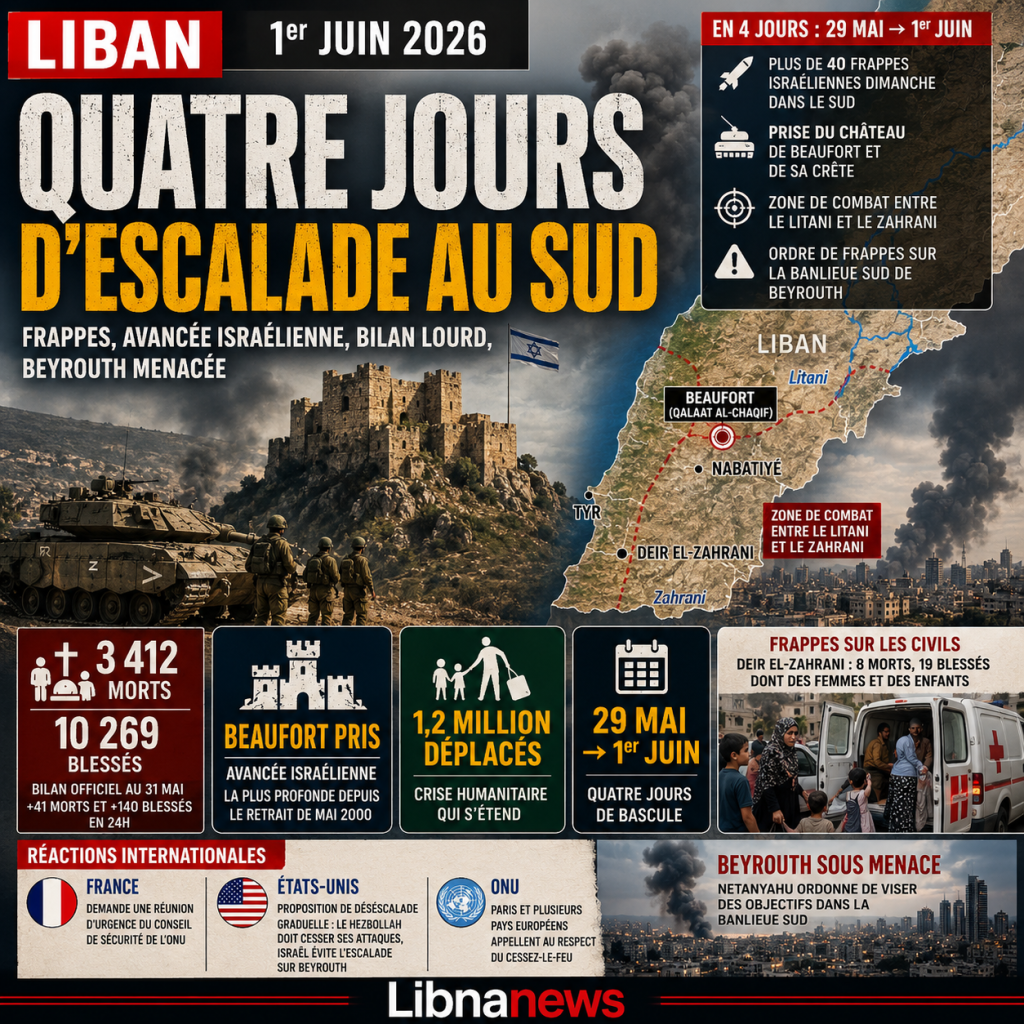
Between Friday, 29 May, and Monday, 1 June, 2026, Lebanon experienced a series of escalations that moved the conflict towards a more dangerous threshold. Israeli strikes continued in the south around Tyre, Nabatiyah, Deir al-Zahrani and localities between Litani and Zahrani. The Israeli army announced the capture of Beaufort Castle, also known as Qalaat al-Shaqif, as well as its ridge. This advance, the deepest in Lebanese territory since the Israeli withdrawal of May 2000, turned an already active front into a battle of positions. Lebanon is thus facing double pressure: an increase in the human balance and a territorial extension of the Israeli operation.
The latest consolidated official report of the Lebanese Ministry of Health, published on Sunday evening, 31 May, states:3,412 dead and 10,269 injuredsince March 2. This total represents an increase of41 dead and 140 injuredin 24 hours compared to saturday’s balance sheet, which was3,371 dead and 10,129 injured. It should not be confused with the partial balance sheets announced on Monday after further strikes. The most serious reported Monday morning concerns Deir al-Zahrani, in Nabatiyah governorate, where an Israeli strike killed8 personsand injured19 otheraccording to the Lebanese Ministry of Health. Three women are among the dead; Five children and six women among the wounded.
A tight chronology, Friday to Monday
On Friday 29 May, the main alert comes from international organisations. UNICEF indicated that77 childrenwere killed or injured in Lebanon in a week, based on figures from the Ministry of Health. The UN agency adds that, since the ceasefire in April,fifty-five childrenwere killed andtwo hundred and twelvewounded. The World Health Organization reports, for the same period of theoretical truce,27 attacksagainst health structures, withtwenty-five deadand42 injured. Sixteen hospitals and 13 primary care centres were damaged. These figures set up the weekend within an already very degraded humanitarian framework.
On Saturday 30 May, the Lebanese Ministry of Health publishes a first consolidated daily review. It then lists3,371 dead and 10,129 injuredsince March 2. In the south, the Lebanese national agency reports Israeli artillery fire against Al-Mansouri, Byout al-Siyyed, Qlaylé and Majdel Zun. Strikes and destructions are also reported in the Nabatiyah area and along the coastal axis. Military pressure remains strong around villages already evacuated or partially emptied. The remaining inhabitants are exposed to repeated evacuation orders, the closure of secondary roads and the gradual removal of relief services.
Sunday, May 31 marks the military turning point. The Israeli army announced that it had taken Beaufort Castle and the nearby ridge. The site, perched above the Litani, dominates a large part of southern Lebanon and offers a view north of Israel. Israel had occupied it from 1982 to 2000. Its recovery therefore has a strong symbolic significance, in addition to its military interest. On the same day, the Israeli army designated the area between the Litani and the Zahrani as a combat zone. It calls on civilians to leave the localities concerned. According to Lebanese security sources and the State media cited by the international press, more than forty Israeli strikes were carried out on Sunday in the South.
On Monday 1 June, the climb continues on two levels. On the ground, the strike of Deir el-Zahrani adds a heavy partial balance to the total already published Sunday night. At the political level, Benjamin Netanyahu announced that he had ordered the army to set targets in the southern suburbs of Beirut, a stronghold of Hezbollah. This announcement alone is not yet a confirmed strike record in the capital. However, it changes the alert level. It comes at a time when Washington is proposing a gradual de-escalation and Paris is calling for an urgent meeting of the United Nations Security Council.
Lebanon: A human score above 3,400 dead
The figure now central is that of3,412 dead and 10,269 injured. This is the last consolidated national balance sheet on Sunday 31 May. It covers the period opened on 2 March, the date of the resumption of the war after Hezbollah fired at Israel and the Israeli response that followed. The Lebanese authorities shall publish the balance sheet in aggregated form. They do not always distinguish between civilians, combatants, health personnel, relief workers and members of the Lebanese armed forces in the total public sector. This limit prevents a complete reading of the nature of the losses.
Sunday’s rise is notable. Forty-one additional deaths and one hundred and forty injuries were added in one day. The figure reflects the intensity of the strikes in the last 24 hours, but it does not close the weekend balance. Several strikes still require local checks. Emergency teams cannot always access the affected buildings quickly. As a result, the balance sheets of some localities remain partial, especially when the strikes sequence or when areas are subjected to artillery fire.
Deir el-Zahrani’s strike illustrates this difficulty. On Sunday, a first check was made, with eight dead and a slightly lower number of wounded. The ministry’s update published on Monday brings the total to eight dead and nineteen injured. Victims include women and children. The attack targeted the Al-Arab neighbourhood near the municipality, according to reports from the Lebanese National Agency. This strike is in addition to reported attacks in the Nabatiyah area, where residential buildings, local roads and homes have been affected.
In Tyre, a strike near Hiram Hospital injured13 health personneland caused significant damage. The facility serves as a medical support point for part of the southern coastline. His exhibition illustrates the vulnerability of the hospital system. Beyond the war wounded, hospitals must continue to provide regular care. Dialysis, childbirth, cardiac emergencies and chronic treatments do not interrupt. Each strike around a hospital also reduces the capacity of displaced and injured people from neighbouring villages.
The bombings: Tyre, Nabatiyah and the Zahrani axis
The weekend bombings are concentrated around three areas. The first is the southern coast, from Tyre to Qlaylé, Majdel Zoun and Al-Mansouri. This coastal band remains strategic, linking villages close to the border with the routes to Saida and Beirut. It also concentrates internally displaced persons from more exposed localities. Artillery fire and air strikes have an immediate effect on roads, ambulances and civilian movements.
The second area is around Nabatiyah. The city and its surroundings constitute a major administrative, commercial and health centre of the interior South. The Israeli advance towards Beaufort brings the front of this agglomeration. The international press placed Israeli troops about five kilometres from Nabatiyah after the ridge was taken. The destruction of buildings and strikes in peripheral neighbourhoods exacerbate the fear of a gradual circle. Many people had already left the area. Others remain because of lack of resources, family obligation or inability to find housing in the north.
The third area is Litani, Wadi al-Saluki and Zahrani. The Israeli army claims to be targeting Hezbollah launch infrastructure. It presents the Beaufort Ridge as a point of observation and control. Hezbollah, for its part, claims to have targeted Israeli troops, military positions and armoured personnel, particularly in the Bayada area and near areas of progress in the South. The two accounts confirm one fact: confrontation is no longer limited to cross-border shooting. It is now a battle over heights, roads, valleys and fire positions.
Beaufort, military and political symbol
Beaufort Castle occupies a special place in southern Lebanon’s military history. Built in the Middle Ages, used by several successive powers, it dominates the surroundings of Litani. Israel had taken it in 1982, at the beginning of its occupation of the South, and then left it when it withdrew in 2000. His return to Israeli control therefore refers to a heavy memory, both in Lebanon and in Israel. For the Israeli government, the image of the flag raised on the site is used to show a resumption of initiative. For the Lebanese, it revives the memory of a long and costly occupation.
On the ground, Beaufort gives Israeli forces an advantage of observation. The ridge is used to monitor valleys, roads and villages. The Israeli army claims to want to destroy Hezbollah infrastructure there, particularly in Wadi al-Saluki. The Israeli Minister of Defence indicated that the soldiers would keep the site as part of a security zone. This formula is heavy. It suggests that the operation is aimed not only at a temporary raid, but at a more lasting control of positions in South Lebanon.
Hezbollah has not published a complete record of its losses. The Israeli government claims to have killed thousands of movement fighters since the beginning of the war, and the Israeli army also makes figures for the post-ceasefire period. These data are not independently verified. They must therefore be reported as Israeli claims. Hezbollah claims attacks on soldiers, tanks and positions, without providing a general picture of its losses. This communication asymmetry makes military assessment very difficult.
Israeli casualties and pressure north of Israel
On the Israeli side, public balance sheets vary by perimeter. Reuters reports that28 israeli deathssince 2 march, of which24 soldiersandfour civilians. Associated Press quotes the Israeli Prime Minister’s office, which at least mentions25 soldiersanda defence contractorkilled in or near South Lebanon, andtwo civilianskilled in the north of Israel. These figures do not overlap perfectly, but they confirm that the firing of Hezbollah missiles and drones has imposed a military and civilian cost on Israel.
The north of Israel remains subject to numerous warnings. Hezbollah’s fire resulted in school closures and restrictions on activity. The Israeli army accuses the movement of using suicide bomber drones that are hard to intercept, some of which are said to have killed soldiers in southern Lebanon. Israel thus justifies the expansion of its land operation. This reasoning is challenged by Beirut, which accuses Israel of going beyond the scope of the response and seeking to impose a new area of occupation.
The situation creates a dangerous mechanics. Each Hezbollah attack serves as an argument to Israel to push further north. Each Israeli advance serves as an argument to Hezbollah to maintain its fire. The ceasefire line, announced in April and extended in May, still exists in diplomatic vocabulary. On the ground, it is largely emptied of its substance. People on both sides of the border pay for this spiral through displacement, restrictions and losses.
Lebanese reactions: the State under duress
Prime Minister Nawaf Salam accuses Israel of pursuing a policy of total destruction of towns and villages. His purpose was to place war within the framework of international humanitarian law. Beirut calls for a halt to the strikes, Israeli withdrawal and the protection of civilians. But the Lebanese State has limited resources. It does not control Hezbollah’s military decisions. Nor can it prevent the Israeli army from moving forward. This weakness feeds internal criticism and complicates discussions with Washington.
President Joseph Aoun supports the American proposal for de-escalation. It seeks an agreement that would avoid the expansion of the strikes in Beirut and allow a political path to be reopened. The Speaker of Parliament, Nabih Berri, an ally of Hezbollah and a central interlocutor in this matter, claims to be able to guarantee the movement’s commitment to a ceasefire, but only if Israel stops firing first. This position refers the initial responsibility to Israel. It does not respond to the American demand for a prior halt to Hezbollah attacks.
Health and municipal authorities manage the daily emergency. In Tyre, civilian defence teams had to redeploy to Saida following threats of evacuation. The displacement of first aid workers weakens the local response at a time when strikes are approaching urban areas. Municipalities must organize departures, identify families, find shelters and coordinate ambulances. Schools, public buildings and religious centres often serve as temporary shelters, while the economic crisis limits available resources.
International reactions: Paris raises tone, Washington temporise
France called for an urgent meeting of the UN Security Council after the Beaufort takeover. Emmanuel Macron believes that there is no justification for the major escalation in South Lebanon. The French Foreign Minister, Jean-Noël Barrot, considers it unacceptable to continue Israeli military operations in Lebanese territory. The United Kingdom and Germany join forces in Paris to demand respect for the ceasefire. This European convergence is a clear concern, but it is not yet accompanied by coercive measures.
The United States favours a step-by-step approach. State Secretary Marco Rubio spoke to Lebanese President Joseph Aoun and Israeli Prime Minister Benjamin Netanyahu. The American proposal provides that Hezbollah will cease all attacks on Israel first. In return, Israel would refrain from climbing against Beirut. Washington believes that this sequence would open a space for progressive de-escalation. This formulation avoids immediate attention to the most serious issues: Israeli withdrawal, the disarmament of Hezbollah, the deployment of the Lebanese army, the return of internally displaced persons and security assurances.
The difficulty lies in the timing. Discussions are to continue in Washington on 2 and 3 June, but military events are changing faster than negotiations. Israel consolidates positions. Hezbollah claims attacks. Civilians are moving. Hospitals absorb the wounded. Diplomacy tries to slow down the war, without having yet imposed a real interruption. The order given Monday by Benjamin Netanyahu to target the southern suburbs of Beirut reinforces this tension: he places the capital at the centre of the threat at the precise moment when Washington seeks to avoid its burning.
A humanitarian crisis that extends
The number of displaced persons is the other major indicator. Reuters evokesmore than 1.2 million displaced Lebaneseisraeli strikes and evacuation orders since 2 March. Associated Press advances, according to its own framing,more than one millioninternally displaced persons. In both cases, the magnitude is considerable for a country already weakened by the financial collapse, public service shortages and the saturation of social infrastructure. Families often leave their homes without a prospect of rapid return.
The movements are made in waves. The inhabitants of villages near the Blue Line left first. Then those in areas close to Litani. The evacuation order for the areas south of the Zahrani now expands the area of flight to approximately 40 kilometres from the border. This affected localities that still served as retreat points. Saida, Beirut and some mountain towns become forced destinations, but the capacity for reception remains limited. Rents are rising. Families come together with relatives. Schools and public buildings are no longer enough.
Public health is under cumulative pressure. Attacks on hospitals and health centres reduce access to treatment. War wounded arrive in already weakened settlements. Displaced children are at risk of school dropout, trauma and promiscuity-related diseases. Pregnant women, the elderly and the chronically ill depend on roads sometimes cut off. War is therefore also measured in terms of interrupted treatment, delayed consultations and exhausting travel to more distant centres.
What remains uncertain Monday
Several elements still need to be consolidated. The first is the exact record of Monday’s strikes. The3,412 dead and 10,269 injuredcorresponds to the last national total published Sunday evening. The eight deaths and nineteen injuries of Deir el-Zahrani must be treated as a separate partial assessment, unless they are confirmed to be included in the next national total. Any formulation automatically adding these numbers would be risky. We must await the next update of the Lebanese Ministry of Health.
The second point concerns the real extent of the Israeli advance after Beaufort. The available sources confirm the capture of the castle, the ridge and the Israeli will to push towards the Zahrani. They do not yet indicate whether Israel will control the entire area between the two rivers in a sustainable manner. The Israeli vocabulary of « safe zone » suggests an intention to maintain. However, the fighting and claims of Hezbollah indicate that the control of the ground remains contested.
The third point is diplomatic. The Security Council meeting, the American proposal and the Washington discussions can still change the course of the week. But on Monday morning, no mechanism imposed a halt to the strikes or fire. Lebanon therefore entered 1 June with an official record of over 3,400 deaths, an Israeli advance in Beaufort, an ever-increasing number of internally displaced persons and a capital again placed under direct threat.




