

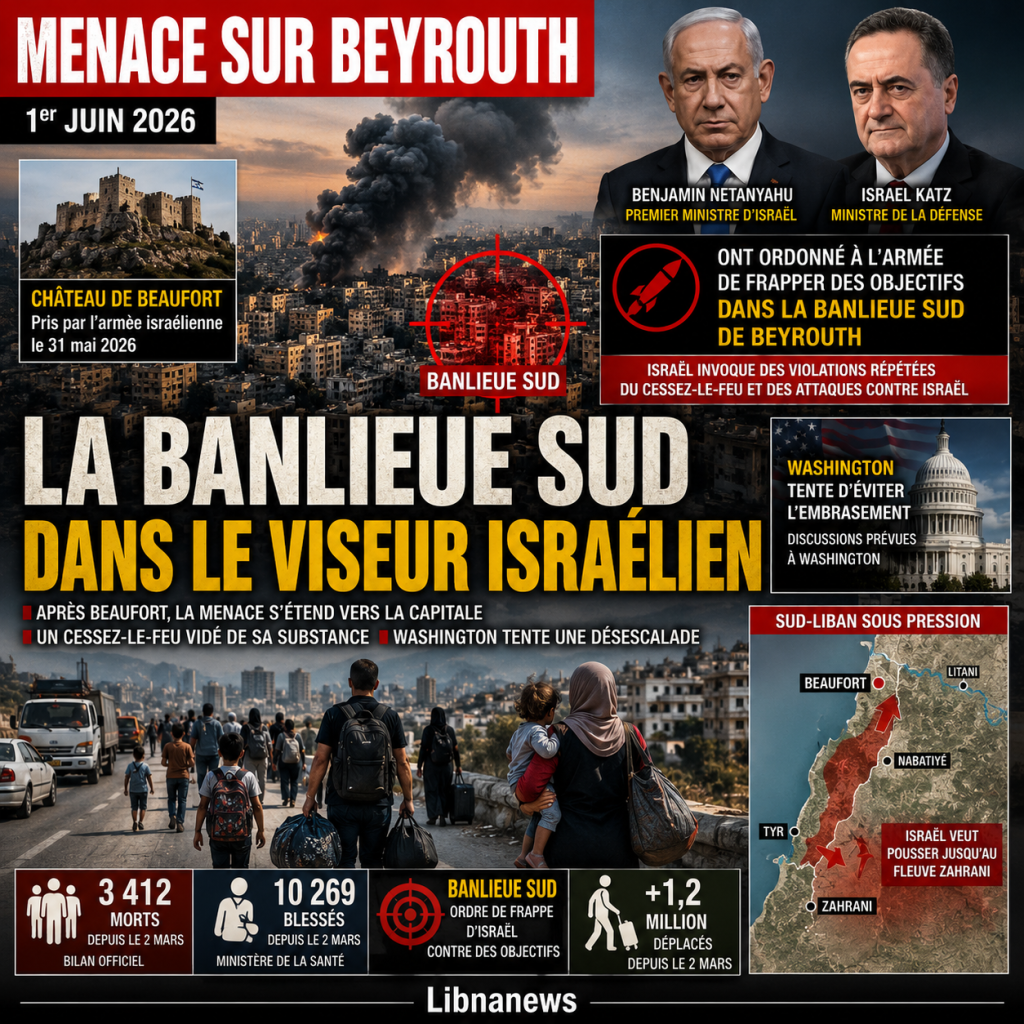
The order given by Benjamin Netanyahu and Israel Katz to strike targets in the southern suburbs of Beirut marks a new stage in the escalation between Israel and Hezbollah. The Israeli joint communiqué, relayed Monday morning in Beirut, invokes repeated violations of the ceasefire in Lebanon and attacks on Israeli cities. He intervened the day after the Israeli army took over Beaufort Castle and as the United States attempted to revive a gradual de-escalation. Lebanon thus entered an even more uncertain sequence, with an official record of over 3,400 deaths since 2 March and a capital once again placed at the centre of military threats.
A strike order targeting the southern suburbs
The statement issued by the Israeli Prime Minister’s Office and the Israeli Ministry of Defence is in a few lines. He claims that Benjamin Netanyahu and Israel Katz ordered the army to strike targets in the southern suburbs of Beirut, known in Israel as Dahiyeh and considered a Hezbollah stronghold. The text presents this decision as a response to repeated violations of the ceasefire by the Shiite movement and attacks on Israeli cities and civilians.
The wording remains important. She announces a strike order. It does not at this stage provide a human assessment or list of the sites concerned. Nor does it specify whether the objectives correspond to military infrastructure, Hezbollah cadres or command facilities. In the absence of independent confirmation of the exact nature of the targets, it is therefore necessary to distinguish the Israeli political and military announcement from an verified operational review. This is essential in a conflict where statements often precede strikes, evacuations or claims.
The southern suburbs of Beirut occupy a central place in the confrontation. It concentrates densely populated neighbourhoods, social institutions, shops, roads and Hezbollah-related structures. Any strike in this area therefore carries a high risk to civilians, even when Israel claims to be targeting specific targets. Previous attacks near the capital have already caused preventive displacement, school closures and high tension in neighbouring neighbourhoods.
Beirut returns to the centre of war
Since the ceasefire announced in mid-April, most of the fighting and bombardments were concentrated in southern Lebanon. Tyre, Nabatiyah, the southern coast, the villages near the Litani River and the Zahrani areas suffered most of the strikes and evacuation orders. Beirut and its periphery remained under constant surveillance, but direct strikes were rarer. The Israeli announcement of Monday changes this perception. It places the capital in the immediate circle of war.
The southern suburbs had already been hit on 28 May by an Israeli strike against a building. The international press then presented it as the first attack near Beirut in several weeks. Israeli sources had claimed to be targeting an official of a missile division linked to the pro-Iranian axis. Hezbollah and Iran had not immediately commented. This strike had already weakened the ceasefire. The order announced on Monday shows that the option of targeting the capital or its surroundings is no longer exceptional.
The psychological dimension is strong. A threat to the southern suburbs is not just about the inhabitants of these neighbourhoods. It affects all Beirut, as the capital operates through interdependence. Roads, hospitals, administrations, universities and emergency services can be disrupted by a single strike. Displaced families from the South who have found refuge in the urban area are also following these threats with concern. For many, the capital represented the last relative retreat space.
A ceasefire emptied of its substance
The Netanyahu-Katz order intervenes in a context where the Lebanese ceasefire exists more than formally. Since the truce announced in April, Israel and Hezbollah continue to exchange fire, drones and strikes. Israel accuses Hezbollah of using low-cost, hard-to-intercept explosive drones that killed several Israeli soldiers in southern Lebanon. Hezbollah, for its part, claims to respond to an occupation, continuous strikes and the expansion of the area controlled by the Israeli army.
On Sunday and Monday, the United States tried to restore a logic of de-escalation. The American plan proposed a simple sequence: stop Hezbollah attacks on Israel, and then Israeli commitment not to expand the strikes in Beirut. President Joseph Aoun supported this path. The Speaker of Parliament, Nabih Berri, a key interlocutor because of his ties with Hezbollah, replied that the movement could respect a halt if Israel stopped its attacks first. The difference therefore concerns the first gesture.
The Israeli announcement directly complicates this attempt. It comes at a time when Washington was precisely trying to prevent an escalation against Beirut. She said that the Israeli government wanted to maintain maximum military pressure on Hezbollah, including near the capital. It can also be read as a way of influencing the discussions planned in Washington between Israeli and Lebanese officials, without the direct involvement of Hezbollah.
Human death rate exceeds 3,400
The latest consolidated official assessment of the Lebanese Ministry of Health, published Sunday evening, 31 May, reported 3,412 deaths and 10,269 injuries since 2 March. This total replaces Saturday’s record of 3,371 deaths and 10,129 injuries. The increase was 41 deaths and 140 injuries in 24 hours. It reflects the intensity of weekend strikes in southern Lebanon and the difficulties of relief efforts in rapidly consolidating information in the targeted areas.
This national balance sheet should not be read as final for Monday. Further strikes were reported after its publication. An attack on Deir al-Zahrani in Nabatiyah governorate resulted in eight deaths and nineteen injuries according to the Lebanese Ministry of Health. Among the deaths are three women. Five children and six women were injured. These victims must be treated as a separate partial assessment until their integration into the national total has been confirmed.
Losses also extend to the health system. A strike near Hiram Hospital in Tyre injured 13 medical personnel and caused significant damage. Since the ceasefire, the World Health Organization has documented repeated attacks on health facilities, including deaths, injuries and damaged settlements. UNICEF also alerted children killed or injured in Lebanon in a week. These figures show that escalation is not limited to military positions.
South Lebanon under constant military pressure
The announcement aimed at the southern suburbs of Beirut cannot be separated from the evolution of the front to the south. On Sunday, the Israeli army announced that it had taken Beaufort Castle, also known as Qalaat al-Shaqif, as well as the nearby ridge. The site overlooks the Litani and occupies a strategic and symbolic place. Israel had occupied it from 1982 to 2000. Its recovery is the most significant advance of the Israeli army in Lebanon since the withdrawal of May 2000.
The Israeli army claims to want to push towards the Zahrani River, about ten kilometres north of the Litani River. It declared the area between the two rivers as a combat zone and asked the inhabitants to leave the localities concerned. The international press reports more than 1.2 million Lebanese displaced by strikes and evacuation orders since 2 March. This estimate gives the measure of a crisis that now affects regions far beyond border villages.
Recent bombings have affected Tyre, Nabatiyah, Deir al-Zahrani, Qlaylé, Majdel Zun, Al-Mansuri and several areas of the southern coast. Residential buildings were targeted or destroyed. Local roads have been made dangerous. Families who had left the border villages for the first time had to flee again to Saida, Beirut or mountain localities. The war thus settles in a logic of successive displacements, without a clear horizon of return.
Israeli arguments and Lebanese response
Israel justifies the extension of its operations by firing Hezbollah against the north of the country. The Israeli authorities claim that the movement’s rockets, missiles and drones targeted cities, infrastructure and civilians. They also report that 24 Israeli soldiers and 4 Israeli civilians have been killed since 2 March, according to a count reported by the international press. Other Israeli public records refer to at least 25 soldiers and a defence contractor killed in or near southern Lebanon, as well as two civilians killed in northern Israel.
The Lebanese Government rejects this reading. Beirut accused Israel of pursuing a policy of destruction in southern Lebanon and collective punishment. Prime Minister Nawaf Salam denounced the total destruction of cities and villages. The Lebanese authorities are calling for a halt to the strikes, Israeli withdrawal and respect for Lebanon’s sovereignty. However, they are in a delicate position. The Lebanese State must negotiate, rescue and receive the displaced while not directly controlling Hezbollah’s military decisions.
Hezbollah presents its attacks as a response to Israeli aggression and the presence of Israeli troops on Lebanese territory. He claims fire on soldiers, armoured personnel and assembly positions. It does not publish a comprehensive record of its losses. Israel, for its part, claims to have inflicted heavy losses on the movement. These figures are not independently verifiable and must remain attributed to those who advance them.
Washington is looking for a way out, Paris is raising its tone
Diplomacy is trying to catch up on fast-moving military ground. US Secretary of State Marco Rubio spoke with Joseph Aoun and Benjamin Netanyahu. Washington wants to stop Hezbollah attacks and avoid, in return, an extension of the Israeli strikes in Beirut. This approach is first of all aimed at preventing a burning of the capital. It does not address substantive issues such as the occupation of areas in the South, the disarmament of Hezbollah, the deployment of the Lebanese army, the return of internally displaced persons and security guarantees for northern Israel.
France adopts a more public line. Paris called for an urgent meeting of the UN Security Council after the Beaufort takeover. Emmanuel Macron called for a halt to the fighting and felt that there was no justification for the ongoing escalation in South Lebanon. The United Kingdom and Germany also called for respect for the ceasefire. These statements increase political pressure on Israel, but they have not yet changed the military reality.
The order to target the southern suburbs of Beirut creates an additional tension between the American line of restraint and the Israeli strategy of intensification. An American official quoted by the press also suggested that Washington did not expect Israel to absorb Hezbollah attacks on its civilians indefinitely. This nuance limits the scope of American calls for de-escalation. It gives Israel a margin of action, while seeking to avoid a massive strike in the Lebanese capital.
A major threat to the capital and internally displaced persons
For the people of Beirut, the immediate issue is not just military. It’s convenient. Where to go in case of evacuation order? What neighborhoods to avoid? Which hospitals will work if the roads block? Displaced families in the South have already filled many homes, schools and reception facilities. An extension of the strikes to the southern suburbs could cause new movements in a city that already absorbs part of the national humanitarian crisis.
The southern suburbs are home to a dense population. It has popular neighbourhoods, commercial areas, residential buildings and essential road infrastructure. A strike, even if targeted, can have significant indirect effects. The windows explode away from the impact point. The schools are closing. Ambulances must cross traffic jams. Families sometimes leave their homes without waiting for official instructions. This dynamic has already been observed after previous strikes near the capital.
The political risk is just as high. A major strike in Beirut could push Hezbollah to intensify its fire on Israel. It could also weaken the room for manoeuvre of President Aoun and the Salam government in the negotiations. Lebanon, already hit by economic collapse and saturation of public services, does not have unlimited absorption capacity. Every additional displacement increases tensions on rents, schools, hospitals and social assistance.
Next hours as a diplomatic test
The central question on Monday is whether the Netanyahu-Katz order will remain a framed threat or whether it will lead to a series of strikes in the capital. The Israeli authorities claim to want to target Hezbollah. The Lebanese authorities fear an extension of the war to densely populated urban areas. The US mediators are still trying to stop Hezbollah attacks and an Israeli commitment to curb escalation.
The diplomatic calendar is getting tight. Discussions must continue in Washington between Israeli and Lebanese officials. France urges the Security Council to seize the escalation. On the ground, Israel consolidates its positions in Beaufort and maintains pressure until the Zahrani. Hezbollah continues to claim attacks against Israeli troops. Human assessments, on the other hand, are likely to evolve with each update of the Lebanese Ministry of Health.
Lebanon therefore enters on 1 June with three open fronts. The first is military, from the Litani to the Zahrani and perhaps to the outskirts of Beirut. The second is humanitarian, with more than 3,400 dead, more than 10,000 injured and more than 1 million displaced. The third is diplomatic, between a fragile American initiative, growing European pressure and local actors who do not agree on the first step to be taken. In the southern suburbs, waiting for an Israeli strike or retreat now suspends the day to an operational decision.




