

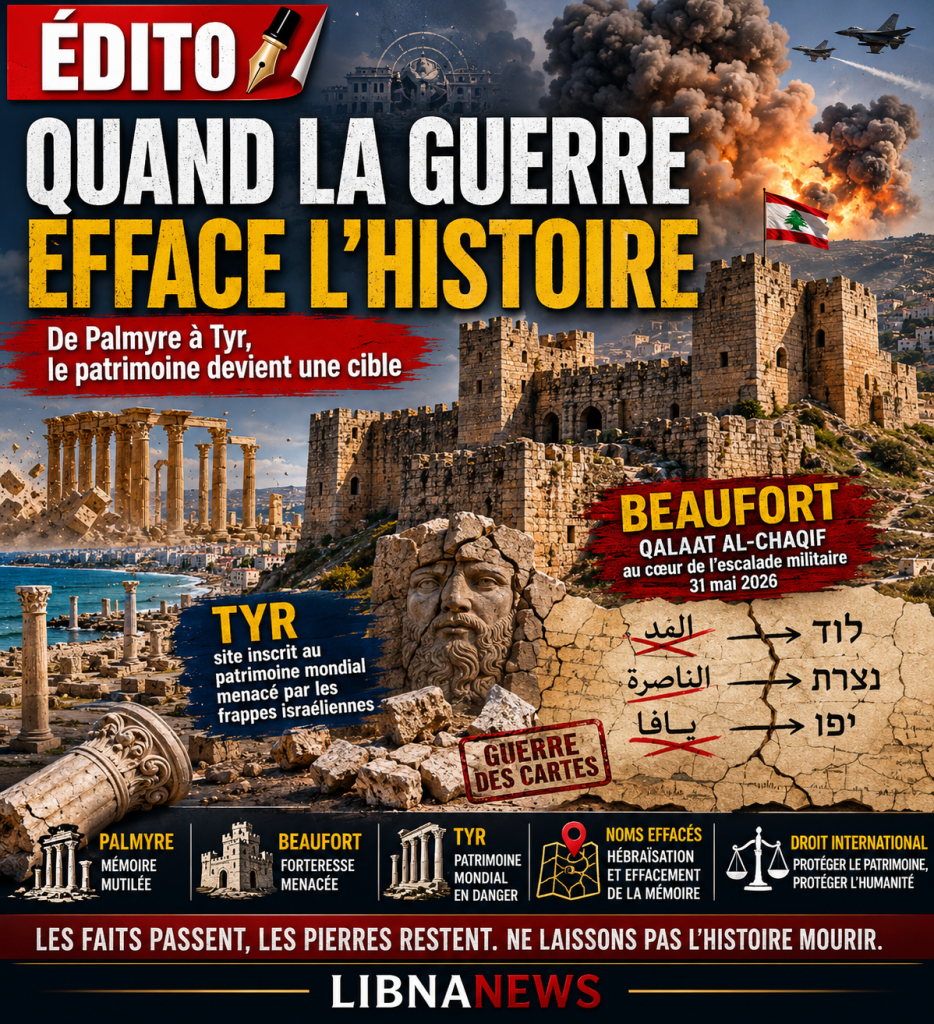
From Palmyra to Tyre, wealth becomes a victim of war
There are the dead, the wounded, the families being moved, the houses being shaved. And then there is another category of victims, quieter, slower to disappear, but whose loss sometimes involves centuries: ancient cities, stones, temples, citadels, names, traces of a people in its own geography.
Human history today pays a huge price in the face of modern conflicts. This prize is not just military. He’s not just human. It is also civilizational. It touches upon what societies transmit, to what they tell themselves, to what allows a people to say: we were there, we built, prayed, traded, resisted, spoken this language, called this hill, this city, this sea.
We saw him in Syria. Palmyre was mutilated by Daesh, not only because his columns disturbed a fanatical organization, but because they embodied a memory older than his ideology. The citadel of Aleppo was taken in the fighting as a strategic trophy as well as a symbol. The Knights’ Krak, a major fortress of the Levant, also bore the scars of a war that no longer always distinguished between a military bastion, a civilian population and a world heritage.
Every time, the same logic comes back: when one cannot only defeat an opponent, one tries to damage his story. When you can’t just occupy land, you want to control your past. When we can’t just destroy buildings, we attack what they mean.
Israel and the temptation to erase
It is in this context that we must look at what is happening today in Lebanon. The Israeli strikes on Tyre and around its archaeological sites are not a mere detail in the war. Tyre is not an ordinary city. It’s a city-memory. A Phoenician, Mediterranean, ancient, biblical, Roman, Arab, Lebanese city. A city built on layers of history. In Tyre, almost every stone refers to another era. The entire city rests on a soil saturated with memory.
Bombarder Tyre is therefore taking the risk of hitting more than a military target. It is reaching a living archive of the Mediterranean. It is to endanger a heritage that is not only Lebanon’s, but human history.
The same danger now weighs on Beaufort Castle, Qalaat al-Shaqif, a medieval fortress dominating the Litani. Here again, Israel presents its action under the usual military vocabulary: security, strategic depth, enemy positions, operational necessity. But this language is not enough to justify everything. A historic site is not just a tactical height. A fortress is not only a position on a staff map. It is also an architectural memory, a collective landmark, a part of the mental landscape of a country.
Modern war always has its apologies. Daesh was talking about religious cleansing. Regular armies speak of national security. Words change. Uniforms change. The methods are not always the same. But the result can become terribly close: destroyed sites, dispossessed peoples, erased names, rewritten maps.
It is not a question of saying that Israel and Daesh are identical in nature, structure or ideology. It would be easy. But we must dare say this: when a state bombards historical sites, treats a heritage city as a shooting zone, when it renames Arab places to incorporate them into an exclusive national narrative, it joins, on the ground of cultural erasure, a logic that has already been seen by fanatics.
The flag difference does not wash the consequence. The destruction of a memory remains a destruction. The deletion of a name remains an erasure. Symbolic dispossession remains a dispossession.
The War of Maps and Names
Clearing doesn’t just go through bombs. It also goes through names. In Israel, many Arab places have been renamed, hebraized, absorbed in an official mapping that seeks to impose a unique historical continuity, to the detriment of Arab and Palestinian memory. This process is not neutral. To name a place is to exercise power over it. To rename a place is often to say to those who lived in it: your memory no longer counts.
Geography then becomes a battlefield. Villages do not disappear only under bulldozers or military operations. They also disappear from signs, maps, manuals, administrative archives. The ancient Arabic appellation becomes a vestige, an embarrassment, sometimes a memory that is barely tolerated. The new name claims to erase the old use, as if the language could be expelled with the inhabitants.
This name policy complements the policy of force. It turns occupation into a narrative. It turns conquest into a historical return. It turns the disappearance of a people into a simple cartographic correction.
That is precisely what makes the Israeli attitude so disturbing. Because war is no longer just about fighters. It is part of a broader ambition: to redesign space, redefine belongings, weaken competing memories. In Lebanon, today, it goes through strikes that threaten Tyre, Beaufort and other sites in the South. In Palestine, this has been going through territorial dispossession, name change, fragmentation of space, marginalization of the Arab narrative for decades.
What Daesh was destroying by mass, states can destroy by bomb
When Daesh dynamited Palmyra, the world realized that it was not just vandalism. It was a war against history. A desire to remove everything that preceded the group’s ideology. Violence against stones because stones contradicted the story of the executioners.
But it would be hypocritical to reserve this outrage to non-State actors alone. A site destroyed by a terrorist organization immediately shocked. A site destroyed or threatened by a regular army is too often wrapped in military communiqués, strategic justifications, operational maps and press conferences. Yet, for heritage, the difference is secondary. An ancient column does not distinguish between the explosive of a fanatic and the bomb of a state. A citadel does not know whether it is hit by an armed group or by modern aviation. It simply falls.
The responsibility of a State should even be higher. Daech claimed his barbarity. A State claims to act in the name of law, security, civilization. It is precisely for this reason that his acts must be tried with more requirement. When Israel endangers Tyre or Beaufort, it cannot take refuge behind the only military argument. He has a historical responsibility. He knows what these places represent. He knows what it means to strike a territory where every village, every valley, every fortress bears a memory.
Lebanese heritage is not collateral damage
Lebanon does not only have to defend its borders. He has to defend his story. Tyre, Baalbeck, Byblos, Beaufort, Tripoli, Sidon, Anjar, old souks, monasteries, mosques, churches, Phoenician, Roman, medieval and Ottoman sites are not decorations for tourist brochures. They are the material proof of continuity. They say that this country, despite its political fragility, belongs to a long history, older than the wars that go through it.
Perhaps this is what bothers modern conflicts: heritage reminds us that people are not reducible to military news. Tyre is not just a city in southern Lebanon under bombs. It is an ancient capital of the Mediterranean. Beaufort is not just a strategic ridge. It is a fortress that has seen empires, crusades, occupations and resistance pass. To reduce them to military coordinates is already to impoverish them.
The international community cannot cry Palmyra and turn its eyes away from Tyre. It cannot condemn Daesh for the destruction of Syrian heritage and remain cautious, embarrassed or silent when the Israeli army endangers Lebanese and Palestinian heritage. Selective indignation is itself a form of complicity.
Heritage does not belong to the winners of the moment. He doesn’t belong to the armies. It does not belong to States that occupy, bomb or rename. It belongs to the peoples who carried it and to humanity who inherits it.
War kills the living. But when it destroys sites, names and memories, it also tries to kill the dead. That’s where the identity erasure begins. And that is where we must refuse to keep silent.




