

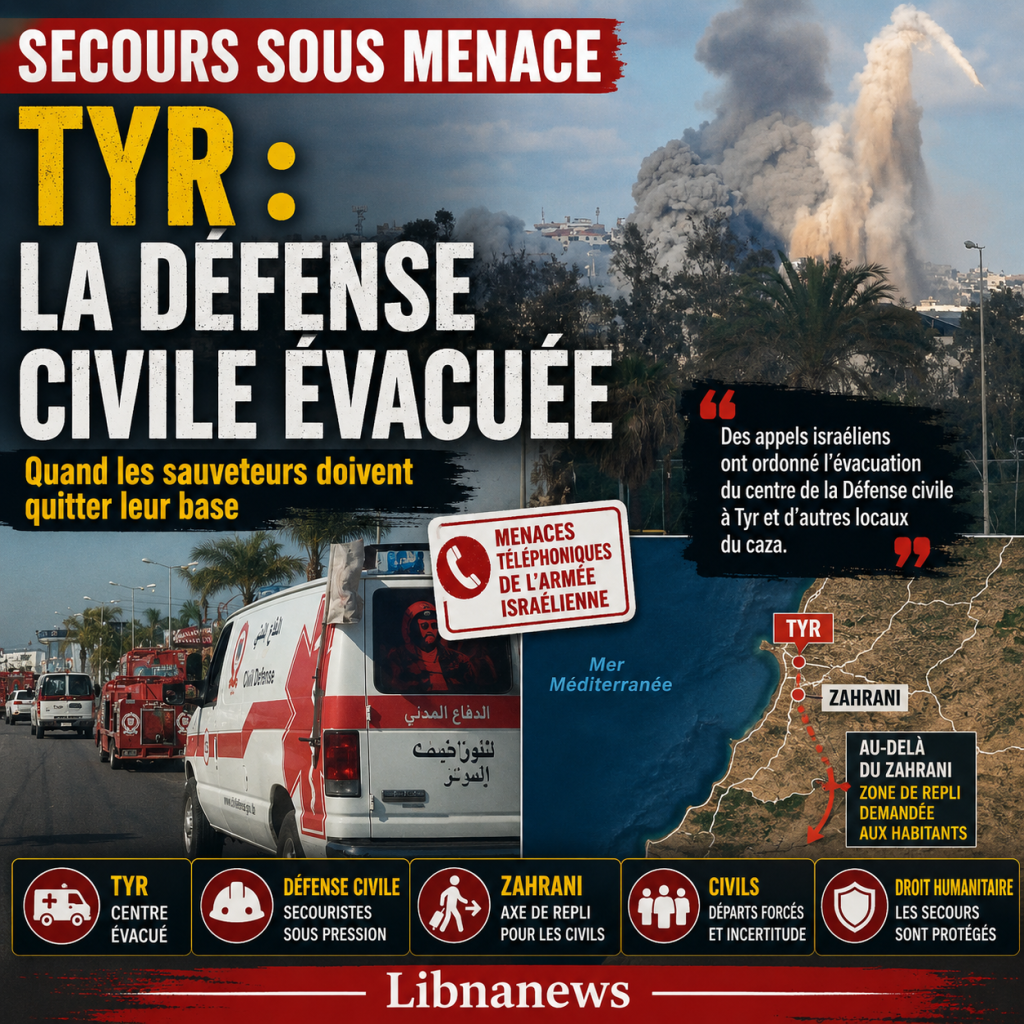
Civil Defence in Tyre evacuated its centre after Israeli threats, according to Lebanese media, in a sequence that summarizes the rapid deterioration of the humanitarian situation in southern Lebanon. The order was reportedly sent by telephone to the head of the centre in Tyre on Sunday 31 May, with an immediate evacuation request. Other appeals reportedly targeted civilian defence centres or relays in localities in the Caza, including Bourghliyé, Kharayeb and Ansariyé, in order to pass departure instructions to the inhabitants to areas beyond the Zahrani. For the Lebanese authorities and relief workers, this represents a worrying threshold: the teams responsible for evacuating civilians are themselves forced to leave their bases.
The episode comes as the Israeli army extended its evacuation orders and intensified its strikes in the area of Tyre, Nabatiyah and several southern localities. Israel claims to be targeting Hezbollah positions and seeking to remove the threat from its northern localities. Lebanon denounces a policy of forced displacement and pressure on civilian infrastructure. The Civil Defence in Tyre is thus caught up in a brutal paradox: it must ask the inhabitants to leave, while losing part of its own ability to intervene from the city.
Tyre under pressure of evacuation orders
Tyre has lived for several days at the pace of warnings, strikes and rushed departures. The city, which still served as a refuge for families from border villages, in turn became an area of uncertainty. The inhabitants follow the messages on telephones, social networks, speakers and the media. Shops are closing. Families gather a few bags. The roads to the north are loading. Palestinian camps and outlying neighbourhoods are experiencing the same tension.
The appeal to Civil Defence strengthens this climate. In practice, Lebanese relief workers do not simply extinguish fires or clear the wounded. They also become relays of evacuation instructions, sometimes under direct pressure. According to reports from Lebanese media, the Israeli army has reportedly asked the centre of Tyre to inform the inhabitants of Bourj al-Shemali that they were to leave the area immediately and move to safer places beyond the southern Zahrani.
This procedure places relief in an untenable position. Civil Defence is not a political force. It does not decide Israeli military orders. It does not validate evacuation cards. It does not control strikes or road corridors. However, it is responsible for warning already tried populations, while assuming the risk that these warnings are not enough to protect the inhabitants. In the event of a strike, the same teams must then intervene on the scene.
In Tyre, this confusion between alert, evacuation and rescue creates additional tension. A city does not empty itself on simple injunction. Older people cannot always leave. Families don’t have cars. Sick people can’t leave their bed. Palestinian refugees do not have the same reception opportunities as Lebanese citizens. Rescue workers must cope with this reality, far from military language, which often reduces evacuation to an abstract population movement.
When first aid workers have to leave their base
The evacuation of a civilian defence centre is not a logistical detail. An emergency centre represents an anchor point. There are ambulances, emergency vehicles, equipment, duty crews, communications and fine field knowledge. When emptied or moved, the response time increases. Teams need to reorganize. Victims sometimes have to wait longer. Fires and collapses can worsen.
This situation takes on a particular dimension in Tyre. The city is dense, old, extensive, mixed with popular neighbourhoods, Palestinian camps, roads, port areas and heritage sites. Intervening after a strike requires immediate proximity. The affected area must be identified, electricity cut, streets secured, the injured evacuated, bodies cleared, fires prevented and secondary explosions avoided. A Civil Defense forced to retreat does not disappear, but it loses part of its effectiveness.
From the Lebanese point of view, the threat to a rescue centre reflects a qualitative deterioration of the war. Bombardments no longer disturb only places of life. They also affect the mechanisms that save lives after the bombing. The local humanitarian system is already running under tension. Hospitals are being asked. Paramedics lack security. The roads are exposed. Municipalities do not have the means to accommodate thousands of displaced persons. Removing or moving a Civil Defence Centre exacerbates this vulnerability chain.
Lebanese relief workers have already paid a heavy price since the beginning of the climb. Paramedics, medical staff and emergency personnel were killed or injured in several strikes. Lebanese health authorities and international organizations documented attacks on health facilities, relief teams and ambulances. In this context, the evacuation order of a centre in Tyre cannot be read as an isolated incident. It is part of a series of pressures that affect those who remain with civilians when many others leave.
Protection under international law
International humanitarian law provides special protection to relief personnel, medical units and civil protection agencies. Civil Defence, when it intervenes to evacuate civilians, fight fires, rescue wounded or protect the population, belongs to this protected category. It cannot be targeted as such. Its facilities cannot be attacked unless they are used outside their humanitarian functions to contribute effectively to military action.
The rule is simple in principle. The parties to a conflict must distinguish between combatants and civilians, between military objectives and civilian property. They must also take all possible precautions to avoid or reduce damage to civilians. Emergency services, ambulances, hospitals and intervention centres must be respected and protected. An intentional attack on humanitarian or medical personnel, when clearly identifiable and not involved in hostilities, may constitute a war crime.
The legal qualification of a specific event always requires an investigation. The nature of the threat, the actual target, the use of the building, the available information, the warnings given and the consequences for civilians must be established. But the repetition of pressure against emergency or health structures is already a serious problem. A threat that forces a civilian defence centre to empty itself can weaken the protection of an entire city. It can also produce an effect of terror and cause the inhabitants to flee without guarantee of safe route.
Israel can claim that its warnings are aimed at reducing civilian casualties. This argument is not enough to resolve the legal issue. An evacuation order does not automatically legalize a subsequent strike. It doesn’t turn a city into a bomb zone. It does not remove the protection of civilians who cannot leave. Nor does it withdraw the protection of civilian property, hospitals, schools or relief centres. The law of war continues to apply after the warning.
A city of refuge now under threat
To date, Tyre has occupied an ambiguous place in the southern crisis. For families from border villages, it was already a welcoming city, a safer space than the directly exposed localities. But recent strikes and evacuation orders have reduced this function. Residents who had fled to Tyre must now consider a new start. Palestinian refugees from the camps of Rachidiyah, Bourj al-Shemali and al-Buss are again confronted with the exodus.
This repetition of displacement weighs heavily on local society. Leaving for the first time means losing your home, routines, work and children’s school. Leaving for a second time also means losing the shelter found in emergency. Many families no longer have a clear solution. Available accommodation is scarce. Costs are rising. Schools and collective centres are saturated. Family networks, already in demand, reach their limits.
Civil Defence is in direct contact with this fatigue. His teams see the same families returning with less business, less money and less certainty. They participate in evacuations, respond to fires, recover injured people and sometimes accompany bodies. Their role goes beyond technical urgency. They become witnesses to the transformation of the South into a space of successive departures.
This is why the evacuation of a centre in Tyre is national in scope. It means that even the structures that kept local are displaced. When relief falls, the population understands that the risk has come close to a new threshold. This perception can speed up departures even before strikes. It can also leave behind the most vulnerable, those who cannot follow the movement.
The Lebanese government facing the humanitarian test
For the Lebanese state, the episode requires a double response. The first is immediate. A response capacity must be maintained around Tyre despite the evacuation of some points. This involves redeploying teams, preserving communications, protecting vehicles, coordinating with hospitals and identifying places of withdrawal. The second is diplomatic. Beirut must address the issue of threats to relief to mediators and international forums.
Prime Minister Nawaf Salam has already denounced Israeli policy in the South and the massive displacement caused by military operations. France called for an urgent meeting of the Security Council following the expansion of the Israeli offensive and the taking of deeper positions in South Lebanon. These approaches must now integrate the protection of relief services as a central point, not as a secondary subject.
The Ministry of the Interior, on which the Civil Defence depends, will also have to assess the needs. First-aid workers need fuel, communications, protective equipment, spare parts, vehicles and places of withdrawal. They also need psychological support. The teams work under drones, under threat of strikes, in empty cities and sometimes in the face of scenes of great violence.
The Lebanese army, municipalities and hospitals will need to coordinate their actions more closely. Mass evacuation cannot be based on telephone calls and speakers. It requires defined roads, reception points, care for the elderly, the sick and children, and reliable communication. Otherwise, the evacuation order creates chaos more than it protects.
The risk of normalising the threat
The greatest danger would be the trivialization of these evacuations. For several weeks, Israeli orders have multiplied. Cards are circulating. Villages are designated. Neighborhoods are empty. Roads change status. As these practices repeat themselves, they can be seen as a routine of war. For the people of the South, however, they correspond to life breaks, material losses and lasting fear.
Civil defence cannot become the mechanical instrument of this standardization. Its role is to save, not to administer permanent displacement. If the relief centres themselves have to evacuate, the civil protection function is weakened. People can lose confidence in the possibility of being rescued. Rescue workers may be forced to choose between their own safety and mission.
The situation in Tyre also shows the limits of the concept of warning. A warning may allow some people to leave. It can also cause dangerous movements, burden roads, separate families and abandon vulnerable people. It cannot become a substitute for respect for humanitarian law. The first obligation remains to avoid hitting civilians and civilian property.
In the Lebanese case, this issue is all the more acute as the South has already experienced waves of occupation, exodus and reconstruction. Every new reactive evacuation of old memories. People don’t see only a security measure. Many see it as an attempt to empty the territory permanently, make the villages uninhabitable and create a de facto zone under military pressure.
Tyre, test of the credibility of the ceasefire
The evacuation of the Civil Defence Centre in Tyre is taking place while diplomatic discussions are still seeking to preserve a ceasefire framework. The United States is pushing for security arrangements. Israel says it wants to remove the threat from Hezbollah. Lebanon calls for a halt to the strikes, Israeli withdrawal and the return of the displaced. But the events in Tyre show the gap between diplomatic vocabulary and the field.
A credible ceasefire must be measured by simple facts. Can the inhabitants stay at home? Can first aid workers work from their centres? Can hospitals operate without a threat? Can schools reopen? Can roads be taken without permanent warning? In Tyre, the answer remains negative. The city lives waiting for the next call, next order and next strike.
This fact weakens the proponents of unconditional negotiations. Several Lebanese officials have already expressed the view that the country may suspend its participation in certain discussions as long as Israel does not respect a serious cessation of hostilities. The Civil Defence case adds a concrete argument. It is no longer just about strikes against disputed positions. This is a direct pressure on a city’s emergency infrastructure.
The rest will depend on the hours to come. If the relief centres can resume their operations, the Lebanese State will preserve part of its response capacity. If threats spread, Tyre may become an additional example of a city made difficult to live by the accumulation of warnings, strikes and departures. Civil Defence, for its part, will continue to embody a fragile line: that of men and women in charge of saving lives in a war where even their centres no longer appear to be sheltered, proof once again that Israel wishes to erase any Lebanese administration, including those of the emergency services to the population.




