A regional agreement, an immediate Lebanese test
Al Sharq Al Awsat of 16 June 2026 places Lebanon in a cautious expectation after the announcement of the preliminary agreement between the United States and Iran. The newspaper states that several capitals are following the preparation of the official signature, planned in Switzerland, while the implementation mechanisms remain unclear. The agreement is presented as a solution to the regional war, but it is not yet a final settlement. For Beirut, the issue is not only diplomatic. It affects the security of the South, the Israeli withdrawal, the return of the displaced, the reconstruction and the ability of the State to take over a sequence that has been played largely outside its borders.
Al Liwa of 16 June 2026 summarizes the general framework of the agreement around three axes: the issue of Iranian nuclear power, the lifting of the blockade around the Strait of Ormuz and the release of some of Iran’s frozen assets. The daily reports that these assets are valued between $100 billion and $120 billion. This reading shows that the agreement primarily addresses major strategic and economic interests. However, Lebanon immediately appears as the ground where the credibility of the agreement will be tested. A truce announced in Geneva will have political value for the Lebanese only if it stops the strikes, protects the villages and paves the way for an effective Israeli withdrawal.
Al 3arabi Al Jadid of 16 June 2026 insists on the grey areas of the agreement. The newspaper notes that not all files in Lebanon, the nuclear programme, Iranian missiles, Tehran’s support for its allies and the Strait of Ormuz are settled. He also stressed that negotiations should continue for sixty days. This deadline sets Lebanon in a difficult period. War can go down in intensity, but the risks do not disappear. Every violation, every delay in withdrawal and every ambiguity about guarantees can revive tension.
The South between return, fear and destruction
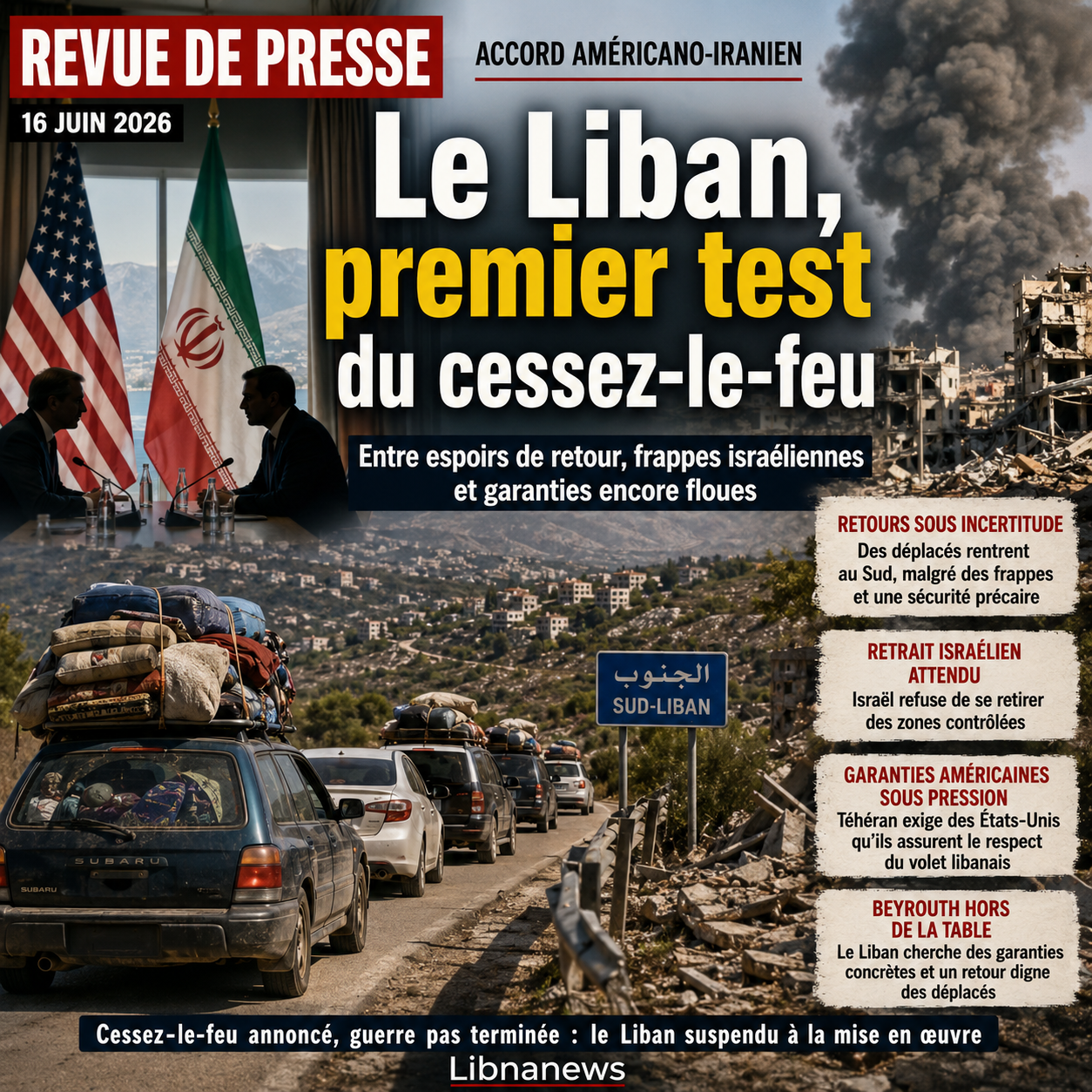
Ad Diyar of 16 June 2026 describes the South as the first concrete scene of the new agreement. The newspaper reports that the inhabitants of the South have again occupied the front of the stage, with roads filled with cars towards cities and villages. This return occurred despite the vagueness surrounding the ceasefire. The daily presents it as the most sensitive field test of the American-Iranian agreement. This image gives a human dimension to a sequence dominated by the great powers. The inhabitants do not reason in diplomatic terms. They look for their homes, lands, neighbourhoods, schools and shops.
Al Bina of 16 June 2026 also evokes a cautious calm in the South, with a visible decrease in military operations compared to previous weeks. The newspaper reports a gradual resumption of returns to certain villages and localities. However, this description remains measured. Return does not mean normalization. It intervenes in a still fragile area, marked by destruction, road closures, military presence and fears of a resumption of fire. The day of 16 June is therefore not that of a clear postwar. Rather, it corresponds to a phase of suspension, where the hope of the inhabitants advances faster than security guarantees.
Al Akhbar of 16 June 2026 adopts a more offensive reading. The newspaper talks about an initial return where the desire to return outweighs fear. He insists that the war is not over and that the agreement note is not enough to erase the objectives, causes and effects of the confrontation. This approach highlights the weight of the terrain. She recalled that civilians could return to the road, but that the balance of military force continued to affect their choices. Return becomes a social and political act. It expresses attachment to the territory, but it also reveals the fragility of a population that returns even before guarantees are fully established.
Israel, central factor of uncertainty
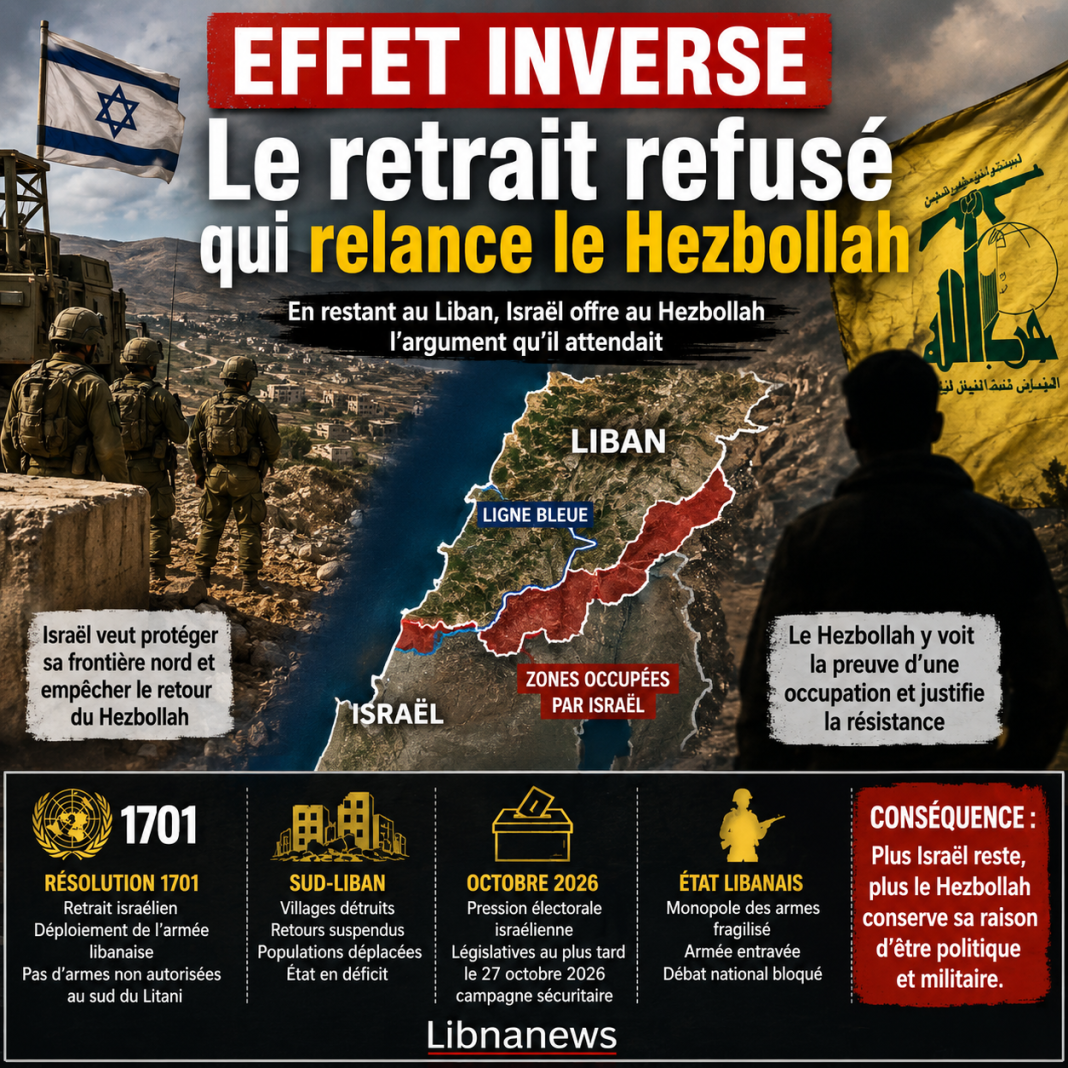
Al 3arabi Al Jadid of 16 June 2026 reports that the Lebanese part of the agreement remains one of the main possible flaws. The newspaper states that Israel does not consider itself bound by this aspect. This position weakens the entire device. It transforms Lebanon into an immediate verification space. If the strikes continue or the withdrawal fails, the agreement appears incomplete. If, on the contrary, calm is confirmed and withdrawal mechanisms are clarified, Lebanon can become proof that the agreement produces results beyond the Strait of Ormuz.
Al Joumhouriyat of 16 June 2026 presents a close but more institutional analysis. The newspaper reports that political circles consider that the first phase of the agreement focuses on two objectives: to ensure the opening of the Ormuz Strait and to provide Iran with a limited economic breath. More complex issues, including Iran’s nuclear programme and Tehran’s regional role, are being referred to a later phase. Lebanon therefore remains in a particular position. Its fate depends on Israeli behaviour, American pressure, the Iranian role and the direct negotiations that the Lebanese State seeks to conduct under American sponsorship.
Al Bina of 16 June 2026 estimates that the next sixty days will be decisive. The newspaper points out that the details of the agreement can become a source of tension, particularly in Lebanon and the Palestinian territories. This reading insists on the continuity of the conflict. It refuses the idea of a clear break between war and peace. The memorandum of understanding may end a military phase, but it opens another battle, with guarantees, deadlines, pressures and competing narratives.
Lebanese State facing a narrow diplomatic window
Al Sharq Al Awsat of 16 June 2026 states that Lebanon is awaiting the practical translation of the agreement. President Joseph Aoun welcomed the mention of Lebanese specificity, while placing sovereignty, security and stability at the heart of the official position. Prime Minister Nawaf Salam, for his part, expressed hope that the announcement of the ceasefire would put an end to the deaths, destruction and displacement. It also linked the new phase to the ongoing negotiations in Washington to secure full Israeli withdrawal, the release of prisoners, the dignified return of the people and reconstruction.
This official line remains cautious. It avoids presenting the agreement as a definitive victory. Rather, it seeks to transform a regional agreement into concrete benefits for the Lebanese. The Presidency insists on sovereignty. The government insists on withdrawal, prisoners and reconstruction. The two branches of the executive thus try to avoid the country being reduced to a simple clause in an agreement negotiated by others. The difficulty is clear: Beirut must obtain guarantees from actors who do not obey it directly. Washington, Tehran and Tel Aviv control much of the calendar. Lebanon, on the other hand, tries to preserve its capacity for initiative.
Al Liwa of 16 June 2026 presents this period as an opportunity to strengthen solidarity among Lebanese leaders. The newspaper refers to a cautious Lebanese welcome and stresses that the situation in Lebanon must find a close solution. This idea of political solidarity is important. If the state speaks with one voice, it can turn the ceasefire into a structured demand: stop attacks, Israeli withdrawal, army deployment, return of displaced persons and reconstruction plan. If internal divisions dominate, Lebanon will remain exposed to competing readings from other powers.
The Strait of Ormuz and southern Lebanon in the same calculation
Al Quds of 16 June 2026 reports that Tehran claims to have obtained commitments on its frozen assets and on the management of the Strait of Ormuz, while Washington insists on freedom of navigation and the absence of long-term costs. This divergence shows that the agreement is not yet stabilized. Both sides seek to present the compromise as a gain. Iran speaks of rights and sovereignty. The United States is talking about verification, navigation and energy security. This presentation battle can have a direct impact on Lebanon, as each bloc will seek to preserve its levers during the 60 days of negotiations.
Al Bina of 16 June 2026 also reports that France and Great Britain are planning a naval mission to the Strait of Ormuz, while Iran rejects any foreign military presence near its waters. This maritime debate may seem far from Lebanon. He’s not totally there. The more international safeguards focus on Ormuz, the more Beirut must avoid the Lebanese side being relegated to the background. Conversely, if violations in the South threaten the whole agreement, the major powers will have to treat the Lebanese front as an essential part of regional stability.
The one of the day is therefore built around a double axis. On the one hand, the American-Iranian agreement promises a reduction in regional tensions and a reopening of economic channels. On the other hand, Lebanon must check whether this promise really protects its villages, its inhabitants and its sovereignty. The newspapers of 16 June 2026 converge on this point: the announced signature is not enough. The truth of the agreement will be played in its application, especially in the South.
Local politics: the Lebanese state between official prudence, Southern pressure and narrative battle
Joseph Aoun sets a line of sovereignty
Al Sharq Al Awsat of 16 June 2026 presents Joseph Aoun’s reaction as a cautious welcome position. The President of the Republic welcomes the mention of Lebanese specificity in the memorandum of understanding between the United States and Iran. It recognizes that the security of Lebanon cannot be separated from regional stability. This formula gives the Presidency a clear line. Lebanon should not be treated as merely an annex front, nor as a clause added to an agreement designed by other Powers. It must obtain concrete guarantees on its territory, including the cessation of strikes, Israeli withdrawal, the return of displaced persons and the launching of reconstruction.
Al Jumhouriyat of 16 June 2026 reports that Joseph Aoun received a call from the Iranian Foreign Minister, Abbas Araghchi. The Head of State welcomed the American-Iranian understanding as a positive step towards reducing tensions. But he also stressed Lebanon’s sovereignty, security, stability and protection of its national interests. This shade is important. Aoun does not turn the agreement into a victory of one axis against another. Instead, he tries to put the Lebanese state back at the centre of the game. His position is that any regional détente must first be measured to its effect on the Lebanese population and the authority of the institutions.
This presidential line also responds to internal concern. Part of the political scene fears that Lebanon will remain a negotiating ground between Washington, Tehran and Tel Aviv. Joseph Aoun therefore seeks to maintain a State word. He speaks of sovereignty, stability and security, not revenge or victory. This vocabulary aims to avoid a new internal fracture. It also reminds us that the return to normality does not depend solely on a ceasefire. It involves withdrawal, deployment of the army, repair of damage and a better protected national decision.
Nawaf Salam gives priority to withdrawal and reconstruction
Al Quds of 16 June 2026 reports that Prime Minister Nawaf Salam opened the meeting of the Council of Ministers with a message focusing on civilians. He expressed hope that the announcement of the ceasefire would end the war, the deaths, the destruction, the displacement and the suffering of the Lebanese. This choice of words gives his intervention a human and institutional tone. It does not present the agreement as an abstract event. It links it to displaced families, destroyed villages, prisoners and residents waiting to return home.
Nawaf Salam also included government action within a specific diplomatic framework. According to Al Quds of 16 June 2026, he claims that the executive will double his efforts in the ongoing negotiations in Washington in order to secure the complete Israeli withdrawal from Lebanese territories and the release of the prisoners. He then linked this phase to the safe and dignified return of the inhabitants, and then to the mobilization of friendly countries for reconstruction. The sequence he proposes is therefore clear. It starts with the stop of fire. It continues with withdrawal. It then expands upon the return of civilians. It finally leads to reconstruction.
Nahar of 16 June 2026 points out that Nawaf Salam does not treat the Washington-Theran deal as a complete settlement. The Prime Minister sees this as an opening that must be converted into guarantees. This position reinforces the role of the US channel in the government’s strategy. It also shows a difference of tone with the forces that attribute Lebanon’s presence in the agreement to the Iranian weight alone. For Salam, the priority remains the official action of the Lebanese State. However, the political risk is real. If Washington fails to impose a rapid Israeli withdrawal, the government will be exposed to criticism from those who consider its diplomatic bet too slow or too dependent on the United States.
The Council of Ministers between social emergency and security expectations
Al Liwa of 16 June 2026 shows that several ministers directly link the agreement with the situation in the South. Minister Kamal Shehade hopes that the American-Iranian agreement will pave the way for a Lebanese-Israeli agreement allowing Israel’s withdrawal and the return of the displaced. Minister Mohammad Haidar says the agreement is not only about the ceasefire but also about withdrawal. Minister Ahmad Hajjar talks about a global ceasefire, the withdrawal of the Israeli army and the deployment of the Lebanese army. Finance Minister Yassine Jaber insists on the scale of the disaster in the South and on the need for international assistance.
These statements show a multi-level emergency government. The first is safe, as residents cannot return permanently if strikes continue. The second is humanitarian, as displaced persons need services, roads, schools, care and housing. The third is financial, because reconstruction requires resources that the state does not have alone. The fourth is political, because the government must prove that it can achieve concrete results. The regional agreement creates a window, but it does not replace state action.
This expectation also weighs on administrative decisions. Al Joumhouriyat of 16 June 2026 discusses, in the context of the government meeting, the effects of security uncertainty on official reviews. The educational record thus becomes an indicator of the general political situation. When security remains unstable, schools, transportation, families and administrations remain suspended. Local politics, therefore, is not limited to statements by those responsible. It directly affects the organisation of daily life.
Nabih Berri claims Lebanon’s inclusion in the cartel
Al Quds of 16 June 2026 reports that Nabih Berri thanked the United States and Iran for having included in the memorandum of understanding an article which he considers essential and mandatory. According to him, this article aims to put an end to the Israeli aggression against all Lebanon. The President of Parliament sees this as a way of preserving Lebanese sovereignty over the whole territory. His speech was more assertive than that of the Presidency. Where Joseph Aoun insists on prudence and expectation of guarantees, Berri emphasizes the existence of a commitment.
Nahar of 16 June 2026 also reports a more offensive formula of Nabih Berri. He believes that anyone in Lebanon who is saddened by the American-Iranian agreement cannot really be proud of his libanity. This sentence refers to those forces who fear that the agreement will strengthen Iran’s and Hezbollah’s position. Berri moves the debate. He claims that the main criterion must be Lebanese interest, not the embarrassment experienced by a camp in front of an agreement between Washington and Tehran.
Ad Diyar of 16 June 2026 adds that Nabih Berri remained in contact with Iranian officials in the hours before the announcement. The newspaper states that the Israeli withdrawal is included in the information transmitted to the President of Parliament and that its details must be discussed. This precision nourishes the role Berri seeks to play. He doesn’t want to be just a commentator of the deal. He wants to appear as a follow-up actor, able to verify that the Lebanese clause will not be reduced to a vague formula.
Refusal of experimental areas reveals fear of fragmentation
Nahar of 16 June 2026 reports that Nabih Berri rejects the idea of experimental zones. He states that he conveyed this position to several interlocutors, including Saudi prince Yazid bin Farhan. This question may seem technical, but it touches the heart of sovereignty. Test areas could create different levels of authority and security in the territory. They could also set up a logic of partial treatment, where some regions would be subject to specific mechanisms before others.
Berri’s position therefore amounts to defending a comprehensive approach. Lebanon should not be divided into test areas. It must be treated as a political and territorial unit. This concern joins Joseph Aoun’s concerns about sovereignty with another path. It also reflects the fear that international post-war management might produce temporary arrangements that would last. In a country already weakened by divisions, the question of territory remains highly sensitive.
Hezbollah and its allies set up the story of victory
Al Quds of 16 June 2026 reports that Hezbollah congratulated Iran after the announcement of the agreement and presented the agreement as an achievement that allowed Lebanon to be included in the global ceasefire. The party stresses that Tehran has insisted that the Lebanese file be present in any outcome of the war. This reading gives Hezbollah a political basis for defending the Iranian role. It also allows him to say that regional pressure has served Lebanon, while his opponents consider this dependence dangerous.
Al Quds of 16 June 2026 also reports the words of Sheikh Ali Khatib, Vice-President of the Shiite Higher Islamic Council. He thanked Iran for linking its agreement with the United States to the ceasefire in Lebanon. He also called on Washington to compel Israel to honour its commitments. This position gives the narrative close to Hezbollah an institutional tone. It is not limited to celebrating Iran. It also calls for an internal dialogue on a national defence strategy.
The same newspaper reports a tougher stance of the jaafarite mufti Ahmad Qabalan. He talks about a moment of national victory and asks Joseph Aoun to change the government. He criticizes the executive and Lebanese diplomacy. This intervention turns the agreement into an issue of internal confrontation. The ceasefire became an argument to attack the government of Nawaf Salam. Local politics thus moves from a diplomatic expectation to an open battle over the legitimacy of the executive.
Opposition fears new regional dependence
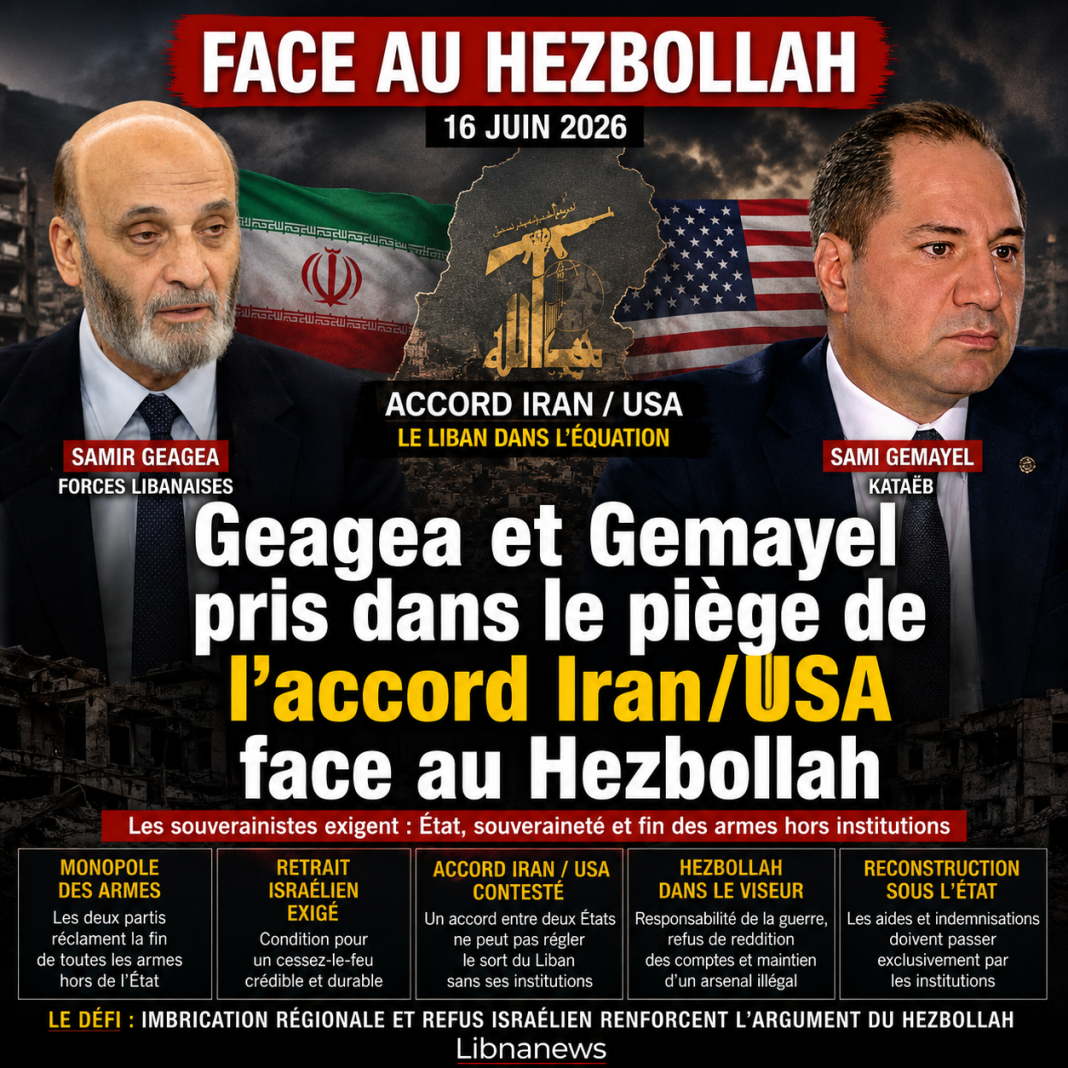
Al Quds of 16 June 2026 reports the reaction of MP Mark Daou. He believes that Lebanon is at the heart of the storm after the conclusion of the agreement in the Gulf. According to him, Benjamin Netanyahu will not easily step back, because a step back from Donald Trump could cost him politically. Mark Daou therefore calls for an accelerated agreement in Washington with strong American guarantees. But he also accuses Iran of using Lebanon for years in its negotiations, before leaving the country under occupation and destruction.
This position forms the most clear counter-recital against the discourse of Hezbollah and its allies. Where they thank Iran, Mark Daou calls on Lebanon to protect itself from Israel and Iran at the same time. Nahar of 16 June 2026 joins this concern by focusing on the issue of Hezbollah’s weapons and the future of military decision-making. The newspaper believes that the next steps in the negotiations should clarify the real effect of the agreement on Lebanese stability. The political divide therefore remains complete. The agreement can reduce violence in the South, but it does not resolve the issue of state authority over war, peace and weapons.
Quote and speech by political figures: Israeli sovereignty, withdrawal and the battle for guarantees
Joseph Aoun prefers state language
Al Sharq Al Awsat of 16 June 2026 reports that Joseph Aoun welcomed the mention of Lebanese specificity in the memorandum of understanding between the United States and Iran. The President of the Republic stressed that Lebanon’s security and stability are part of any serious effort to stabilize the region. This declaration establishes the presidential register. Aoun isn’t talking about winning one side against another. It speaks of sovereignty, territorial protection and the need to translate the agreement into concrete measures. His speech sought to prevent Lebanon from being reduced to a mere clause in a regional compromise. He wanted to place Lebanese institutions at the centre of the sequence, especially when the South was waiting for security assurances and when the displaced sought to return.
Al Jumhouriyat of 16 June 2026 states that Joseph Aoun received a call from the Iranian Foreign Minister, Abbas Araghchi. The Head of State welcomed the American-Iranian understanding as a positive step towards reducing tensions and achieving diplomatic solutions. But he also insisted on Lebanese sovereignty, the security of the country, its stability and the protection of its national interests. This wording gives the Presidency a margin of balance. It allows us to accept relaxation without entering into the narrative of regional guardianship. It also makes it clear that Lebanon is concerned by the agreement, but that it must remain in control of its demands: cessation of strikes, Israeli withdrawal, return of displaced persons, deployment of the army and reconstruction.
This presidential speech remains deliberately sober. It stands out from speeches that celebrate the agreement as a strategic victory. It is also distinguished from reactions that see it as only a risk of instrumentalization of Lebanon. Joseph Aoun tried to build a common vocabulary around the state. The words chosen are simple, but politically charged: sovereignty, stability, security, national interest. They aim to keep an institutional position above partisan confrontations. In a period when the internal forces each seek to assign the agreement to their own camp, this restraint becomes a form of political line.
Nawaf Salam links the ceasefire to civilian suffering
Al Quds of 16 June 2026 reports that Nawaf Salam opened the meeting of the Council of Ministers, recalling the suffering of the Lebanese. The Prime Minister expressed hope that the announcement of the cease-fire would put an end to war, death, destruction, displacement and pain. This entry in the field gives his speech a humanitarian basis. Salam does not start with regional balances. It starts with civilians, houses destroyed, displaced families and the daily effects of war.
The same Al Quds of 16 June 2026 reports that Nawaf Salam promised to double the efforts of the government in the ongoing negotiations in Washington. The announced objective is the complete Israeli withdrawal from Lebanese territories, the release of prisoners, the safe and dignified return of the inhabitants to their towns and villages, and the mobilization of friendly countries to finance reconstruction. This sequence is very structured. It starts from the end of the fire, passes through the withdrawal and release of the prisoners, then arrives at the return and reconstruction. The Prime Minister thus gives the government a roadmap that does not depend solely on the memorandum of understanding. It also depends on continued diplomatic work with Washington.
Nahar of 16 June 2026 stresses that Nawaf Salam does not present the American-Iranian agreement as a complete settlement. Rather, it treats it as an opening that must be converted into guarantees. This choice reinforces the place of the American channel in the government strategy. But he also exposes the executive to a quick test. If the strikes continue or if the Israeli withdrawal fails, the government’s opponents will say that Salam’s diplomatic route does not produce enough. His speech therefore depended heavily on Washington’s ability to turn its regional commitments into effective pressure on Israel.
Nabih Berri claims the Lebanese clause
Al Quds of 16 June 2026 reports that Nabih Berri thanked the United States and Iran for having included in the memorandum of understanding an article which he considers essential and mandatory. According to him, this article aims to put an end to the Israeli aggression against all Lebanon. The President of Parliament presents this clause as a tool for defending national sovereignty over the whole territory. His tone is more assertive than Joseph Aoun’s. Where the Presidency insists on waiting for guarantees, Berri insists on the existence of a commitment already enshrined in the agreement.
Nahar of 16 June 2026 reports a more direct formula of Nabih Berri. He believes that whoever in Lebanon is saddened by the American-Iranian agreement cannot be proud of his libanity. This sentence refers to political forces who fear that the agreement will strengthen Iran and Hezbollah. Berri moves the debate towards the national interest. In his view, Lebanon’s presence in the agreement must be judged on the basis of the cessation of aggression and withdrawal, not on the basis of the political unease caused by an agreement between Washington and Tehran. This sentence also illustrates the battle of the narrative. The same agreement is presented by some as a chance for Lebanon, by others as a new proof of its dependence on regional power relations.
Ad Diyar of 16 June 2026 states that Nabih Berri remained in contact with Iranian officials in the hours before the announcement. The newspaper reports that Israeli withdrawal is one of the elements transmitted to the Speaker of Parliament and that its details must be discussed. This information reinforces Berri’s posture. He doesn’t just want to comment on the deal. He wants to appear as a person responsible for monitoring its application, checking the Lebanese clause and refusing that it remains a vague formula.
Nahar of 16 June 2026 also reports that Nabih Berri rejects the idea of experimental zones. He claims to have conveyed this position to several interlocutors, including Saudi prince Yazid bin Farhan. The refusal is political. Test areas could produce fragmented treatment of the territory, with different levels of security and sovereignty. Berri wants to prevent the post-war period from creating local arrangements that would last. It advocates a comprehensive national approach based on all Lebanese territory.
Ministers translate agreement into concrete demands
Al Liwa of 16 June 2026 reports several ministerial statements before and around the government meeting. Minister Kamal Shehade wants the American-Iranian agreement to pave the way for a Lebanese-Israeli agreement allowing Israel’s withdrawal and the return of the displaced. Minister Mohammad Haidar states that the agreement is not only about the ceasefire but also about withdrawal. Minister Ahmad Hajjar talks about a global ceasefire, the withdrawal of the Israeli army and the deployment of the Lebanese army. These statements show that in the government the agreement is read through practical objectives. It’s not enough to reduce the shots. State action on the ground must be made possible.
Al Liwa of 16 June 2026 also reports that Finance Minister Yassine Jaber insists on the scale of the disaster in the South and the need for international assistance. His speech introduces an economic and social dimension into political discourse. The cease-fire has a lasting meaning only if it is followed by financing for reconstruction. Villages cannot be content with a lull. They need repaired roads, reopened schools, health services, housing and a resumption of activities. Jaber’s speech recalls that the war leaves an invoice that the Lebanese State cannot assume alone.
These ministerial interventions give the government discourse a more concrete form. They translate the great words of sovereignty and stability into action. The withdrawal, the deployment of the army, the return of internally displaced persons and reconstruction become the criteria for success. The Government will not be able to judge the agreement only on its text. It must be judged by its effects in villages, on roads and in the lives of families.
Abbas Araghchi presents Lebanon as a clause to apply
Al Jumhouriyat of 16 June 2026 reports that Abbas Araghchi, in his contacts with Lebanese officials, insisted on the full and immediate implementation of the ceasefire in Lebanon during the 60 days of negotiations. This declaration makes Lebanon one of the direct tests of the agreement. The Iranian minister is not just talking about nuclear, Ormuz Strait or frozen assets. He referred to the Lebanese terrain as a space where commitments must be respected.
Ad Diyar of 16 June 2026 presents this position as a pressure on Washington. According to the newspaper, Tehran wants to ensure that the United States compels Israel to implement a serious and comprehensive ceasefire before a gradual withdrawal from the occupied Lebanese territories. This reading gives the word of Araghchi a dual function. It reassures Iran’s allies in Lebanon, showing that the Lebanese file is included. But it also places the United States before a responsibility. If Israel continues its operations, American credibility will be directly undermined.
The Iranian statement, however, feeds an opposite reading among Hezbollah’s opponents. For them, it confirms that Lebanon remains a map in regional negotiations. For Hezbollah’s allies, it proves on the contrary that Tehran has protected Lebanon’s place in the agreement. This ambiguity explains the political tension around the same words. A sentence presented as a guarantee by one camp is seen as a sign of dependence by the other.
US officials talk about verification and end of crisis
Al Liwa of 16 June 2026 reports that Donald Trump announced, after his arrival in France for the G7 summit, that the United States and Iran had signed the memorandum of understanding to end the war in the Gulf. He stated that the Strait of Ormuz was already partially open and that the text could be published shortly after the official signature. This statement gives Trump the role of public guarantor of the agreement. It presents the sequence as a personal success and a response to the economic effects of war.
Ad Diyar of 16 June 2026 reports that Donald Trump, along with Emmanuel Macron, declared that the situation in Lebanon was to end soon. The newspaper also states that he mentioned the need for discussions with Hezbollah. This sentence is sensitive in the Lebanese context. It can be read as diplomatic realism, because Hezbollah is a central player on the ground. It can also be seen as a problematic recognition by those who want to refocus any negotiations on the Lebanese State alone.
Al Quds of 16 June 2026 reports that J.D. Vance presents Washington as ready to open a new page with Iran if Tehran accepts a verifiable commitment on the abandonment of nuclear weapons. He also stressed freedom of navigation and the absence of long-term costs in the Strait of Ormuz. This emphasis on verification can serve as a model for the Lebanese case. The commitments concerning Israeli withdrawal and the ceasefire must also be verifiable. Otherwise, Lebanon will remain in a blurred zone, between diplomatic announcement and military reality.
Shiite Religious Voices Harden Internal Debate
Al Quds of 16 June 2026 reports that Sheikh Ali Khatib, Vice-President of the Shiite Higher Islamic Council, thanks Iran for linking his agreement with the United States to the ceasefire in Lebanon. He also called on Washington to compel Israel to honour its commitments. His position gives the narrative close to Hezbollah an institutional tone. It defends the Iranian role, but it also calls for a national defence strategy discussed among Lebanese.
The same Al Quds of 16 June 2026 reported a harsher speech by the jaafarite mufti Ahmad Qabalan. He talks about a moment of national victory and asks Joseph Aoun to change the government. He criticizes the executive and Lebanese diplomacy. This declaration transforms the agreement into an internal political weapon. It’s not just the southern front. It directly attacks the government of Nawaf Salam and seeks to open a confrontation on its legitimacy.
These two speeches belong to the same political environment, but they do not have the same register. Ali Khatib talks about guarantees, Washington, Israel and strategic dialogue. Ahmad Qabalan talks about victory and government change. The first seeks a form of institutional framework. The second pushes the political crisis. Their juxtaposition shows that the ceasefire does not automatically calm the Lebanese scene. He redistributes the arguments.
Mark Daou opposes sovereignty to regional calculations
Al Quds of 16 June 2026 reports that MP Mark Daou believes that Lebanon is at the heart of the storm after the conclusion of the agreement in the Gulf. He warns that Benjamin Netanyahu will not easily retreat, because a retreat from Donald Trump could cost him politically. He therefore called for speeding up an agreement in Washington with strong American guarantees.
Mark Daou also accuses Iran of using Lebanon for years in its negotiations, before leaving the country under occupation and destruction. His word is the most clear counterpoint to the story of Hezbollah’s allies. Where they thank Tehran, Daou calls on Lebanon to save itself from Israel and Iran at the same time. Nahar of 16 June 2026 joins this concern by focusing on the issue of Hezbollah’s weapons and the future of military decision-making. Today’s statements thus draw a clear fracture. The state talks about sovereignty and reconstruction. Hezbollah allies speak of Iranian victory and loyalty. The opposition speaks of threatened national independence. The outside powers are talking about guarantees. The land remains the only arbiter of the real value of speeches.
Diplomacy: the American-Iranian agreement places Lebanon at the centre of regional guarantees
Geneva and Evian frame the new sequence
Al Sharq Al Awsat of 16 June 2026 presents the preliminary agreement between the United States and Iran as the main diplomatic issue of the moment. The official signature is expected in Switzerland, while the capitals concerned are still questioning the implementation mechanisms. The text should open a follow-up phase, more than a complete peace. This shade is central. The announced cease-fire reduces immediate risks, but leaves several outstanding issues. For Lebanon, the stake is direct. The country was waiting to know whether the clause concerning him would lead to a real halt to the strikes, a complete Israeli withdrawal and lasting protection from the South.
Al Liwa of 16 June 2026 describes the agreement as a political framework built around three axes. The first concerns Iran’s commitment not to possess nuclear weapons. The second concerns the reopening of the Strait of Ormuz. The third is the release of some of Iran’s frozen assets, estimated by the newspaper at between $100 billion and $120 billion. This architecture shows that the agreement primarily addresses strategic, energy and financial priorities. Lebanon appears to be a related issue, but not the original centre of the compromise. In Lebanon, however, the credibility of the agreement can be quickly tested.
Al 3arabi Al Jadid of 16 June 2026 stresses that negotiations must continue for sixty days. The newspaper quotes several still open issues: Lebanon, nuclear power, Iranian missiles, Tehran’s support for its allies and the future of the Strait of Ormuz. This list shows that diplomacy is entering a risk management phase. The ceasefire does not address the root causes of the conflict. He opens a window. In this window, each party will seek to improve its position, reassure its allies and limit its losses.
The G7 becomes a scene of compromise management
Al Sharq Al Awsat of 16 June 2026 reports that the G7 summit in Evian gives an international dimension to the agreement. Emmanuel Macron welcomes Donald Trump in a context of strong European questions on tariffs, Ukraine, the global economy and digital. But the deal with Iran also dominates trade. The presence of Arab leaders, including Abdel Fattah Al Sissi, Mohammed bin Zayed and Tamim bin Hamad, shows that Arab capitals want to influence the way out of the crisis. They would not only like to see a compromise between Washington and Tehran. They want to frame its regional effects.
Al Liwa of 16 June 2026 reports that Donald Trump claims from France that the United States and Iran signed the memorandum of understanding electronically. He adds that the Strait of Ormuz is already partially open. It also promises to publish the text after the official signature. This communication places the US President in a position of public guarantor. It gives Washington the responsibility to transform the announcement into reality. If the strait stays open, Trump will be able to highlight an energy victory. If the Lebanese front remains unstable, the American promise will appear incomplete.
This dimension explains Lebanese prudence. Lebanon cannot be content with statements made in Evian or Geneva. He’s waiting for a translation in his villages. Diplomatic vocabulary must become a calendar. It must include halting attacks, Israeli withdrawal, return of displaced persons, release of prisoners and launching reconstruction. Without these steps, the mention of Lebanon in the agreement will remain an element of language.
Arab reactions seek to avoid lasting war
Al Quds of 16 June 2026 reported an Arab and international welcome to the announcement of the agreement. The newspaper cites positive reactions from Saudi Arabia, Qatar, Oman, Kuwait, Bahrain, Egypt, Jordan and the United Arab Emirates. This convergence reflects a common priority. The Arab States want to reduce the risk of prolonged regional war. They also want to protect their countries’ navigation, energy markets and internal stability.
Al Sharq Al Awsat of 16 June 2026 states that Saudi Arabia insists on safe navigation, respect for the sovereignty of States and non-interference in their internal affairs. This formulation is important for Beirut. It provides an Arab framework that can be used in Lebanon. The country needs a ceasefire, but also a clear recognition of its sovereignty. The end of the strikes is not enough if the territory remains subject to arrangements decided by other powers.
Al Quds of 16 June 2026 also reports the warning of Ahmed Aboul Gheit, Secretary General of the Arab League. He welcomed the agreement, but warned against Israeli attempts to sabotage it and maintain a logic of permanent war. This warning directly joins the Lebanese case. Israel remains the most uncertain factor. Arab diplomacy can support the cessation of war, but it will also have to follow the violations, deadlines and conditions of withdrawal.
Tehran between mistrust and demand for gains
Al Quds of 16 June 2026 reports that Iranian spokesman Esmail Baghaei presents the agreement as a step towards the reduction of tensions, without real confidence in Washington. He claims that Iran’s mistrust of the United States is based on a long history of American overtaking. This position allows Tehran to justify the negotiation without appearing to yield. It speaks to Iranian opinion, but also to Iran’s regional allies.
The same Al Quds of 16 June 2026 states that Tehran claims to have obtained commitments on frozen assets and on the management of the Strait of Ormuz. Washington does not confirm all these statements. This shift reveals a battle of presentation. The United States wants to show that Iran remains subject to verifiable conditions. Iran wants to show that it has not negotiated in a position of weakness. This difference in tone can complicate the next sixty days. Each party will seek to avoid the image of a concession.
Al Sharq Al Awsat of 16 June 2026 reports that Washington links the lifting of the freeze on Iranian funds and the reduction of sanctions to Tehran’s performance. The newspaper quotes the American will to see verifiable and irreversible measures. This verification requirement could become a model for the Lebanese case. The promises of Israeli withdrawal and ceasefire must also be monitored. Otherwise, the agreement will remain fragile.
The Lebanese side remains the most exposed point
Al 3arabi Al Jadid of 16 June 2026 presents Lebanon as one of the main possible flaws of the agreement. The newspaper reports that Israel does not consider itself bound by the Lebanese aspect of the agreement. This position directly threatens the credibility of the compromise. It means that Lebanon can become the land where the agreement succeeds or fails. A signature in Geneva will not be enough if the strikes continue in the South or if the withdrawal remains blocked.
Al Jumhouriyat of 16 June 2026 reports, according to political circles, that the first phase of the agreement is mainly limited to two objectives: to ensure the opening of the Strait of Ormuz and to offer an economic breath to Iran. More complex issues, including the nuclear programme and the Tehran regional role, are being referred to a later phase. The newspaper states that Lebanon depends on two parallel paths. The first is linked to Israel, which conditions any withdrawal from the Hezbollah weapons file. The second concerns the American effort to frame a negotiation between Lebanon and Israel.
This reading requires great caution. Lebanon is included in the agreement, but it is not yet secured by it. The ceasefire must be transformed into a mechanism. This mechanism must then produce a withdrawal. Then it must allow the deployment of the Lebanese army and the return of the displaced. At each stage, a blockage is possible. The role of Washington will therefore be decisive, as Israel will have to be forced or convinced to follow the announced path.
Iranian contacts with Beirut reinforce the weight of the case
Ad Diyar of 16 June 2026 reports that Abbas Araghchi informed Joseph Aoun and Nabih Berri of the place of Lebanon in the agreement. The newspaper claims that Lebanon is mentioned as a global ceasefire. This Iranian communication has a twofold effect. It reassures Lebanese forces close to Tehran, who see it as proof of Iranian commitment. But it also feeds the concerns of those who fear that Lebanon will remain a regional map in wider negotiations.
Al Jumhouriyat of 16 June 2026 reports that Abbas Araghchi insists on the full and immediate implementation of the ceasefire in Lebanon during the 60 days of negotiations. This position gives Lebanon a test place. If the United States really guarantees the agreement, they will have to get Israel to stop operations. If this does not happen, Tehran may accuse Washington of failing to fulfil its commitments. Lebanon thus became a field of diplomatic verification.
This situation shows the structural weakness of Beirut. The Lebanese State is primarily concerned, but it does not control the parameters of the agreement alone. He must act in Washington, speak to the Arab capitals, maintain an institutional line and avoid an internal explosion. Lebanese diplomacy must therefore transform a regional reference into an international obligation. This is a narrow but decisive task.
Naval diplomacy adds additional tension
Al Bina of 16 June 2026 reports that France and Great Britain are considering sending a naval mission to the Strait of Ormuz to protect navigation. The newspaper also reports that Iran rejects any foreign military presence near the area. This divergence adds a layer of tension at the same time as the agreement seeks to reduce escalation. Europeans want to secure energy roads. Tehran wants to preserve its maritime sovereignty.
This file may seem far from Lebanon. He’s not completely there. If the major powers concentrate on Ormuz, the Lebanese side may be relegated. Conversely, if southern Lebanon threatens the stability of the agreement, it will become a diplomatic priority. Beirut must therefore keep the Lebanese file at the centre of the discussions. The country must avoid being treated as a security annex. He must argue that regional stability also requires respect for his territory.
Beirut seeks a place in a negotiation that goes beyond it
Al Sharq Al Awsat of 16 June 2026 reports that the Lebanese State is still awaiting the practical details of the agreement. Joseph Aoun welcomed the mention of Lebanese specificity, while Nawaf Salam wanted to strengthen negotiations in Washington to secure Israeli withdrawal, the release of prisoners, the return of displaced persons and reconstruction. This dual posture summarizes Lebanese diplomacy. Lebanon welcomes the agreement, but considers it to be applicable. He thanked the mediators, but asked for guarantees.
Al Liwa of 16 June 2026 stresses that the agreement can strengthen solidarity between Lebanese officials. This solidarity will be necessary. Facing Washington, Tehran, Tel Aviv and the Arab capitals, Beirut must avoid contradictory messages. Lebanese diplomacy is entering a test period. It will have to prove that it can transform regional détente into concrete national gain. The only criterion will be the land: withdrawal, security, return of the inhabitants and reconstruction.
International policy: regional restructuring, open crises and state fragility
The agreement between Washington and Tehran talks regional maps
Al Sharq Al Awsat of 16 June 2026 presents the preliminary agreement between the United States and Iran as the main international political event of the moment. The newspaper states that several capitals are waiting for official signature in Switzerland, while questioning the enforcement mechanisms. Donald Trump states that the Strait of Ormuz must reopen completely, while J. D. Vance announces that the text should be published within the week. This sequence places Washington in a guarantor position. It also gives Tehran the opportunity to present the agreement as recognition of its regional weight. The compromise does not resolve all the questions. Rather, it opens a 60-day period for each case to be renegotiated or verified.
Al Quds of 16 June 2026 describes a climate of caution on the Iranian side. Spokesperson Esmail Baghaei insists on deep mistrust of the United States. It presents the agreement as a simple step towards reducing tensions, not as a rapid normalization. The newspaper also reports that Tehran claims to have obtained commitments on frozen assets and management of the Strait of Ormuz, while Washington does not confirm all these readings. This difference in tone shows that the agreement also remains a narrative battle. Iran wants to appear as an actor who imposes its conditions. The United States wants to display verification controls, particularly on nuclear and navigation.
Al Akhbar of 16 June 2026 moves analysis towards Israel. The newspaper believes that the American-Iranian agreement places Benjamin Netanyahu’s government in a difficult political position. According to this reading, Israel finds itself facing a war that it helped to open against Iran, but whose exit is decided in a channel between Washington and Tehran. The text describes an Israeli scene crossed by accusations against Netanyahu, presented by his opponents as responsible for a failure. This reading is partisan, but it highlights an important political reality: Israel does not control the regional suite alone, despite its central military role.
The G7 is trying to frame Donald Trump
Al Sharq Al Awsat of 16 June 2026 reports that the G7 summit in Evian opens in an atmosphere dominated by the European will to frame Donald Trump. The newspaper discusses questions about its tariff threats, its report to the world order, and how to manage crises. Emmanuel Macron puts on the agenda the agreement with Iran, the war in Ukraine, global economic turmoil and digital control. This combination reveals a wider concern. The allies of the United States are seeking to maintain Western coordination, but they must deal with an American presidency that favours direct agreements, strong announcements and bilateral power relations.
Al Liwa of 16 June 2026 reports that Donald Trump, from France, claims that the United States and Iran have already signed the memorandum of understanding electronically. The US President also described the reopening of the Strait of Ormuz as a success. This communication gives the summit a particular tone. Trump comes with a result for sale to his partners, but also with a text that is not yet published. Europeans must therefore react to an announcement whose details remain incomplete. This method creates a gap between the pace of US diplomacy and that of multilateral frameworks.
Al Bina of 16 June 2026 links this moment to a deeper crisis in the relationship between Washington and Israel. The newspaper believes that the agreement with Iran causes tension in the American-Israeli alliance, as it reduces Netanyahu’s ability to impose its own calendar. This reading highlights the international political dimension of the compromise. The G7 does not only deal with a ceasefire or sea crossing. It becomes the place where the effects of a new balance between the United States, Iran, Europe, Israel and Arab countries are measured.
Palestine between electoral promise and crisis of legitimacy
Al Sharq Al Awsat of 16 June 2026 reports that Mahmoud Abbas is preparing the ground for Palestinian elections, with amendments to the general electoral law. The newspaper reports that these parliamentary elections would be the first in twenty years in the Palestinian territories. They should be held in parallel with elections to the Palestinian National Council, before a presidential promise of 2027. This announcement comes in a context of lasting political crisis, marked by the division between Fatah and Hamas since 2006.
The same Al Sharq Al Awsat of 16 June 2026 reports that a Palestinian source presents these measures as part of a commitment to Arab, European and American countries to renew the Palestinian Authority. This formulation is essential. It shows that elections are not just an internal matter. They are part of an international pressure to rebuild Palestinian political legitimacy. But Hamas criticizes this approach and associates it with a logic of power grabbing. The risk is therefore clear. Elections announced as a renewal tool can become a new source of conflict if the rules, timing and inclusion of actors remain contested.
This Palestinian sequence illustrates a broader trend in international politics. The external powers want to stabilize local institutions after wars or crises. But legitimacy cannot be produced solely by promises made to donors or mediators. It must be recognized by the population and accepted by the forces involved. In Palestine, this issue remains even more sensitive, as it takes place under occupation, with fragmented territory and divided institutions.
Sudan, drone war and civilian collapse
Al 3arabi Al Jadid of 16 June 2026 highlights the deterioration of the war in Sudan. The newspaper reports that the United Nations High Commissioner for Human Rights, Volker Türk, denounced a sharp increase in the use of drones in the conflict. According to the text, more than 1,000 civilians were killed by drone strikes during the first five months of 2026. The newspaper also refers to sexual violence, fighting in Darfur and Kordofan, and the burning of villages in the Orshi area of northern Darfur.
Al Quds of 16 June 2026 reports that the Sudanese war continues to produce massive displacements and civilian casualties. The newspaper cites accusations by the Darfur governor, Minni Arko Minnawi, against the Rapid Support Forces after an attack in the Orshi area. Five civilians were reportedly killed, eight villages burned and thousands of displaced inhabitants. The Sudanese army claims to have destroyed 141 combat vehicles belonging to Mohamed Hamdan Dagalo’s forces in the last two weeks. These figures show a war that combines ground fighting, attacks on civilians and communication war between the parties.
The Sudan thus appears to be one of the most serious cases in the international arena. The war is no longer limited to a confrontation between two armed forces. It turns entire regions into areas of famine, rape, displacement and destruction. The increasing use of drones adds a new dimension. It allows more strikes, often away from direct front lines. It also makes it more difficult to protect civilians. The Sudanese crisis, however, remains less central on the diplomatic agenda than Iran, Ormuz and Ukraine. This gap between humanitarian scope and international attention remains one of the highlights of the day.
Ukraine remains at the heart of Moscow-Europe confrontation
Al Sharq Al Awsat of 16 June 2026 warns that Moscow warns Europe against the use of ultimatum language. This title is part of a sequence where war in Ukraine remains at the centre of the G7 discussions. The Evian Summit must address efforts to put an end to this war, in a context where Europeans seek to maintain a common position vis-à-vis Russia, while taking into account Donald Trump’s choices.
Al 3arabi Al Jadid of 16 June 2026 also reports a very violent Russian bombing against Ukraine during the month of June. The newspaper lists this topic in an international summary dominated by security crises. Although the details of the balance sheet do not appear in the available extracts, the presence of this title shows that the war in Ukraine remains one of the major centres of international policy of the day. It affects Western discussions, military budgets, energy balances and relations between Europe and Washington.
The Ukrainian case differs from the agreement with Iran in its absence of a visible diplomatic breakthrough in the sources of 16 June. While Washington and Tehran announce a framework for exit from war, Moscow and European capitals remain in a confrontational logic. The Russian warning against the ultimatums reflects a treachery. It also shows that European diplomacy still faces two simultaneous crises: negotiating or accompanying a compromise in the Middle East, while maintaining a firm line against Russia.
Yemen reveals crisis of social institutions and norms
Al 3arabi Al Jadid of 16 June 2026 focuses on sexual violence against children in Yemen. The newspaper mentions an estimated 29,000 violations that have affected children since 2015, including crimes of sexual assault. The text highlights the case of a child victim of rape and highlights the institutional and moral collapse aggravated by years of war, political division and insecurity. The newspaper also emphasizes the role of social silence, standards of shame and weak judicial mechanisms.
This case goes beyond the judicial register alone. It illustrates the profound effects of long wars on societies. When the state is fragmented, children become more exposed. When fear of scandal dominates, families can be silenced. When institutions do not protect, aggressors understand that impunity is possible. Yemen therefore appears to be a case of total crisis. War destroys infrastructure, but it also destroys the collective capacity to protect the weakest.
Al Sharq Al Awsat of 16 June 2026 also reported, in one, statements related to Yemen and the role of Saudi Arabia in preventing a new civil war. This framing refers to another dimension of the same folder. Yemen is not just a humanitarian field. There remains a regional political dossier, where stability depends on arrangements between local forces, Arab actors and external powers.
Political rights in Mauritania signal another form of tension
Al Quds of 16 June 2026 reports an urgent appeal concerning the situation of political and civil rights in Mauritania. The text links recent arrests against activists and some elected officials to what the signatories describe as a methodical tightening of the space of freedoms. They demand the release of persons detained for their public activities, political positions or opinions.
This case does not have the military weight of Sudan, Ukraine or the Middle East. Yet it shows another facet of today’s international policy. Democratic fragility is not only manifested in war. It also involves restricting civic space, putting pressure on activists and using detention as a political tool. In a press review dominated by armed conflicts, this topic recalls that governance crises remain numerous in the Arab and African world.
Economy: deposits, reconstruction and fragile return of trust
Deposits at the centre of the financial debate
Nahar of 16 June 2026 places the issue of deposits at the heart of the Lebanese economic debate through an interview with Ibrahim Kanaan. The MP refused the idea of financial legislation that would move forward without a clear guarantee for depositors. Its position is based on a simple idea: reorganization cannot begin with the erasure of rights. He believed that the crisis should be treated as a systemic crisis, according to the qualification adopted by the International Monetary Fund, and that therefore its cost could not be transferred to a single party. The State, the Bank of Lebanon and the banks must share responsibility for the solution. This approach aims to avoid a sharp distribution of losses that would directly affect depositors and destroy the lack of confidence remaining in the banking system.
Nahar of 16 June 2026 also reports that Kanaan rejects the presentation of the full return of deposits as an unrealistic promise. He states that financial reality does not mean acceptance of the elimination of funds. Rather, it implies a gradual strategy to restore rights. In this sense, the choice is not between immediate total restitution and abandonment of deposits. It’s in between plans. The first organizes a progressive return of rights. The second liquidates the losses on the depositors’ back. He therefore called for a full audit of the assets of the State, the Bank of Lebanon and the banks, and for the identification of available sources of financing. He also felt that any restitution should start with small applicants before expanding to higher deposits.
This position brings the banking crisis back to its political stake. This is not just an accounting issue. It affects the legitimacy of the State and the country’s ability to rebuild a trust contract with citizens. Without minimum deposit guarantees, any financial reform may be seen as a new sanction against households. But without recognition of losses and credible financing mechanisms, the promise of restitution can also become a slogan. The economic debate of the day therefore lies between these two risks: liquidating rights or promising the impossible.
Financial Gap Bill remains in dispute
Ad Diyar of 16 June 2026 reports that the draft law on the financial loophole raises strong reservations in the economic circles. The newspaper quotes the president of the Lebanese National Council of Economists, according to which economic bodies have not yet been involved in parliamentary discussions. However, they are preparing a study on economic recovery. This exclusion feeds a broader critique. The treatment of the crisis cannot remain confined in a small circle, while it engages depositors, businesses, banks, the Bank of Lebanon, public finances and the future of investment.
Ad Diyar of 16 June 2026 also states that the same official finds it difficult to pass the bill, as the funds necessary for the return of deposits would not be available. He believes that the actors concerned are not yet ready to recognize their responsibilities. He described the crisis as systemic and stressed that Joseph Aoun opposed the project in its current form. According to this reading, the President of the Republic wants a solution shared between the State, the Bank of Lebanon and banks. This approach joins, by another way, Kanaan’s analysis in Nahar. Both readings refuse an exit from the crisis that would make applicants pay without clarifying their responsibilities.
The disagreement therefore concerns both the method and the figures. A financial instrument may be needed to organize losses, reclassify liabilities and pave the way for an agreement with creditors or international institutions. But a poorly prepared text can aggravate mistrust. Lebanon is already suffering from a very deep deficit of confidence. Citizens have seen their deposits frozen, their purchasing power destroyed and their public services weakened. A law that does not clearly address the issue of rights, responsibilities and timing could prolong the crisis rather than resolve it.
The recovery requires confidence, not just numbers
Nahar of June 16, 2026 reports that Kanaan defines the recovery plan as a multi-year process. It must simultaneously reform the State, the Bank of Lebanon and the banking sector. The announced objective is to gradually restore rights, restore confidence and attract investment and financial investment to the Lebanese economy. That is crucial. The Lebanese crisis is not just a balance sheet crisis. It is also a crisis of credibility. Capital will not return if the rules remain unclear, if losses are imposed without justice or if the institutions do not demonstrate their ability to implement the reforms.
Nahar of 16 June 2026 states that Kanaan requests to separate legitimate funds from funds derived from corruption crimes. It calls for the activation of laws relating to the recovery of stolen funds and the referral of their proceeds to a fund intended to contribute to the return of deposits. It also refers to the assets of the State, the reserves and assets of the Bank of Lebanon, as well as any proceeds from banks. This logic seeks to build several sources of funding. It also shows that the issue of deposits cannot be isolated from the fight against corruption and the management of public assets.
This approach has an obvious political significance. She asked to distinguish ordinary applicants from those who would have benefited from the system or corruption. It also raises the question of the use of public assets. Unstructured mobilization of State assets could be seen as disguised privatization. Conversely, refusing any use of these assets may make restitution impossible. The economic debate of 16 June 2026 thus shows a country stuck between justice, solvency and social emergency.
Tax delays become a survival issue for businesses
Al Sharq of 16 June 2026 reports the appeal of Hicham Al Mokammel, President of the Lebanese Tax Association. It believes that the exceptional conditions in Lebanon and the economic and financial effects of the war require urgent measures to support businesses. He requested an extension of the tax period, an additional period for the payment of taxes, duties and contributions to the National Social Security Fund, and the suspension of fines and interest during that exceptional period.
Al Sharq of 16 June 2026 states that this request is intended to enable institutions and companies to continue their activities and preserve their employees. The logic is clear. An enterprise affected by war, declining activity, declining consumption, transport difficulties or material destruction cannot be treated as if the economy were functioning normally. Deferral of deadlines does not resolve everything. But it gives air to actors who have to pay their employees, maintain their stocks, repair their premises or simply survive a period of high uncertainty.
This claim highlights the link between fiscal policy and social stability. When a firm closes, it is not only government revenue that declines. They are families who lose income, suppliers who lose a client and neighbourhoods who lose an activity. The extension of fiscal deadlines can therefore be understood as a measure to protect the productive fabric. But it also poses a budgetary challenge. The state needs revenue. However, it must avoid strangling companies that will enable it to regain a stronger tax base tomorrow.
Southern reconstruction becomes a national economic emergency
Al Liwa of 16 June 2026 reports that Joseph Aoun insisted on the losses suffered by the Lebanese, especially in areas exposed to attacks and destruction. The President stressed that the people were waiting for the agreements to be transformed into concrete measures capable of ending violence, establishing a phase of stability, security, recovery and reconstruction. This formulation directly links reconstruction to security. There can be no serious economic recovery if the villages remain under threat, if the roads are cut off and if families cannot return sustainably.
Al Sharq Al Awsat of 16 June 2026 reports that Nawaf Salam promised to double the efforts in the negotiations in order to secure the complete Israeli withdrawal and release of the prisoners. The Prime Minister also links the new phase with the return of displaced persons and reconstruction. The newspaper notes that some IDPs have already chosen to return, while others are waiting for guarantees. This hesitation has a direct economic dimension. As long as families do not know if they can stay, they cannot repair their homes, reopen their shops or revive their cultures.
Ad Diyar of 16 June 2026 describes heavy destruction in southern towns and villages. The newspaper mentions destroyed houses, damaged roads, damaged infrastructure and difficult living conditions for returning residents. He cited Tyre as a heavily affected city, while it also represented a tourist and economic area. This description recalls that reconstruction is not limited to housing. It concerns roads, electricity, water, schools, shops, ports, beaches and local services. The South is not just an area of humanitarian return. It is an active part of the national economy.
The cost of the next day and the battle for financing
Al Akhbar of 16 June 2026 put in a formula attributed to Yassine Jaber around $600 million for the post-war period. Even if the full detail does not appear in the available excerpts, the political signal is strong. The economic debate no longer focuses solely on financial stabilization or banking. It also concerns the immediate post-war bill. The country needs to assess the needs for repair, rehousing, rehabilitation of roads, support for municipalities and resumption of services.
Al Liwa of 16 June 2026 reports that Yassine Jaber insists on the disaster in the South and on the need for international assistance. This demand puts the government in the face of a difficult equation. Lebanon must convince its partners to finance reconstruction, even though its banking crisis is not resolved and its financial framework remains in dispute. Donors will seek guarantees, controls, clear priorities and transparent mechanisms. The reconstruction of the South cannot therefore be separated from national financial reforms.
This tension is at the heart of the economic section. On the one hand, the state must act quickly to support the affected populations. On the other hand, it must avoid disorderly reconstruction, without a plan, without control and without sustainable financing. Lebanese experience shows that promises of aid are not enough. Institutions must be able to plan, execute and report. The return of internally displaced persons will depend as much on security as on the ability to restore services.
Ormuz, energy and indirect effects on Lebanon
Al Liwa of 16 June 2026 states that the American-Iranian agreement provides for the reopening of the Strait of Ormuz and the release of part of the frozen Iranian funds. The newspaper estimates these assets between $100 billion and $120 billion. For Lebanon, this element is not secondary. The stability of the Strait affects energy markets, transportation costs and economic expectations throughout the region. Sustainable appeasement could reduce price pressure and facilitate trade. Conversely, a new tension around Ormuz could increase imports and weigh on an already fragile country.
Al Quds of 16 June 2026 reports that the Iraqi Ministry of Foreign Affairs welcomes the prospect of a normal reopening of the Strait of Ormuz, because of its importance for the flow of oil and gas to world markets and for the stability of energy markets. This regional reading helps to understand the possible effects on Lebanon. The country is not a major energy producer and depends on its imports. Any sustained cost increases affect households, businesses, transport and production.
The energy dimension therefore joins reconstruction. Fuel, materials, machinery, transportation and electricity will be required to repair the South. If regional markets stabilize, costs will be more predictable. If the voltage goes back, the bill will increase. Lebanon is thus linked to a regional economic balance that it does not control, but is directly affected.
Economy between three emergencies
Al Sharq of 16 June 2026 refers to the idea of replacing the war economy with an economy of peace and development. The newspaper links this transition to the restoration of state sovereignty and the abandonment of the logic of cross-border loyalty. This reading is political, but it contains a real economic issue. An economy cannot attract investment if it remains at the permanent risk of war. It cannot produce normally if its roads, borders and institutions are unstable.
The newspapers of 16 June 2026 draw three economic emergencies. The first concerns deposits and the restoration of financial confidence. The second concerns businesses, which demand tax and social support to survive the war. The third is the reconstruction of the South, which requires rapid financing but also credible governance. These three emergencies are linked. Without banking confidence, capital will not return. Without businesses, there will be no jobs or revenue. Without reconstruction, the return of internally displaced persons will remain incomplete. The Lebanese economy is thus entering a phase where every financial decision will also have a social and political impact.
Society: return of displaced persons, suspended schools and social vulnerabilities
The return to the South becomes a major social fact
Al Akhbar of 16 June 2026 describes the return of tens of thousands of displaced persons to their villages, towns and houses in the South and in the southern suburbs. The newspaper insists on a scene dominated by the mixture of haste and fear. The roads to the villages are filled from the first hours of relative calm, while the inhabitants seek to check whether their houses still exist, whether the roads are practicable and whether the announced ceasefire can be believed, at least for a few hours. This description gives the return a strong social reach. This is not just about moving people in the opposite direction. It is a gesture of repossession, after weeks or months of forced removal.
Ad Diyar of 16 June 2026 also places the inhabitants of the South at the center of the day. The newspaper reports that the roads filled themselves with cars to towns and villages, despite the blurry surrounding the ceasefire. It presents this movement as the most sensitive field test of the American-Iranian accord. This formula shows that Lebanese society does not see the agreement as a diplomatic abstraction. For the displaced, the test is measured by the right to return, to sleep at home, to return to a business, to reopen a school or to see the state of a neighbourhood. The war has displaced families, but it has also interrupted habits, neighbourhood solidarity, income and local ties.
Al Liwa of 16 June 2026 illustrates this same dynamic with the image of cars returning to the South from the first hours of the day. The newspaper links this movement to the careful reception of the memorandum of understanding and the hope that the Lebanese situation will find a close solution. This image is important because it shows a company advancing before the state, or at least before the full clarification of the guarantees. Residents do not always wait for the communiqués, because the need to return is beyond official prudence. But this return remains fragile. It depends on safe roads, the absence of strikes, the capacity of municipalities to reopen access and the presence of basic services.
Calm remains too uncertain to normalize daily life
Al Akhbar of 16 June 2026 stresses that while the displaced were returning, the Israeli army sought to impose a new fait accompli on the ground. The newspaper claims that the announcement of the ceasefire called for an immediate cessation of fire, but that circumvention and progression operations were reported. This reading highlights the social contradiction of the day. Families try to return to ordinary life while the terrain remains unstable. They have to decide if they come back, if they wait, if they keep part of their business elsewhere, or if they send a family member first to inspect the house.
Al Bina of 16 June 2026 also points out that the decrease in the noise of planes and raids is not enough to install normality. The paper describes a phase in which calm seems new, but still fragile. This fragility has direct social effects. A family cannot enrol its children in school, repair a house, re-launch an agricultural activity or reopen a business if it fears a rapid resumption of strikes. Return therefore becomes an emotional and economic decision. It’s about going home, but it’s also about measuring the cost of risk.
This uncertainty changes behaviour. The inhabitants return with caution. Local municipalities and relief agencies are opening roads, but safety instructions are still needed. Displaced families also have to deal with damaged housing, destroyed businesses, lost reserves and sometimes lack of services. The ceasefire doesn’t fix the walls. It does not return water or electricity by decree. It also does not guarantee that children will immediately return to school. Society therefore enters a zone between war and normal life.
School and exams reflect national uncertainty
Al Joumhouriyat of 16 June 2026 links the government meeting to the uncertainty surrounding the official reviews. The newspaper states that the Council of Ministers is evolving in an atmosphere where educational decisions depend on real stability on the ground. This file exceeds the school administration alone. It affects families, displaced students, teachers, examination centres and transport. When security is uncertain, equality between candidates becomes difficult to guarantee. Some students have studied under normal conditions. Others lost their homes, changed schools, lived in reception centres or suffered regular cuts.
Ad Diyar of 16 June 2026 states in one way that the official examination file has not yet been finalized. The newspaper refers to discussions, parliamentary pressure, popular demands and proposals for cancellation, modification or alternative mechanisms. This debate shows the extent of the social shock. Normally, the examinations are an expected administrative passage. In times of war, they become a symbol of social justice. Maintaining the tests without adaptation can penalize the most affected students. Cancelling them can be seen as an infringement of the value of diplomas. Changing them requires a clear, accepted and fast device.
This school question also reveals the weight of war on youth. Students are not only confronted with interrupted programs. They experience anxiety about travel, loss of landmarks, fear for their loved ones and uncertainty about the future. Families, for their part, must choose between safety, education and economic constraints. The school thus becomes a place where the effects of the national crisis are condensed. A decision on the examinations cannot only be technical. It must take into account the experience of students, the situation in the regions, the state of the roads and the capacity of schools to accommodate applicants.
Older people enter the social debate
Ad Diyar of June 16, 2026 devotes a signal in one to aging and the elderly with the formula that seniors are a red line. This presence in the front page that another social issue seeks to emerge in a topicality dominated by war and ceasefire. The ageing of the population, the protection of the elderly, access to care, loneliness, pensions and the cost of treatment are heavy subjects in Lebanon. In a context of financial crisis and displacement, older persons are often among the most vulnerable.
War exacerbates this vulnerability. An elderly person cannot always leave a village quickly, live a long time in a reception centre or support the absence of medicines. Returning to a damaged home can also be more difficult for her than for young adults. Families must then make complex decisions. They must protect seniors, keep children in school and maintain income. The dossier of the elderly therefore joins that of the displaced. He recalls that the return does not affect all groups in the same way.
Ad Diyar of 16 June 2026 also reports, in the same editorial environment, on matters relating to services, daily life and public issues. This juxtaposition shows that Lebanese society cannot be reduced to the military front. It must manage at the same time post-war, education, care, ageing, income and family security. The country is entering a phase where social protection should become an element of national stability, not a secondary issue.
Municipalities and local relief support the weight of return
Al Liwa of 16 June 2026 mentions the cars of families returning to the South, while other newspapers describe the gradual opening of roads and the role of local networks. This dimension is central. In the early hours of a massive return, it is often the municipalities, relief agencies, local associations and the inhabitants themselves that restore access, report dangerous areas, clear roads and share information. The central state gives a political line, but life resumes with local gestures.
Al Akhbar of 16 June 2026 describes the return as an initial test where the desire to return prevails over fear. This formula allows us to understand the pressure exerted on local structures. When thousands of families move at the same time, the need increases. Roads must be checked, risks must be prevented, access to water must be arranged, dangerous buildings must be identified, uninhabitable houses must be identified and families must be directed. Spontaneous return can therefore create immediate overload for municipalities already affected by destruction.
Local civil society then becomes a shock absorber. It fills the state’s delays, but it cannot replace a national plan. Municipalities can open roads, but they cannot finance reconstruction alone. The associations can distribute emergency aid, but they cannot guarantee sustainable return. Families can clean their homes, but they cannot repair public infrastructure. Social return must therefore be followed by institutional support. Without this, people’s momentum may run into material exhaustion.
Social reconstruction goes beyond buildings
Al Akhbar of 16 June 2026 mentions, in one, the need of $600 million for the post-war period, through a title linked to Finance Minister Yassine Jaber. This number refers first to a reconstruction invoice. But it must also be read as a social indicator. Repairing houses is not enough. Families should also be allowed to remain, children should be allowed to return to school, shops should be allowed to reopen, clinics should be allowed to operate and farmers should be allowed to resume their activities.
Al Bina of 16 June 2026 evokes another social angle, that of Lebanese farmers waiting for promises, platforms and meetings with donors to turn into real aid for the losses. This question extends reconstruction to the rural world. The villages of the South are not just places of residence. They are also agricultural areas, family networks, local markets and sources of income. When land is affected, when access roads are cut off or when crops are lost, return becomes more difficult.
Social reconstruction must therefore integrate income. A resident may return to his village, but he cannot stay there if his work has disappeared. A farmer can regain his land, but he cannot revive his season without inputs, access, financing and opportunities. A family can repair a room, but it cannot rebuild its life if the children remain without school and the elderly without care. Lebanese society is facing diaper reconstruction. The first is physical. The second is economic. The third is psychological. The fourth is institutional.
Regional crises recall the human cost of wars
Al 3arabi Al Jadid of 16 June 2026 extended the social perspective to the region by referring to the insects and rodents surrounding the displaced in Gaza, as well as a dossier on sexual violence against children in Yemen. The newspaper mentions an estimate of 29,000 violations that have affected Yemeni children since 2015, including crimes of sexual assault. These subjects are not Lebanese, but they recall the profound social effects of long wars: displacement, insecurity, collapse of protections, harm to children and health crisis.
These regional examples shed light on the Lebanese case in contrast. Lebanon still has institutions, municipalities, schools, family networks and an active civil society. But these protections wear out over time. The longer the war lasts, the poorer families, the more children drop out, the more isolated the elderly and the more resources the municipalities lack. Lebanese society can absorb a brief shock. It bears much less prolonged instability.
The social section of 16 June 2026 is therefore dominated by the same question: how to move from the announced ceasefire to the real return to daily life. The newspapers show a population in a hurry to return, students suspended from a decision on exams, seniors exposed, municipalities under pressure and families facing reconstruction. The social field thus gives the most concrete measure of the regional agreement. As long as the inhabitants cannot live, study, work and care safely, war remains present in society.
Technology: artificial intelligence, digital childhood and security of use
Artificial intelligence between openness and control
Al Akhbar of 16 June 2026 treats artificial intelligence as a technology entering a new political phase. The journal sets a parallel with the encryption. According to his analysis, the encryption was first framed, then gradually released under judicial and economic pressure. Artificial intelligence follows, according to him, the reverse path. It was born in a wide opening moment, with accessible tools, quickly disseminated and integrated into work, research, writing, code, education and services. But this opening now encounters a logic of gradual closure. The newspaper explains that states rediscover the strategic scope of these models and retain the possibility of removing access when they consider that there is a security risk.
Al Akhbar of 16 June 2026 insists on an important idea: access to certain models of artificial intelligence is not an acquired right, but a license that can be withdrawn. The newspaper believes that any person, company, university or research team building a project on a specific model becomes exposed to a risk of sudden withdrawal. This risk is not only technical. It is also political. A sovereign decision can cut off access, change usage conditions, restrict certain functions or render a tool unusable for a given actor. This reading transforms artificial intelligence into infrastructure dependent on state and commercial arbitration.
This analysis is of direct relevance to fragile countries, including Lebanon. Local actors can use global tools, but they do not control their rules, costs or availability. Editors, universities, businesses, banks, administrations or developers can save time with these technologies. But they can also become dependent on foreign platforms. So the question is not just how to use artificial intelligence. It is also about how to prevent a local digital economy from relying on tools that others can close, slow down or increase without consultation.
Cybersecurity adapts to digital fraud
Al Sharq Al Awsat of 16 June 2026 addresses another face of technology: the fight against online scams. The newspaper reports that Malwarebytes collaborated with OpenAI and Anthropic to link its free fraud detection application to ChatGPT and Claude conversational robots. The principle presented is simple. The user can copy a site address or a screenshot, submit it to these tools and request an analysis to verify whether the site appears authentic or suspicious. This evolution shows that artificial intelligence is also used to protect Internet users, after increasing the sophistication of scams.
Al Sharq Al Awsat of 16 June 2026, however, recalls a rule of caution that remains valid despite the advanced tools: when an offer seems too good to be true, it is often suspicious. This formula may seem old. Yet it becomes even more useful in an environment where fake sites, brand-like messages, identity fraud and fraudulent offers become more credible. Scams are no longer based solely on gross mistakes or poorly imitated pages. They use clean interfaces, well-written texts, realistic images and sometimes known brand names.
The fight against digital fraud is therefore entering a mixed phase. Automated tools can help identify risks, but they do not replace human judgment. A strange address, an artificial emergency, a promise of rapid gain, an unusual payment request or a link received by an unverified channel must continue to alert. For Lebanese users, often exposed to informal payments, money transfers, online job offers and digital banking, this caution becomes a real economic challenge. Fraud can affect a family, small business or self-employed person. Cybersecurity thus ceases to be an area reserved for experts. It becomes a basic social competence.
Children at the heart of the platform debate
Al 3arabi Al Jadid of 16 June 2026 devotes a file to digital childhood in the United Kingdom. The newspaper raises the central question of responsibility: who should protect the child in the digital space? Parents who monitor at home, the government that sets the rules, or technology companies that design platforms made to retain users as long as possible? This question moves the debate. It shows that child protection can no longer be reduced to family councils. Platforms structure attention, habits and behaviours. They influence connection time, exposure to content and social practices.
Al 3arabi Al Jadid of 16 June 2026 reports that Keir Starmer described this sequence as a decisive moment for his country. He claims to want to protect children from harmful content and excessive use of screens. He said he was prepared to stand up to technological companies if they resisted. The newspaper also points out that the debate has taken on a transatlantic political and economic dimension, following warnings from Donald Trump’s US administration against too wide restrictions inspired by the Australian model. The subject is therefore not just educational. It affects trade, data, platform influence and state power in the face of large digital companies.
The folder shows a strong tension. On the one hand, the protection of children requires rules. On the other hand, too rigid rules can pose problems of freedom, access and privacy. Al 3arabi Al Jadid of 16 June 2026 quotes James Baker of the Open Rights Group, who believes that widespread filtering can force all adults to prove their identity before accessing the Internet. According to him, such a logic can restrict an open internet if people have to sacrifice their privacy to access it. This criticism recalls that digital security itself can create new risks, including the monitoring and mass collection of personal data.
Young people are not just users to protect
Al 3arabi Al Jadid of 16 June 2026 also reports that James Baker defends another idea: young people should not be considered merely passive objects of public policy. They use digital spaces to communicate, learn, create, organize and play. It warns that too strong exclusionary measures can produce distrust and opposition rather than security and membership. This analysis is important. It avoids a simplistic reading that the solution would only ban. Digital youth is exposed to risks, but they also have rights, legitimate uses and capacity to express themselves.
Al 3arabi Al Jadid of 16 June 2026 adds figures from the British Communications Authority. The possession of a smartphone increases sharply at the time of high school, from 56% in children aged 10 to 83% in children aged 11 years. This data shows that the telephone becomes an early part of school, social and family life. The debate on screens is therefore not about marginal practice. It concerns an object which has become central in the daily organization of children and families.
This also concerns Arab societies and Lebanon. Families use phones for school, homework, family messages, leisure and sometimes payments. Children learn, play, talk and learn about the same devices. Any regulation must therefore be realistic. It must limit harmful content, reduce algorithmic pressure and protect data, without cutting children off from their educational and social uses. The real challenge is to share responsibility between families, schools, states and businesses.
Influencers, algorithms and adolescent consumption
Al Quds of 16 June 2026 deals with the influence of social networks on the online shopping of children and adolescents in Germany. The paper quotes an analysis of media addiction, conducted by DAK Gesundheit and the Hamburg-Eppendorf University Medical Center. According to this study, 47% of young people between the ages of 10 and 17 are discovering products through ads on social platforms, while 40% discover them through the recommendations of influencers. These figures show the extent of the commercial power of platforms in the lives of minors.
Al Quds of 16 June 2026 also indicates that 1.2% of young people between the ages of 10 and 17 had problematic online shopping behaviour. The newspaper states that the rate is 1.3 per cent for girls and 1 per cent for boys. He adds that more than three quarters of teenagers never buy online or do it irregularly, but that practice increases with age. 28.5% of 14 to 17 year olds buy online at least once a month.
These data describe an economy of attention that has become a purchasing economy. The content no longer serves only to entertain or inform. They guide desires, speed up decisions and reduce the distance between recommendation and payment. Al Quds of 16 June 2026 reports that Kerstin Paschke, the study manager, stresses the vulnerability of young people to the manipulative mechanisms that reinforce consumption, due to their neurological and psychological development. This observation shows that digital education cannot be limited to teaching young people to use a device. It must also teach them to recognize business strategies, disguised advertising and influencer pressure.
Digital infrastructure remains vulnerable
Al Quds of 16 June 2026 reports that an international submarine cable linking Tartous to Alexandria was the victim of a sabotage, according to the Syrian telecommunications company. The newspaper states that this incident affected the Internet service for users throughout Syria. The information appears in a security context marked by an attack on Raqqa, but it also carries a major technological message. Digital networks depend on fragile physical infrastructures. A damaged cable can disrupt Internet access on a large scale.
This reminder is useful for Lebanon and the region. Digital often seems immaterial, as it passes through screens, applications and cloud computing. But it is based on cables, stations, data centres, antennas, electricity and interconnection roads. War, sabotage, power failures and energy crises can therefore directly affect access to digital services. A country can speak of digital transformation, but it must first secure its basic infrastructure. Without reliable connectivity, online utilities, distance education, digital payments, work platforms and security tools are losing their effectiveness.
This vulnerability gives a strategic dimension to digital technology. Cables are not simple technical equipment. They become critical assets. Their protection must be considered as part of national security, as must energy, ports, roads and conventional telecommunications. In a conflict-ridden region, digital resilience becomes a condition of stability.
General public technology relies on immersive experience
Al Sharq Al Awsat of 16 June 2026 devotes an information technology page to the sound system LG S95TR. The newspaper presents this product as a solution for fans of football, movies and electronic games, with an immersive sound experience. In particular, he cites Dolby Atmos and DTS:X technologies, which aim to create a spatial and enveloping sound. This is in contrast to the risks associated with artificial intelligence, fraud and digital childhood. It shows the other side of the technology: improving domestic experience and entertainment.
Al Sharq Al Awsat of 16 June 2026 specifies that the system can be configured via the ThinQ application and that it offers several connection options. The newspaper mentions a HDMI output compatible with eARC technology, capable of transmitting high quality uncompressed audio signals, as well as an optical port for older devices. This description shows an important trend in the market: domestic equipment must now connect smart TVs, game consoles, applications, phones and audio systems in a single environment.
This type of innovation reflects a change in usage. The house becomes a connected space, centered on screen, sound, play, sport and broadcast platforms. But these developments also raise questions of cost, compatibility and sustainability. A sophisticated device can offer a better experience. It can also increase dependence on closed ecosystems. The consumer must check not only the quality of the sound, but also the ease of updating, the compatibility with its existing devices and the life of the product.
The same question: who controls technology?
The newspapers of 16 June 2026 draw a technological section dominated by the same question. Artificial intelligence promises huge gains, but access can be withdrawn or restricted. Cybersecurity tools help identify fraud, but scams become more credible. The platforms give children learning and expression spaces, but they can also capture their attention and direct their purchases. Digital cables and infrastructures allow connection, but they remain exposed to sabotage. Domestic equipment enriches entertainment, but it fits into closed and expensive systems.
Thus, technology does not appear as a neutral domain. It is both tool, market, infrastructure, power and risk. For Lebanon, the challenge is not just to adopt innovations. It is to build a capacity of choice. This requires digital skills, data protection, accessible cybersecurity, family education, platform regulation and reliable infrastructure. Modernisation cannot consist of importing tools without considering their dependence. It must allow citizens, institutions and businesses to control their uses rather than to suffer them.