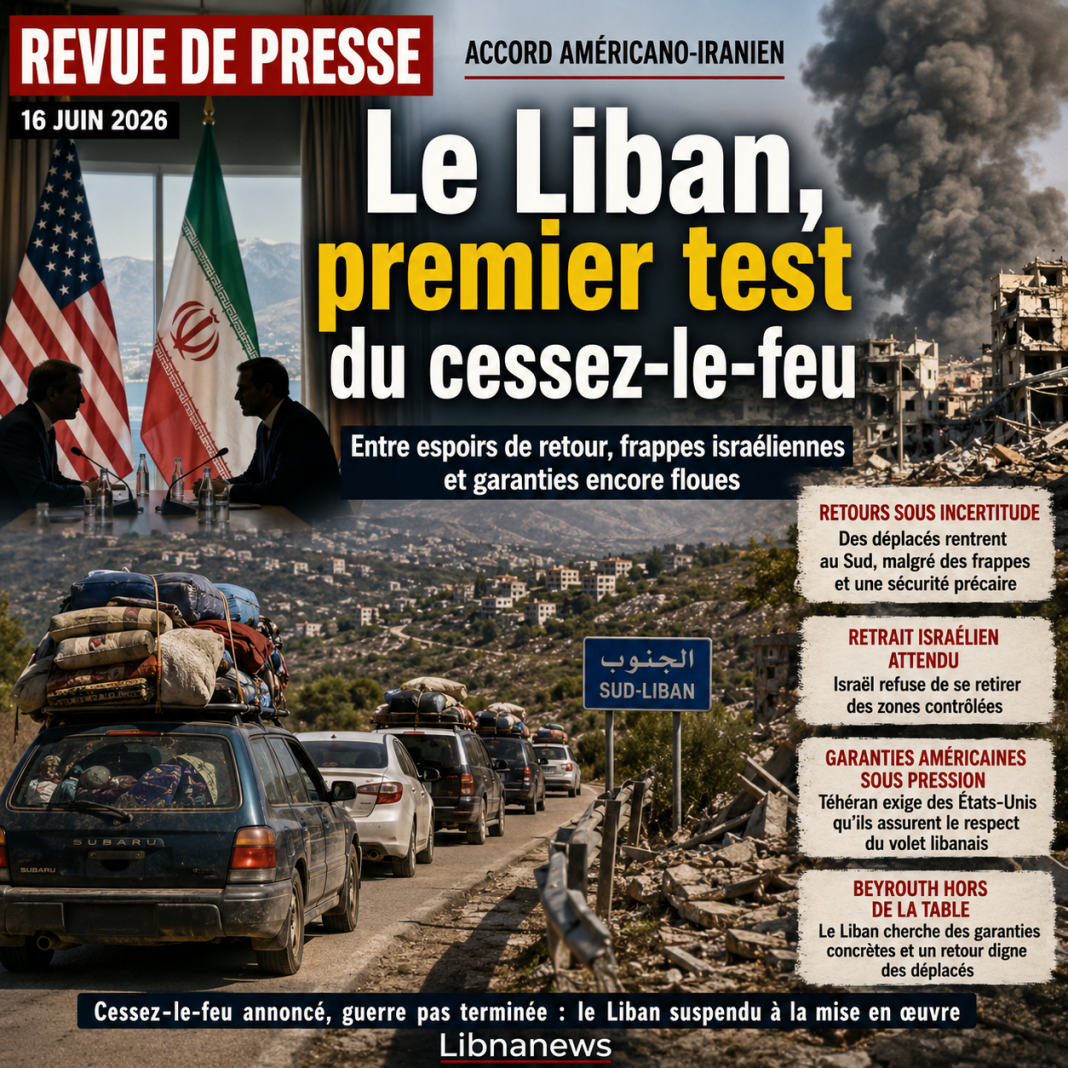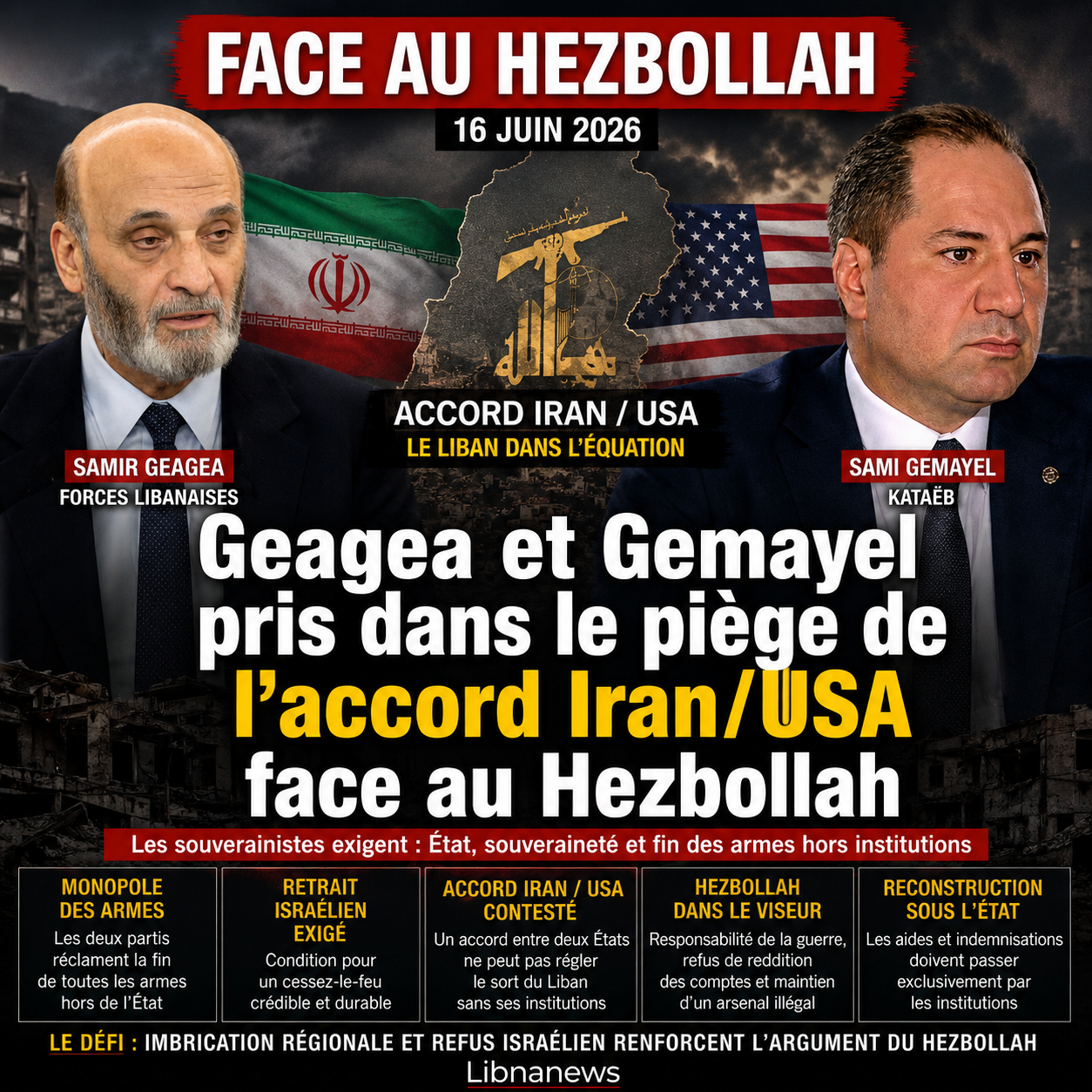
The reactions of the Lebanese Forces and Kataeb to the framework agreement between the United States and Iran place Hezbollah at the centre of the open political battle in Beirut. In two communiqués issued after separate meetings, Samir Geagea and Sami Gemayel rejected the idea that a regional ceasefire could be sufficient to resolve the Lebanese crisis. Both parties call for a definitive end to wars, a state monopoly on arms, Israeli withdrawal and the resumption of the decision on war and peace by the institutions. Their texts, however, take place in a sequence unfavourable to their line. The Israeli refusal to withdraw from Lebanon gives Hezbollah the argument of occupation. The agreement presented from Islamabad also confirms that the Lebanese case remains embedded in the Iranian case, even when the sovereignist formations want to put it back in a strictly national framework.
Lebanese Forces defend sovereign state
The first communiqué was issued by the Lebanese Forces. The bloc of the strong Republic, in its parliamentary and ministerial components, and the executive committee of the party met exceptionally under the chairmanship of Samir Geagea. The text published at the end of this meeting stresses first of all a goal presented as an old and constant one: the establishment of an effective State in Lebanon since the end of the civil war in 1990. Participants stated that the State should refer to the Constitution and legitimate institutions, control borders, hold arms alone and keep decisions on war and peace alone. The communiqué recalls that the Lebanese Forces claimed to have defended this line despite the arrests, prosecutions and marginalization suffered by their leader, activists and other sovereignist forces. It presents this battle as a condition for Lebanon’s return to its natural place as a free, sovereign and independent state.
The Lebanese Forces consider that this claim does not change with regional circumstances. The communiqué affirms that the central question remains the same: to prevent Lebanon from remaining an open scene for the conflicts of others. This formula summarizes the party’s reading. According to him, the agreement between Washington and Tehran should not mask the Lebanese crisis. The participants consider that an agreement between the United States and the Islamic Republic of Iran concerns the two signatory States first. They believe that the ceasefire referred to in the regional framework remains general and does not necessarily have a practical effect in Lebanon, where the direct military adversary is Israel and not the United States.
The Lebanese Forces text is particularly critical of the Iranian role. He claims that Tehran would seek, by mentioning Lebanon in the ceasefire, to provide Hezbollah with political and verbal services to enable it to continue its fight in accordance with Iranian objectives. The party also cites the experience of a previous ceasefire, applied in the Gulf but not translated in Lebanon, to justify its prudence. In this reading, the question is not just to silence weapons. It consists of ending a system of repeated wars that, according to the Lebanese Forces, have torn the country apart and impoverished the Lebanese.
The communiqué then formulates a central request: to turn the page of wars definitively. Participants claim that a mere cessation of fire, without changing the internal power ratio, would be tantamount to maintaining the old order. In their view, Iran and Hezbollah were part of this old order. The text therefore calls for the dissolution of illegal military organizations, primarily Hezbollah. This request is a continuation of the Government decisions that the Lebanese Forces claim to support, including those relating to the disarmament of the party and the dismantling of its military and security structures. Participants called for their implementation, especially as soon as they entered a ceasefire phase.
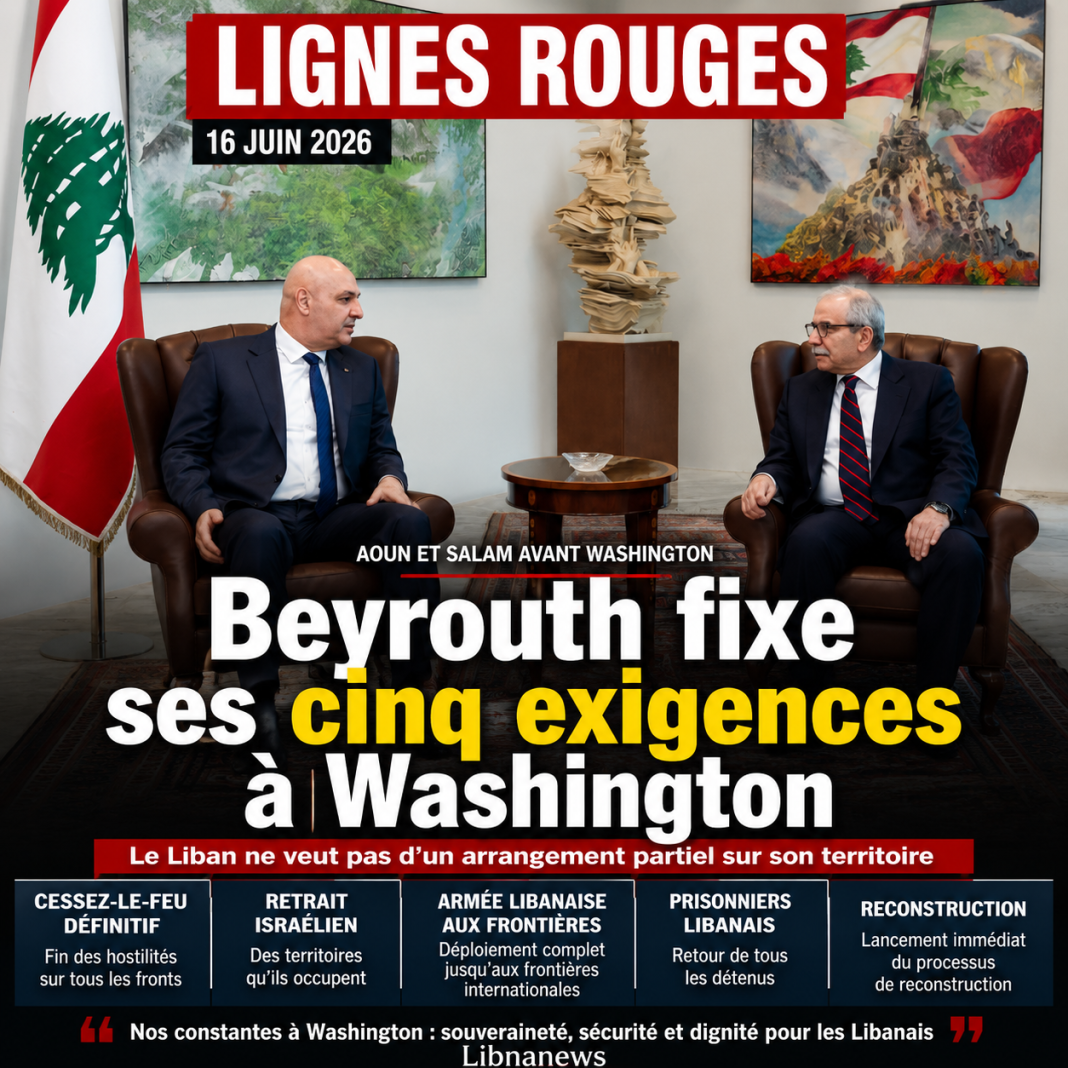
The Lebanese Forces also support the political, diplomatic and negotiated approaches led by the constitutional authorities. The press release quotes President Joseph Aoun and Prime Minister Nawaf Salam, whose tandem leads the formal process related to the Washington talks. The Samir Geagea party presents this channel as the only way out of the wars to bring Lebanon back to a real state. It believes that this should restore the country’s Arab and international relations while establishing an internal rule: the State must be the sole holder of sovereignty, arms and strategic decision.
Hezbollah as a direct target of the press release
The press release then accuses Hezbollah of missing several historical opportunities. The Lebanese Forces refer to the Israeli withdrawal of 2000 and the departure of the Syrian army in 2005. They believe that these two moments could have helped consolidate the state. They then cite the July 2006 war and the so-called « support wars » in Gaza and Tehran, as many episodes that brought the country back into cycles of destruction. This chronology occupies an important place in their argument. It aims to show that the present war is not an isolated accident, but the consequence of a military decision that is kept outside the institutions.
The text of the Lebanese Forces is also intended to be offensive internally. He claims that the State now has a real opportunity to resume its full role. According to the press release, a President of the Republic, a Prime Minister, and a ministerial, parliamentary and popular majority beyond denominational divides join together around the goal of an effective state. The party believes that any attempt to obstruct this trajectory is doomed to failure. It also rejects any attempt to link Lebanon’s future to the Iranian axis. The country, according to the press release, cannot be linked to other people’s projects or serve as a basis for settling their accounts.
The final position of the Lebanese Forces concerns the function of the ceasefire. For the party, it must open a phase of extension of state authority throughout the territory. It must also accompany the Washington decisions, which are presented as the road to Israeli withdrawal from Lebanese territories. The press release concludes with a simple idea: the first and final request of the Lebanese would be to definitively close the war page. According to the Lebanese Forces, this fence ends all the illegal situations that cause them, primarily the military and security structure of Hezbollah.
Kataeb accuse Hezbollah of war
The second statement comes from the Kataëb. The political bureau of the party, meeting under the chairmanship of deputy Sami Gemayel, begins by responding to calls from Hezbollah for the fall of the government. The Kataeb see it as an attempt to shift the responsibility for the war that hit Lebanon under the slogan of support. The text states that the priority is not to overthrow the executive, but to hold accountable those who have engaged the country in a spiral of destruction, displacement and death outside the institutions, against the Constitution and against the social contract between Lebanese.
The Kataëb communiqué then rejects the keeping of any weapon outside the authority of the State. According to the party, this weapon has proved to be the main obstacle to the stability, unity of the country and the full restoration of the role of the State. The text here joins the line of the Lebanese Forces, but it insists more on the immediate responsibility of Hezbollah in the recent war. The Kataëb refuse that appeals against the government serve to erase the initial question: who has decided to open the front, on behalf of what objectives and with what national mandate?
On the American-Iranian agreement, the Kataëb adopt a position of strict institutional sovereignty. The Political Bureau states that this agreement concerns only both parties. It considers that Lebanon is not bound by any arrangement concerning it if it does not participate in it by its legitimate institutions, elected by the Lebanese, and by representatives officially mandated in Washington. This clarification is intended to prevent any reading that the fate of Lebanon could be resolved in a negotiation between Washington and Tehran. For Sami Gemayel, the Lebanese settlement must go through the Lebanese State and those who have an official delegation to speak on his behalf.
The Kataëb also set the objectives for these negotiations. The text mentions the restoration of sovereignty, the resumption of a free decision, the Israeli withdrawal, the cessation of attacks and the continued implementation of government decisions related to the state’s arms monopoly. This list brings the Kataeb closer to the Lebanese Forces. Both parties accept formal negotiation when it serves the return of the state. On the other hand, they reject any arrangement that would place Lebanon in a logic of regional compensation or stabilization of Hezbollah.
Reconstruction as another political front
The Kataëb communiqué adds a section on post-war management. The party calls for the identification of damage and destruction to be entrusted exclusively to the legitimate institutions, first and foremost the Lebanese army, as soon as a comprehensive ceasefire is established. He also called on the Government, on the proposal of the Minister of Justice, to demand compensation from the Islamic Republic of Iran for the Lebanese, in proportion to the damage caused by a war that the party presented as imposed on Lebanon, without national interest and without Lebanese decision. Finally, the Kataëb insist that any international assistance for reconstruction or compensation should be limited to State institutions.
This demand opens a major political battle. Reconstruction is not only about buildings, roads or infrastructure. It also affects post-war social control. The person who evaluates the losses, distributes the aid and compensates the families gains a concrete influence in the affected areas. The Kataëb want to prevent this function from returning to partisan networks. Their request is therefore aimed at making the army and public institutions central to the return to normal life. It joins, from another perspective, the will of the Lebanese Forces to transform the ceasefire into an effective return of the State.
The two communiqués thus agree on the main points. The Lebanese Forces and the Kataeb refuse to treat the American-Iranian agreement as a complete Lebanese solution. They support the Washington process when it is led by the constitutional authorities. They are calling for Israeli withdrawal and cessation of attacks. They call for the implementation of government decisions to concentrate weapons and security decisions in the hands of the State. They refer to Hezbollah as the central actor of the current Lebanese crisis and as the main obstacle to the establishment of a sovereign state.
However, the two texts differ in their accent. The Lebanese Forces develop a historical narrative from 1990, going through 2000, 2005 and 2006, and arriving at recent wars. Their statement wants to show continuity in the battle for the state. The Kataeb prefer a more direct indictment of Hezbollah in the current sequence. Their text insists on appeals against the government, on the responsibility of war and on the need to move reconstruction through institutions. One builds a long-term reading. The other sets out immediate responsibilities and post-war conditions.
Small analysis: an objective political setback
This sequence, however, creates a political difficulty for both formations. The Israeli refusal to withdraw from Lebanon politically reinforces Hezbollah, as it renders it a territorial argument that its opponents have been seeking for years to withdraw from it. As long as an Israeli presence remains in Lebanese areas, the party can present its weapons as a response to an occupation, even though this response remains contested by a large part of the political class. The agreement presented since Islamabad produces a second effect. By linking the Lebanese front to a discussion between Washington and Tehran, he demonstrates the interlocking of the Lebanese file with the Iranian file. For the sovereignists, who want to bring the crisis back to the exclusive framework of the Lebanese state, this interlocking is an objective political setback.
This setback does not mean that Geagea and Gemayel lose their main argument. The war has placed the issue of the state monopoly on arms and the decision on war at the centre of the debate. But their speech comes up against two concrete facts. Israel does not yet want to withdraw. Lebanon was mentioned in a regional agreement where Iran plays a central role. These two elements give Hezbollah a political margin just as its opponents want to reduce its space. The follow-up will therefore depend on the State’s ability to obtain a verifiable Israeli withdrawal, to impose its role in the Washington negotiations and to control reconstruction by its own institutions.