

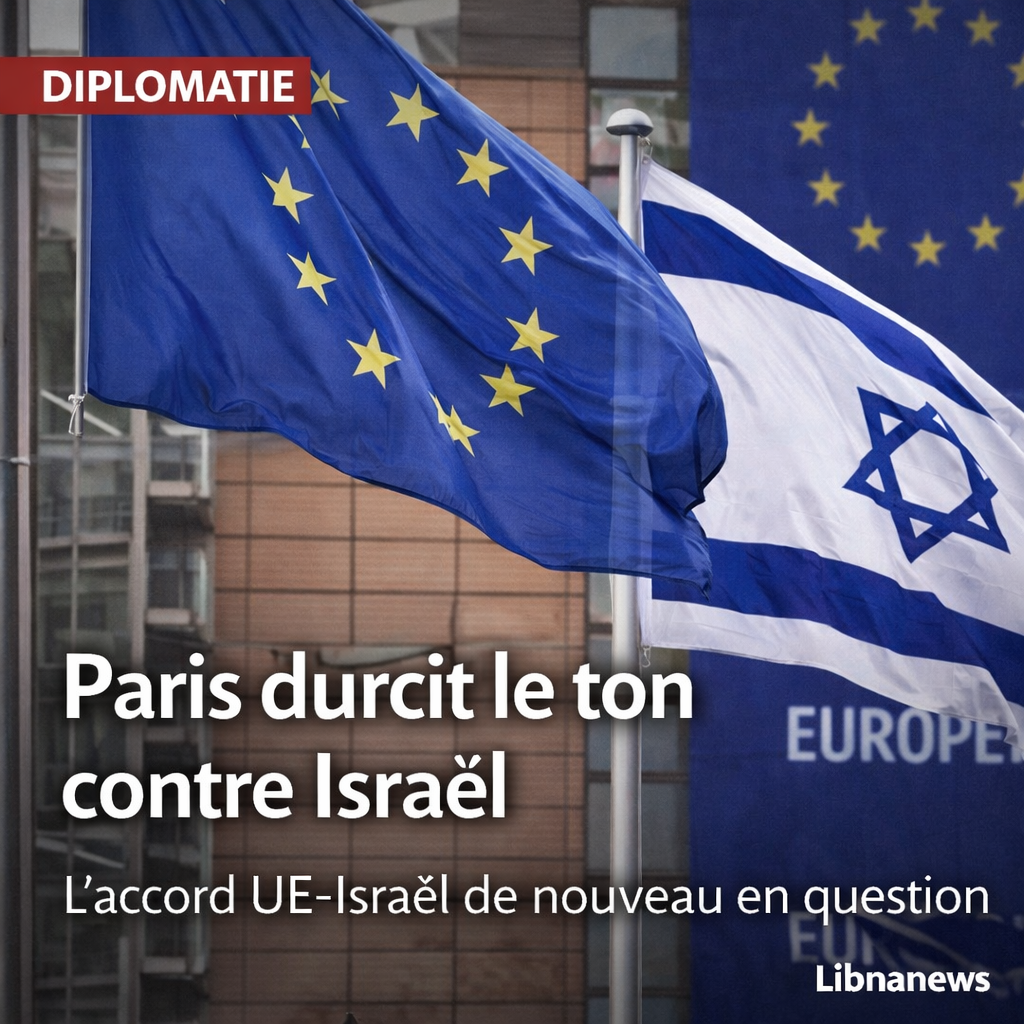
France is rising sharply after the Israeli strikes in Lebanon. On Thursday, the spokesman for the French Ministry of Foreign Affairs, Pascal Confavreux, considered that a reopening of the discussion on a suspension of the association agreement between the European Union and Israel could not be excluded, because of the seriousness of the Israeli strikes in Lebanon and the situation in the West Bank. He also described Israeli actions as « disproportionate » and « unacceptable ». This position marks a marked political tightening, even if a possible suspension of the agreement would require unanimity of the 27 Member States of the European Union.
The French declaration comes the day after a particularly deadly day in Lebanon. Paris is no longer content with a general call for restraint. The Quai d’Orsay now places the issue of Israeli strikes in a broader context, that of institutional relations between the European Union and Israel. By saying that a rediscussion of the Association Agreement cannot be excluded, French diplomacy points out that the events in Lebanon on Wednesday could have political consequences at European level, not just diplomatic or humanitarian.
According to the AFP, taken up by several media, Pascal Confavreux said that « given the gravity of what happened yesterday in Lebanon » and also given the situation in the West Bank, the discussion on the suspension of the association agreement between the European Union and Israel could reopen, « in addition to national sanctions ». He added that Israel had « the right to defend itself », but that its actions were « not only unacceptable but also disproportionate » and led « de facto to an impasse ». The wording is important: Paris does not dispute the principle of Israel’s right to security, but considers that the current conduct of its operations crosses a political and legal threshold that requires a firmer response.
Central agreement in relations between the European Union and Israel
The Association Agreement between the European Union and Israel has been in force since 2000. It is one of the main frameworks for political dialogue and economic exchanges between the two sides. The documents of the Council of the European Union recall that its Article 2 makes respect for human rights and democratic principles an « essential element » of the agreement. This means that the agreement is not only commercial. It is also based, legally and politically, on substantive commitments to law and values.
It is this point that gives the French declaration its real scope. When Paris evokes the possibility of reopening the discussion on a suspension, it does not speak of a mere symbolic gesture. It refers to the most sensitive clause in the EU-Israel architecture: the one linking political and economic relations with respect for fundamental principles. In other words, France suggests that what happened in Lebanon, together with the situation in the West Bank, could justify a more difficult review of Israel’s compliance with the spirit of this agreement. This reading is directly supported by the EU’s official reference to Article 2.
There is, however, a clear institutional limit. A possible suspension of the Agreement should be adopted unanimously by the 27 Member States. It’s a major political lock. In practice, this means that a French declaration, even a strong one, is not enough alone to produce a suspension. There should be a very broad European consensus, which remains difficult to achieve on such a sensitive issue. The AFP also recalls that Germany, inter alia, opposed any global suspension or termination of the agreement.
Lebanon brings the EU-Israel relationship into a new phase of tension
The novelty in the current sequence is that Lebanon is becoming a direct factor in tension between Israel and several European capitals. So far, discussions on the Association Agreement had been mainly revived by the war in Gaza and by human rights issues in the Palestinian territories. Now, Israeli strikes on Lebanon add to this dispute. The French declaration explicitly establishes this link: Wednesday in Lebanon and the abuses of settlers in the West Bank are a common concern in the Paris speech.
This shift is politically important for Beirut. It means that Lebanon is no longer treated only as a secondary theatre of the regional crisis. The bombing of Beirut and other Lebanese regions is beginning to affect the way in which some European countries view their overall relationship with Israel. This does not mean that a suspension is imminent. But this means that the diplomatic cost of strikes in Lebanon is increasing in some European chancelleries. This conclusion is based on an analysis based on comments made by the spokesperson for the Quai d’Orsay.
France had already publicly tightened its position on Lebanon in recent hours. Reuters reported on Thursday that Jean-Noël Barrot had claimed that Lebanon must be covered by the ceasefire and that the massive Israeli strikes of the day before must be condemned. The new statement by the spokesman for the Ministry of Foreign Affairs goes further: it no longer merely calls for a cessation of hostilities, it suggests that the institutional relationship between the European Union and Israel could itself be put on the table.
A political threat more than immediate sanction
However, we must measure precisely what is said, and not say, Paris. The Quai d’Orsay does not announce the suspension of the agreement. He said the discussion could be reopened. The shade counts. We are, at this stage, in the register of political and diplomatic pressure, not in that of a European decision already being implemented. France opens a possibility, it does not see an irreversible process.
This caution is explained by the functioning of the European Union. Any challenge to the Association Agreement would affect both the political dialogue, trade and the entire structured relationship between the EU and Israel. Such a decision would require not only unanimity but also political will which the Member States have not always shared so far. That is why the French sentence must be read as a strong political signal, intended to show that a threshold has been crossed, rather than as the announcement of an already ready sanction. This reading is consistent with the institutional constraint recalled by the AFP.
The reference to « national sanctions » is also revealing. It suggests that, even in the absence of European unanimity on the Association Agreement, some States might consider their own measures. Again, no specific arrangements were publicly detailed in the items consulted. But the mere fact that Paris evokes this possibility indicates that the French response is no longer limited to the language of protest. One enters a register where more concrete political consequences are at least publicly mentioned.
What France really says about the Israeli strikes
The strongest sentence of the French spokesman probably remains this: Israeli actions are « unacceptable » and « disproportionate ». In French diplomacy, this type of vocabulary is not trivial. He places criticism on both political and legal ground. It is no longer just a matter of regretting an escalation or calling for restraint. The aim is to describe the acts in question in a way that can then justify a discussion of concrete measures, particularly at European level.
The reminder that Israel « has the right to defend itself » does not nullify this harshness. On the contrary, it allows Paris to show that it does not contest the principle of Israel’s security, while asserting that the way in which this security is invoked cannot justify everything. It is a classic balance of French diplomacy, but here it is formulated more clearly than usual. The message is that self-defence does not allow the disproportion or political stalemate of the current strikes.
For Lebanon, this French qualification is an important political support. It does not change the military power ratio immediately. But it places Lebanese suffering, attacks on Beirut and civilian casualties in a more difficult European diplomatic language. This helps to remove Lebanon from the status of peripheral theatre as a concrete element of the rediscussion of relations between Israel and its European partners. This conclusion is based on an analysis based on the scope of the French declaration.
Rediscussion already begun from Gaza
The French declaration is also part of an older European debate. The AFP recalls that last year, in the face of military escalation and the humanitarian crisis in Gaza, the European Union initiated a review of the Association Agreement at the request of several Member States, including the Netherlands. The review included the question of respect for human rights and democratic principles referred to in Article 2. According to the AFP, a report by the European Commission had subsequently found Israel to be violating this article.
This means that Thursday’s statement does not arise in a vacuum. It reactivates an already open debate within the Union. The new thing is that Lebanon is now adding to the file. The Israeli strikes on Wednesday alone do not create all the controversy. They are part of a broader European dispute already being fed by Gaza, the West Bank and the question of Article 2. This cumulation reinforces the political weight of French speech.
But it also recalls the difficulty of the way ahead. If last year the debate did not lead to a global suspension, despite Gaza, it is clear that the only outrage caused by the strikes in Lebanon will not mechanically guarantee a switch. The main obstacle remains political: to obtain real European unanimity on a matter where national sensitivities diverge sharply. Again, Germany appears to be one of the most important locks.
For Beirut, a signal more than a guarantee
For Lebanon, the French position is the first signal. It shows that at least one major European capital is ready to publicly say that the Israeli strikes on Wednesday could have an impact on the EU-Israel relationship. This is far from negligible. In a sequence in which Beirut tries to make it recognised that Lebanon cannot be excluded from regional de-escalation, Paris thus hardens its tone gives it tangible political support.
But this is not yet a guarantee of results. A suspension of the Association Agreement remains legally and politically difficult. The 27 must agree. And even beyond the procedure, several European governments should decide that the political threshold is now crossed. The French declaration opens this possibility. She doesn’t make it automatic.
But the verbal threshold was crossed. When French diplomacy speaks of « unacceptable » and « disproportionate » actions, when it explicitly refers to a possible rediscussion of the association agreement, and when it links the strikes on Lebanon with the situation in the West Bank, it sends a clear message: for Paris, the European relationship with Israel can no longer be considered politically separate from what is being played today in Beirut and in the rest of Lebanon.




