

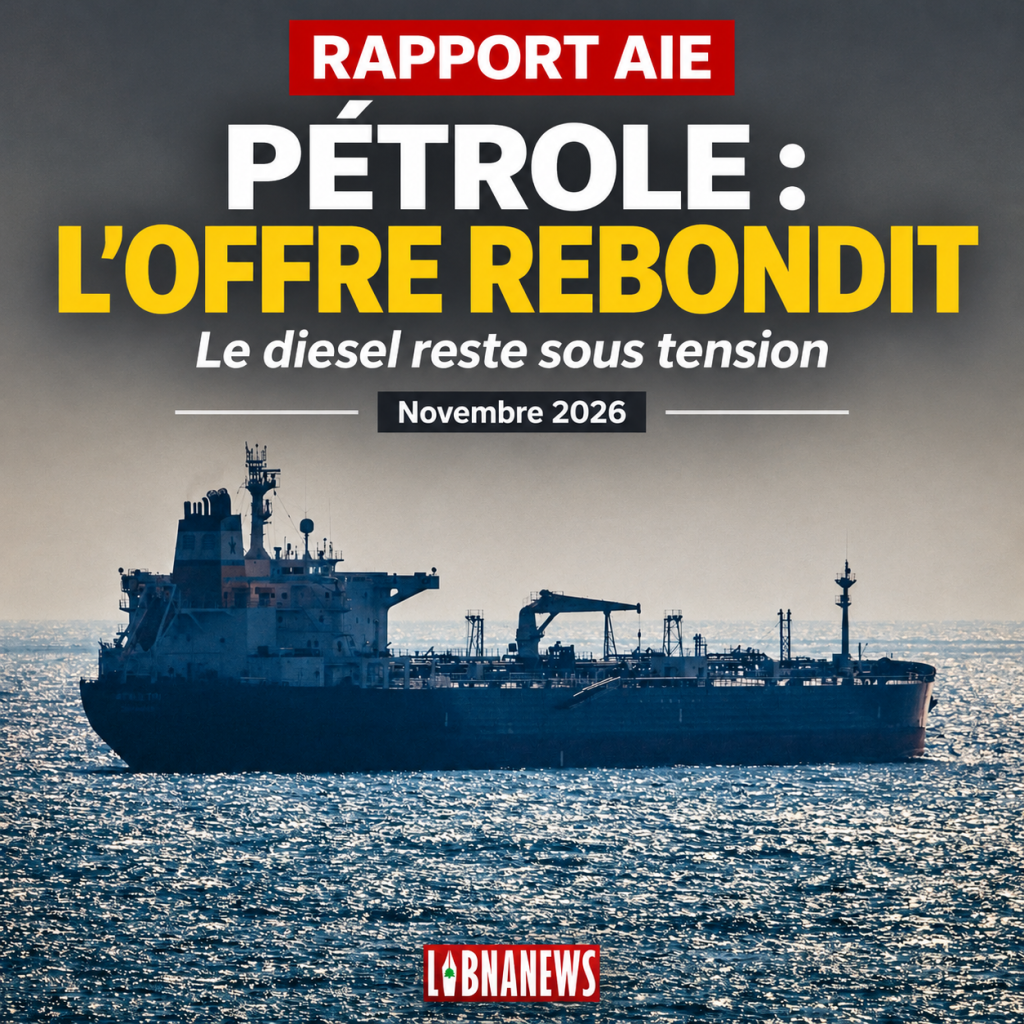
The International Energy Agency forecasts a decrease in world oil demand of 2.7 million barrels per day in 2026. In its report published Friday, 13 November, it estimates consumption at 102.3 million barrels per day. A rebound of 2 million is expected in 2027. The supply goes up faster, but diesel remains expensive and the stock available on land continues to decline.
Oil: the return of cargo from the Gulf
World production reached 105.4 million barrels per day in October, 2.3 million more than in September. This increase follows an increase of 3 million in September. A cumulative increase of 5.3 million has been recorded since August.
Gulf oil exports, excluding Oman, reached 18.4 million barrels per day in October. However, they remain 26% below their pre-war level. The crude oil represents 15 million barrels per day, or 82 per cent of the pre-conflict volume.
This recovery led the agency to increase its global supply forecast for the fourth quarter of 2026 by 3.3 million barrels per day. Over the entire year, however, it expects a decrease of 4.8 million. The losses in the Middle East and Russia are only partially offset elsewhere.
Together, the United States, Canada, Brazil, Argentina and Guyana are expected to increase production by 1.6 million barrels per day this year. For 2027, the IEA forecasts an average global supply of 108.1 million, up 6.6 million. It is a projection, depending in particular on the recovery of Gulf flows.
Consumption still held back by prices
Demand recovers less quickly than supply. Exports of refined products and liquefied petroleum gas from the Gulf remain close to half their pre-war level. High fuel prices also continue to affect consumption.
The expected annual decline in the fourth quarter is 2.7 million barrels per day. It would therefore be less marked than in the second quarter, where the decrease was 5 million, and than in the third, at 3.8 million. The agency envisages a return to growth around March 2027.
Almost 80% of the expected rebound next year would come from LPG, ethane and naphtha, which are used in petrochemicals. Transport fuels would grow much less. The EIA underlines the effect of electrification of vehicles and of improving their energy efficiency.
More oil at sea, less on land
World stocks increased by 52 million barrels in October, their first increase since June. This increase masks different situations. Volumes transported at sea jumped by 86 million barrels with the resumption of Gulf exports.
On land, reserves have declined further and are at their lowest level since at least 2016. Total OECD stocks lost 47 million barrels, including 41 million barrels for industrial stocks. Since the beginning of the war, the cumulative decline in world stocks has been 462 million.
An increase in transit cargo therefore does not mean that refineries and markets immediately have the same volumes. The transport, unloading and processing of crude oil remain distinct steps.
Diesel remains the point of tension
The decline in crude oil prices is not evenly passed on to refined products. North Sea Dated Reference Oil increased from $136 per barrel in early October to approximately $93 at the time of reporting. This price is not a real-time quote on Friday.
In Europe, diesel prices fell by 11% over the same period. However, they remained close to $180 per barrel, 77 per cent above their pre-war level. Attacks on Russian energy infrastructure limit diesel deliveries, in addition to losses in the Middle East.
Global refineries processed 81.3 million barrels per day in October, a seasonal hollow. IEA plans to increase to 84.7 million in December. It also relies on China’s new export quotas for refined products and on accelerating the availability of emergency diesel stocks to reduce the supply gap in the coming months.





Comments