

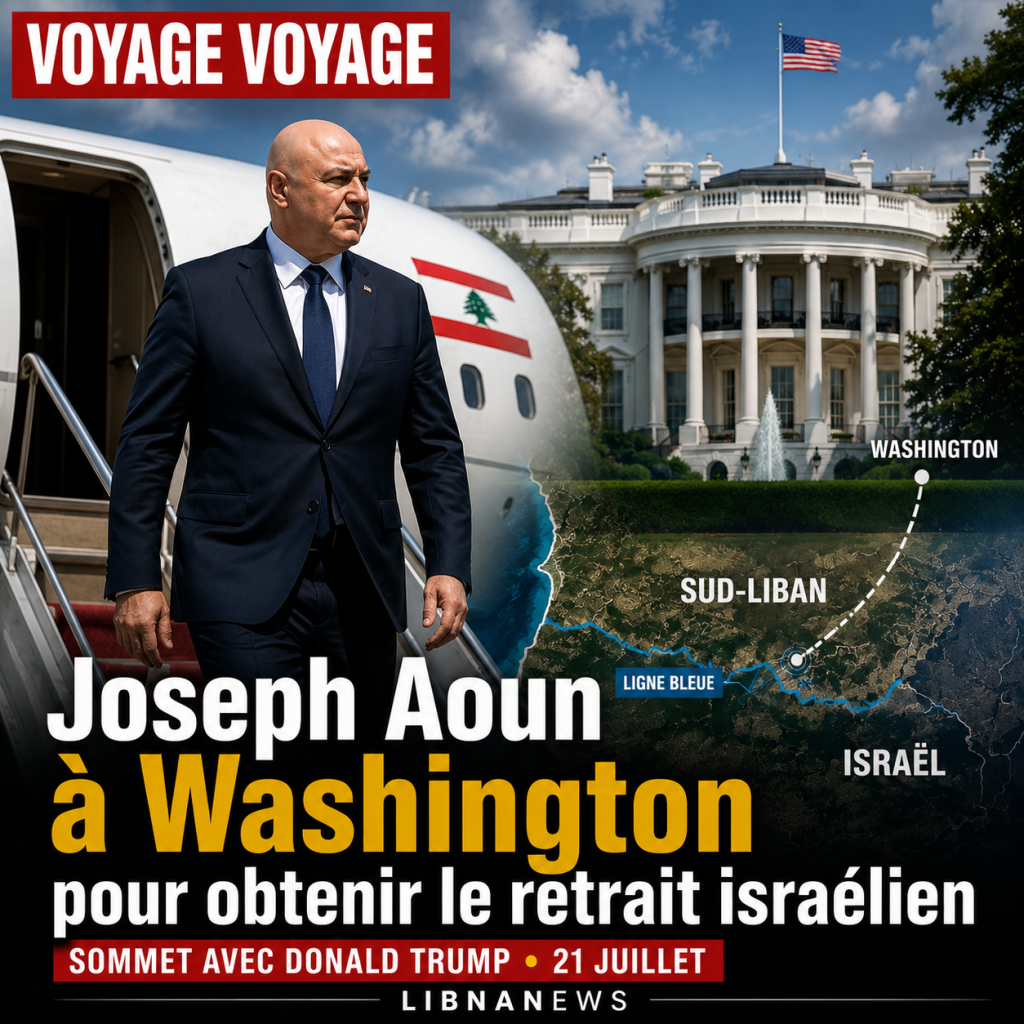
President Joseph Aoun and First Lady Nehmat Aoun left Beirut on Saturday morning for Washington, at the invitation of US President Donald Trump. This visit opens a major diplomatic sequence for Lebanon. A summit meeting is to be held at the White House on 21 July, with the ceasefire, the Israeli withdrawal from Lebanese territories, the deployment of the army and the restoration of stability in the south at the centre of the discussions. Joseph Aoun must also meet with several American officials. His displacement came a few days after the Rome negotiations, which involved a mechanism of pilot zones and a gradual withdrawal of Israeli forces. No concrete movement has yet been observed on the ground. The Lebanese President therefore arrives in Washington with an immediate priority: to obtain American guarantees capable of transforming diplomatic commitments into executed decisions.
Joseph Aoun in Washington for a decisive visit
The departure of the Head of State marks his first official visit to the White House since his election. The trip had been mentioned for several weeks, but its outfit is now in a particularly tense phase. Lebanon seeks to consolidate a fragile ceasefire, while strikes and incidents continue to cause concern in the south. Israel also maintains forces in several areas that Beirut considers to be occupied.
Donald Trump’s invitation gives the meeting a greater reach than the technical exchanges conducted in recent months. Discussions will not be limited to military procedures. They will affect the political choices that must govern the Israeli withdrawal, the role of the Lebanese army and the timetable for a return to stability. The US President has a direct leverage on the Israeli government. Joseph Aoun will seek a clear commitment from Washington.
The presence of First Lady Nehmat Aoun also highlights the official dimension of the visit. It distinguishes this shift from a simple crisis consultation. The Lebanese presidency wants to present the trip as an institutional step in relations between Beirut and Washington. This image counts as Lebanon tries to reaffirm the legitimacy of the State in the face of armed actors and regional pressure.
The summit will nevertheless be judged on its results. A photograph at the White House will not be enough to meet expectations. The Lebanese authorities must return with precise guarantees, a credible timetable and follow-up mechanisms. Most of the people in the south expect visible changes: the end of the attacks, the withdrawal of Israeli forces and the possibility of a sustainable return to their communities.
Israeli withdrawal at the heart of Lebanese demands
Joseph Aoun’s first request concerns the Israeli withdrawal from the occupied Lebanese sectors. Beirut considers that any lasting stabilization requires an end to this presence. The maintenance of Israeli positions creates a military fait accompli and complicates the full deployment of the Lebanese army. It also maintains a permanent risk of escalation.
The discussions in Rome have recently focused on pilot areas. According to the principle mentioned, Israel had to withdraw from certain areas before they were handed over to the Lebanese army. This procedure was to be used as a test before an extension to other areas. However, no new positions had been handed over to the Lebanese Army at the time of Joseph Aoun’s departure for Washington.
This delay places the issue of timing at the centre of the summit. The Lebanese President should request that the commitments made be accompanied by verifiable dates and milestones. Without a specific deadline, an agreement in principle can remain ineffective. Israel then retains control of the pace and can condition each movement to new demands.
Lebanon also wants to prevent pilot areas from replacing the objective of full withdrawal. A limited evacuation may be a first step. It must not become a definitive solution that would leave other sectors under occupation. Joseph Aoun must therefore defend a progressive logic, but linked to a clearly defined final result.
Washington can play an essential role in this sequence. The US administration can pass on guarantees, check movements and put pressure on Israel. It can also link diplomatic support to the implementation of commitments. The meeting with Donald Trump will give the Lebanese President the opportunity to ask for the personal involvement of the White House leader.
Consolidate the ceasefire before further escalation
The second issue concerns the consolidation of the ceasefire. The Lebanese authorities want to prevent a general resumption of hostilities. The situation remains unstable, as strikes and violations continue to threaten the truce. Each incident can cause a reaction and bring the border back to a broader confrontation.
Joseph Aoun will probably present the ceasefire as a step that should benefit both sides of the border. Lebanon calls for the protection of its population, the reconstruction of villages and the resumption of economic activity. Israel, for its part, claims to want to prevent any threat to its northern communities. American mediation seeks to bring these requirements closer together in a common framework.
The difficulty lies in the definition of obligations. Beirut wants the cessation of Israeli attacks to precede or accompany any internal measures. Israel links its withdrawals to guarantees concerning the weapons and movements of Hezbollah. This divergence partly explains the slowness of the process. It also gives the United States a central role in establishing an acceptable sequence.
The Lebanese President must insist that the State cannot strengthen its authority under the strikes. The deployment of the army requires a stable environment. Military personnel must be able to move, establish positions and cooperate with municipalities. Permanent military pressure weakens their mission instead of facilitating it.
A solid truce would also have an internal political impact. It would give the government time to address sensitive issues within an institutional framework. Conversely, a resumption of fighting would reinforce the logic of urgency and reduce the space for national debate. Joseph Aoun therefore seeks to obtain a sufficiently long period to restore the normal functioning of the state in the south.
Deployment of the army as a test of sovereignty
The visit to Washington must also focus on strengthening the Lebanese army. President Aoun, former Commander-in-Chief, places this institution at the centre of his strategy. He wants the army to be the only force responsible for securing borders and exercising state authority throughout the country.
This ambition requires significant resources. The army must have personnel, vehicles, surveillance equipment and logistical capabilities. It must also rebuild or rehabilitate damaged positions. The United States has long been one of its main external supporters. Joseph Aoun should ask for the continuation and increase of this aid.
Funding remains an urgent issue. The economic crisis has reduced the real wages of the military and complicated the daily functioning of the institution. An extension of the deployment to the south entails new costs. It requires infrastructure, fuel, communications and demining capabilities. Without external support, Lebanon will find it difficult to maintain long-term positions.
Washington will, however, seek guarantees on the use of this aid and on the mission entrusted to the army. US officials want to ensure that deployed units effectively control the sectors concerned. They will likely require regular audit mechanisms and reporting. Joseph Aoun will have to reconcile these expectations with the Lebanese refusal to place the army under foreign guardianship.
The success of the deployment will ultimately depend on an internal political consensus. The army cannot be charged alone with resolving an issue that affects Hezbollah weapons and national balance. It can implement a decision, secure an area and control borders. It cannot replace the necessary political dialogue on the defence strategy.
The issue of Hezbollah weapons in the background
Even if the official communiqué insists on the ceasefire, Israeli withdrawal and state authority, the issue of Hezbollah weapons will be included in the discussions. Washington and Israel see this as a major condition for any development. The Lebanese authorities, for their part, seek to avoid an approach that would provoke internal confrontation.
Joseph Aoun has repeatedly defended the principle of the state monopoly on arms. This position constitutes an important political basis. However, its implementation remains complex. Hezbollah maintains a military organization, political influence and social base. Any decision must therefore take into account the risk of internal tensions.
The Lebanese President should explain that the consolidation of the State is an orderly sequence. The Israeli withdrawal and the cessation of attacks would reinforce the argument for the exclusive deployment of the army. Conversely, continued occupation allows Hezbollah to justify the preservation of its weapons in the name of resistance.
This relationship between external withdrawal and domestic decision will probably be one of the most difficult points of the summit. Donald Trump can demand quick commitments. Joseph Aoun will have to defend a realistic timetable. Excessive pressure could weaken Lebanese institutions and produce the opposite effect of that sought.
The President must also preserve the unity of the country. He cannot appear as the bearer of a plan imposed by Washington. It will therefore seek to present its commitments as the application of a Lebanese sovereign choice. This distinction will be essential when he returns to Beirut.
A visit to the United States
The summit is beyond the security record. It should help to redefine the relationship between Lebanon and the United States. Washington remains a major player in the military, financial and diplomatic fields. Its influence also extends to international institutions that can support reconstruction and economic stability.
Joseph Aoun will meet several American officials in addition to Donald Trump. Such consultations should include military assistance, reconstruction, reforms and protection of Lebanon from the effects of regional crises. The Head of State will seek to show that his country can once again become a reliable institutional partner.
The economic context will give particular weight to these exchanges. Lebanon needed funding to repair infrastructure, revive public services and support displaced populations. International partners often condition their support for reforms. The Presidency will therefore need to link urgent needs with a credible governance programme.
Washington can also facilitate the mobilization of the World Bank, the International Monetary Fund and donor countries. However, no massive aid will be sustainable without political stability. The summit between Aoun and Trump will therefore have to link security and economic issues rather than deal with them separately.
Lebanon will finally try to avoid an exclusive dependency. His diplomacy is traditionally based on several Arab and international partnerships. The visit to the United States does not mean full alignment. Its main purpose is to use the American channel to obtain results on a case where Washington has a decisive influence.
The weight of the Rome meeting
The move came after the negotiations in Rome under American mediation. These discussions were presented as productive by American officials. They have made progress on the principles of the pilot areas, but their application remains pending. The Washington summit must now give political impetus to the technical phase.
Joseph Aoun may ask that the results of Rome be formalized. The military needs specific instructions. Ombudsmen must set procedures. The parties must also agree on the locations concerned and the order of withdrawals. Without a decision at the highest level, technical meetings may be prolonged without outcome.
The Lebanese President comes with a simple argument: the State has accepted the path of direct negotiation and must obtain a concrete counterpart. He cannot defend this choice before public opinion unless Israel changes its presence on the ground. A first evacuation would therefore be a political as well as a military signal.
Donald Trump will probably seek to present the process as a success of his diplomacy. This will can serve Lebanese interests if it pushes Washington to withdraw. It can also create pressure to quickly announce an incomplete agreement. Joseph Aoun will have to ensure that the search for an American political victory is not to the detriment of Lebanese demands.
The sequence of Rome and Washington thus forms the same process. Rome worked on the framework. The White House must decide on the level of engagement. The ground will then show whether the promises are being implemented.
High expectations in southern Lebanon
In border localities, the presidential trip is followed through its possible consequences. The inhabitants are waiting to be able to return, repair their homes and resume their activities. Many have undergone repeated displacements. Farmers have lost access to land. Municipalities must manage needs beyond their means.
An Israeli withdrawal would create the conditions for a gradual return. However, roads should be secured, unexploded ordnance removed and buildings evaluated. The army and civilian services should act together. International aid would be needed to accelerate this phase.
The ceasefire must also become predictable. A one-time truce does not allow families to rebuild. Residents need guarantees over several months. Schools, shops and farms cannot operate until a new alert is issued.
Joseph Aoun will therefore have to bring a request to Washington that is not limited to geopolitics. The case concerns tens of thousands of civilians directly. Stability is measured by the possibility of living normally, not only by the reduction in the number of strikes.
The president will also have to avoid some localities being forgotten in the logic of the pilot zones. A progressive mechanism can begin in a few sectors, but it must cover all occupied or threatened areas. The inhabitants will judge the agreement on the basis of this equal treatment.
A summit tested for results
The July 21 meeting will be scrutinized in Lebanon, Israel and regional capitals. A joint declaration could announce a timetable, a withdrawal mechanism or a new phase of negotiations. The exact content remains unknown. The Lebanese Presidency did not detail the documents that could be signed.
The best result for Beirut would be an explicit US commitment to the Israeli withdrawal, accompanied by enhanced support for the army and reconstruction assistance. A timetable for pilot areas would give a first concrete translation. A simple reaffirmation of the principles already known would be more difficult to present as a step forward.
Joseph Aoun will also have to manage diplomatic language. Any mention of immediate peace or normalisation would provoke intense internal debate. Lebanon affirms that the priority remains the cessation of hostilities, withdrawal and sovereignty. The President should maintain this hierarchy in his public statements.
Donald Trump can look for a spectacular announcement. The Head of State of Lebanon will have an interest in giving priority to applicable commitments. A discreet but binding mechanism would be more useful than an ambitious formula without a timetable. The credibility of the visit will depend on what will happen in the following days.
Joseph Aoun and Nehmat Aoun left Beirut with a programme focused on security, Israeli withdrawal and state authority. Consultations in Washington must begin before the summit on 21 July. The first concrete signal will be expected in the south, where no new area has yet been handed over to the Lebanese army.




