

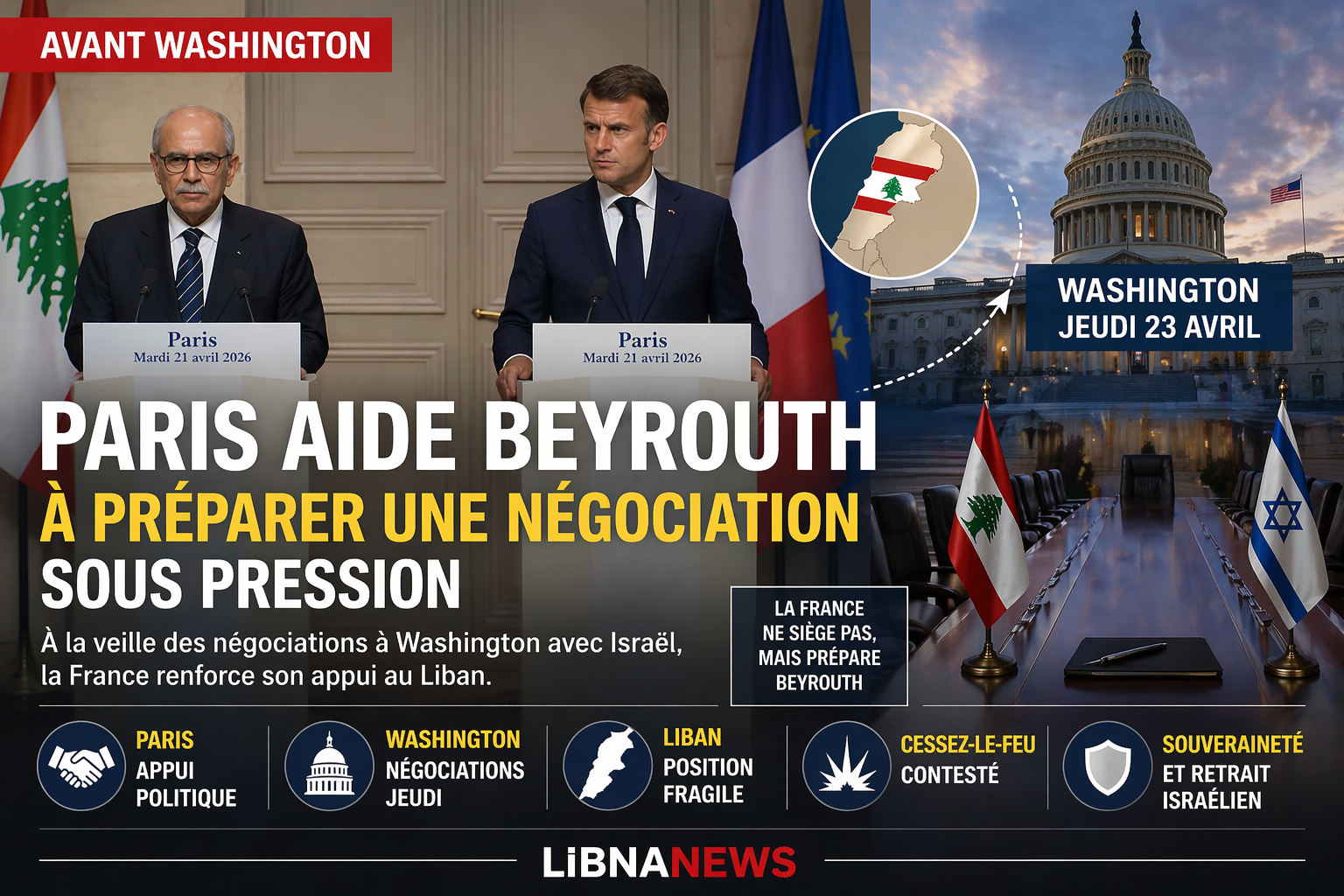
At 48 hours of a new round of negotiations in Washington between Lebanese and Israeli representatives, France chose to reappear in the Lebanese case without pretending to take over. Emmanuel Macron said in Paris that his country would help the Lebanese authorities prepare for these discussions, even if France did not sit directly at the table. The formula is important. It recognizes a new diplomatic reality: the centre of gravity of the negotiations has moved to Washington, but Paris refuses to disappear from the game. For Beirut, this aid is not a prestige supplement. This is an attempt to rebalancing, at a time when Lebanon is getting weakened at a historic meeting with Israel.
The subject is more sensitive than it seems. Officially, Lebanon and Israel must speak to consolidate the ceasefire announced on 17 April and, perhaps, open a more sustainable path. Officially, everyone knows that the Washington table will not be neutral. The United States is both Israel’s host, facilitator and main ally. Lebanon, for its part, presents itself with a war-torn state, more than one million internally displaced persons, an already contested truce on the ground, and an internal scene crossed by the country’s most explosive issue: Hezbollah weapons, state sovereignty and the political price of direct dialogue with the Israeli enemy.
In this context, the French offer is worth less as a substitute mediation than as a support mechanism. Paris cannot impose a timetable on Israel, nor can it guarantee the withdrawal of Israeli troops alone, nor can it replace the American leverage effect. On the other hand, France can help Beirut to structure its priorities, to defend a more legal and political reading of the case, to recall the framework of international law, and to prevent negotiations from being reduced to a mere list of security requirements formulated by the strongest camp. In other words, France does not promise to speak for Lebanon. She promises to help her not to arrive alone and without clean language.
Before the negotiations in Washington, Paris returns
The image produced by the encounter between Nawaf Salam and Emmanuel Macron at the Elysée had nothing to do with a simple protocol exchange. She intervened at the very moment when Beirut was seeking to tighten its support before the Washington rendezvous. The head of the Lebanese government was not only coming to Paris to demand humanitarian assistance. He also came to test how far France remained willing to accompany him in a negotiation where it apparently lost its seat.
Emmanuel Macron also formulated it straight away. For him, it is secondary whether or not France is sitting at the table, as long as Lebanese interests are supported. This sentence has two readings. The first is tactical: Paris admits that there is no point in transforming its own presence into a prerequisite, at the risk of further complicating the opening of discussions. The second is deeper: France knows that it has been marginalized by the United States and Israel, but it wants to avoid this marginalization turning into erasure.
This shade counts a lot. In the previous sequence, Paris was not a peripheral actor. France had worked with Washington on the November 2024 ceasefire and participated in the mechanism to monitor its implementation, with a recognized military and diplomatic presence in Beirut. It therefore had a role, language and legitimacy acquired. The Washington format, on the other hand, devotes another logic: tight negotiation, under exclusive American mediation, with a small number of actors and an agenda very directly linked to Israeli security priorities.
For French diplomacy, the stakes therefore go beyond the symbol. Being removed from the first circle does not only mean losing visibility. This also means that a French way of ordering the stages must be reversed: a ceasefire first, protection of civilians, Israeli withdrawal, strengthening of the Lebanese army, and then dealing with the most sensitive issues within a state framework. The new US system partly reverses this hierarchy. It opens the discussions in a more crude balance of force, with a weakened Lebanon, a militarily dominant Israel, and a priority given to the neutralization of Hezbollah.
French method aid, no facade
This is where the aid promised by Paris takes on a concrete meaning. It is not based on official participation in Washington’s face-to-face. It focuses on the political and diplomatic preparation of the Lebanese delegation. This means clarifying the red lines, prioritizing demands, anticipating American and Israeli pressures, and recalling that Lebanon does not come to discuss abstract normalization, but seeks a lasting cessation of hostilities, an Israeli withdrawal from its territory and a gradual restoration of its sovereignty.
This preparation work has nothing secondary. In this type of negotiation, the weaker party often loses not because it ignores its interests, but because it arrives with too much urgency at once. Lebanon must achieve both military stabilization, defend the sovereignty of its territory, limit humanitarian damage, avoid an internal divide with Hezbollah, and preserve diplomatic space for further action. A state under such pressure can easily find itself trapped in a defensive logic, responding point by point to the demands of the strongest instead of imposing its own discussion architecture.
France can help to avoid this trap. It can push Beirut to stick to some central priorities rather than disperse. It can help reformulate its applications in terms acceptable to Western partners without emptying their substance. It may also recall that negotiations on Lebanon cannot be treated as a mere annex to Israeli security. This does not mean that Paris defends an anti-Israeli line. This means that she wants the Washington table to also speak of Lebanon as a state, not just as Hezbollah theatre.
What France still brings to Lebanon
The French utility lies first in the history of the case. The relationship between Paris and Beirut is not only sentimental or memorial. It is based on old political channels, a thorough knowledge of Lebanese personnel, a presence in UNIFIL, access to Europeans and a capacity to speak both the language of Lebanese sovereignty and that of institution-building. It’s a specific asset. The United States can weigh more heavily on Israel. France, for its part, understands better than others the internal fragility of the Lebanese system and the way in which foreign negotiations can produce dangerous political replicas.
This internal dimension is essential. Several European and Lebanese diplomats expressed concern that an overly weakened Lebanese government might be exposed to unrealistic demands in Washington. This concern is not theoretical. It touches the heart of the Lebanese system. The disarmament of Hezbollah, the presence of the army in the South, the return of the displaced, the prisoners, the question of the disputed points on the border line, the status of the areas occupied by Israel: each of these subjects can become a factor of national tension in Beirut.
France can therefore play an intellectual and diplomatic firewall role. It can remind Beirut that some poorly prepared concessions would be impossible to secure in the country. It can also show Europeans that too hard a negotiation, or presented as a capitulation, would feed exactly what the West says it wants to avoid: a new internal polarisation, a delegitimization of the state and a strengthening of the discourse of armed resistance.
French aid is not only defensive. It can also be positive. Paris still has credibility to articulate security, humanitarianism and reconstruction. Lebanon needs that articulation. A truce will not hold if it remains purely military. It should be accompanied by assistance to internally displaced persons, support to municipalities, support to the Lebanese army, and a return perspective for the people of the South. On these issues, France is not the only actor, but it remains one of the few capable of linking politics, humanitarian and European.
French support for the army and the international framework
Another aspect of this aid lies in the institutional framework that Paris continues to defend. France explicitly supports the continuation of discussions between Israel and Lebanon on a political solution including Israeli withdrawal and the disarmament of Hezbollah. This formulation is important because it holds two often dissociated imperatives together. On the one hand, the Israeli withdrawal from Lebanese territory. On the other hand, the restoration of the state monopoly on force. Paris does not choose between Lebanon’s sovereignty and Hezbollah’s limitation. She’s trying to put them in the same sequence.
For Beirut, this balance is precious. It avoids two pitfalls. The first would be to talk only about the disarmament of Hezbollah without first demanding an end to Israeli attacks and the withdrawal of Israeli troops present in the South. The second would be to speak only of the Israeli occupation by leaving aside the question of the effective authority of the State. French diplomacy, by its wording, recalls that no lasting stabilization is possible if one of these two strands crushes the other.
This point joins the question of the Lebanese army. France is one of the partners who consider that the lasting exit from the crisis requires the strengthening of state institutions, primarily the army. Again, this does not produce an immediate solution. But this gives Lebanon a structural argument in the negotiation: the alternative to Hezbollah cannot be the vacuum. If the international community wants to reduce the military role of the Shiite movement, it must more seriously support the Lebanese State’s ability to occupy the ground, secure border areas and protect civilians.
Why Washington and Israel prefer to limit Paris
If France can do this service, why isn’t it at the table? The answer is political. Both Israel and the United States have shown that they prefer a narrower format. From the Israeli point of view, Paris has become a less convenient interlocutor. Relations have deteriorated due to French positions on Gaza and the West Bank, criticism of the disproportionate nature of some Israeli strikes in Lebanon, and France’s contacts with the political wing of Hezbollah. For Jerusalem, this profile makes Paris too nuanced, so less useful in a sequence focused on Israeli security and the weakening of Hezbollah.
From the American point of view, the logic is a little different, but the effect is the same. Washington seeks to maintain complete control of the process. The United States wants to decide the tempo, format and language of the discussions. Adding France would mean introducing another Western centre of gravity, with other priorities, other sensitivities and a stronger emphasis on international law, civilians, UNIFIL and reconstruction. But the current American format is designed to go fast, talk bilaterally and produce, if possible, a legible safe result.
Lebanon pays the price. By accepting the Washington framework without conditioning its participation in the Paris presence, Beirut made a choice of necessity more than preferably. Lebanese officials know that the only power that can directly influence Israel today remains the United States. So they can’t afford to slam the American table. But they also know that this choice deprives them of a valuable Western counterweight. France could not have reversed the balance of power. However, it could have corrected its narrative and hierarchy.
A simpler but harder table
This is probably the best way to summarize the situation. With France absent, the Washington table becomes simpler. She’s also tougher. The United States appears to be a mediator, potential guarantor and ally of Israel at the same time. Israel achieves this with the military advantage, an army in southern Lebanon and an unbroken pressure capacity. Lebanon, for its part, comes with a priority demand for stabilization, an urgent need for humanitarian assistance and a fractured internal scene.
In such a context, French diplomacy serves at least one thing: to give a little depth to the Lebanese position before the test. Even if Paris does not sit at the table, its support can help Beirut not to present itself as a state that only comes to ask grace. It can help reformulate the negotiation not as a bargaining on Lebanese weakness, but as a process that must produce two inseparable results: security for Israel and sovereignty for Lebanon.
It is also a way for France to defend its own place in the Middle East. Lebanon is one of the few cases where Paris still had clear visibility, based on history, diplomacy, UNIFIL and its ability to mobilize Europe. To be excluded from the room where the strategic framework of South Lebanon is redesigned is a real loss. By helping Beirut upstream, France also seeks to remind that it remains useful, even when it is no longer central.
What Beirut is going to look for in Washington
The question is obviously not just that of the French role. It is also the subject of the negotiation itself. For Lebanon, the immediate priority remains the consolidation of the ceasefire, the Israeli withdrawal, the return of internally displaced persons and the reduction of the continued military pressure on the South and, more broadly, the country. For Israel, the objectives are formulated differently: to prevent Hezbollah from redeploying, to secure northern Israel, and to achieve progress on the long-term limitation of its arsenal and military presence.
These two agendas do not overlap. That’s why Washington can quickly turn into a misunderstanding table. Beirut wants to stop bleeding first. Israel wants to use war to redefine the balance of power. France, in this configuration, can help Lebanon not to lose this hierarchy of views. If the Lebanese delegation agreed too quickly to move the discussion to Israeli strategic issues alone, it risked leaving without tangible benefits for civilians, internally displaced persons or territorial sovereignty.
President Joseph Aoun himself set the tone for this approach by explaining that the cease-fire should be transformed into permanent agreements preserving the rights of the Lebanese people, unity of their territory and sovereignty. This formulation does not close the door to ambitious discussions. But it recalls that for Beirut, no progress will be politically defensible if it appears as a concession on the territory or as a peace dictated by bombs.
The internal risk that Paris knows well
This is where the French experience becomes useful again. Paris knows how far Lebanese politics cannot be read as mere state-to-state diplomacy. Every external advance reflects on religious, partisan and institutional balances. A poorly calibrated concession can be read as a betrayal. A negotiation conducted too quickly can be denounced as a surrender. Conversely, total paralysis can reinforce those who say that only force protects the country.
Hezbollah is not directly at the Washington table, but it remains in the room because of its internal weight, its military capacity and its ability to challenge the legitimacy of any negotiations it deems directed against it. Nawaf Salam Is recognized in his own way by explaining not to seek confrontation with the movement while asserting that he would not be intimidated. This line is narrow. She asked exactly what France could offer: political support, diplomatic preparation and an understanding of the thresholds beyond which the Lebanese equation deregulated.
France can help, not guarantee
However, what Paris can do should not be overestimated. France is not in a position to guarantee an Israeli withdrawal alone, silence weapons or impose another negotiating architecture on Washington. Its influence is real, but limited. It can support, advise, mobilise Europeans, strengthen the discourse of sovereignty and prepare for it. It cannot replace the American lever.
This limit is essential because it prevents any illusion. French aid to Lebanon in Washington will not be that of a decisive sponsor. It will be that of a preparatory ally, of a European relay, of political support that can make the Lebanese position less vulnerable, but not reversed. This is not negligible. In asymmetric negotiation, a few points of method, language and sequencing can make a big difference.
So the real question is less whether Paris can save Beirut than measuring what its support can prevent. It can prevent Lebanon from arriving without a framework. It can prevent humanitarian and territorial priorities from disappearing behind the Israeli security agenda alone. It may prevent the Lebanese State from presenting itself as a purely plaintiff. And he can remind Europe that it is not intended to finance Lebanon after the blow if it leaves today, without it, the terms of the future security order in the South.
A useful alliance before the Washington test
The Paris meeting therefore has the value of signal more than of tipping. France has not returned to the centre of the game. But it shows that it refuses to allow Lebanon to enter into a discussion alone where the balance of power is unfavourable to it. For Beirut, this closeness displayed with Emmanuel Macron is an external and internal message. Externally, it means that Lebanon is not completely isolated from the American-Israeli tandem. Internally, it allows the government to show that it does not advance without support and diplomatic net.
This scene also counts because it takes place while the truce remains unstable. The Israeli strikes did not stop completely. Hezbollah has responded in recent days in the name of Israeli violations. The Bekaa was hit again. The South remains crossed by destruction, the Israeli military presence and uncertainty about the sustainable return of the inhabitants. Under these conditions, any negotiation is first a negotiation under duress.
France does not change this fact. On the other hand, it can help Lebanon not to suffer without language. This is perhaps the real meaning of the commitment announced in Paris. In a region where the negotiating table almost always follows the military power ratio, Beirut seeks support not to reduce its diplomacy to managing its weakness. Paris cannot provide him with strength. But he can still lend him a grammar, consistency and a little depth when entering Washington.




