





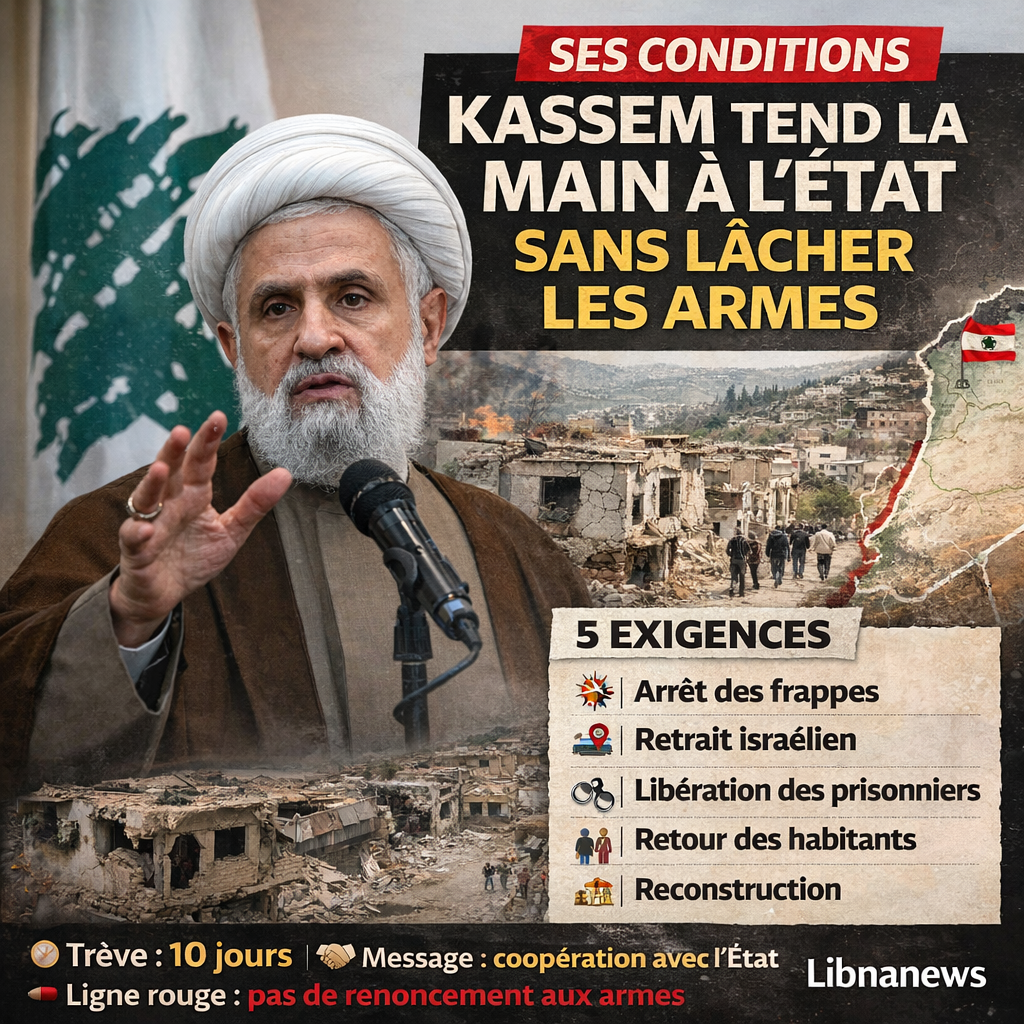
Hezbollah Secretary-General Naim Kassem claimed on Saturday an offensive reading of the cease-fire that had entered into force between Lebanon and Israel. In a very political text, Naim Kassem states that his movement has not been defeated, threatens to respond to any Israeli violation and at the same time says it is ready to open « a new page » with the Lebanese State. Behind this formula, the message is twofold: to refuse any military surrender and to try to place Hezbollah in an inner sequence dominated by sovereignty, reconstruction and post-war.
A declaration that combines military challenge and political openness
The text circulated by the Hizbullah leader comes at a time of great fragility. The truce announced on 16 April for an initial ten-day period suspended part of the hostilities, but neither closed the clashes nor resolved the Israeli withdrawal issue nor defined a political mechanism accepted by all Lebanese actors. In this void, each side seeks to impose its narrative.
Naim Kassem chose a clean line. It presents the cessation of fighting not as a result of diplomatic pressure on all parties, but as a direct consequence of the fight led by Hezbollah fighters on the southern front. The heart of his argument is simple: if a ceasefire exists, it is because Israel has not achieved its military objectives.
This reading is not just rhetorical. It is used to lock the interpretation of the open sequence since the truce came into effect. For Hezbollah, recognizing that the movement has been weakened to the point of accepting an imposed break from the outside would undermine its internal legitimacy. On the contrary, Naim Kassem tries to maintain intact the idea of an active deterrent.
The tone of the text speaks a lot of this will. The communiqué borrows from the register of mobilization, tribute to the dead and refusal to defeat. He insists on the tenacity of the fighters, on the human cost borne by the social environment of Hezbollah and on the centrality of South Lebanon in the political imagination of the movement. This insistence targets both Hezbollah supporters and the rest of the country. It seeks to make war a national matter, not just the case of an armed party.
Ceasefire, central to the battle of narratives
The current truce is based on a text that opens a negotiating window, but leaves many sensitive points without an immediate solution. The document provides for a cessation of hostilities for ten days, direct discussions facilitated by the United States and an exclusive responsibility for the sovereignty and defence of the Lebanese security forces. On the other hand, it does not immediately resolve the issue of the retention of Israeli troops in southern Lebanon and does not explicitly grant Lebanon the same response framework as Israel during that period. (Reuters)
It is precisely on this flaw that Hezbollah supports his speech. Naim Kassem claims that there can be no one-way ceasefire. He refused to accept the idea of a resistance to arrest while Israel maintained, according to him, a freedom of military action. In announcing that the fighters will remain « on the ground » and « finger on the trigger », he tries to turn a supposed period of de-escalation into a phase of permanent armed vigilance.
This passage is politically decisive. It means that Hezbollah does not consider itself bound by a narrow reading of the text, especially if Israeli operations continue to the south. It thus maintains a calculated ambiguity: the movement does not formally endorse the agreement as a signatory party, but reserves the right to impose its own interpretation by force. This position maintains the possibility of a rapid resumption of exchanges of fire, even if the truce continues officially.
In fact, the fragility of the arrangement is already visible. Violations and incidents were reported after the ceasefire came into force, while Israel maintains that it retains the right to act against threats it considers imminent. The gap between the letter of the text, the readings made by the protagonists, and the reality of the terrain, therefore, feeds into immediate instability. It is in this space that Naim Kassem writes his statement.
A hand stretched to the state without giving up on arms
However, the most prominent element of the press release is elsewhere. After several days of very hard talk against the discussions conducted under American mediation, Naim Kassem claims that Hezbollah is open to the « highest degree of cooperation with the authority in Lebanon », within the framework of « a new page » based on national sovereignty.
The formula may seem conciliatory. It is not, however, a matter of simple adherence to the logic of the State. It is more like an attempt to redefine Hezbollah’s place in the Lebanese post-war balance. The movement does not say that he surrenders his weapons to the state. Nor does he say that he renounces his military autonomy. It proposes maximum cooperation provided that it is reflected in a common understanding of sovereignty and in a « national security strategy » capable of integrating « force capabilities ».
In other words, Hezbollah is trying to move the debate. Instead of accepting a frontal opposition between the state monopoly of violence and the existence of its military apparatus, he suggests a articulation between the two. This articulation is old in the discourse of the movement, but the current formulation takes a particular resonance. It intervenes at a time when the text of the truce reaffirms the exclusive responsibility of the Lebanese security forces for sovereignty and defence.
The contrast is clear. On the one hand, the logic of the document which entered into force on 16 April reinforces the institutional role of the army and the state services. On the other hand, Hezbollah responds that it is willing to cooperate, but in an architecture where its means of force would remain resources to value, not tools to dissolve. The « new page » mentioned by Naim Kassem does not therefore announce a complete standardization. Rather, she draws a living together under tension.
What this « new page » really says
Internally, this opening performs several functions.
It allows Hezbollah first to present itself as a responsible actor, anxious to avoid the fitna and close the door to foreign interference. The choice of these words is not insignificant. It responds to criticisms of the movement for months, both in Lebanon and abroad, about the national cost of its regional strategy.
It then allows him to speak to the Lebanese government without appearing in a position of weakness. The communiqué does not require rescue mediation. He proposed cooperation between partners, which, according to his author, would have a common objective: to protect Lebanon, to recover the country’s rights and to prevent Israel from obtaining on the political ground what it would not have obtained by war.
Finally, this openness serves to frame any future security debate in advance. If discussions open on the role of Hezbollah, the movement wants them to be held not from the perspective of immediate disarmament, but from the perspective of a national strategy integrating resistance as a component of power.
The five points put forward by Naim Kassem
In the middle of a text loaded with symbols and accusations, Naim Kassem also lists five concrete requirements for the continuation:
- a permanent cessation of aggression against all Lebanon by air, land and sea;
- israeli withdrawal from the occupied territories to the border;
- release of prisoners;
- the return of the inhabitants to their villages and localities to the border line;
- reconstruction with international and arab support, under national responsibility.
These five points play an essential role. They allow Hezbollah to leave, at least in part, the ground of military rhetoric alone to occupy that of immediate political objectives. The movement is not just about response, dignity or victory. It highlights requests that directly affect Lebanese opinion: daily security, the return of displaced persons, detainees and reconstruction money.
In the current context, this list is also relevant to prioritisation. In essence, Naim Kassem says that no serious discussion on the future of Lebanese security can take place until the full end of Israeli operations, the withdrawal of forces deployed to the south and the revival of civilian life in devastated areas. It is a way of delaying any structural debate on the weaponization of Hezbollah.
The reconstruction agenda deserves special attention. The movement knows that the material question will weigh heavily in the period that opens. Villages in the south have been severely damaged, infrastructure has been damaged and families are beginning to return to areas that are still unstable or in ruins. By prioritizing reconstruction, Hezbollah is trying to remain central in post-war management, a land where the state, Arab donors, international partners and Lebanese parties will fight for the initiative.
Frontal rejection of direct negotiation under pressure
The other strong axis of the communiqué is the ongoing diplomatic sequence. Naim Kassem attacked the document published after the ceasefire came into force and denounced what he presented as a humiliation for Lebanon. He reproached the United States for having formulated a text speaking on behalf of the Lebanese Government and for having included it in a logic of direct negotiation with Israel.
This charge is part of the continuity of its positions of the previous days. Hezbollah had already rejected discussions in Washington between Lebanese and Israeli representatives, finding them unacceptable as long as the bombing continued. Saturday’s press release deepens this line: negotiating under strikes, according to him, amounts to submitting to an imposed balance of power.
The argument has an obvious internal scope. It aims to put into jeopardy any Lebanese authority trying to defend direct diplomacy as a way out of crisis. But it also responds to a broader reality: the current truce does not resemble a peace agreement. It constitutes a limited suspension, backed by American mediation, with shadows on the practical application of the text and on the political sequence that must follow.
In denouncing the form of the document, Naim Kassem therefore seeks to delegitimize the framework that could eventually lead to the redeployment of security balances in Lebanon. He refused to be locked in a diplomatic architecture where the state would discuss while Hezbollah was being treated as a problem to be solved. Hence this seemingly paradoxical combination of cooperation with the authority and refusal of a process which he considers to be externally dictated.
What comes under the speech, what comes under the facts
Naim Kassem’s statement also accumulates claims that nothing at this stage can establish as acquired facts. This is the case when it presents the cessation of fighting as the exclusive result of Hezbollah’s military performance. This is also the case when he assigns a specific role to Iran, Pakistan or the closure of the Strait of Ormuz in the sequence that led to the truce.
These passages must be read for what they are: elements of political narrative, intended to magnify the role of the movement, to place the Lebanese front in a wider regional framework and to thank allies. Not all of them have been corroborated by the public documents available or by the information cross-checked on the exact conditions of the truce.
This distinction is important, as it is a condition for reading the text. The press release is not a neutral account of events. It’s a strategic intervention. It aims to give meaning to post-combat, to avoid any feeling of backwardness among supporters, to put the state in front of its responsibilities and to remind foreign mediators that Hezbollah intends to remain a key player.
A message to several audiences at once
The text does not speak to a single recipient. It is addressed first to the Hezbollah base, tested by human casualties, destruction and uncertainty. By repeating that Israel did not defeat the movement, Naim Kassem tried to preserve the cohesion of the partisan camp as the war entered a less legible phase.
It also addresses Lebanese institutions. The message is clear: Hezbollah does not exclude an internal arrangement, but it wants to negotiate it on the basis of a political power relationship which it still considers favourable on several points. He wants to prevent the truce from being turned into a lever to remove it or to impose a unilateral treatment of the issue of his weapons.
The communiqué still targets regional and Western actors. He tells them that Hezbollah does not consider itself out of play despite military and diplomatic pressure. Even weakened, even disputed, even under surveillance, the movement claims to maintain a capacity for initiative, nuisance and blocking.
Finally, he speaks to the rest of Lebanese society. By highlighting the return of the inhabitants, reconstruction and national unity, Naim Kassem tries to expand his register. He does not want to appear only as the leader of an armed organisation speaking with his sole support. He is trying to occupy the field of national language, where much of the political battle in the coming weeks will be played.
Hezbollah’s post-war bet
Saturday’s statement reveals the difficulty of Hezbollah’s position. The movement does not want to give any sign of surrender. Nor can it ignore that the opening phase will be dominated by issues where the State is becoming central again: the implementation of the truce, the management of violations, the return of displaced persons, reconstruction, external relations and the future of the security framework in the south.
So Naim Kassem tries to hold both ends. It reaffirms the legitimacy of armed combat and the right to respond. At the same time, it opens the door to broad cooperation with the authorities. This line does not erase contradictions. She’s organizing them. Hezbollah wants to be both a resistance force, an indirect institutional actor and a partner obliged in any redefinition of Lebanese sovereignty.
The central question remains: can this posture hold if the truce continues and if international pressure increases on the arms monopoly? The whole follow-up will depend on the answer to this question, but also on the terrain itself, the violations found or not, the fate of the areas still occupied, the speed of the return of the inhabitants and the form that will take, or not, this « new page » that Naim Kassem says he wants to open with the State.
Full translation of Naim Kassem’s speech
Full translation of the Arabic text provided in the dispatch.
Naim Kassem stressed, in a statement, that « the ground proved that he had the last word, and that the successful policy is one that can take advantage of his results as a source of force to force the Israeli enemy to give in, in order to obtain the rights of Lebanon and its citizens on their land and in their sovereignty, within the framework of a cooperative national complementarity that closes the doors of discord and exploitation of our country by foreigners ».
The press release adds: « The temporary ceasefire would not have taken place without the jihad of resistance fighters on the noble positions of the southern front, in a legendary performance that has stunned the world, and in a firm martyrdom against the Israeli-American enemy despite a huge imbalance in the relations of military force. Resistance fighters have proven that their three-dimensional weapon — faith, will and capacity — is stronger than all the armies of the aggressors, and that in Lebanon there are men willing to sacrifice what they have most precious for liberation, dignity and independence. The presence of the hesitant, the demoralizers and those who stab in the back does not hinder their march towards this noble objective, for they have offered their heads to Almighty God before all things, and they are surrounded by a dignified and sacrificial people who have endured the killing, destruction, displacement and the price of dignity and honor. This people comes from all faiths, communities and regions; Its direction is South Lebanon, because all Lebanon is its South. If the South smiles and is liberated, all Lebanon smiles and is liberated. »
He adds: « Praise be to God Almighty first, for He is the Victor and the Helper. Then thank you to the heroes of the resistance who broke the advance of the Israeli enemy despite the deployment of a hundred thousand soldiers at the border, and who did not allow him to reach the Litani, neither during the first week as he had planned, nor during the forty-five days of the battle known as the d`al-Asf al-Ma’koul. Thanks also to the inhabitants, people and sympathizers for their gifts and sacrifices. Thirdly, thanks to the Islamic Republic of Iran, its leadership and its people, who supported and supported the ceasefire, and who linked the Pakistan agreement to its explicit arrest in Lebanon in the official announcement; Then Iran closed the Strait of Ormuz in response to the American failure to comply with the ceasefire in Lebanon; Then there was the American capitulation and the pressure on the Israeli enemy to stop him, which led to the reopening of the Strait of Ormuz. We’ve been following this path all the time. And we do not forget to thank Pakistan’s sponsorship and all those who helped, if only through a declaration, in support of the ceasefire in Lebanon. »
He continues: « We have read a publication issued by the United States Department of State under the title « Ceasefire Agreement between Lebanon and Israel – April 2026, » published after the ceasefire came into force. It does not mean anything in practice, but it is an insult to our country, our homeland, Lebanon, that a text be dictated by America, which speaks on behalf of the Lebanese government. It is written at the beginning of the press release: The Government of Israel and the Government of Lebanon approved the following text, while everyone knows that the Government of Lebanon did not meet and gave its approval to this declaration. It is enough to bring such humiliations to Lebanon in direct negotiations with the Israeli enemy to hear its dictates, and in this shameful scene in Washington where tyranny surrounds its prey, and where positions are taken in the name of Lebanon. It’s an endless slope. »
He says: « Suffice it. The Lebanese people are worthy and will remain, in complementarity and solidarity with the army, the people, the resistance and the political authority that wants Lebanon’s independence and liberation. The ceasefire means a complete cessation of all hostile acts. And because we don’t trust this enemy, resistance fighters will stay on the ground, finger on the trigger, and they will respond to aggression violations accordingly. There is no ceasefire on the only side of the resistance; It must be respected by both sides, and we will not agree to relive the fifteen months of patience in the face of Israeli aggression pending a diplomacy that has not achieved anything. »
« The next step is to apply the following five points:
- a permanent cessation of aggression throughout Lebanon, by air, land and sea;
- the withdrawal of the israeli enemy from the occupied territories to the border;
- release of prisoners;
- the return of the inhabitants to their villages and localities to the border;
- reconstruction with international and arab support, and under national responsibility. »
He continued: « Hizbullah is open to the highest degree of cooperation with the authority in Lebanon, within the framework of a new page based on the realization of the sovereignty of our homeland, Lebanon, in the spirit of unity, the prevention of discord and the investment of force capabilities in a national security strategy. Let us together build our homeland, Lebanon, prevent foreigners from exercising guardianship and achieving the Israeli enemy’s objectives through politics, and let us translate the sovereignty and protection of citizens into clear measures and plans. »
He concludes: « Israel, together with all the tyrants of the earth, has not defeated us, and will not defeat us, especially after the sacrifices of the martyrs, first among them the master of the martyrs of the nation, Sayyed Hassan Nasrallah, whom God has swallowed, and Sayyed al-Hashemi and all the martyrs, as well as the sacrifices of the wounded, the prisoners and this great people. The head of Lebanon will remain high thanks to its sacrificing sons. »