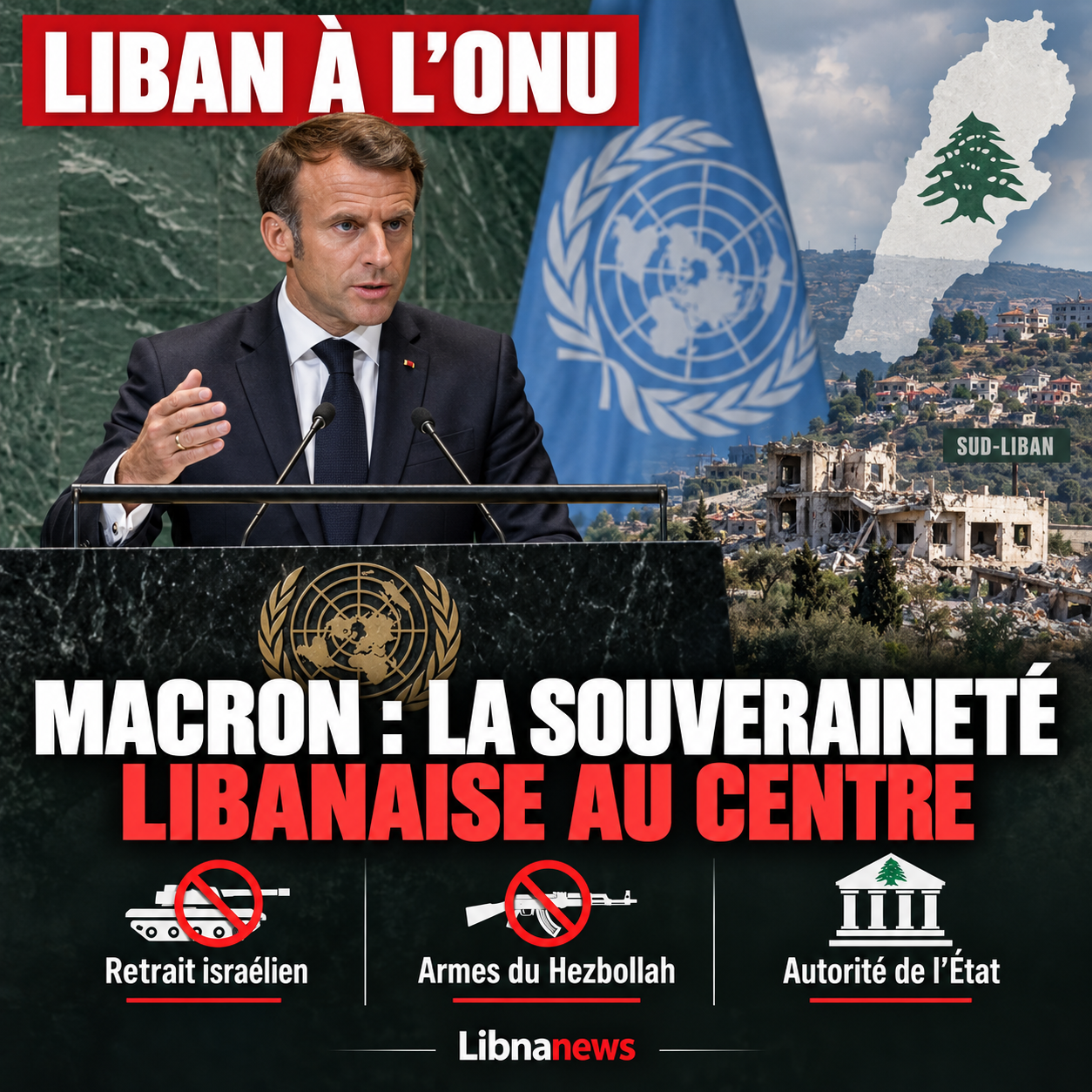
In the rostrum of the UN General Assembly, Tuesday, September 22, 2026 in New York, Emmanuel Macron devoted a substantial part of his last speech to the UN as French President to the Middle East crisis. For Lebanon, his message was particularly direct: destruction in the South and displacement of people are linked to an attack on Lebanese sovereignty, while, in his view, the disarmament of Hezbollah can only be achieved on a lasting basis through the restoration of the authority of a fully sovereign Lebanese State. At the same time, the French President hardened his speech towards Israel, believing that the security of the Hebrew State could not be built by the violation of the sovereignty of its neighbours.
The passage dedicated to Lebanon occupied only a few minutes of a much larger intervention. However, it focuses on the doctrine that Paris has been defending for several months: Israeli withdrawal, restoration of the authority of the Lebanese State, monopoly of arms by legitimate institutions and political settlement of security issues. Macron thus refused to dissociate the two issues that dominate the Lebanese debate. He condemned the violation of the country’s sovereignty while reaffirming that Hezbollah must surrender its weapons.
Macron at the UN: Lebanon returns to sovereignty
Emmanuel Macron built his passage on the Middle East around a principle: state sovereignty. It considered that its respect alone could restore peace and security in the region. Lebanon arrived first in this sequence before Palestine and the West Bank. This choice gave the Lebanese case a special political place in a speech devoted largely to the defence of international law and multilateralism.
The French president referred to displaced Lebanese and villages in the South « destroyed one after another ». This formulation directly refers to the territorial reality of the conflict: southern Lebanese localities remain at the centre of military operations, displacement and litigation between Beirut and Israel. Macron therefore did not merely portray the crisis as a confrontation between Israel and Hezbollah. It has placed it in the broader context of the sovereignty of a State and the protection of its people.
He then linked this sovereignty to Hezbollah’s weapons file. « Only a fully sovereign Lebanon can lead to the return of arms to Hezbollah, » said the French Head of State. The sentence is important because it sets a political order. In French reasoning, the disarmament of the Shiite movement must not result from a lasting substitution of the Israeli army with the Lebanese state. It must result from the strengthening of Lebanese institutions and the restoration of their authority throughout the country.
This position does not mean that Hezbollah is spared. Macron explicitly asks that the movement return its weapons. For several months, Paris has considered that the monopoly of force must be returned to legitimate institutions. But the French President places this requirement in a framework that also imposes obligations on Israel. Lebanese sovereignty cannot be invoked against Hezbollah’s weapons while being ignored when it comes to the Israeli military presence or operations in Lebanon.
A much more direct critique of the Israeli strategy
It is on this point that the speech of 22 September marks one of its strongest passages. Emmanuel Macron said that those who claim to ensure Israel’s security by violating the sovereignty of its neighbours are committing a « worse mistake. » He added that such a strategy weakened Israeli security in the short and long term. The point therefore goes beyond the Lebanese case: it aims at a regional concept of security based on military intervention beyond Israeli borders.
Applied in Lebanon, the message is unambiguous. Paris does not consider that Israeli security concerns give Israel a general right to intervene in Lebanese territory. France recognizes the security challenges facing Israel, but disputes that their treatment can be sustained through strikes, territorial presence or operations that weaken Beirut’s authority.
This criticism is part of a line already formulated by Macron before the General Assembly. In July, during a trip to Syria, he summarized the French position in two parallel demands: Hezbollah must return arms and Israel must leave Lebanon. He had also advocated a coordination mechanism to address security concerns without immediate use of bombardments. The New York speech takes over this architecture and gives it international visibility.
French reasoning thus has two parts which respond. The first concerns Hezbollah: no armed organization should be a long-term substitute for the Lebanese State. The second is Israel: no neighbouring power should take advantage of the weakening of the Lebanese State to impose its own security arrangements by force. In both cases, Paris places the Lebanese state at the centre of the solution.
South Lebanon, concrete point of the French speech
The reference to destroyed villages and displaced populations gives the discourse a concrete dimension. The South is not referred to as a simple line of military confrontation. Macron insists on the consequences for the inhabitants and on the difficulty of restoring normal life until Lebanese sovereignty is effectively restored.
This issue is central to Beirut. The sustainable return of internally displaced persons depends on security conditions, the reconstruction of the affected localities and the ability of the State to regain control of the territory. The presence of Israeli forces, the strikes and the record of Hezbollah’s weapons remain intertwined. A solution limited to one of these elements would leave other causes of tension intact.
For Paris, the Lebanese army must be the institution around which this resumption of sovereignty is organised. France has long been working to strengthen the Lebanese Armed Forces. This priority has taken on additional importance with discussions on the future of the international arrangement in the South and the planned withdrawal of UNIFIL from 2027.
A few days before his speech in New York, Macron had received in Paris Lebanese President Joseph Aoun and King Abdullah II of Jordan. The discussions on 17 September focused specifically on the needs of the Lebanese Armed Forces, security in the South and options for avoiding a vacuum after UNIFIL. The UN sequence is therefore not isolated. It extends a diplomatic and military initiative undertaken before the General Assembly.
Disarming Hezbollah without weakening the state
The most sensitive point remains the disarmament of Hezbollah. Emmanuel Macron neither avoided him nor relativized him. He explicitly described it as a condition for the restoration of security in Lebanon and for neighbouring countries. But its formulation differs from a logic that Israeli military pressure alone would be the means to achieve this result.
The French position is based on a political observation: asking the Lebanese State to disarm Hezbollah means giving that State the means to effectively exercise its authority. This means strengthening the army, institutions and security mechanisms. Paris fears that further weakening of state structures will make disarmament more difficult and increase the risk of internal confrontation.
Macron had explained this reasoning with great precision in July. He warned that the removal of Hezbollah weapons could not be requested while weakening those who hold the legitimate monopoly of force. He had even mentioned the risk of pushing the country towards a civil war if this contradiction was not taken into account. In New York, he condensed this doctrine into the notion of « full sovereign Lebanon ».
This formulation is also important to the Lebanese authorities. President Joseph Aoun and the government of Nawaf Salam affirmed their will to restore the state monopoly on weapons. The question now concerns the timetable, means and guarantees for conducting this process without causing further internal confrontation and without leaving the South exposed to permanent Israeli occupation or operations.
Israel directly affected by the principle of sovereignty
Macron’s speech was not limited to Lebanon. The sequence dedicated to Gaza and the West Bank strengthened the scope of its criticism of the Israeli government. The French President denounced the lack of real humanitarian improvement in Gaza and questioned the international credibility of the continuing crisis. It also attacked the logic of Israeli operations in the West Bank.
Macron challenged in particular the use of the struggle against Hamas as a general justification for policy in the Palestinian territories. His statements on the West Bank provoked a very strong reaction from the Israeli Prime Minister Benjamin Netanyahu’s office, who called them « grotesque absurdity. » This reaction shows that the verbal confrontation between Paris and the Israeli government now exceeds technical disagreements.
For Lebanon, this is an important development. The French criticism of Israeli operations is no longer formulated solely in the name of the stability of the Lebanese-Israeli border. It inserts into a more general denunciation of the use of force when it violates the sovereignty of Israel’s neighbours or the rights of Palestinians. Macron thus seeks to apply the same principle to several regional theatres.
At the same time, the French President maintains his commitment to Israel’s security. It is precisely in the name of this security that he challenges the Israeli government’s strategy. His argument is not that Israel does not have legitimate security concerns, but that the repeated violation of the sovereignty of its neighbours, he says, results in more instability and therefore more insecurity.
Gaza and the West Bank give regional significance to the discourse
The passage dedicated to Gaza was one of the most offensive of the speech. Macron recalled the recognition of the State of Palestine announced a year earlier with several other countries. Faced with criticism of this recognition as purely symbolic, he overturned the argument by asking what credibility the international community retained if it remained inactive in Gaza.
He also denounced a peace that, in his view, had not allowed humanitarian channels to be reopened in a sustainable manner. Then he asked if the leaders gathered in New York should continue to contemplate a « show that shames us all. » The tone contrasts with a French diplomacy long anxious to publicly maintain a very strict verbal balance between Israel’s security and the criticism of its operations.
This firmness gives more weight to the passage on Lebanon. When Macron speaks of the destroyed villages of the South, this sentence is not an isolated remark. It belongs to a sequence in which the French President questions the territorial and human consequences of the Israeli strategy in several neighbouring areas.
This does not mean that Paris adopts Hezbollah’s positions or abandons its demands on it. On the contrary, Macron associates in the same reasoning the disarmament of the movement and the end of Israeli attacks on Lebanese sovereignty. This simultaneity is the core of the French position: Lebanon must not be a territory used by an autonomous armed organization to act against Israel or a space in which Israel could intervene in the name of its security.
A French doctrine based on the « same right for all »
The thread of speech goes beyond the Middle East. Emmanuel Macron defended an international order in which sovereignty does not depend on the military power of a state or its alliances. He opposed this conception to what he described as the return of force without rule and logic of power.
For Paris, this coherence is also a question of diplomatic credibility. France cannot defend Ukraine’s territorial integrity against Russia while treating violations of sovereignty in the Middle East differently. Macron had already formulated this principle when he moved to Syria: international law cannot change according to latitudes and longitudes.
In the Lebanese case, this doctrine leads to a demanding equation. Hezbollah must abandon its autonomous arsenal. Israel must respect the territorial integrity of Lebanon. The Lebanese army must be able to deploy. The Beirut institutions must recover the real exercise of sovereignty. Finally, a security system must prevent the border from becoming a permanent front.
This approach attempts to break the binary choice between Israeli and Hezbollah security arguments. Paris wants to move the centre of gravity to the Lebanese state. This, however, implies that the Government has sufficient military, political and financial resources. This condition remains one of the main obstacles to the application of French doctrine.
UNIFIL and the post-2026 context
The UNIFIL question gives the speech an additional urgency. The international arrangement in the South must undergo a major transformation, with a planned withdrawal from January 2027. For Lebanon, the risk is a security vacuum in an area where balances remain fragile.
France is therefore working with Lebanon, Jordan and several European and Arab partners on solutions that could accompany the Lebanese army. Discussions included training, equipment, intelligence, assistance and international mechanisms that might succeed certain functions currently performed by UNIFIL.
The challenge is political as well as military. A new mechanism cannot be effective if the main issues of sovereignty remain open. Israeli withdrawal, arms control, the deployment of the Lebanese army and the security of the people must move forward in a coordinated manner. Otherwise, replacing an international mission with another architecture would only temporarily manage the symptoms of the crisis.
Macron’s speech at the United Nations must therefore be read in the light of that deadline. By insisting on a « full sovereign Lebanon », the French President sets less a slogan than an operational objective: to gradually transfer security responsibility to Lebanese institutions, while obtaining external guarantees allowing this transition not to turn into a new confrontation.
What the discourse changes, and what it does not regulate
For Beirut, the main political significance of the speech lies in the fact that France publicly links the disarmament of Hezbollah with respect for Lebanese sovereignty by Israel. This articulation enables the Lebanese authorities to defend the arms monopoly without presenting this policy as the execution of an Israeli demand. It places the process in a Lebanese institutional logic.
The speech also reinforces diplomatic pressure on Israel. In referring to the destroyed villages, displaced persons and Lebanese sovereignty before the General Assembly, Macron again internationalizes an issue that could be reduced to a one-on-one relationship of military force between Israel and Hezbollah. Paris asserts that the Lebanese border and territory are subject to international law and not merely to the relationship of forces.
But this French position is not enough to resolve the concrete issues. The timetable for an Israeli withdrawal, the modalities for the disarmament of Hezbollah, the ability of the Lebanese army to deploy everywhere, the security guarantees demanded by Israel and the future international mechanism remain separate, even if they are linked.
The September 22 speech therefore does not provide a detailed implementation plan. Rather, it sets out the principles that France wants to see guide the next phase. Its interest in Lebanon lies precisely in the combination of these principles: the refusal of a competing armed sovereignty embodied by Hezbollah, the refusal of Lebanese sovereignty amputated by Israeli intervention, and the support of the army as an institution responsible for regaining control of the territory.
In New York, Macron put Lebanon in a broader diplomatic battle over the value of international law. The next step will be less in the statements than in the capacity of Paris and its partners to transform this doctrine into concrete mechanisms: support for the Lebanese Armed Forces, organization of the post-FINUL, reconstruction of the South, return of displaced persons, Israeli withdrawal and effective transfer of arms to State institutions. A few months from the beginning of UNIFIL’s withdrawal, the French position will now be measured on this implementation.